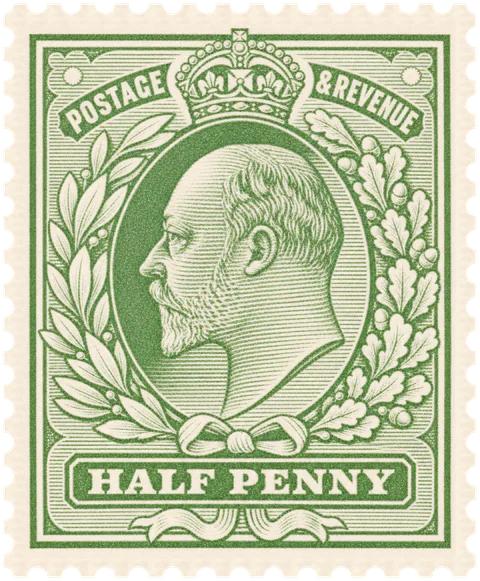
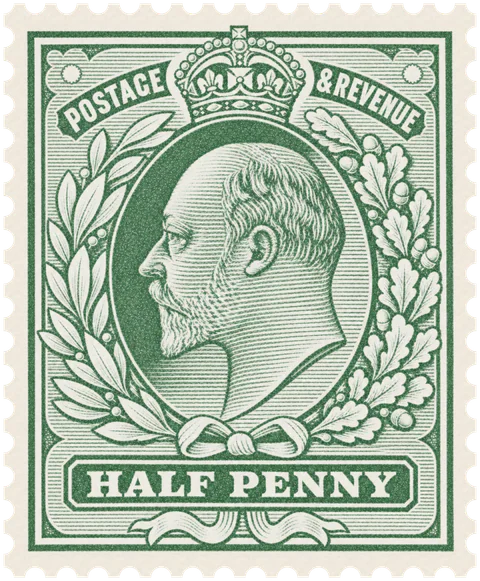
The collection / Edward VII / Harrison & Sons / Halfpenny comparisonThe Harrison halfpenny pair The familiar Edward VII design, printed by Harrison & Sons in 1911, in two perforation formats.
Compare the top edges Perforation 14 has the same spacing in both directions. In 15 × 14, the top and bottom holes are closer together, while the side spacing stays the same. [5 ]
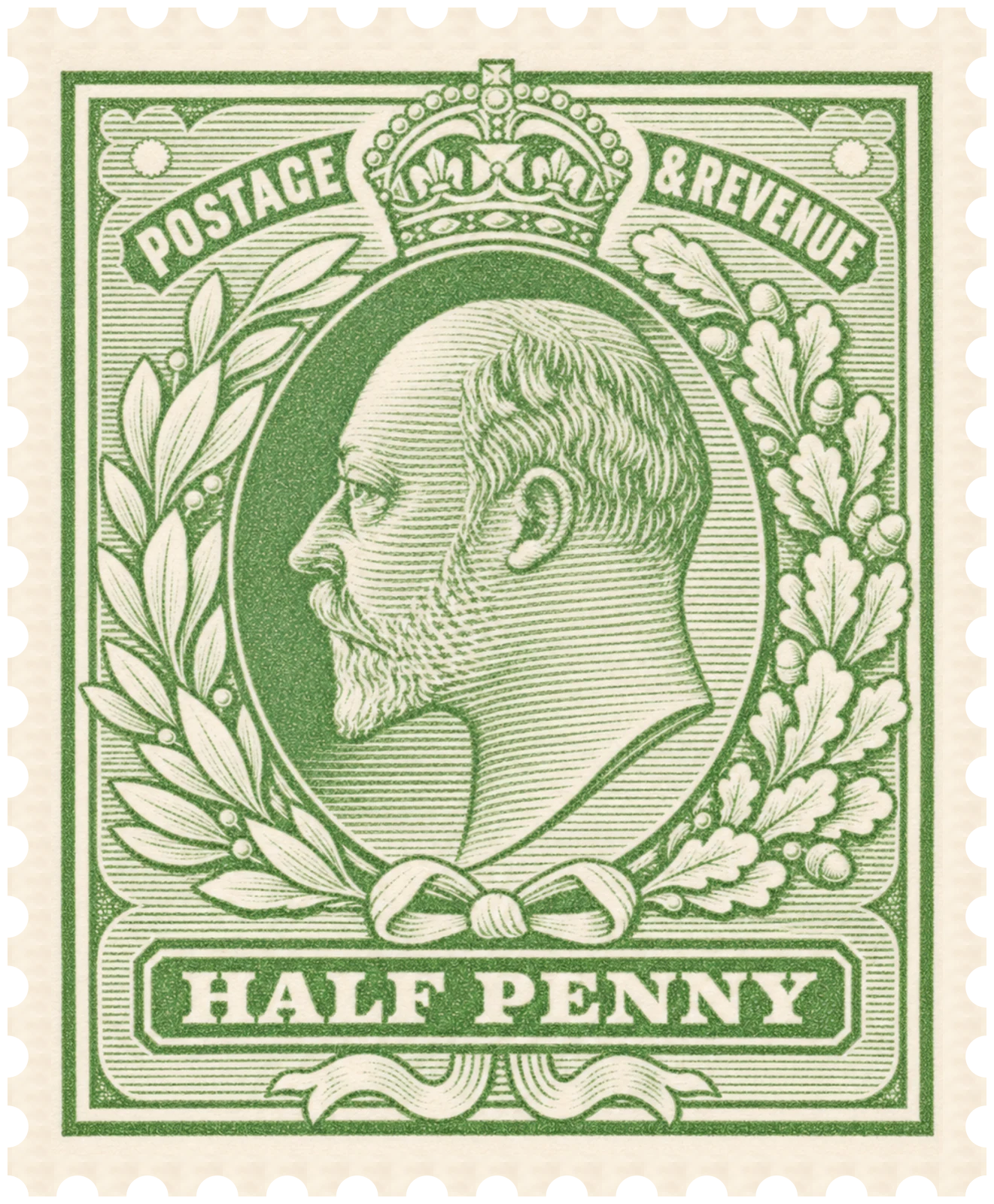
½d dull yellow-green · perf 14
Stunning Stamps Options Summary Harrison continued printing Edward VII halfpennies after George V’s first stamps had reached post offices. The two versions shown here belong to that overlap of royal portraits. Their top and bottom edges have differently spaced perforations, reflecting a change in the machinery used to separate the stamps. [3 ]
Production, paper and watermark Printer Harrison & Sons [1 ] Printing works Hayes, Middlesex [3 ] Process Typography (surface printing) [3 ] Printing colours One: dull yellow-green [1 ] Watermark Imperial Crown [3 ] Catalogue reference SG 267 [1 ]
Dimensions 21 × 24 mm Government-supplied dies and plates Royal Mint; stated provision cost £3,400 under the new contract [7 ] Read the full stamp entry →
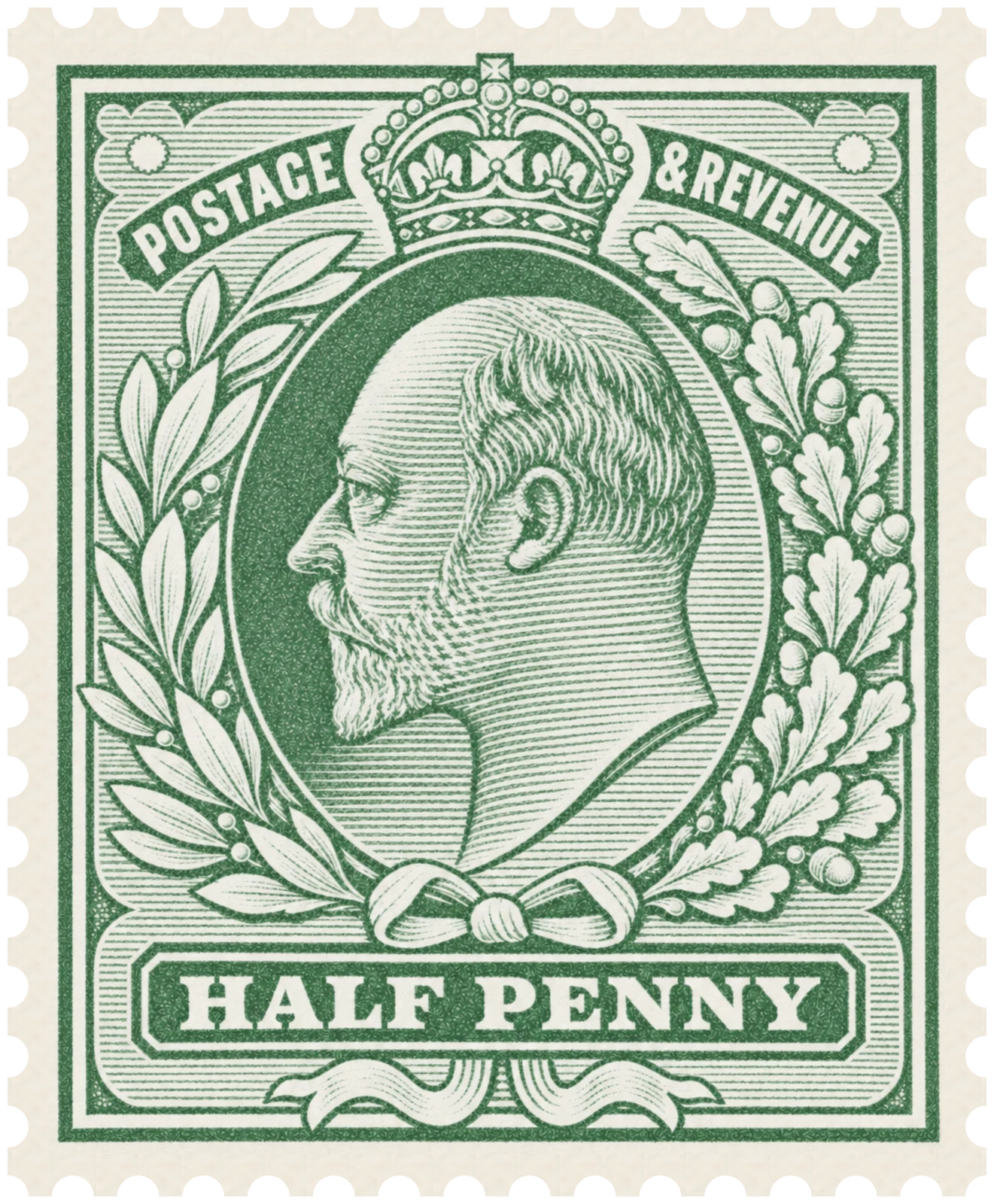
½d dull green · perf 15 × 14
Stunning Stamps Options Summary Harrison continued printing Edward VII halfpennies after George V’s first stamps had reached post offices. The two versions shown here belong to that overlap of royal portraits. Their top and bottom edges have differently spaced perforations, reflecting a change in the machinery used to separate the stamps. [3 ]
Production, paper and watermark Printer Harrison & Sons [2 ] Printing works Hayes, Middlesex [3 ] Issued October 1911 [3 , 6 ] Process Typography (surface printing) [3 ] Printing colours One: green [3 ] Watermark Imperial Crown [3 ] Catalogue reference Stanley Gibbons SG 279 [2 ]
Dimensions 21 × 24 mm Government-supplied dies and plates Royal Mint; stated provision cost £3,400 under the new contract [7 ] Read the full stamp entry →
The same watermark Both printings use the Imperial Crown watermark. [3 ]
Sources Show in text
Andrew G. Lajer: Harrison SG267, dull yellow-green, perforation 14, A11 control block Paul Fraser Collectibles: Harrison SG279, dull green, perforation 15 × 14 L. W. Crouch: New Issues of 1911, The Stamp Year 1912, p. 120 L. W. Crouch: The Postage Stamp, 11 November 1911, p. 75 BB Stamps: Edward VII concise listings British Stamp Market Values 2020: Edward VII Royal Mint Museum: Postage dues, Dr Paul Ramsay — the 1911 printing contract The Royal Family: Edward VII (1901–1910) Feldman Auctions, 29 February 2024, lot 1102: Harrison 15 × 14 deep dull green, very blotchy print Universal Philatelic Auctions 89, lot 12303: SG 279a, specialist M4(3) BB Stamps: Edward VII specialist listings, SG267 M3(1), crown flaws and booklet panes (SKUs 94638, 96126, 86411, 93543) Andrew G. Lajer: SG267 Plate 63b block of four, three with crown cross almost missing; M3(1)l Andrew G. Lajer: Harrison halfpenny shades and blotchy M3(4) impressions Universal Philatelic Auctions 98, lot 11113: Harrison dull yellow-green booklet pane of six, MB3 Stanley Gibbons auction 5957, 21 November 2023, lot 583: Harrison dull yellow-green pane of five and St Andrew’s Cross, MB4 David Feldman, 20 June 2024, lot 50584: SG267 nearly imperforate pair, realised £1,000 David Feldman, 16 June 2026, lot 10189: SG267 offset and misperforations, realised £170 David Feldman, 20 June 2024, lot 50582: SG267 pre-printing paper fold Great Britain Philatelic Society: inland postcard rates, 1870–1968 Great Britain Philatelic Society: inland printed matter rates, 1848–1968 Grosvenor sale 41, 29 May 2008, lots 3970–3973 and 3981: experimental plates and recurring flaws Grosvenor sale 49, 17 June 2009, lots 1039–1047: fluorescence, unwatermarked blocks and paper-fold perforations Grosvenor sale 85, 30 October 2013, lots 672–675: Plate 62 and 61b controls, double gum and broken frame Steven Allen Stamps, item 43: SG280 / M7(1), rose-red, perforation 15 × 14 B & B Stamps: Edward VII specialised issues and shade listings Great Britain Overprints Society: Levant issues, overprints and fourpenny colour change Great Britain Overprints Society: Morocco Agencies issues and quantities Grosvenor sale 100, 9 November 2015, lots 464–465: inverted and misplaced watermarks Grosvenor sale 41, 29 May 2008, lot 3974: very blotchy deep bright blue David Feldman, 20 June 2024, lot 50585: dull-blue perforation-15 × 14 offset block Paul Fraser Collectibles: Harrison dull-blue paper-fold pair, M18(3)b, ex Minoru Great Britain Philatelic Society: overseas surface letter rates, 1875–1975 Fred Gee: Varieties of yesteryear — coloured papers, British Philatelic Bulletin, September 2000, p. 20 Grosvenor sale 48, lots 2153–2155 and 2165–2171: Harrison threepenny shades, cuts and plate flaws Grosvenor sale 51, 8 October 2009, lots 2554–2560: Harrison threepenny plating pieces Corinphila auction 286, 30 May 2022, p. 102, lots 4740–4741: transient beard flaw and broken scroll David Feldman, Spring 2020, lots 30305–30306: broken-scroll block and Leeds registered cover Great Britain Philatelic Society: inland registration fees and compensation, 1841–1993 The Stamp Collectors’ Annual 1912, pp. 107–108: Harrison and Somerset House chronology and checklist Grosvenor sale 48, lots 2198–2206: Harrison fourpenny shades, Plate 6a half-cut and short hatch lines Grosvenor sale 51, lots 2584–2594: Harrison fourpenny shades and marginal blocks GBstamps.net: Harrison fourpenny comparison, deep bright orange and dots in the north-east value tablet Great Britain Philatelic Society: inland letter rates, 1840–1968 Fred J. Melville: The Stamp Year 1912, “The New Stamp Contract”, pp. 9–10, Royal Philatelic Society London, Crawford Collection Hansard: New Postage Stamps, House of Commons debate, 15 August 1911 Royal Mail: Edward VII and Emil Fuchs, British Philatelic Bulletin, September 1993
Harrison halfpenny Close × Fit 100% − +
Loading image…