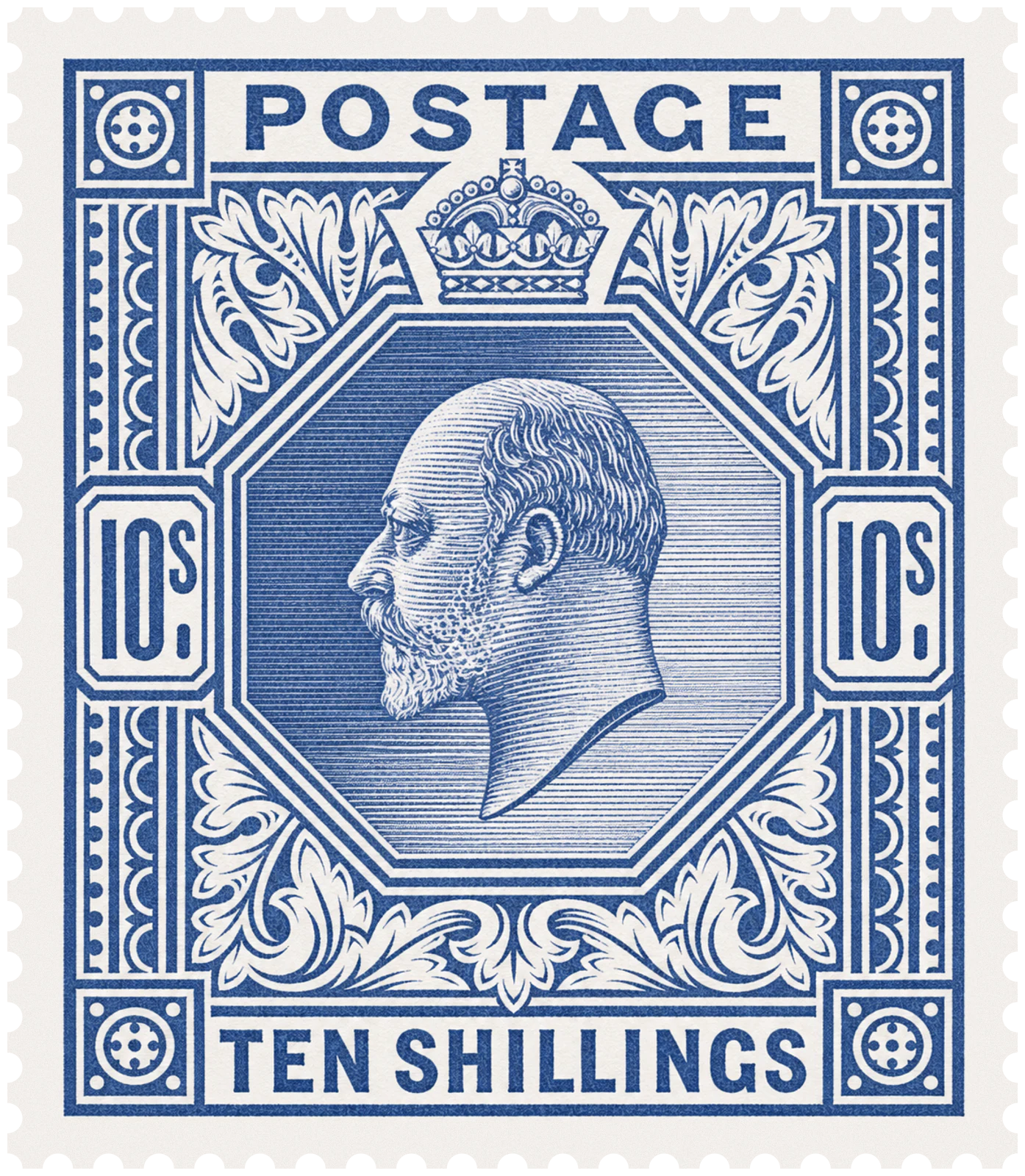
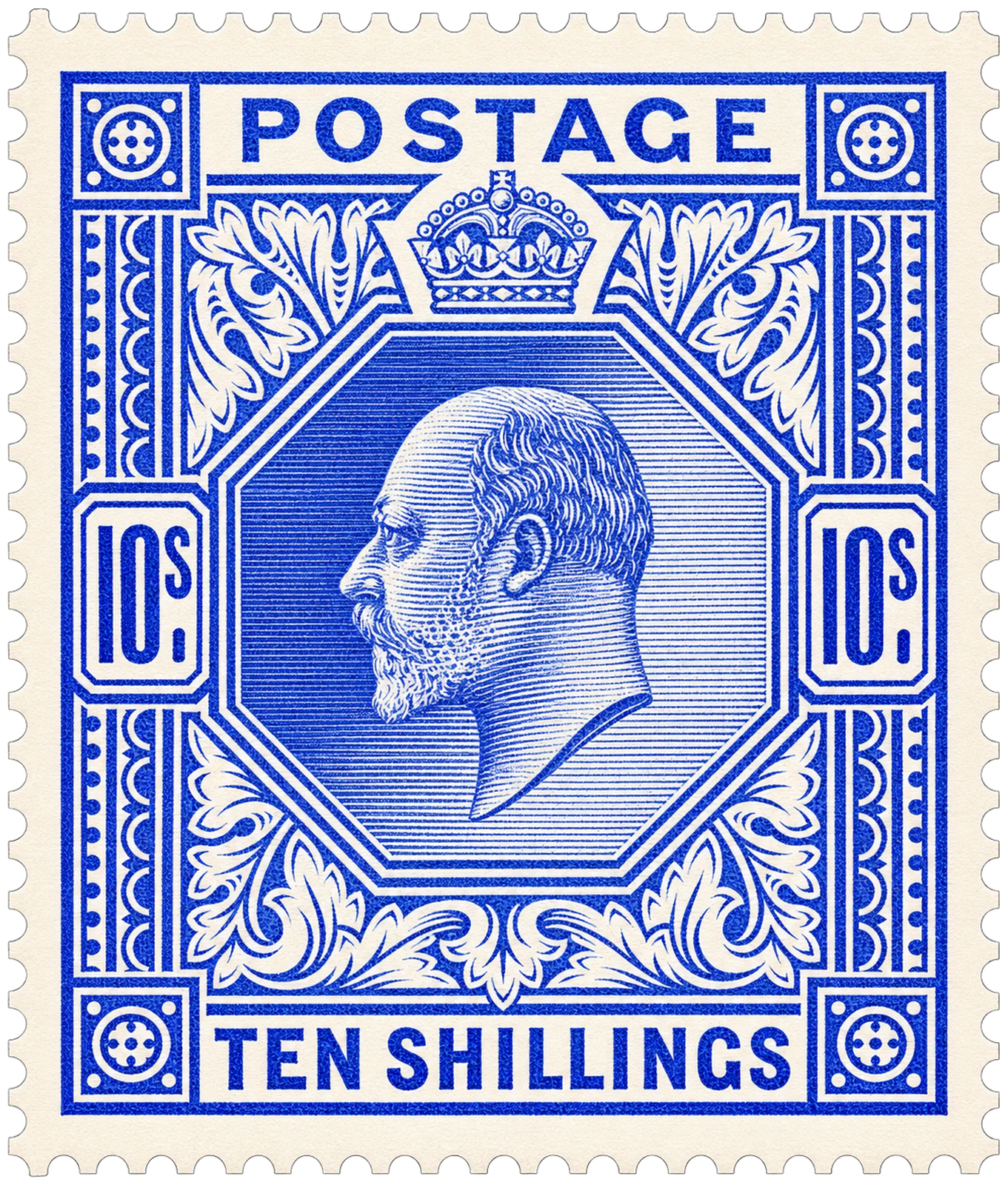
De La Rue shades are ultramarine and deep ultramarine. Somerset House shades are bright blue, blue and deep blue. Compare the character of the blue, not simply how dark it is: both printers produced deep shades. [14]
Fine cuts in the bottom rule
In upper-pane Somerset House plate 1a pairs, fine cuts lie in the marginal rule between the last two stamps of the bottom row. In plate 1b they lie below the last stamp. These marks identify plate states when the relevant margin survives. [15]
A gum clue on mint examples
Greenish-blue gum is recorded on Somerset House ten-shillings. It is a feature of particular printings, so an example without that tint is not automatically De La Rue. [16]
Features they share
Both retain the same principal design, the Large Anchor watermark and perforation 14. Both were printed on ordinary wove paper. These features do not separate the printers.
Summary
This blue ten-shilling appeared in January 1912, well into George V’s reign, yet still bore Edward VII’s portrait. It was new production at Somerset House, not leftover stock. The government’s decision to manufacture selected stamp values there had already been questioned in Parliament. [1, 2]
Stories
The cuts move from one plate state to another
The cuts move from one plate state to another
The date cuts move between two recorded states of the ten-shilling plate. On an upper-pane Plate 1a corner pair, fine cuts interrupt the marginal rule between the final two stamps. On the corresponding Plate 1b pair, they lie beneath the eighth stamp. The Plate 1a piece had belonged to the H. C. V. Adams and Cecil Shaw collections. [10]
Six stamps and one extra blue dot
An extra blue dot appears above the eighth stamp in the first row of one upper-right corner block. Six stamps remain attached to the margin carrying it. The recorded block is described as Plate 1a/b and noted for its deep shade. The dot lies outside the ordinary stamp design. [8]
Three blues, each with a certificate
Bright blue, blue and deep blue share the main catalogue number SG 319. Specialised references M54(1), M54(2) and M54(3) distinguish the three principal shade groups. A recorded comparison brought together used examples of each, all accompanied by Hendon certificates dated 2008. [4]
Blue on the front, a greenish tint behind
Greenish-blue gum is recorded on more than one ten-shilling shade. A bright-blue M54(1) example was accompanied by a 2013 Hendon certificate noting the tinted adhesive. Separately, a study lists blue M54(2) with the same general gum tint among printings associated with approximately November 1912 to February 1913. [9, 6]
Guernsey: a corner block and a strip
A top-right corner block of four bears a Guernsey datestamp of 21 May 1912 on each stamp. A separate strip of three from the Besançon collection has Guernsey cancellations dated 4 June 1912. The two groups preserve different joined arrangements and two dated connections with the island. [12, 13]
Their original supporting documents are absent, so the markings do not establish the service or transaction behind either group. The dates and neighbouring stamps survive even where the full postal context does not. [12, 13]
A parcel handstamp from Alderney
A circular ALDERNEY / CHANNEL ISLANDS parcel handstamp crosses one blue ten-shilling from the Besançon collection. It identifies parcel-office handling on the island. The original label or wrapper would be needed to reconstruct the complete payment, including any other stamps used with it. [1]
A new printing with the previous king’s portrait
The Somerset House blue ten-shilling is dated to 14 January 1912 in the cited specialist catalogue. Its Edward VII portrait therefore appeared on new production during George V’s reign. Manufacture had already been discussed in Parliament. In August 1911, Mr Touche named the ten-shilling among the postage denominations assigned to Somerset House. [1, 2]
Why do some stories appear on several pages?
Every page is written to make sense on its own. Visitors often arrive directly at a particular stamp or subject, without having explored the rest of the site.
Some stories are relevant to several stamps, so they are repeated where they help explain what you're looking at. For those exploring a series, the details specific to each stamp generally come first, with the more familiar stories further down the page.
This way, you can explore the site in any order without missing interesting background.
The curling foliage belongs to the same decorative world as the acanthus leaves seen in architectural carving and Victorian textiles. The Design article sets the stamp’s stylised ornament beside the plant that helps explain those forms. [17, 18]
Much of the framework came from Queen Victoria’s ten-shilling. A new portrait and the removal of the corner identification letters carried it into Edward VII’s reign. [19]
White wove paper; early printings on ordinary unglazed paper. Later plate-glazed printings are recorded, including M54(2) with greenish-blue tinted gum. [6]
R7/8 means row 7, stamp 8 of the upper pane; R14/7 identifies the seventh stamp in the bottom row of the lower pane using full-sheet numbering. Date cuts distinguish plate states, rather than an exact printing day. [8, 10]
A stamp’s portrait and its date of issue answer different questions. Existing designs can stay in use after a monarch dies, while replacement stamps are being prepared.
Edward VII died in 1910. Harrison and Somerset House continued printing his portrait during George V’s reign. These are posthumous Edward VII issues: the old portrait remained, but the printer and production period changed.
On this stamp
The portrait on this 10s is Edward VII, while Somerset House produced the issue during George V’s reign. The archive groups it with Edward VII because that is the design you see on the stamp.
The country identifies the postal authority that issued the stamp. The monarch identifies the ruler whose portrait it carries. A definitive is an everyday stamp intended for regular postal use.
The first-issue date records when the stamp became available for use. Read it alongside the description: an entry may describe a new design, a replacement colour or a change of printer. A stamp can remain in production long after that first date.
On this stamp
14 January 1912. This dates the introduction of the Somerset House issue, after the earlier De La Rue design. It does not date every shade separately.
A shade is a variation within a stamp’s colour. Some variations receive their own catalogue numbers even though the design and denomination stay the same.
Compare known examples under consistent lighting. Fading can change a stamp’s appearance, and photographs or screens can alter how colours look. A catalogue colour name helps describe a shade; it is not a colour test by itself.
On this stamp
M54(1) · SG 319: Bright blue. This name belongs to the specified printer’s colour range. Compare known examples under consistent lighting before assigning a shade.
A stamp catalogue gives each listed issue a reference number. SG means Stanley Gibbons, the publisher of the catalogue used here. These numbers help collectors refer to the same issue; they are not serial numbers printed on individual stamps.
A range of numbers groups related entries. Colour, paper or perforation differences may account for separate listings within that range.
Perforations are the rows of punched holes that let neighbouring stamps separate. Their gauge describes the spacing over a standard distance of 2 centimetres, rather than the total number of holes along a stamp’s edge.
A perforation gauge has rows of dots or lines at known spacings. Match an edge against them: the marks should line up all the way along. A single number applies to both directions; two numbers give the horizontal gauge first, then the vertical.
Enlarged spacing diagram, not to scale. Match the spacing with a perforation gauge.Image information
Enlarged perforation spacing: fourteen equal intervals between hole centres span 20 millimetres. This is a schematic, not a ruler.
Credit
Stunning Stamps · 2026
On this stamp
This Somerset House 10s is listed as perforation 14 in both directions. Match the hole spacing over 2 cm; the number does not mean that every edge has exactly fourteen holes.
These dimensions describe the complete stamp, including its perforated edges. Width is given first, followed by height. Measure from the outer tips of the perforations on one side to the outer tips on the opposite side.
The printed design occupies a smaller area inside the paper margins. Its size is a separate measurement.
Width × height of the complete stamp, across the perforation tips. Diagram enlarged; screen size is not calibrated.Image information
Complete stamp width 29 mm and height 34 mm, measured across the outer perforation tips. The printed area is smaller. Schematic, not actual size.
Credit
Stunning Stamps · 2026
On this stamp
The listed 29 × 34 mm is the complete stamp: width first, height second, measured across the outer perforation tips. This is the larger upright high-value format. It is a nominal reference size, not a measurement of the image on your screen.
Somerset House housed the Inland Revenue’s Stamping Department. Its work included manufacturing stamps and controlling their supply. In 1914 the relevant staff and responsibilities passed to the Post Office.
On this stamp
Here “Somerset House” means the Board of Inland Revenue’s Stamping Department in London. It identifies the government printing of the Edward VII design. Similar-looking De La Rue examples belong to the earlier printing.
Typography, or surface printing, uses a raised printing surface. Ink is applied to the raised parts, then transferred to paper under pressure. The lower spaces leave the paper unprinted.
Fine lines and solid areas are both part of that raised image. This is the same basic principle as letterpress printing.
Surface printing, shown from the side. The paper is pressed onto the inked surface.Image information
Side view of surface printing. Paper is pressed down onto ink on the raised parts of a printing plate; the lower spaces do not touch the paper.
Credit
Stunning Stamps · 2026
On this stamp
The Somerset House 10s was surface printed in one ink. Its pale lines are areas where the paper remains visible within the printed design; the inscriptions and value numerals are printed in blue.
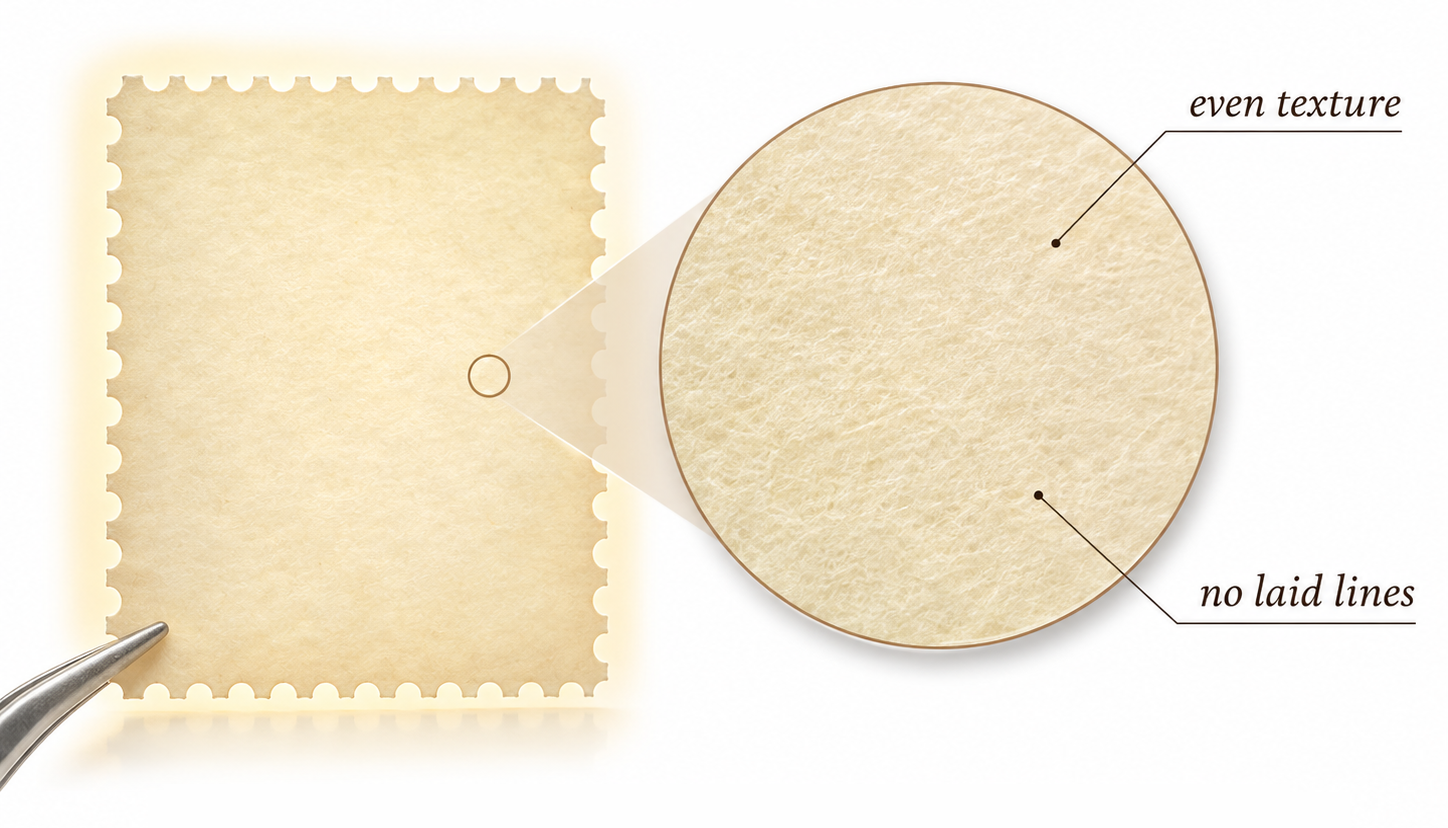
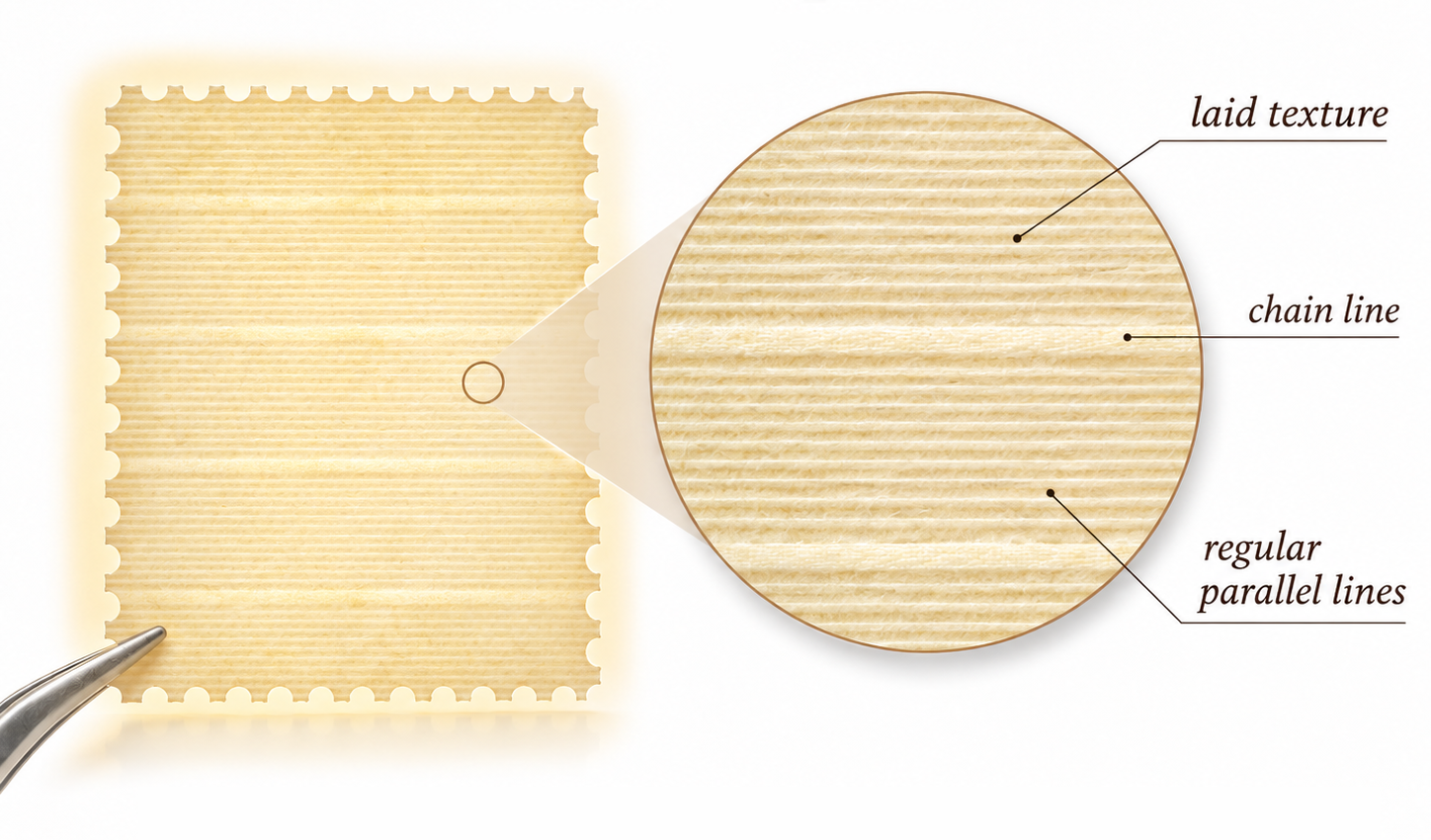
Wove describes the structure of the paper. Viewed against the light, it has a fairly even appearance. Laid paper instead shows a regular pattern of lines left by its manufacture.
Paper structure and watermark are separate characteristics: wove paper can carry a watermark. Both can help distinguish stamps with similar printed designs.
Wove paper: even texture without laid lines.Image information
Click image to magnify
Diagram of wove paper with a magnified inset showing an even texture without laid lines.
Credit
Stunning Stamps · 2026
Notes
Digitally constructed
Laid paper: regular parallel lines, shown for comparison.Image information
Click image to magnify
Diagram of laid paper with a magnified inset showing regular parallel lines.
Credit
Stunning Stamps · 2026
Notes
Digitally constructed
On this stamp
White wove paper; early printings on ordinary unglazed paper. Later plate-glazed printings are recorded, including M54(2) with greenish-blue tinted gum. Wove describes the paper structure. Plate-glazing mechanically smooths the paper; it is not a chalk coating.
A watermark is a pattern formed in the paper while it is being made. Variations in the paper allow the pattern to show when light passes through it. It is part of the paper itself, rather than an inked design.
A watermark may be faint or only partly visible on a single stamp. Collectors use it to identify the paper and distinguish otherwise similar issues.
Large Anchor · front view · upright. Enlarged; not a scale or stamp-position template.Image information
Large Anchor watermark, front view, upright
Credit
Stunning Stamps · 2026
Notes
Digitally reconstructed
On this stamp
The Somerset House 10s uses the Large Anchor watermark. This is a different paper pattern from the Imperial Crown found on the small-format low values. Look for the anchor in the paper; it is not part of the printed ornament.
The denomination is the stamp’s face value: the amount of postage it represents. Its price to a collector can be quite different.
In Britain’s old currency, 12 pence made one shilling and 20 shillings made one pound: 240 pence altogether. The abbreviations were d for pence, s for shillings and £ for pounds. The d comes from the Latin denarius. A halfpenny, written ½d, was half an old penny.
On this stamp
The face value is 10s, equivalent to 120 old pence. Ten shillings made half a pound.
The first-issue date records when the stamp became available for use. Read it alongside the description: an entry may describe a new design, a replacement colour or a change of printer. A stamp can remain in production long after that first date.
On this stamp
July 1912. This records the bright-blue printing within the Somerset House 10s family. It is later than the January 1912 date given for the issue’s introduction.
A specialised catalogue divides an issue more finely than a general listing. For Edward VII, references beginning with M identify families in the Stanley Gibbons Specialised catalogue; a number in brackets distinguishes an entry within that family.
Several specialised entries may share one ordinary SG number. Read the complete reference alongside the printer, paper, perforation and shade. A plate number or a position in a sheet describes something different.
On this stamp
SG 319; specialised M54. The M reference gives the finer specialised classification. Keep its bracketed number, where present, with the reference; it can distinguish entries that share a general SG number.
A printing sheet may contain several groups of stamps, called panes. Unprinted gaps between panes are gutters; the outer paper margin is also called selvedge. A pane may occupy an entire printing sheet or be one of several panes.
The sheet supplied to a post office may be smaller than the sheet used for printing. Keep those two counts separate. Row and column counts explain how many stamps belong to each pane.
Sheet, panes and margins: a simplified example.Image information
A schematic printing sheet contains two panes separated by an unprinted gutter and surrounded by a margin.
Credit
Stunning Stamps · 2026
On this stamp
56 stamps: 8 columns × 7 rows; upper and lower panes. Read the pane count separately from the total sheet count. The diagram explains the terms; the figures here give this issue’s arrangement.
A shade is a variation within a stamp’s colour. Some variations receive their own catalogue numbers even though the design and denomination stay the same.
Compare known examples under consistent lighting. Fading can change a stamp’s appearance, and photographs or screens can alter how colours look. A catalogue colour name helps describe a shade; it is not a colour test by itself.
On this stamp
M54(2) · SG 319: Blue. This name belongs to the specified printer’s colour range. Compare known examples under consistent lighting before assigning a shade.
A shade is a variation within a stamp’s colour. Some variations receive their own catalogue numbers even though the design and denomination stay the same.
Compare known examples under consistent lighting. Fading can change a stamp’s appearance, and photographs or screens can alter how colours look. A catalogue colour name helps describe a shade; it is not a colour test by itself.
On this stamp
M54(3) · SG 319: Deep blue. This name belongs to the specified printer’s colour range. Compare known examples under consistent lighting before assigning a shade.
Gum is the adhesive on the back of an unused stamp. Its colour is a separate characteristic from the ink and the paper. Some specialised entries record a distinctive tint in the gum.
A front view cannot establish the colour or originality of the gum. Read a recorded tinted-gum example as evidence for that variety, rather than as a feature that every stamp in its shade must have.
On this stamp
Greenish-blue gum; certified M54(1) example. This is a recorded characteristic of gum on the reverse. It does not mean that the printed face or every example of this shade has the same tint.
Gum is the adhesive on the back of an unused stamp. Its colour is a separate characteristic from the ink and the paper. Some specialised entries record a distinctive tint in the gum.
A front view cannot establish the colour or originality of the gum. Read a recorded tinted-gum example as evidence for that variety, rather than as a feature that every stamp in its shade must have.
On this stamp
Greenish-blue gum; M54(2) recorded by Harris. This is a recorded characteristic of gum on the reverse. It does not mean that the printed face or every example of this shade has the same tint.
A stamp can combine work by several people: a portrait artist, frame designer, photographer or engraver. Their roles are identified separately here.
Emil Fuchs was a Vienna-born sculptor, medallist and portrait painter who worked in London and later New York. His portrait of Edward VII supplied the likeness used on the King’s British definitive stamps.
On this stamp
Fuchs supplied the Edward VII portrait retained on this 10s blue stamp. The surrounding design was developed for De La Rue; later printers continued the established portrait and frame.