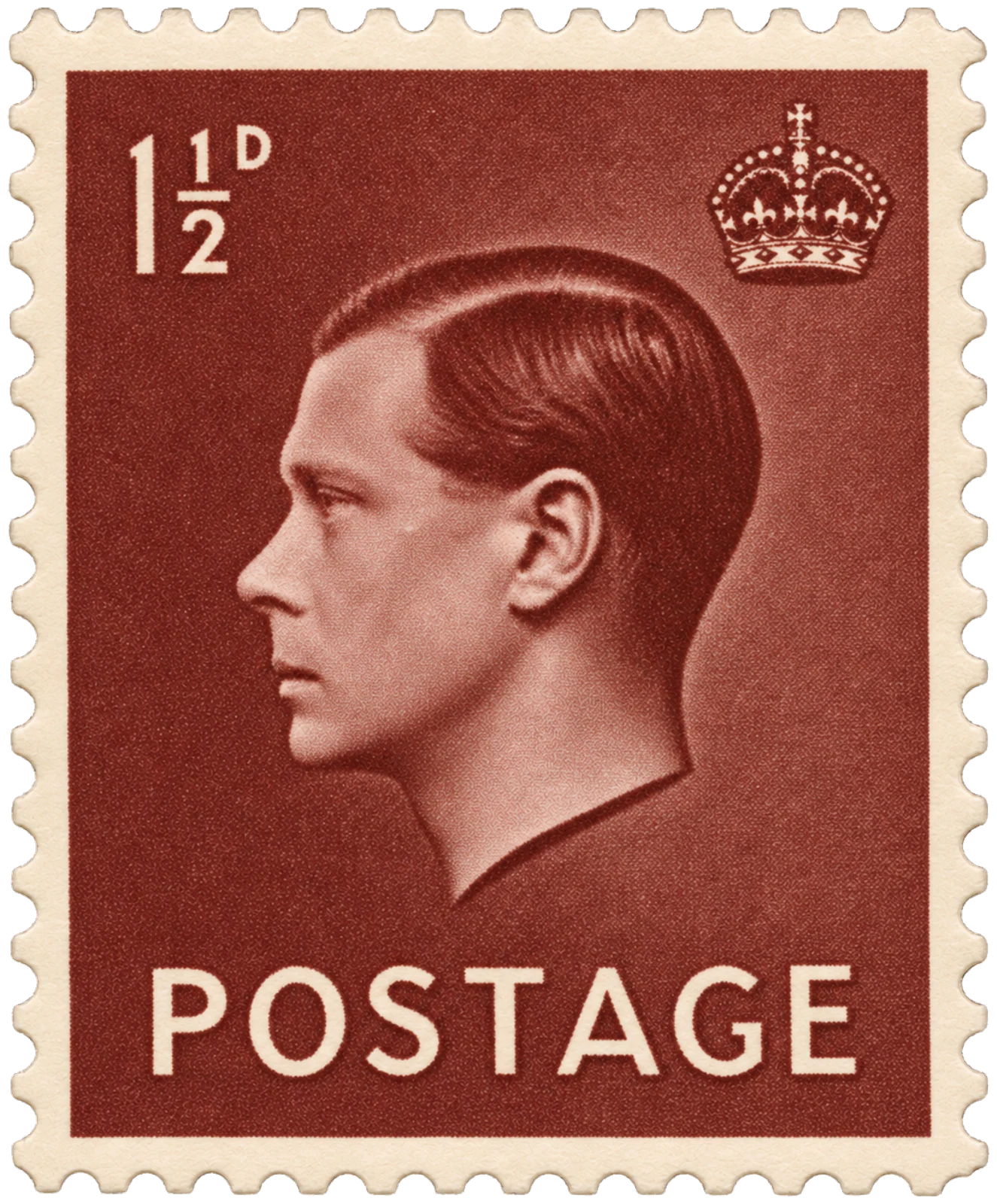
The red-brown three-halfpenny paid for an ordinary inland letter weighing up to 2 oz. It was the everyday letter stamp of Edward VIII’s brief reign; booklet buyers could even find advertisements attached to it. [1, 2]
Stories
One stamp for an ordinary letter
One stamp for an ordinary letter
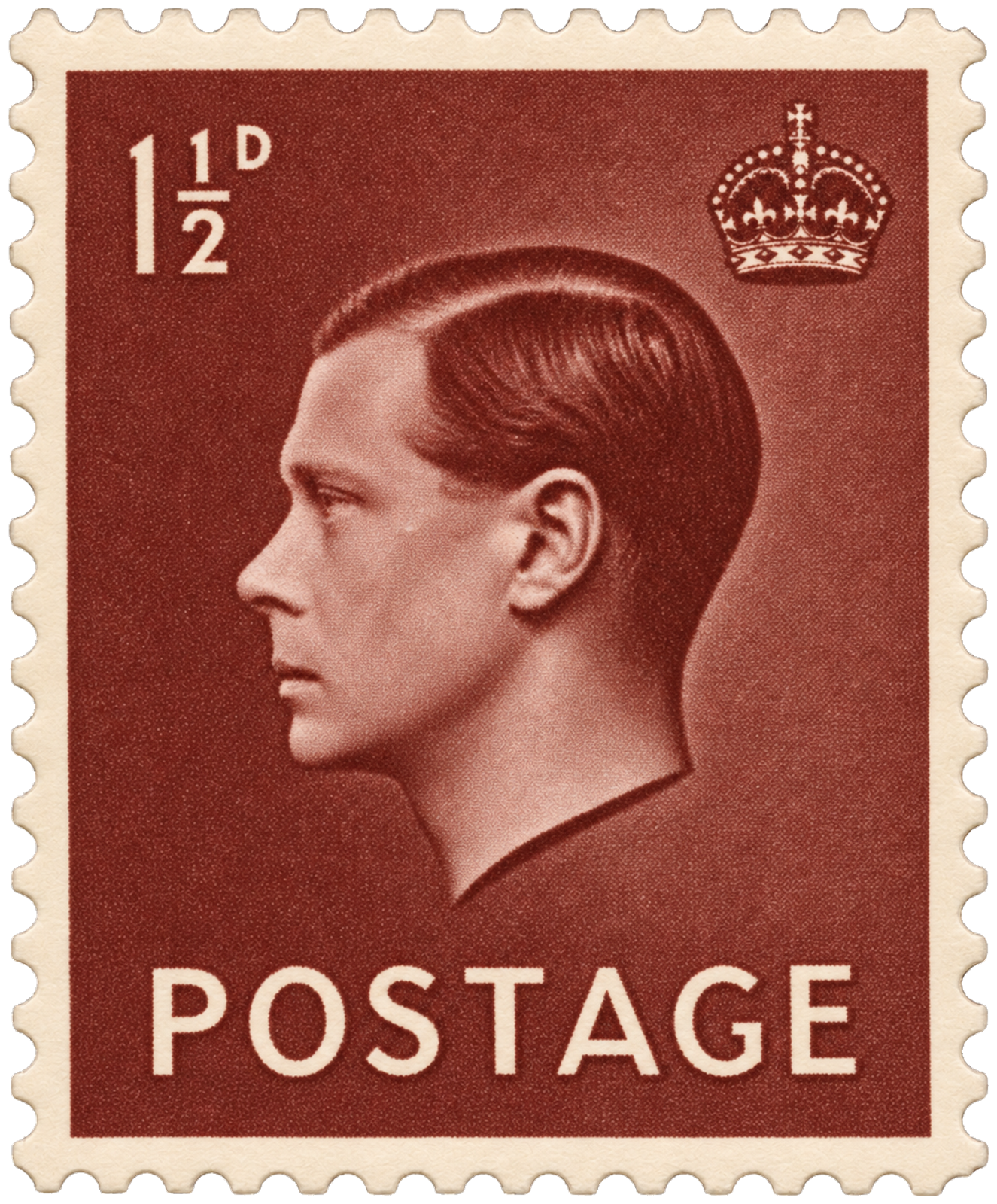
In September 1936, one and a half old pence paid the inland letter rate up to 2 oz. The red-brown stamp therefore did a straightforward everyday job: a sender could put one on a letter without assembling the charge from smaller values. [1]
Postage with an advertisement attached
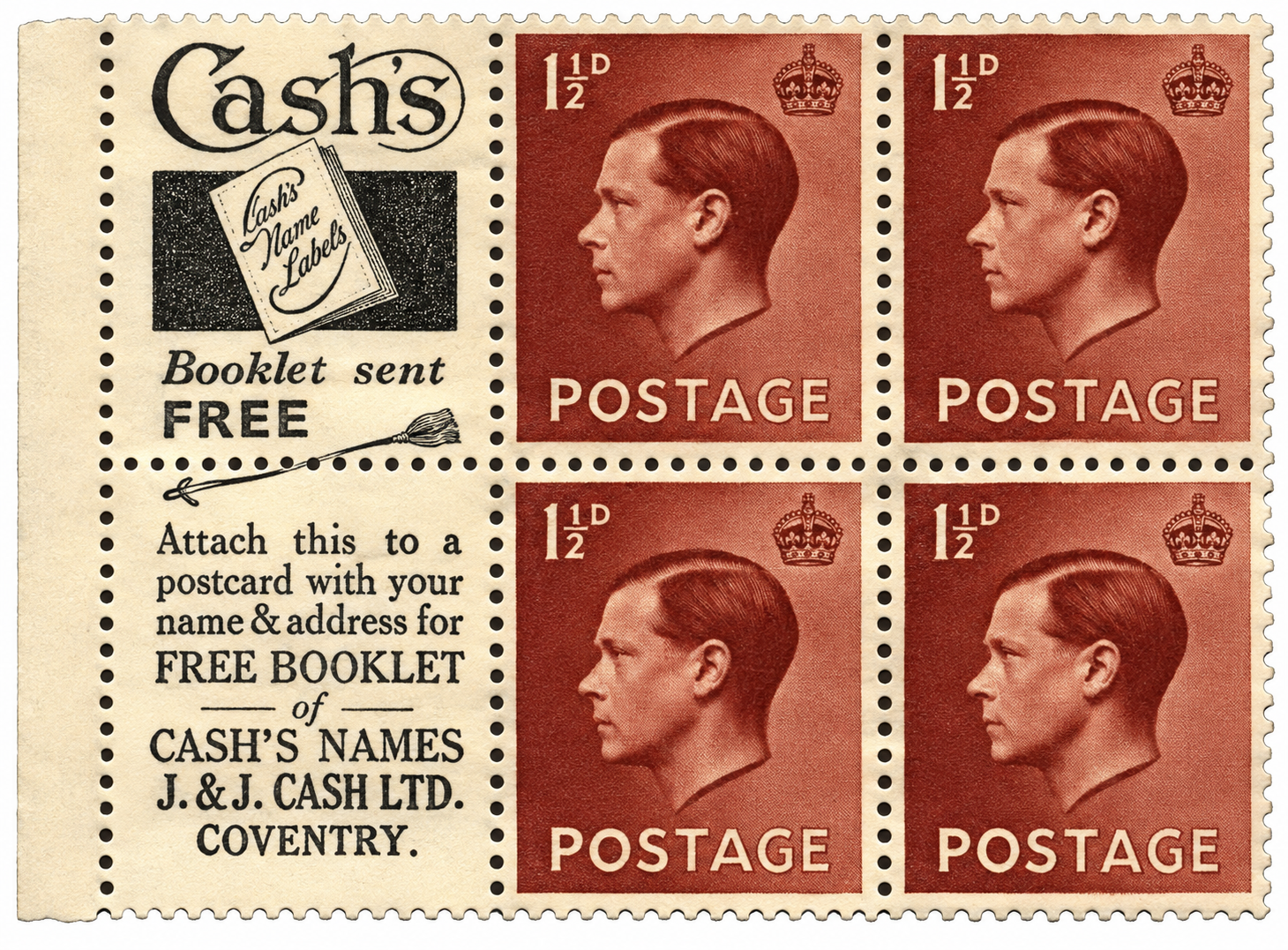
Buying postage could put a household advertisement beside the King’s portrait. One booklet pane combined four 1½d stamps with two advertising labels: sixpence in postage, accompanied by a sales pitch. [2, 3]
Cash’s advertised woven name labels for marking linen. Its lower label invited the buyer to attach it to a postcard, add a name and address, and request a free booklet. A small piece of the stamp booklet could thus become the start of another postal exchange. [2]
Other panes advertised Drages furniture and Charles Nissen’s stamp business. Alongside the royal image were practical concerns of everyday life: identifying clothes, furnishing a home and finding something for a collection. [2]
Cash’s name-label advertisements beside four letter-rate stamps.
How a teenager’s drawing reached the King
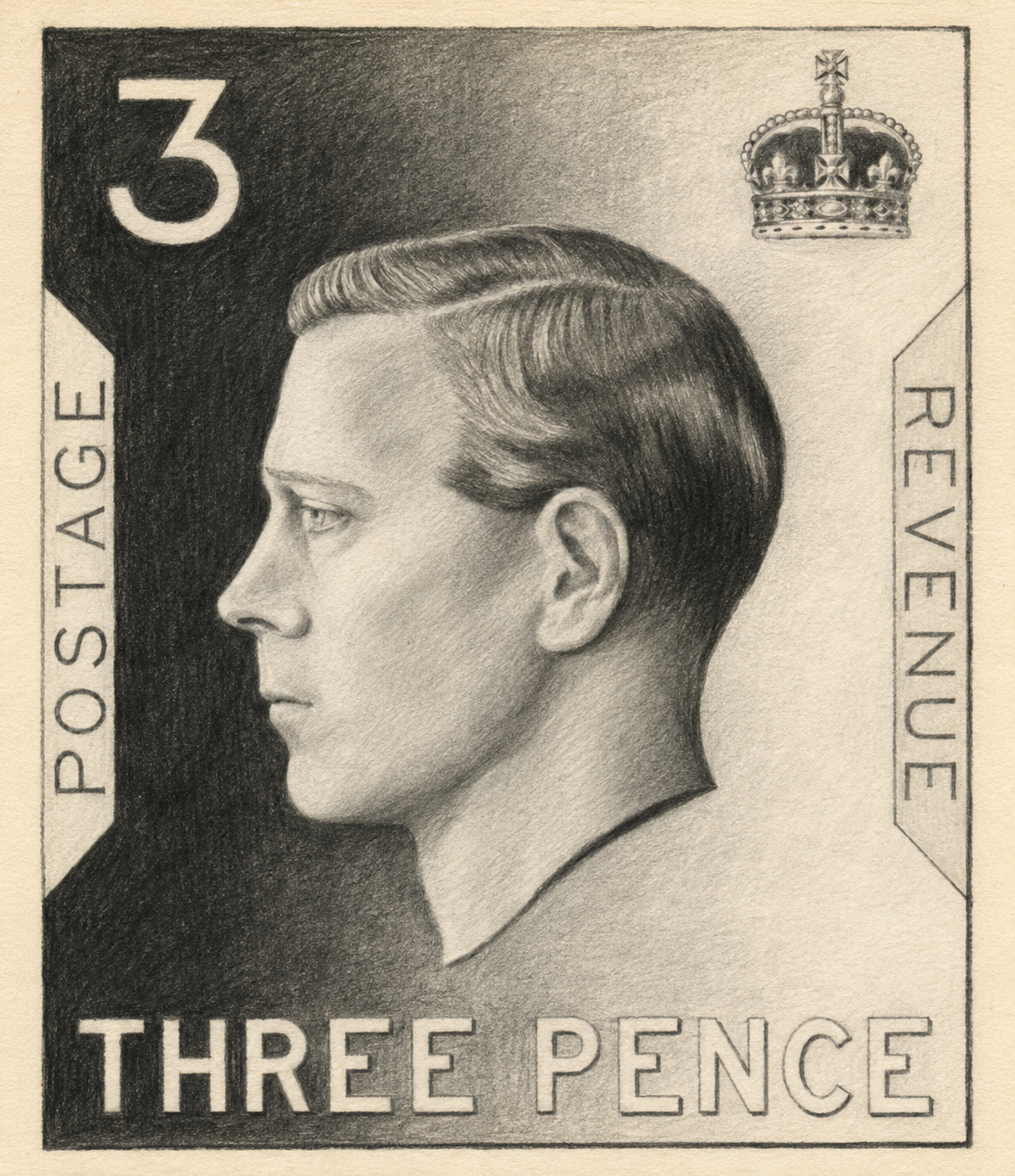
Hubert John Brown later recalled sketching his idea while studying for actuarial examinations. He asked the Postmaster General for permission to submit a design, then prepared a finished pencil drawing and had a local Torquay photographer make reductions. He wanted to see whether the design worked at stamp size before putting it forward. [7]
His finished drawing, submitted on 4 April 1936, caught someone’s eye inside the Post Office. It was forwarded to A. Kidner, who headed the Mails Branch, with the comment “this design appeals to me rather more than most of the others I have seen” and a recommendation to show it to Harrison & Sons. The printers received it on 14 April. An official had turned Brown’s carefully prepared submission into a serious candidate. [8]
Harrison & Sons developed the arrangement around Hugh Cecil’s photographic portrait. When Edward VIII rejected an earlier design as too ornate, he preferred their adaptation of Brown’s proposal. The printers simplified it further: the words POSTAGE and REVENUE disappeared from the sides, and POSTAGE moved to the foot in place of the value in words. Brown’s initiative, the official recommendation and the King’s taste all helped bring the design to the postbox. [9]
The Post Office only learnt that Brown had been seventeen when his father wrote on 1 September, the day the first stamps appeared. His youth had not won him the opportunity: his drawing had. A letter of appreciation had reached him shortly before issue, but he received no payment or public credit at the time. [9]
Brown’s proposal, using a threepenny value.Image information
Click image to magnify
Reconstruction of Brown’s pencil proposal: Edward VIII facing left, the numeral 3 and crown above, POSTAGE and REVENUE down the sides and THREE PENCE below.
Credit
Stunning Stamps · 2026
Notes
Digitally reconstructed from a published reproduction of Hubert J. Brown’s 1936 pencil proposal. This is a proposed design, not an issued threepenny stamp. The reconstruction explains the arrangement, not the original drawing’s fine surface detail.
The issued 1½d stamp.
The King had gone; his stamps remained
These stamps were meant to be temporary, with coronation and permanent designs to follow. Edward VIII’s abdication in December 1936 ended those plans. The four values issued that September became the whole ordinary British definitive set of his reign. [9]
But abdication did not empty the post offices of his portrait. In January 1937, a new sixpenny machine booklet appeared containing four Edward VIII 1½d stamps—enough for four ordinary inland letters. The King had left the throne, yet people could still buy his stamps and use them to send their news. [2, 1]
Why do some stories appear on several pages?
Every page is written to make sense on its own. Visitors often arrive directly at a particular stamp or subject, without having explored the rest of the site.
Some stories are relevant to several stamps, so they are repeated where they help explain what you're looking at. For those exploring a series, the details specific to each stamp generally come first, with the more familiar stories further down the page.
This way, you can explore the site in any order without missing interesting background.
The brown was inherited from George V. Frank Pick, who shaped London Underground’s design, later urged a change for George VI. Trials of replacement colours helped keep the familiar brown in use for a third reign. [10, 11]
The four values shared a design that Harrison & Sons simplified from a young collector’s proposal, using Hugh Cecil’s specially commissioned photograph and Gill Sans lettering. [12]
Before decimalisation, a pound contained twenty shillings and each shilling twelve pence. The letter d means old pence. A halfpenny was half of one old penny, not a modern decimal halfpenny.
Before decimalisation, a pound contained twenty shillings and each shilling twelve pence. The letter d means old pence. A halfpenny was half of one old penny, not a modern decimal halfpenny.
On this stamp
One and a half old pence equalled three halfpennies. Eight of these stamps had a face value of one shilling.
The first-issue date records when the stamp became available for use. Read it alongside the description: an entry may describe a new design, a replacement colour or a change of printer. A stamp can remain in production long after that first date.
The first-issue date records when the stamp became available for use. Read it alongside the description: an entry may describe a new design, a replacement colour or a change of printer. A stamp can remain in production long after that first date.
On this stamp
1 September 1936. This is the introduction of the stamp; later booklet supplies have their own dates.
A stamp catalogue gives each listed issue a reference number. SG means Stanley Gibbons, the publisher of the catalogue used here. These numbers help collectors refer to the same issue; they are not serial numbers printed on individual stamps.
A range of numbers groups related entries. Colour, paper or perforation differences may account for separate listings within that range.
On this stamp
SG 459 identifies the ordinary 1½d red-brown Edward VIII definitive. The collecting details distinguish additional formats where applicable.
A shade is a variation within a stamp’s colour. Some variations receive their own catalogue numbers even though the design and denomination stay the same.
Compare known examples under consistent lighting. Fading can change a stamp’s appearance, and photographs or screens can alter how colours look. A catalogue colour name helps describe a shade; it is not a colour test by itself.
On this stamp
Red-brown. Use this catalogue description alongside paper, printing and provenance when identifying an original.
The printer is the firm or government department that manufactured the stamp. A design can pass from one printer to another. Paper, ink, perforations and small differences in the impression help collectors distinguish their work.
Harrison & Sons was a security-printing firm that supplied stamps as well as passports and other documents. It printed British letterpress stamps before introducing photogravure for the George V definitives in 1934.
On this stamp
Harrison & Sons adapted the layout and printed this 1½d red-brown Edward VIII stamp by photogravure. Recessed cells in printing cylinders reproduced the photographic tones as well as the surrounding colour and lettering.
Photogravure carries ink in tiny recessed cells on a printing cylinder. A blade removes surplus ink from the surface before the cells transfer their ink to the paper. The cell pattern allows the image to reproduce different tones.
Harrison introduced the process for British definitive postage stamps in 1934. On original stamps, the fine grid visible under magnification can help distinguish photogravure from the earlier letterpress printing.
Simplified cell pattern, not a scan of the stamp. Photogravure uses tiny recesses in a printing cylinder to carry the ink.Image information
Enlarged plan view of a gravure cell grid. Separate recessed cells carry ink; varying the ink they hold creates tone.
Credit
Stunning Stamps · 2026
On this stamp
The portrait and surrounding colour were printed by photogravure. The photographic tones are formed by the ink-bearing cells rather than by a separately printed photograph.
The paper supports the printed image and carries its watermark. A partial crown or letter can be all that falls within one stamp position when the watermark repeats across a sheet.
The paper supports the printed image and carries its watermark. A partial crown or letter can be all that falls within one stamp position when the watermark repeats across a sheet.
On this stamp
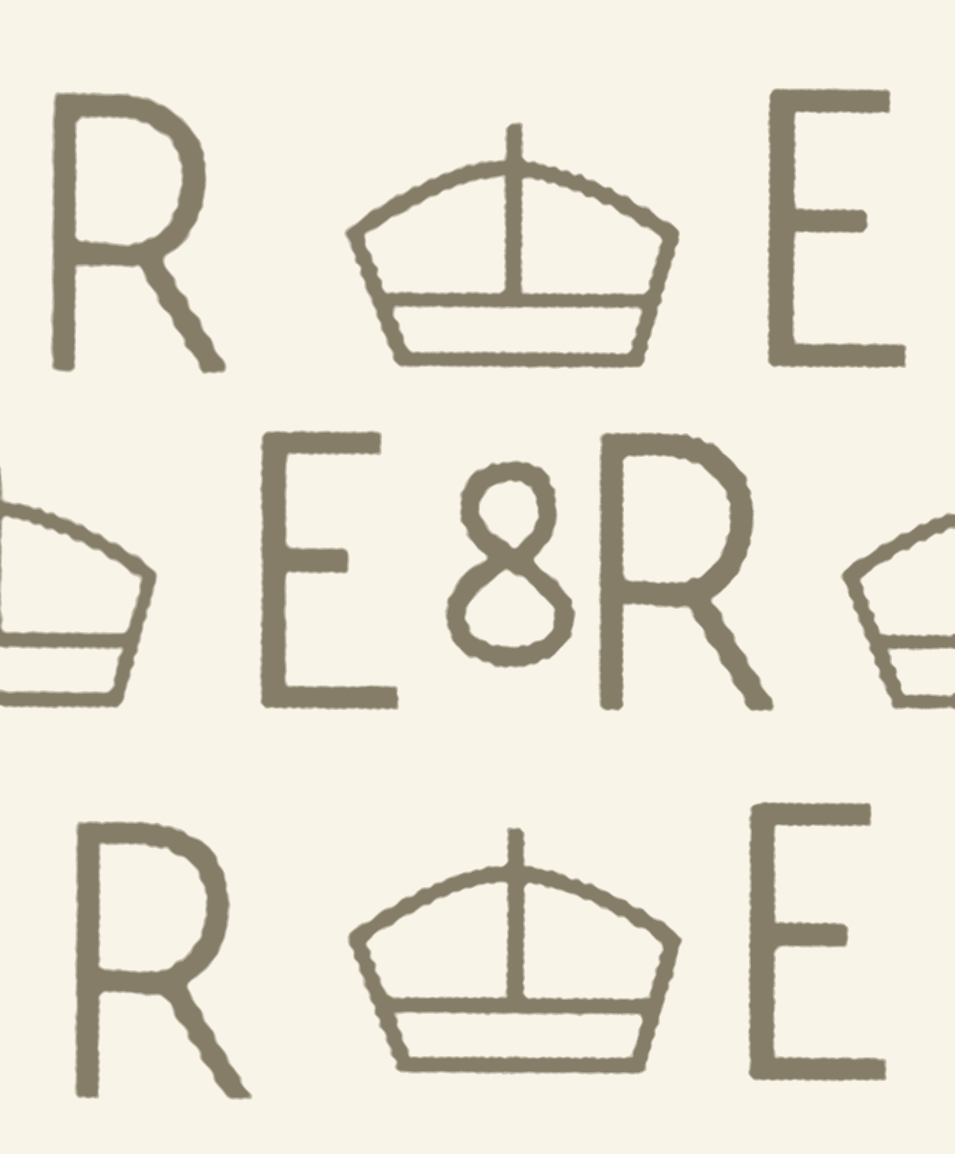
The paper is watermarked with the repeating crown and E8R of Edward VIII.
A watermark is a pattern formed in the paper while it is being made. Variations in the paper allow the pattern to show when light passes through it. It is part of the paper itself, rather than an inked design.
A watermark may be faint or only partly visible on a single stamp. Collectors use it to identify the paper and distinguish otherwise similar issues.
Multiple Crown and E8R · front view · upright. Repeating pattern, viewed from the front. From the back, the letters appear mirrored. Enlarged; not a scale or stamp-position template.Image information
Multiple Crown and E8R watermark, front view, upright
Credit
Stunning Stamps · 2026
Notes
Digitally reconstructed
On this stamp
Multiple Crown and E8R is the repeating paper watermark. Upright and inverted versions are listed for the 1½d and its booklet panes. The January 1937 booklet did not introduce a new royal watermark.
Perforations are the rows of punched holes that let neighbouring stamps separate. Their gauge describes the spacing over a standard distance of 2 centimetres, rather than the total number of holes along a stamp’s edge.
A perforation gauge has rows of dots or lines at known spacings. Match an edge against them: the marks should line up all the way along. A single number applies to both directions; two numbers give the horizontal gauge first, then the vertical.
Enlarged spacing diagram, not to scale. Match the spacing with a perforation gauge.Image information
Enlarged perforation spacing: fourteen equal intervals between hole centres span 20 millimetres. This is a schematic, not a ruler.
Credit
Stunning Stamps · 2026
On this stamp
15 × 14 gives the horizontal gauge first and the vertical gauge second, measured over 2 cm.
These dimensions describe the complete stamp, including its perforated edges. Width is given first, followed by height. Measure from the outer tips of the perforations on one side to the outer tips on the opposite side.
The printed design occupies a smaller area inside the paper margins. Its size is a separate measurement.
Width × height of the complete stamp, across the perforation tips. Diagram enlarged; screen size is not calibrated.Image information
Complete stamp width 21 mm and height 24 mm, measured across the outer perforation tips. The printed area is smaller. Schematic, not actual size.
Credit
Stunning Stamps · 2026
On this stamp
Approximately 21 mm wide by 24 mm high across the outer perforation tips. The printed design is smaller. Separated paper edges vary slightly, so this is an approximate reference size.
A printing sheet may contain several groups of stamps, called panes. Unprinted gaps between panes are gutters; the outer paper margin is also called selvedge. A pane may occupy an entire printing sheet or be one of several panes.
The sheet supplied to a post office may be smaller than the sheet used for printing. Keep those two counts separate. Row and column counts explain how many stamps belong to each pane.
Sheet, panes and margins: a simplified example.Image information
A schematic printing sheet contains two panes separated by an unprinted gutter and surrounded by a margin.
Credit
Stunning Stamps · 2026
On this stamp
The counter sheet held 240 stamps. This is separate from the booklet-pane and machine-roll formats described on this page. The guide diagram is schematic.
Hubert John Brown was a young stamp collector and member of the Exeter and Torquay philatelic societies. At seventeen he submitted a design proposal for Edward VIII’s stamps. Harrison & Sons developed the layout for production.
Hubert John Brown was the young designer whose proposal helped shape Edward VIII’s definitive stamps. The final design also depended on the royal photograph and the printer’s adaptation of the layout.
Hugh Cecil was the professional name of portrait photographer Hugh Cecil Saunders. His studio supplied the photograph of Edward VIII used on the 1936 definitives; the stamp layout was a separate contribution.
Eric Gill designed Gill Sans for Monotype. The typeface was already in existence when Harrison & Sons used it for this stamp’s letters and value figures, alongside Brown’s layout and Cecil’s portrait.
On this stamp
Brown supplied the starting layout; Harrison & Sons adapted it around Hugh Cecil’s photograph. The printer’s contribution was part of the design’s development, as well as its manufacture.
Hugh Cecil was the professional name of Hugh Cecil Saunders, a London portrait photographer whose work appeared in the Sketch and Tatler. Edward first sat for him as Prince of Wales in 1925.
Hugh Cecil was the professional name of portrait photographer Hugh Cecil Saunders. His studio supplied the photograph of Edward VIII used on the 1936 definitives; the stamp layout was a separate contribution.
On this stamp
Cecil’s photograph supplied Edward VIII’s likeness. Photogravure translated its tones into the printed portrait on this stamp.
A postal rate is the charge for a particular service. Check the date, destination, contents and weight together. A denomination could pay a whole charge or form part of a larger amount.
A postal rate is the charge for a particular service. Check the date, destination, contents and weight together. A denomination could pay a whole charge or form part of a larger amount.
A booklet holds small groups of stamps called panes between protective covers. Binding margins, attached labels and the orientation of the paper can help identify how a pane was produced and sold.
A booklet holds small groups of stamps called panes between protective covers. Binding margins, attached labels and the orientation of the paper can help identify how a pane was produced and sold.
On this stamp
SG 459a: four stamps and two labels; sixpence in postage.
A booklet holds small groups of stamps called panes between protective covers. Binding margins, attached labels and the orientation of the paper can help identify how a pane was produced and sold.
On this stamp
SG 459b identifies a six-stamp pane; SG 459c a two-stamp pane. The sixpenny machine booklet introduced in January 1937 contained two panes of two 1½d stamps inside plain buff covers: enough postage for four basic inland letters. These differ from SG 459a, the four-stamp pane with two advertising labels.
A roll, also called a coil, feeds a sequence of stamps through a vending or affixing machine. Some rolls were continuously printed; others were assembled by joining strips cut from sheets. A roll code describes the supply format, not a new stamp design.
A roll, also called a coil, feeds a sequence of stamps through a vending or affixing machine. Some rolls were continuously printed; others were assembled by joining strips cut from sheets. A roll code describes the supply format, not a new stamp design.
On this stamp
No Edward VIII 1½d rolls issued; existing George V stocks were sufficient.
A printing variety is a documented departure from the normal stamp. A repeated flaw needs a reliable diagnostic; a named catalogue entry is not enough to authenticate a suspected example. Imperforate means that the normal separating holes are absent.
A printing variety is a documented departure from the normal stamp. A repeated flaw needs a reliable diagnostic; a named catalogue entry is not enough to authenticate a suspected example. Imperforate means that the normal separating holes are absent.
On this stamp
SG 459d: imperforate pair, distinct from an ordinary perforated stamp.