
The design of the 5s bright rose-red
King George V · Great Britain · Waterlow & Sons · 1934
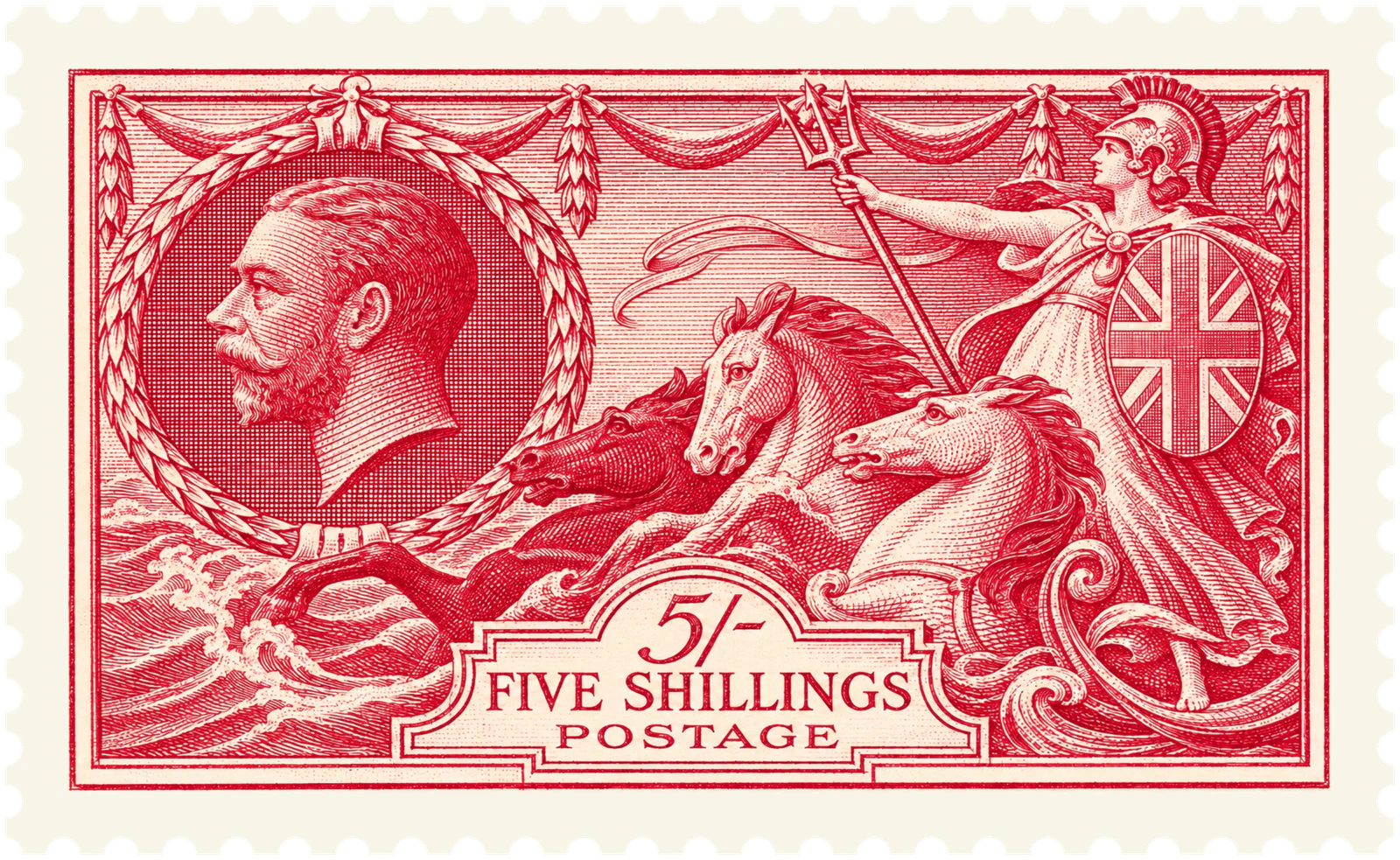
The 1934 change — cross-hatching
Look immediately behind the King’s head. Diagonal lines cross the horizontal shading, forming a fine mesh. This cross-hatching is a useful way to recognise the re-engraved Seahorse design introduced in 1934. [1]
The revised linework gives the portrait a denser setting, while retaining the wreath, Britannia, horses and value tablet. It is a change to the engraving within the established composition, rather than a new scene.
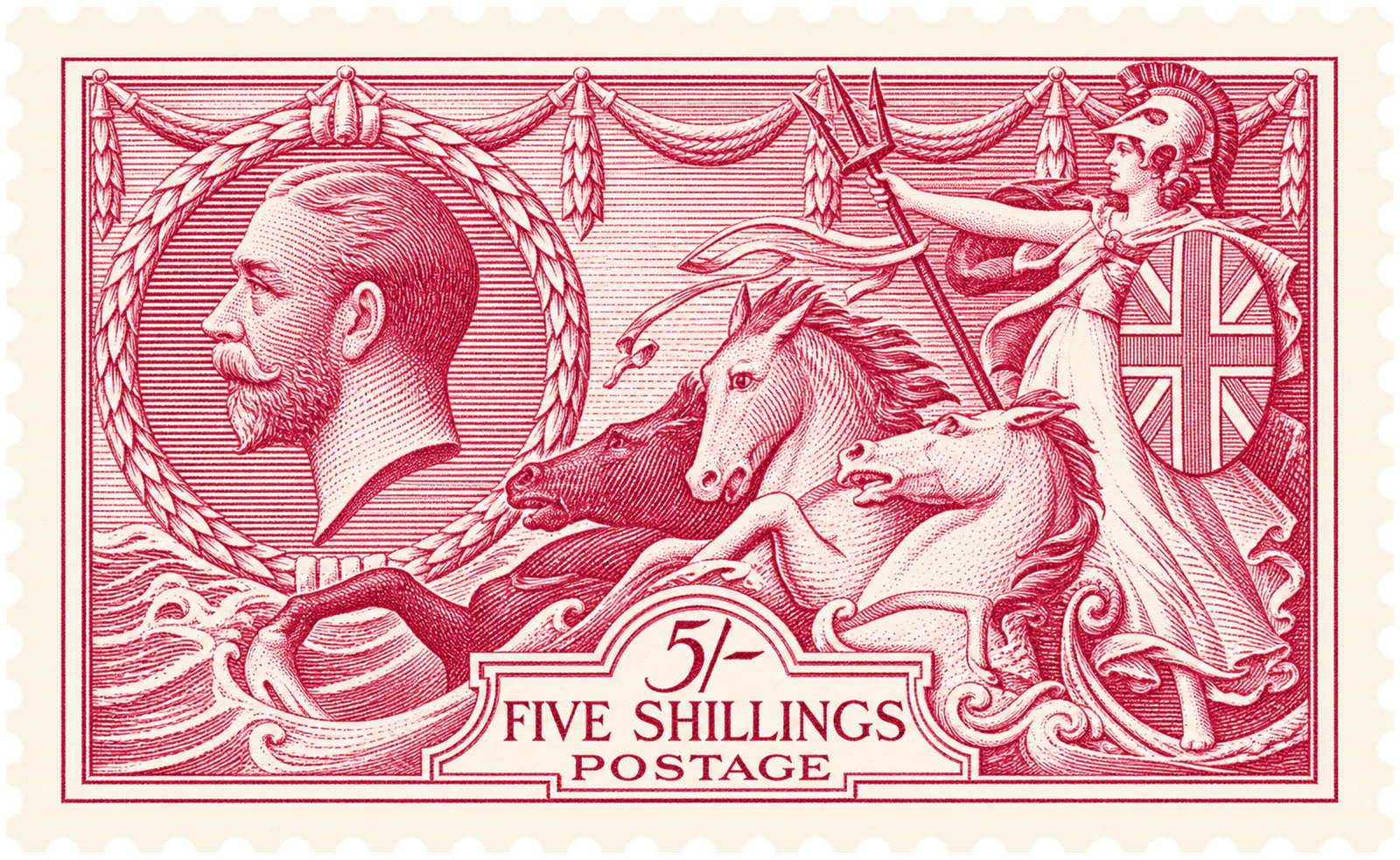
Click either stamp to magnify
The revised design beneath an Irish overprint
Ireland had been using overprinted Bradbury Wilkinson Seahorses since 1922. In 1935 the revised Waterlow stamps followed. The five-shilling carried the Irish Free State inscription over the newly engraved British picture. [2, 3]
The three lines read Saorstát Éireann 1922, identifying the Irish Free State. The date belongs to the wording of the overprint; it does not date the underlying stamp to 1922. The cross-hatched portrait background identifies the later engraving. [2, 3]
Overprinting kept an existing high-value design in service while Ireland developed its own stamp range. Irish high values with their own designs followed in 1937. [2]
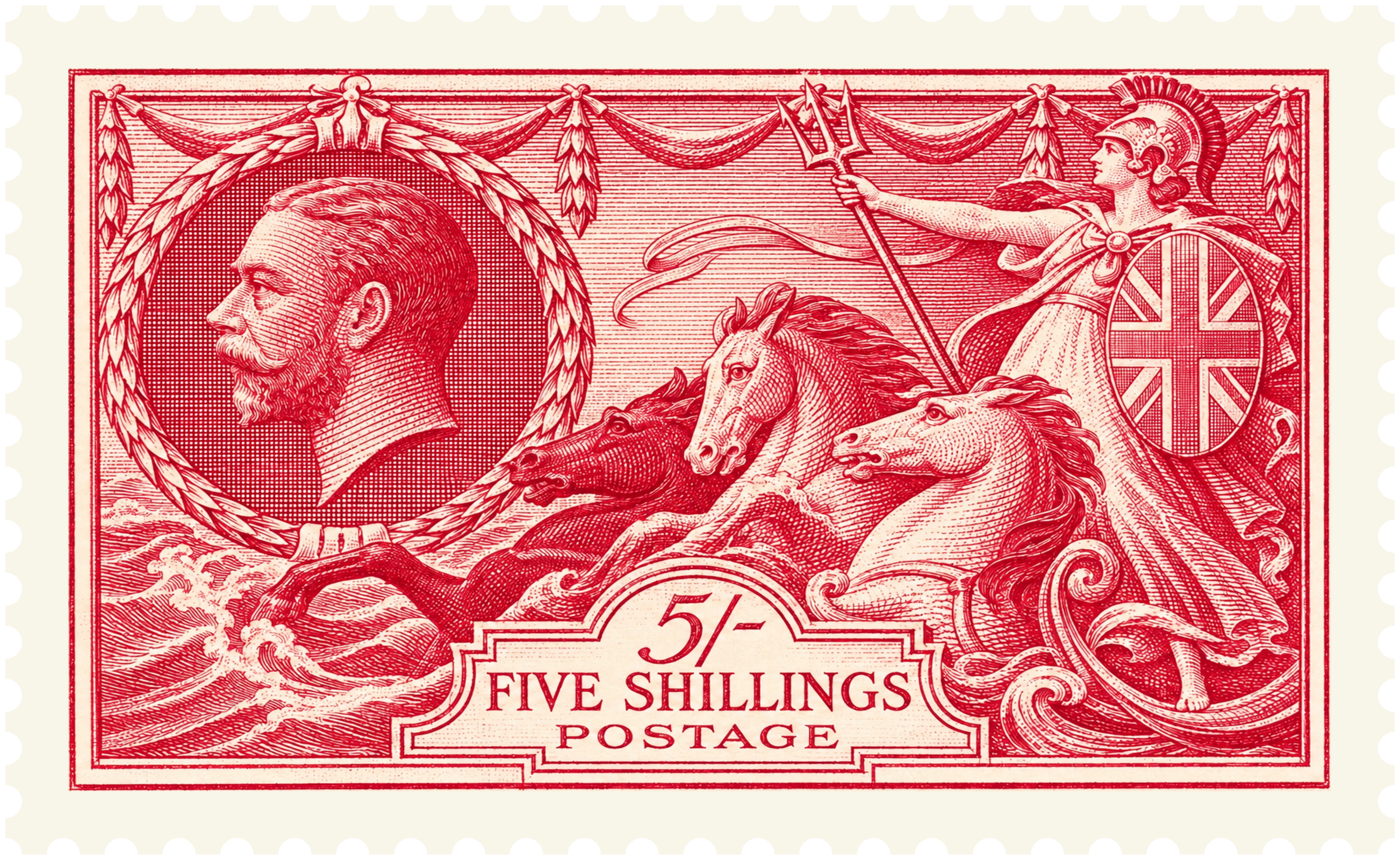
Image information
Click image to magnify
George V 5s bright rose-red Seahorse from Seahorses — Waterlow re-engraved.
- Credit
- Stunning Stamps · 2026
- Notes
- Digital reconstruction. The approved artwork used for the main stamp image.
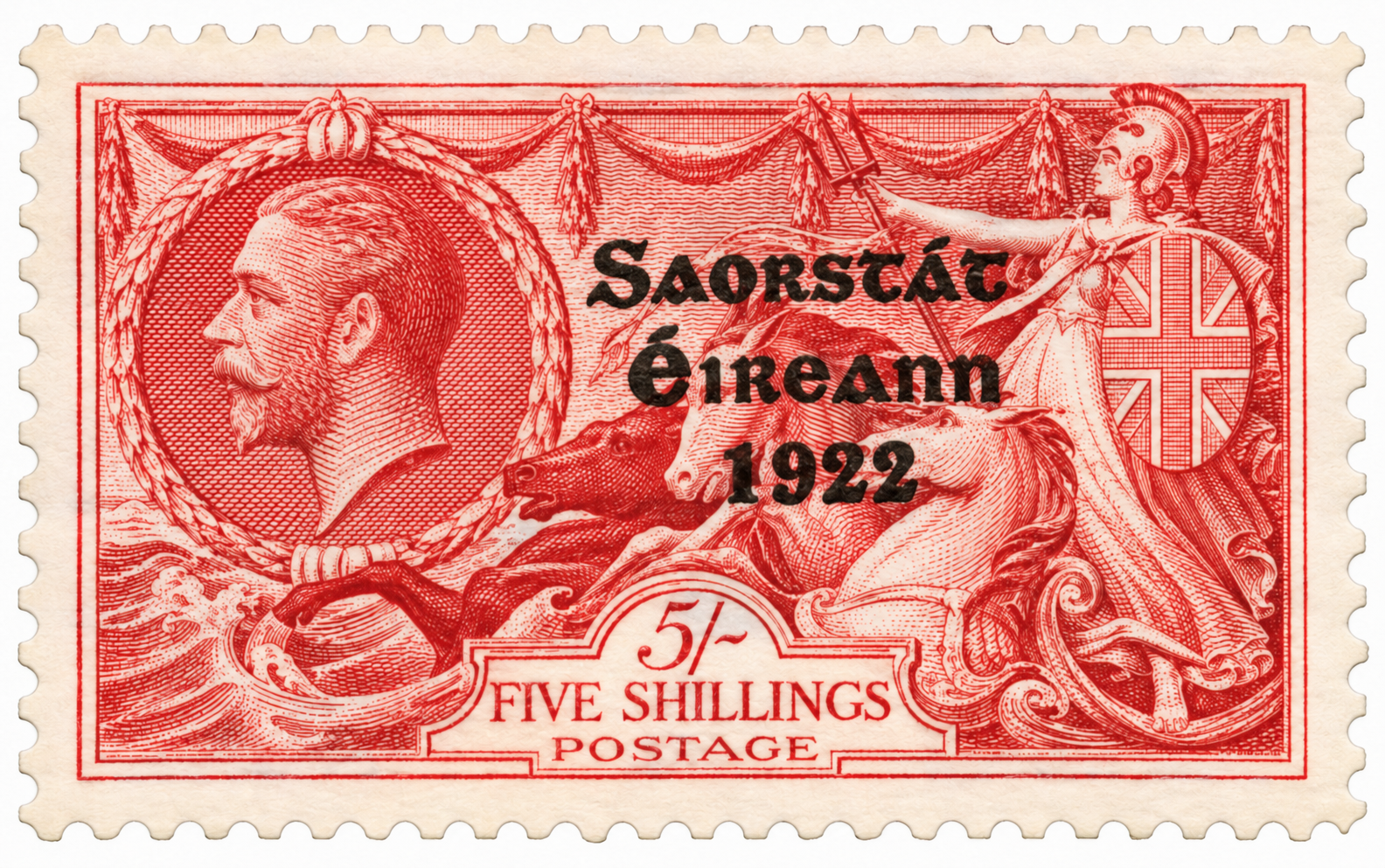
Image information
Click image to magnify
Red re-engraved five-shilling Seahorse with the three-line Saorstát Éireann 1922 overprint, issued in 1935.
- Credit
- Digital reconstruction by Stunning Stamps, after the example illustrated by the GB Overprints Society.
- Notes
- Digitally reconstructed. Illustrates the wording and placement of the overprint; fine printing details are interpretive. The printed date 1922 is retained on the 1935 issue.
Before the Seahorses: Britannia on a Victorian medal
Britannia was driving sea horses long before the stamps of 1913. The reverse of Leonard Charles Wyon’s 1854 medal commemorating his father, William Wyon, places her above four horses, holding a trident and an olive branch. The reconstruction here follows the Metropolitan Museum of Art’s example. [4]
Compare the two compositions. The medal gathers the horses around a central standing figure; the stamp sends a team of three across the picture, with Britannia at the right and the King’s portrait at the left. The trident, drapery and water belong to the same maritime language, but their arrangement is different. [4, 5]
The British Philatelic Bulletin proposed this medal among the possible precedents for Mackennal’s design, alongside a Thomas Simon medal of 1665 and a Barbados stamp of 1892 based on an earlier colonial seal. These comparisons show the artistic tradition in which he worked; they do not establish a documented chain of borrowing. [5]
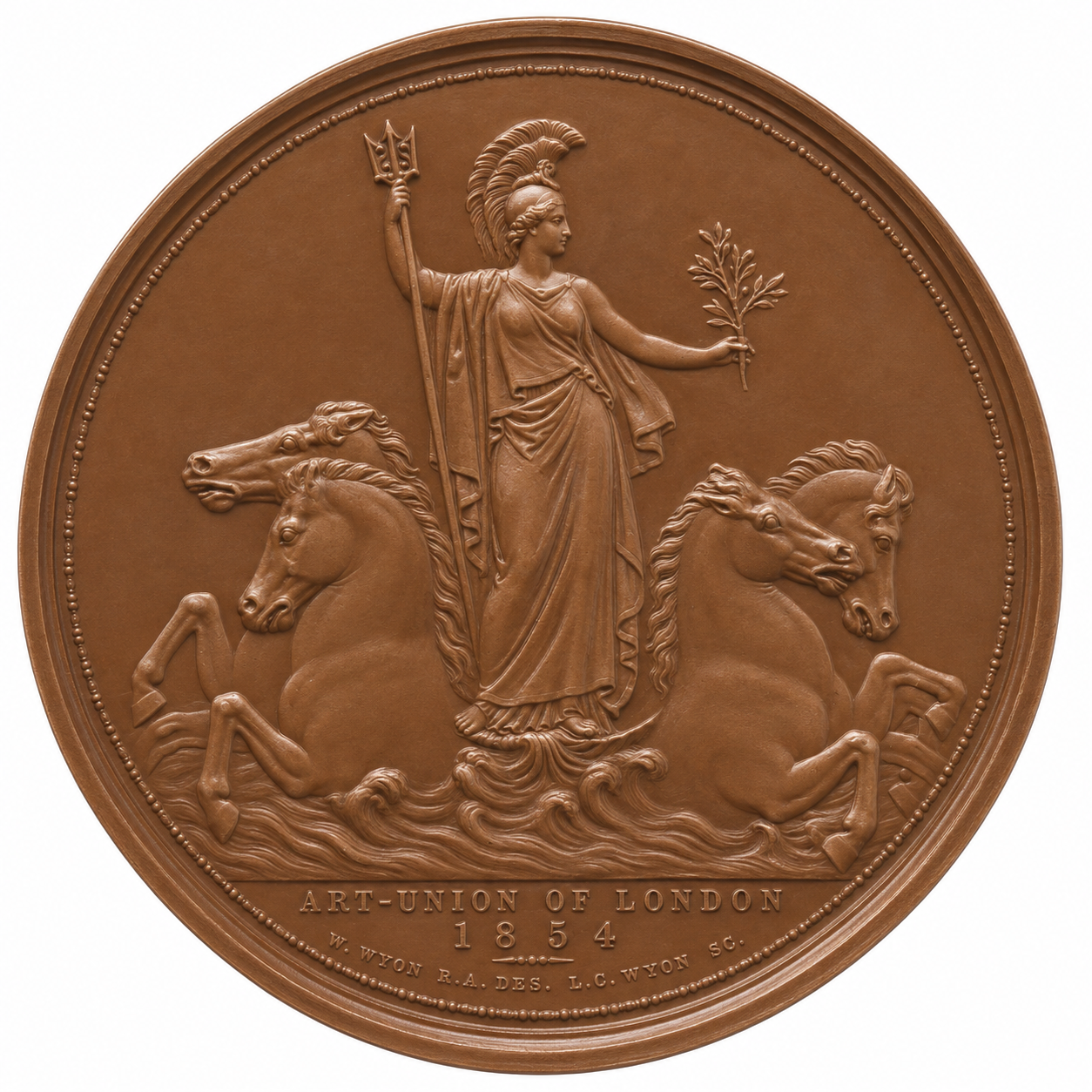
Image information
Click image to magnify
Bronze medal reverse showing helmeted Britannia holding a trident and olive branch above four sea horses and waves.
- Credit
- Digital reconstruction by Stunning Stamps, after Leonard Charles Wyon’s 1854 medal. Reference photograph: The Metropolitan Museum of Art, object 2001.217.8, Public Domain.
- Notes
- Digitally reconstructed from the museum photograph. A proposed artistic precedent for the Seahorses; fine details are interpretive.
Image information
Click image to magnify
George V 5s bright rose-red Seahorse from Seahorses — Waterlow re-engraved.
- Credit
- Stunning Stamps · 2026
- Notes
- Digital reconstruction. The approved artwork used for the main stamp image.
Britannia, the shield and trident
Britannia stands at the right, with a crested helmet, flowing robes, a shield bearing the Union flag and a raised trident. Britannia is the female personification of Britain; her maritime associations were already familiar from coinage. [6]
Her arm and trident reach diagonally towards the centre of the stamp. The shield supplies a more upright shape behind the horses. Together they make her recognisable within a scene crowded with curves, folds and waves.
Three horses moving through the sea
Three horses pull Britannia’s chariot towards the left. Their heads overlap, but their eyes, ears and open mouths remain separate. Raised forelegs and backward-flowing manes suggest movement across the face of the stamp.
Below them, long curved lines form rolling water, broken by pale crests and spray. The horses, chariot and waves supply the scene from which collectors take the name “Seahorses”.
These are ordinary horses in the sea. In classical art, hippocamps combine a horse’s head and forelegs with a fish’s tail; they often draw the chariot of Neptune, the sea god. Mackennal’s team has the familiar form of horses instead. Royal Mail’s January 2019 Bulletin makes the same basic distinction, describing the animals as horses rather than fish. [7, 8]
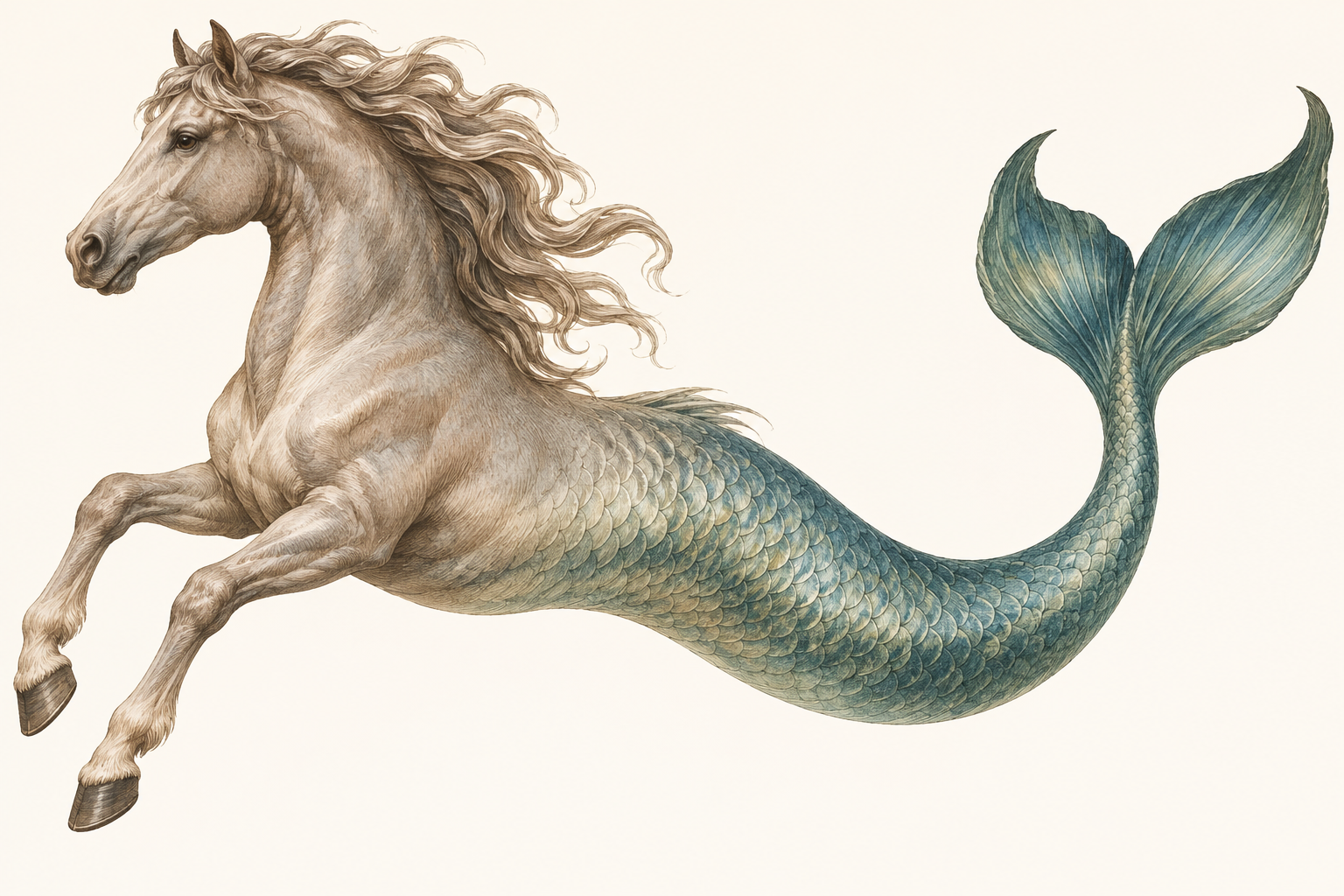
Image information
Click image to magnify
Watercolour-style illustration of a mythical creature with a horse’s head and two forelegs, ending in a long blue-green fish tail.
- Credit
- Stunning Stamps · 2026
- Notes
- Digitally constructed. An illustration of a mythological creature, not a copy of a historical object.
Britannia and command of the seas
Britannia takes the place of a sea god, directing the horses and chariot across the waves. The scene can be read as an allegory of British sea power: the nation, represented by Britannia, commands the ocean. Giving her ordinary horses to drive through open water makes that imagined mastery particularly striking. [9]
When the original design appeared in 1913, Britain and Germany had spent years competing to build powerful battle fleets. Britain depended on its navy to protect overseas trade and its empire. Against that background, Britannia’s confident progress through the waves carried a contemporary political resonance. This is a historical reading of the design; the naval rivalry alone does not establish that it was commissioned as a response to Germany. [10, 9]
The King at the left
The King’s still profile is contained within an oval wreath at the left, set apart from the moving horses and Britannia. Waves continue beneath both parts of the picture.
The likeness belongs to Mackennal’s profile work, but contemporary records refer to different models for this engraving. Identifying a particular medal as its direct source remains uncertain. [11]
The garlands and portrait wreath
Garlands hang in repeated curves along the top, with leaf-shaped drops between them. The portrait wreath echoes that decoration at a larger scale. A small bow closes the wreath beneath the King’s neck.
The King’s portrait is enclosed by a laurel wreath. Its narrow, pointed leaves overlap around the oval, repeating a classical emblem of victory and honour. The wreath gives the portrait a formal setting beside Britannia’s moving chariot; the hanging garlands above are a separate decorative border. [12, 13]

Image information
Click image to magnify
Illustration of a laurel branch with glossy pointed green leaves and dark berries.
- Credit
- Stunning Stamps · 2026
- Notes
- Digitally constructed
The value tablet and POSTAGE
The tablet reads 5/− above FIVE SHILLINGS. The slash and dash indicate 5 shillings with no additional pence.
The tablet leaves clear space among the horses and waves for the stamp’s value. Its curved shoulders and raised centre accommodate both figures and words.
POSTAGE appears beneath the denomination. Unlike the low-value designs, the Seahorses do not carry a REVENUE inscription.
Five shillings equalled sixty old pence, or a quarter of a pound.
Click either stamp to magnify
One ink, engraved light and shade
The bright rose-red ink carries the whole scene, from its strongest shadows to the finest lines. Unprinted paper supplies the light ground behind the lettering, highlights in the figures and foam on the waves.
Recess printing takes its ink from grooves cut into a plate. The surface is wiped, leaving ink in the incised lines; pressure brings the paper into contact with that ink. The marks that describe the King’s face, the horses and Britannia’s dress are therefore the marks that print the image. [14]
Closely packed lines make the leading horse dark; wider spaces leave the paper to supply the lighter horses and the foam. Those differences in tone come from the engraved marks and unprinted paper, without a second colour.
Image information
Click image to magnify
Decorative blue, green and white advertisement for Mander Brothers printing inks, Wolverhampton.
- Credit
- Stunning Stamps · 2026
- Notes
- Digitally constructed
The high values kept their printing process
Waterlow & Sons printed the revised high values in recess. Britain’s small everyday stamps were moving to Harrison’s photogravure process in the same year, under a separate contract. The two ranges therefore followed different production paths. [14]
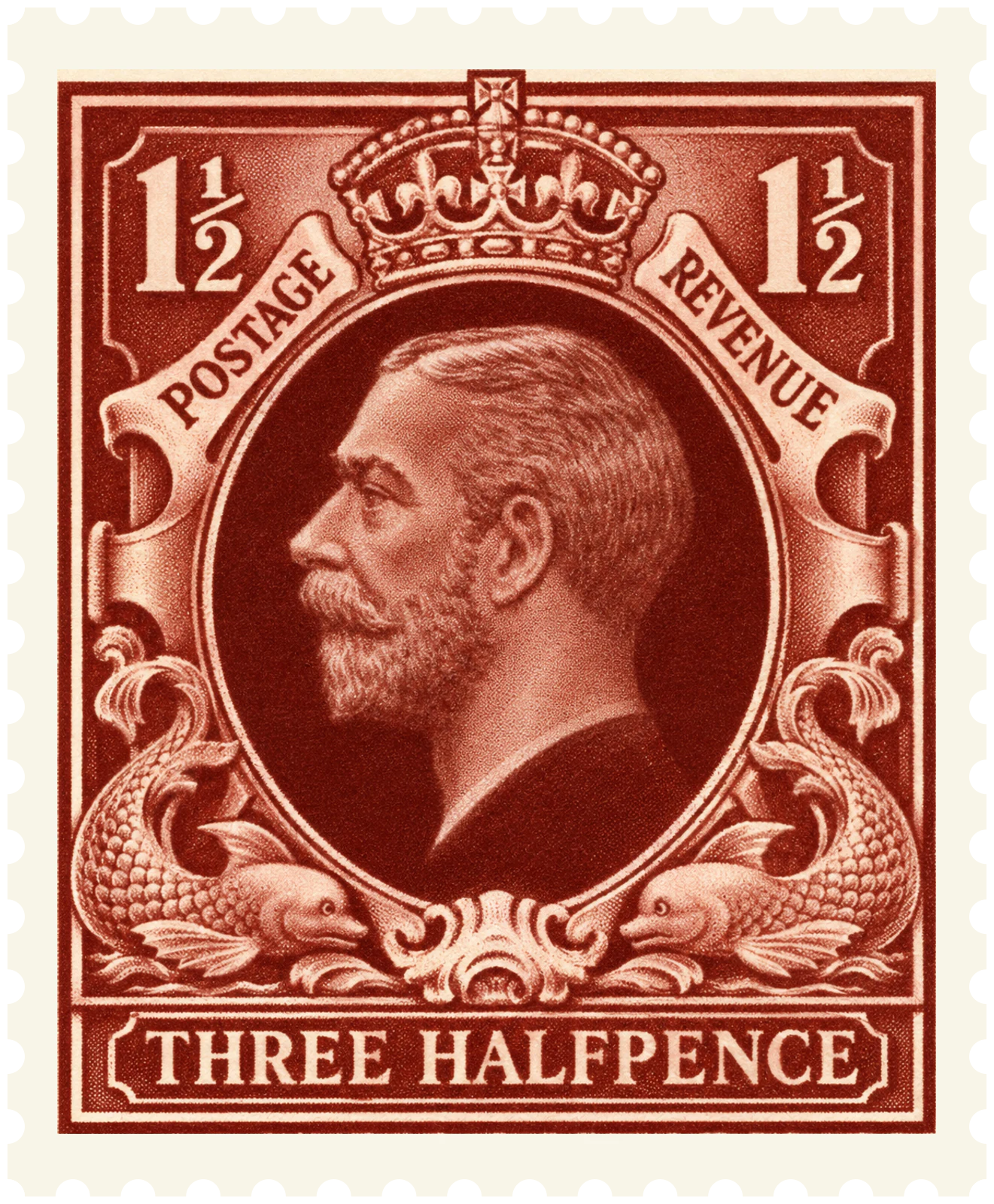
Shown at approximate relative physical size. The low-value illustration is the final small design of 1935, not the initial August 1934 format.
Click either stamp to magnify
The people and printer behind this stamp
Bertram Mackennal designed the Seahorse composition, George W. Eve supplied the lettering and J. A. C. Harrison engraved the original die. The original-die credit does not identify the engraver of the 1934 revision. [15, 16]
Waterlow & Sons printed the revised design. Its company history is linked below, alongside the lives of the contributors to the original composition. [15]
Sources
- Roy Lingen, Great Britain Seahorse issues: a short tutorial, NSDA, April 2012
- Barry Cousins: Seahorse Stamps Overprinted, 2022, pages 6–8
- GB Overprints Society: Ireland — 1922 Bradbury Wilkinson and 1935 re-engraved high-value overprints
- The Metropolitan Museum of Art: Leonard Charles Wyon, William Wyon medal, 1854, object 2001.217.8 — public-domain reverse photograph
- British Philatelic Bulletin, March 1993, vol.30 no.7, p.157: NPM “Britannia Depicta” Exhibition — possible sources of the Seahorse design
- The Royal Mint: Britannia — the personification of Britain and her helmet, shield and trident
- Royal Mail, British Philatelic Bulletin, January 2019, vol.56 no.5: King George V — 2s 6d Seahorses of 1913
- National Trust Collections: Neptune and Hippocamps, object 514968 — the horse-and-fish creatures of maritime art
- Stanley Gibbons: The mythology of the Seahorses
- Churchill Archives Centre: How serious was the German naval threat to Great Britain before 1914?
- Alan N. Moorcroft, The King’s Head, RPSL display, 2010, pp.11–12
- Spink Insider, Autumn 2018: Seahorse design and the King’s portrait in a laurel wreath
- Deirdre Larkin, The Metropolitan Museum of Art: Green Victory, 27 January 2012
- Adrian Keppel: The Four Kings, British Philatelic Bulletin, February 2012
- Science Museum Group: Waterlow and Sons Limited
- Royal Philatelic Society London: The King’s Head, 2010
← Return to the 5s bright rose-red stamp
Last reviewed · Facts checked