
The design of the 5s rose
Queen Victoria · Great Britain · Thomas De La Rue & Co. · 1867
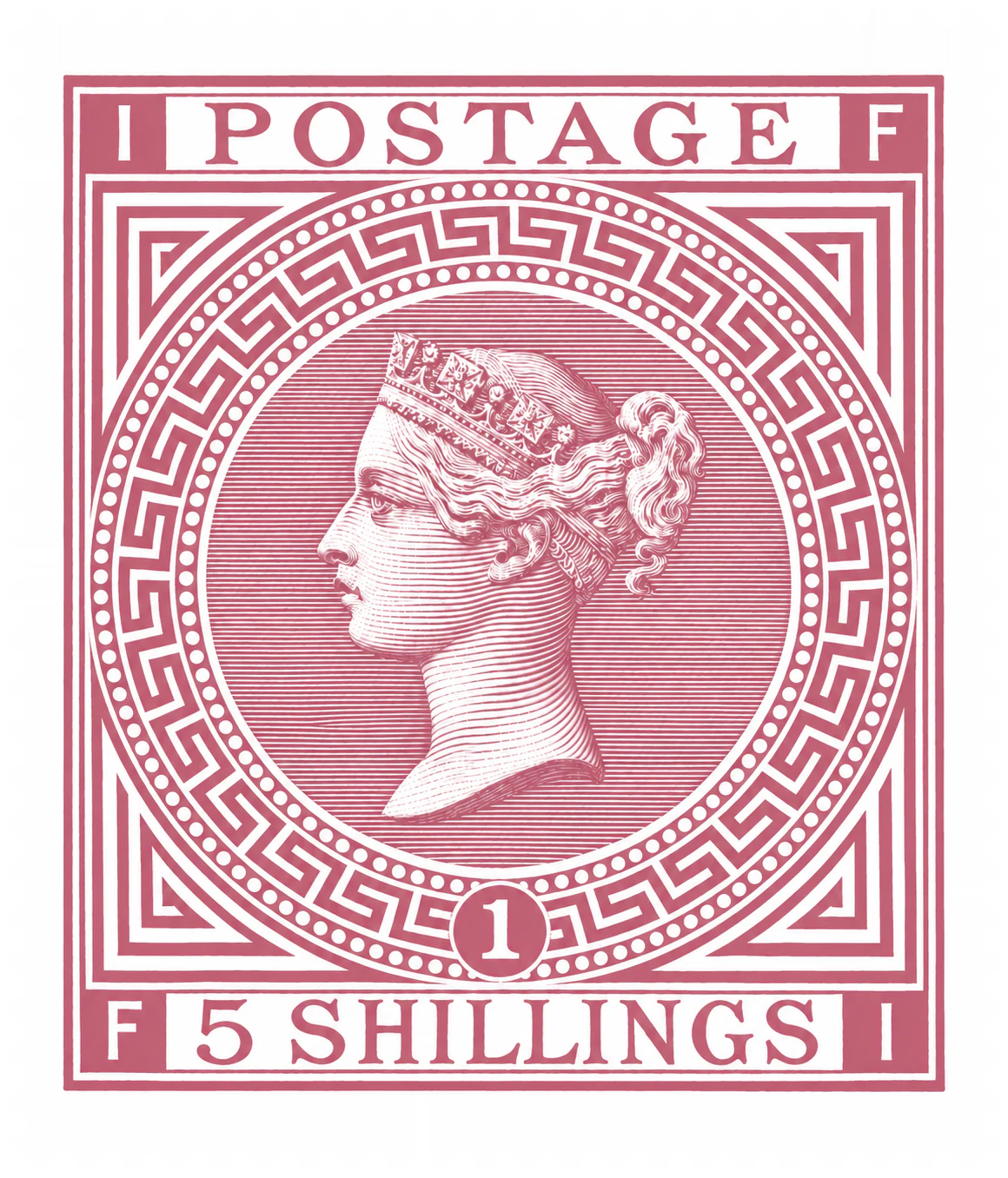
A Greek pattern around the Queen
The five-shilling rose has a distinctive circular frame surrounding Victoria's portrait.
Its main ornament is a continuous Greek-key pattern, made from repeated angular turns. A row of small pearl-like dots runs along each side of the patterned band. [1]
The arrangement reflects the Victorian taste for classical and geometric decoration.
Owen Jones, who contributed the design, had studied ornamental patterns from many cultures. His influential Grammar of Ornament explored the principles behind such designs. [2, 3]
The Greek-key border gives the stamp an architectural quality, enclosing the royal portrait within an elaborate but carefully ordered frame.
The numeral that replaced a word
During discussions in November 1866, the Postmaster-General and Inland Revenue disagreed about the new stamp's design.
One detail concerned the denomination. Inland Revenue agreed that the numeral 5 could replace the word FIVE, if the Postmaster-General preferred it. [1]
The finished stamp reads 5 SHILLINGS in the lower white panel, with POSTAGE above.
The decision gave the denomination a prominent figure rather than spelling it entirely in words.
A small detail of the issued design preserves evidence of a discussion between government officials and the engravers responsible for carrying out their instructions.
Why the five-shilling was larger
The five-shilling introduced a larger rectangular format than the ordinary Victorian definitives.
Its extra space allowed Owen Jones to use a broad ornamental circle, stronger inscriptions and more elaborate decoration around Victoria's portrait. [4]
The corner letters remained large and clear, while the plate number appeared in a small disc at the foot of the circular border.
The larger format established an approach subsequently used for the ten-shilling and one-pound values.
The change was not merely one of size. It gave the designer more room to balance ornament, lettering and portraiture.
The Maltese Cross hidden in the paper
The five-shilling was printed on paper carrying a large cross-shaped watermark, commonly called the Maltese Cross.
The historic description cross pattée is more precise. The design was formed within the paper during manufacture, rather than printed in ink.
In January 1867, Turner & Co. received an order to make ten reams of the special paper. Each complete printing sheet carried eighty watermarks, one for every stamp. [1]
The watermark helped make the paper difficult to imitate.
A second design therefore accompanied Victoria's printed portrait, almost invisible unless the paper was examined against transmitted light.
The lettering that revealed each stamp's position
The five-shilling had white letters in all four corners.
The lower pair identified the stamp's position within the sheet. Those at the top repeated the same letters in reverse order.
The arrangement was intended to expose attempts to construct fraudulent stamps from pieces of used examples. [1]
Each letter sat inside a solid rose-coloured panel.
A small white plate number also appeared in the lower part of the circular ornament, allowing the printing plate to be identified from an individual stamp.
These markings combined practical security information with the decorative appearance of the design.
The inscriptions around the printing sheet
The eighty stamps on a complete printing plate were divided into four panes of twenty.
Above and below each pane, De La Rue printed POSTAGE FIVE SHILLINGS. Along the sides appeared an inscription identifying the twenty stamps and their total value of five pounds. [1]
The side inscriptions were not entirely consistent. Wright and Creeke, who examined the original sheets, noted their irregular punctuation.
When plate 2 was prepared, the orientation of the inscriptions between the panes was also altered.
A single stamp reveals the artist's design; a complete sheet reveals the additional lettering and decisions made by the people preparing the printing plate.
The diamond diadem made for a king
The ornament in Victoria's hair was commissioned for George IV's coronation in 1821. [5]
It contains 1,333 diamonds, with crosses and the national emblems of the rose, thistle and shamrock.
Victoria later wore the diadem in portraits, and it became a familiar feature of British postage stamps.
On the five-shilling rose, its jewels are reduced to tiny printed lines. A magnificent royal ornament had become part of an everyday object worth five shillings.

Image information
Click image to magnify
Digitally created illustration of the diamond diadem, with crosses, floral emblems and rows of pearls, resting on a blue cushion.
- Credit
- Stunning Stamps.
- Notes
- Digitally created.
The inherited royal portrait
The five-shilling retained Joubert’s earlier surface-printed portrait, based on Henry Corbould’s drawing after William Wyon’s City of London medal. These credits identify the inherited likeness within Owen Jones’s larger stamp design. [6, 7, 3]
Sources
- Hastings E. Wright and A. B. Creeke: A History of the Adhesive Stamps of the British Isles (1899), pp. 137–140
- Victoria and Albert Museum: Owen Jones and The Grammar of Ornament
- Robert B. Galland — The First Low Value Surface Printed Postage Stamps of Great Britain 1855–1880 (RPSL, 2014), p. 21
- Royal Mail Philatelic Bulletin: Collecting the Victorians — The First High Values (1980)
- Royal Collection Trust: George IV's Diamond Diadem
- Robert B. Galland, The First Low Value Surface Printed Postage Stamps of Great Britain, 1855–1880 (RPSL, 2014), pp. 3–4
- Douglas N. Muir, William Wyon & the Penny Black, Royal Mint Museum