
The design of the 10s greenish-grey
Queen Victoria · Great Britain · Thomas De La Rue & Co. · 1878
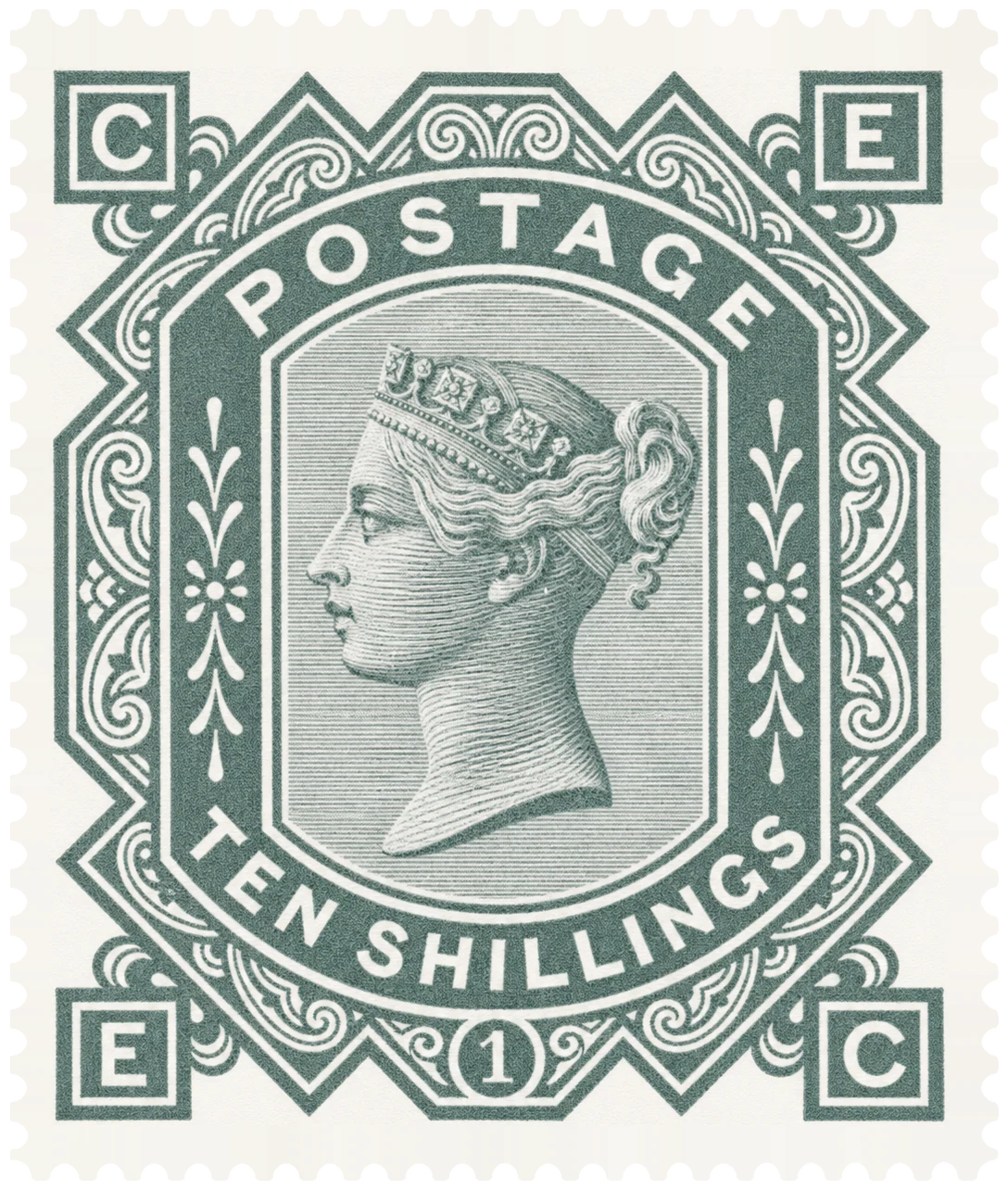
A frame without a straight outer border
The ten-shilling greenish-grey has an unusual frame, quite different from the circular arrangement of the five-shilling rose.
Victoria's portrait is enclosed by a coloured border with curved upper and lower sections and straight, ornamented sides.
The outer edge forms a series of angular projections, creating a zigzag silhouette rather than the usual continuous rectangular frame. [1]
Small decorative details fill the spaces between the main frame and the outer edges.
The resulting design has a distinctly architectural appearance, combining strong geometric shapes with fine ornamental work.
The proof before the letters appeared
The engravers did not complete the ten-shilling design in a single operation.
Surviving proofs dated between April and May 1878 show successive adjustments to the framework, ornament and background. Some were printed in black on glazed white card. [2]
The proofs have empty corner-letter panels and an unfinished plate-number circle.
A proof dated 6 May was marked as the completed design before the die was hardened.
The contrast with the issued stamp reveals the sequence of work. First the portrait and ornamental frame were perfected; the individual corner letters and plate number were dealt with later.
De La Rue prepared and printed the ten-shilling, retaining the earlier royal portrait within its new ornamental frame. [1, 3]
The lettering that follows the frame
The inscriptions are incorporated directly into the coloured border surrounding Victoria.
POSTAGE follows the upper curve, while TEN SHILLINGS occupies a matching curved section below.
Both are printed in white sans-serif capitals against the greenish-grey background. [1]
The curved inscriptions are balanced by straight ornamental panels at the sides.
The design differs from the five-shilling, where the denomination appears in a separate white tablet beneath the circular portrait.
The two stamps share their large format and youthful royal image, but their lettering was arranged in quite different ways.
Four corner letters and a single plate number
The ten-shilling has large white letters in all four corners.
The lower letters identify each stamp's position in the printing sheet. Those above repeat the same pair in reverse order, helping expose attempts to assemble fraudulent stamps from pieces of used examples.
Below the main frame is a small white circle containing the plate number 1. [1]
Only one printing plate was made for this design, so every ordinary ten-shilling carries the same number.
The individual corner letters change from stamp to stamp, while the plate number remains constant.
A Maltese Cross beneath the portrait
The first ten-shilling was printed on paper with the Maltese Cross watermark, more precisely described as a cross pattée.
The watermark was formed within the paper during manufacture rather than printed in ink. It made the paper more difficult to imitate.
The paper had originally been developed for the five-shilling stamp introduced in 1867. [1]
In 1883, the ten-shilling changed to paper with a Large Anchor watermark.
The printing plate had to be dismantled and rearranged to match the new paper, but the appearance of the stamp itself remained unchanged.
Two copies can therefore look identical from the front while carrying different hidden designs.
The fine perforations of the high values
The first ten-shilling stamps were perforated differently from most ordinary Victorian definitives.
The larger format required a specially arranged perforating machine, producing approximately fifteen and a half intervals horizontally and fifteen vertically over two centimetres. [1]
When the paper changed to the Large Anchor watermark in 1883, the stamps were instead perforated fourteen.
The change accompanied the rearrangement of the printing plate.
Although the portrait and border remained familiar, the edges reveal another stage in the development of the machinery used to manufacture the stamp.
A portrait of a fifteen-year-old princess
Victoria's likeness originated before she became Queen. William Wyon, Chief Engraver at the Royal Mint, created a medal commemorating her visit to the City of London in November 1837. Its portrait drew on a sketch made in 1834, when Victoria was fifteen. The medal was issued in 1838. [4]
Henry Corbould prepared a drawing based on Wyon's portrait, which later supplied the model for Jean Ferdinand Joubert de la Ferté's surface-printed engraving.
The ten-shilling retained Joubert's interpretation.
The stamp brought together the work of artists whose contributions extended across more than forty years. [5, 6]
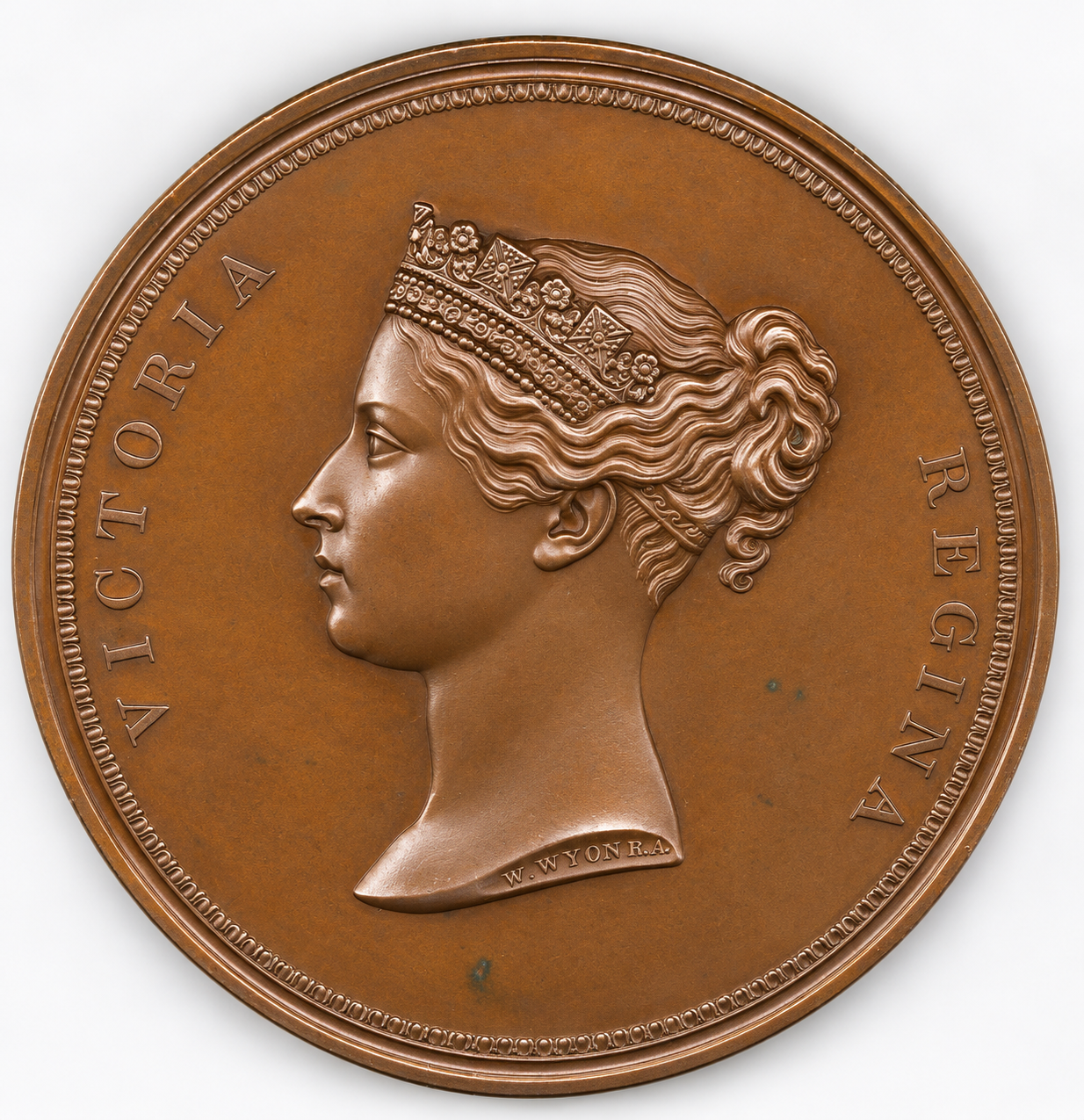
Image information
Click image to magnify
Bronze medal showing the young Victoria in left-facing profile, wearing the diamond diadem, with the inscription VICTORIA REGINA.
- Credit
- Heritage Auctions, via Wikimedia Commons. CC BY 3.0.
- Notes
- Brightness, contrast, sharpness and colour balance adjusted by Stunning Stamps.
The diamond diadem made for a king
The ornament in Victoria's hair was commissioned for George IV's coronation in 1821. [7]
It contains 1,333 diamonds, with crosses and the national emblems of the rose, thistle and shamrock.
Victoria later wore the diadem in portraits, and it became a familiar feature of British postage stamps.
On the ten-shilling greenish-grey, its jewels are reduced to tiny printed lines. A magnificent royal ornament had become part of an everyday object worth ten shillings.

Image information
Click image to magnify
Digitally created illustration of the diamond diadem, with crosses, floral emblems and rows of pearls, resting on a blue cushion.
- Credit
- Stunning Stamps.
- Notes
- Digitally created.
Sources
- Hastings E. Wright and A. B. Creeke: A History of the Adhesive Stamps of the British Isles (1899), pp. 141–143
- Corinphila: Great Britain 1840–1910, Auction 286 (2022), p. 82 — progressive die proofs
- Robert B. Galland, The First Low Value Surface Printed Postage Stamps of Great Britain, 1855–1880 (RPSL, 2014), pp. 3–4
- Douglas N. Muir, Royal Mint Museum: William Wyon & the Penny Black
- Heritage Auctions, William Wyon medal photograph, via Wikimedia Commons (enhanced for display)
- Wyon medal photograph: Creative Commons Attribution 3.0 licence
- Royal Collection Trust: George IV's Diamond Diadem
