
The design of the 5d dull purple and blue · Die I
Queen Victoria · Great Britain · Thomas De La Rue & Co. · 1887
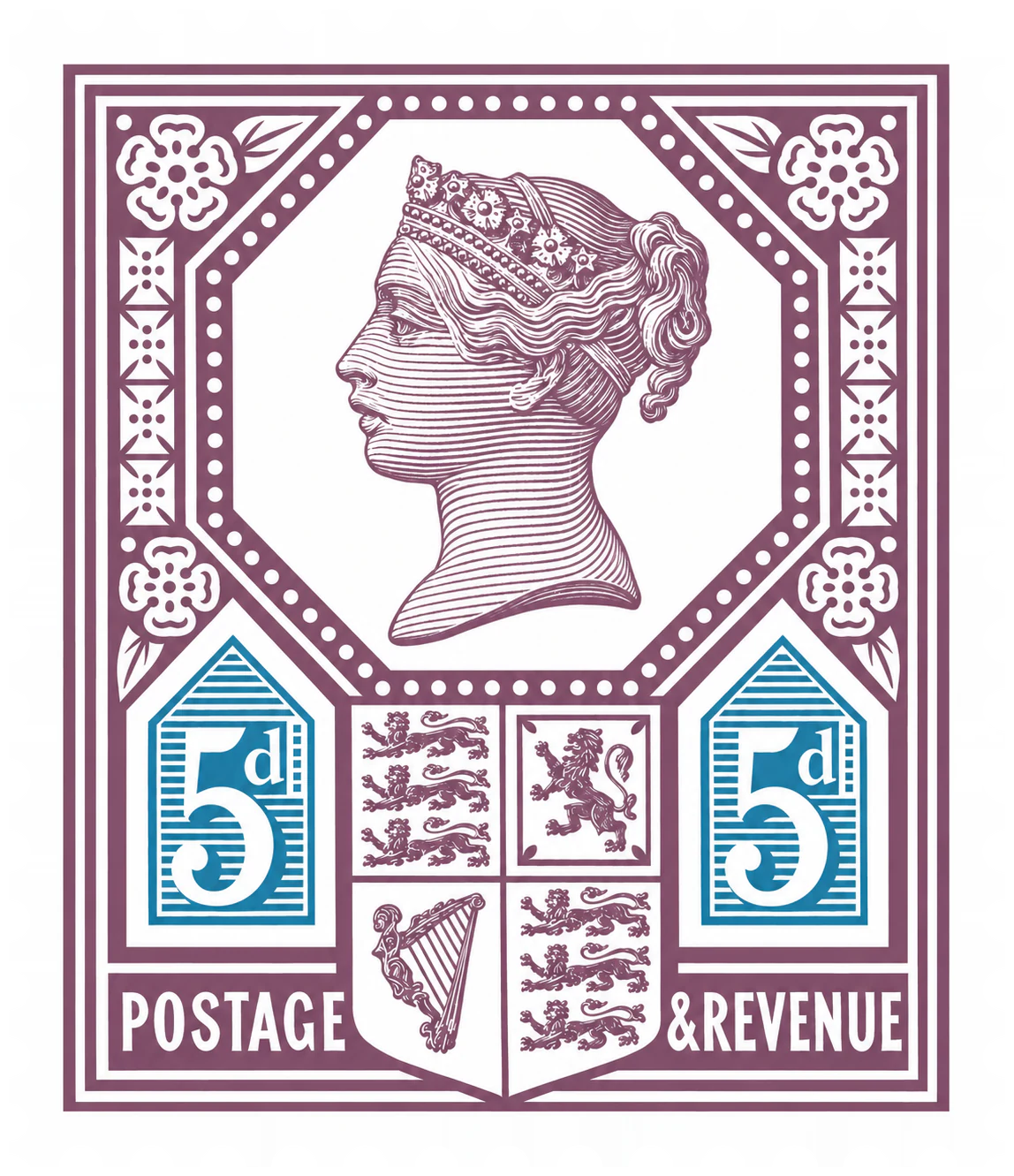
The little square dots after the d
The most reliable way to distinguish Die I is to look at the two blue denomination panels.
Each contains the value 5d. To the right of the small letter d is a tiny dot.
On Die I, these dots are square. On Die II, they resemble short, thin vertical lines. [1]
The difference is almost invisible without magnification.
Yet it identifies two separate engravings prepared before the stamp was issued.
A tiny detail of punctuation preserves a mystery about De La Rue's manufacturing decisions.
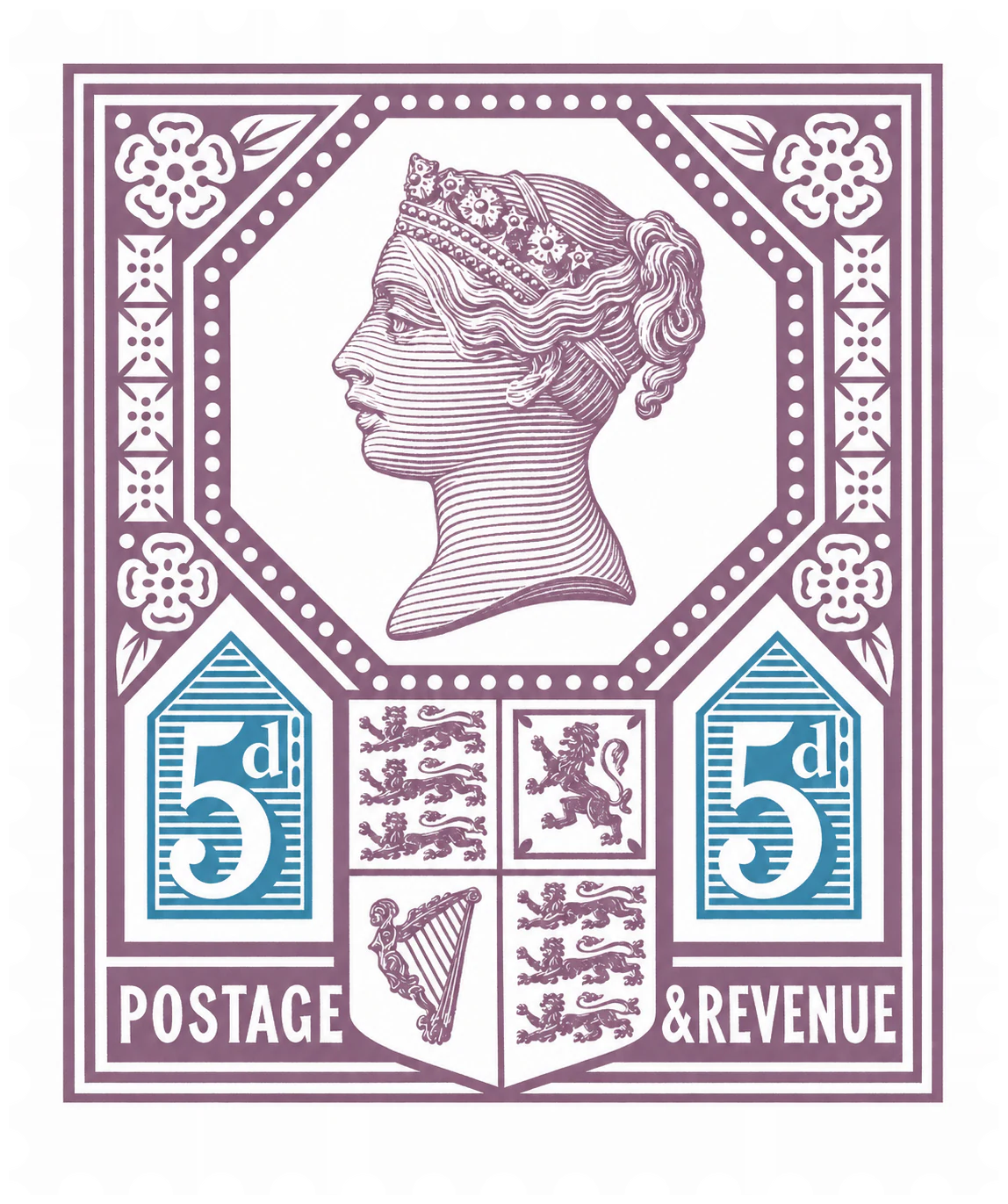
Magnify the small marks after the d in each blue value panel. The purple portrait frame is shared.
Click either stamp to magnify
Two colours made from two dies
Victoria's portrait and the main framework were printed in dull purple.
The value panels and selected decorative details were printed in blue.
Each colour required a separate engraving and printing plate. The head plate supplied the portrait, while the duty plate supplied the denomination. [2]
The two impressions had to meet accurately on the paper.
This arrangement gave De La Rue greater freedom to combine colour and ornament, but it also increased the precision required during printing.
The portrait that did not change
The distinction between Die I and Die II does not concern Victoria's head.
The same head engraving was used with both versions of the fivepenny duty die.
The Queen's portrait, her hair and the surrounding purple framework therefore remained unchanged. [1]
Only the engraving used for the blue portions differed.
This makes the fivepenny especially interesting: two stamps can appear virtually identical, yet have been produced using different tools for one colour.
The youthful head belongs to the earlier surface-printed portrait tradition established through Joubert’s engraving after Corbould’s drawing from Wyon’s medal. These inherited sources are distinct from De La Rue’s later Jubilee head and duty dies. The Die I designation concerns the duty engraving, not a new portrait by those earlier artists. [3, 4, 5, 1]
The blue panels beside the portrait
The fivepenny places a blue value tablet on either side of Victoria's portrait.
Each displays 5d, making the denomination immediately recognisable.
The surrounding purple design includes finely engraved ornament and lettering, with the royal portrait occupying the central space.
The blue panels interrupt the purple framework, providing a strong visual contrast.
Their position also made it possible to identify the two duty dies through the small differences in the lettering.
The paper's hidden crown
The fivepenny was printed on paper carrying the Imperial Crown watermark.
The crown was formed during manufacture by R. D. Turner & Co. of Roughway Mill in Kent, rather than printed in ink. [2]
Each printing sheet contained 240 stamps, arranged in two panes of 120.
For distribution, the fivepenny sheets could be divided into smaller panes of sixty.
The watermark was already present before either the purple or blue impression was added.
The two printing colours behaved differently
The dull purple was a fugitive security ink, intended to be damaged by attempts to remove cancellations.
The blue duty ink was more resistant to water. [2]
The difference meant that the two colours did not necessarily respond in the same way to moisture or chemicals.
A stamp exposed to washing might lose much of its purple appearance while retaining stronger blue details.
The colour scheme was therefore part of the security system, not simply an artistic choice.
The diamond diadem made for a king
The ornament in Victoria's hair was commissioned for George IV's coronation in 1821. [6]
It contains 1,333 diamonds, with crosses and the national emblems of the rose, thistle and shamrock.
Victoria later wore the diadem in portraits, and it became a familiar feature of British postage stamps.
On the fivepenny purple and blue, its jewels are reduced to tiny engraved marks. A magnificent royal ornament had become part of an everyday stamp worth fivepence.

Image information
Click image to magnify
Digitally created illustration of the diamond diadem, with crosses, floral emblems and rows of pearls, resting on a blue cushion.
- Credit
- Stunning Stamps.
- Notes
- Digitally created.
Sources
- Fred Gee: Two Dies for the 5d Value, British Philatelic Bulletin, July 1995
- The 1887 Jubilee Issue: Technical Information
- Robert B. Galland, The First Low Value Surface Printed Postage Stamps of Great Britain (RPSL, 2014), p. 3: earlier Joubert portrait engraving after Corbould
- Douglas N. Muir, William Wyon & the Penny Black, Royal Mint Museum
- Philip Waud and David Willmer, The Story of the QV Jubilees, GBPS display at RPSL (2019), development and laydown 2 frames 1–2
- Royal Collection Trust: George IV's Diamond Diadem