
The design of the 4d green and purple-brown
Queen Victoria · Great Britain · Thomas De La Rue & Co. · 1887
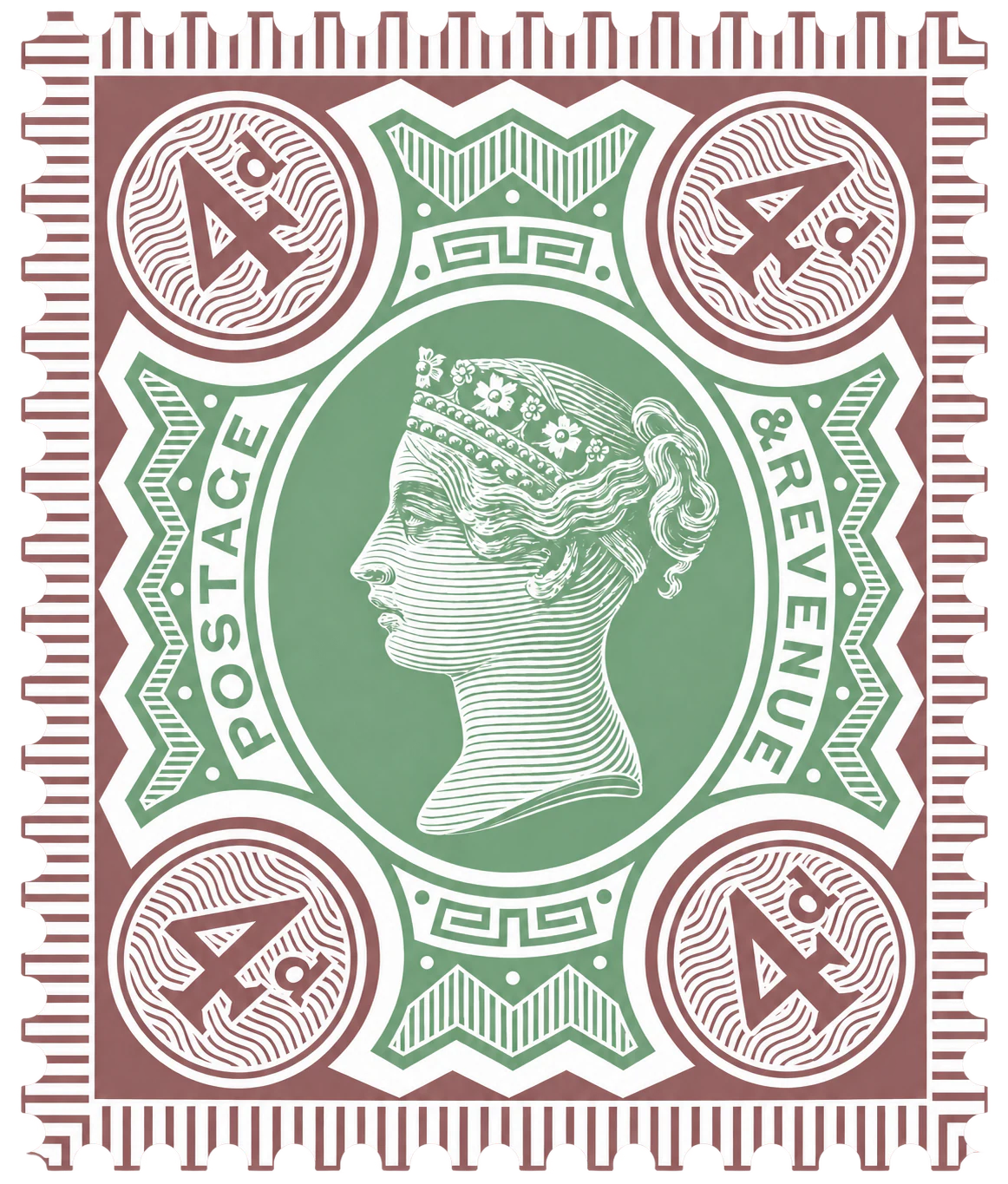
Two colours printed separately
The fourpenny combines green and purple-brown, produced from separate printing plates.
The portrait and main framework came from the head plate, while other coloured portions of the design came from the duty plate.
Both impressions had to align accurately. Even a small movement could leave one colour displaced relative to the other. [1]
The arrangement allowed De La Rue to produce a much more decorative stamp than the earlier single-colour issues.
Its finished appearance concealed the work involved in bringing the two plates together.
The frame surrounded by a coloured fringe
The fourpenny has an elaborate framework combining angular ornament with the Queen's portrait.
Its design includes decoration extending towards the outer edge, producing a fringe-like effect.
This was a new approach for the Jubilee issue and was later used for the ninepenny, tenpenny and four-and-a-halfpenny stamps. [2]
The arrangement gave the different denominations a related appearance without making their frames identical.
The fringe was also important in determining how the stamps were positioned and separated on the printing sheets.
Joubert engraved the earlier surface-printed Queen’s head after Corbould’s drawing from Wyon’s medal. This is the inherited portrait source, separate from De La Rue’s later Jubilee small-head dies, fringed frame and fourpenny duty engraving. No individual engraver of those later elements is established here. [3, 4, 5, 2]
The figures that sometimes appear white
The fourpenny's value figures are normally printed in their intended contrasting colour.
On some impressions, one or more figures 4 appears white.
The peculiarity is known as the White 4 variety. Examples exist with the effect in several corners or even all four. [6]
The difference is not an intentional redesign.
It is a printing irregularity that reveals how the figures were produced separately from other portions of the stamp.
The lines that protected the printing plates
De La Rue added narrow coloured rules around the printing panes.
These were known as Jubilee lines. Their purpose was to protect the edges of the printing plates from the inking rollers. [7]
The arrangements changed repeatedly during production.
Some corners were rounded, others square, and later versions had the corners cut away entirely.
These differences were not visible on ordinary individual stamps.
A marginal example can reveal how the printer's equipment evolved while the stamp design remained unchanged.
The little ladders between the panes
The fourpenny was printed in small panes of twenty stamps, separated by wide gutters.
The paper could curl in these unsupported spaces, causing problems when the two colours were printed.
De La Rue introduced small ladder-like supports across the gutters to help hold the paper flat. [7]
These marks were outside the individual stamp design.
They formed part of the practical arrangement of the printing sheet.
A complete pane or marginal block can therefore reveal details of the work needed to keep the two colours accurately aligned.
The paper prepared for small panes
The fourpenny was printed on machine-made paper carrying the Imperial Crown watermark.
R. D. Turner & Co. supplied special sheets with 320 watermarks, arranged to accommodate sixteen panes of twenty stamps. [1]
The stamps were subsequently divided into smaller sheets for perforation and distribution.
The crown was formed within the paper during manufacture rather than printed in ink.
The unusual sheet arrangement shows how the papermaker's work had to match the printer's equipment.
The diamond diadem made for a king
The ornament in Victoria's hair was commissioned for George IV's coronation in 1821. [8]
It contains 1,333 diamonds, with crosses and the national emblems of the rose, thistle and shamrock.
Victoria later wore the diadem in portraits, and it became a familiar feature of British postage stamps.
On the fourpenny green and purple-brown, its jewels are reduced to tiny printed marks. A magnificent royal ornament had become part of an everyday stamp worth fourpence.

Image information
Click image to magnify
Digitally created illustration of the diamond diadem, with crosses, floral emblems and rows of pearls, resting on a blue cushion.
- Credit
- Stunning Stamps.
- Notes
- Digitally created.
Sources
- The 1887 Jubilee Issue: Technical Information
- Philip Waud and David Willmer: The Story of the QV Jubilees (2019)
- Robert B. Galland, The First Low Value Surface Printed Postage Stamps of Great Britain (RPSL, 2014), p. 3: earlier Joubert portrait engraving after Corbould
- Douglas N. Muir, William Wyon & the Penny Black, Royal Mint Museum
- Philip Waud and David Willmer, The Story of the QV Jubilees, GBPS display at RPSL (2019), development, laydown 1 frames 9–11, laydown 2 frame 1 and chronology
- Andrew G. Lajer Philately: White 4 varieties
- Royal Philatelic Society London: The 1887 Jubilee Issue and Its Derivatives (1994)
- Royal Collection Trust: George IV's Diamond Diadem