
The design of the ½d vermilion
Queen Victoria · Great Britain · Thomas De La Rue & Co. · 1887
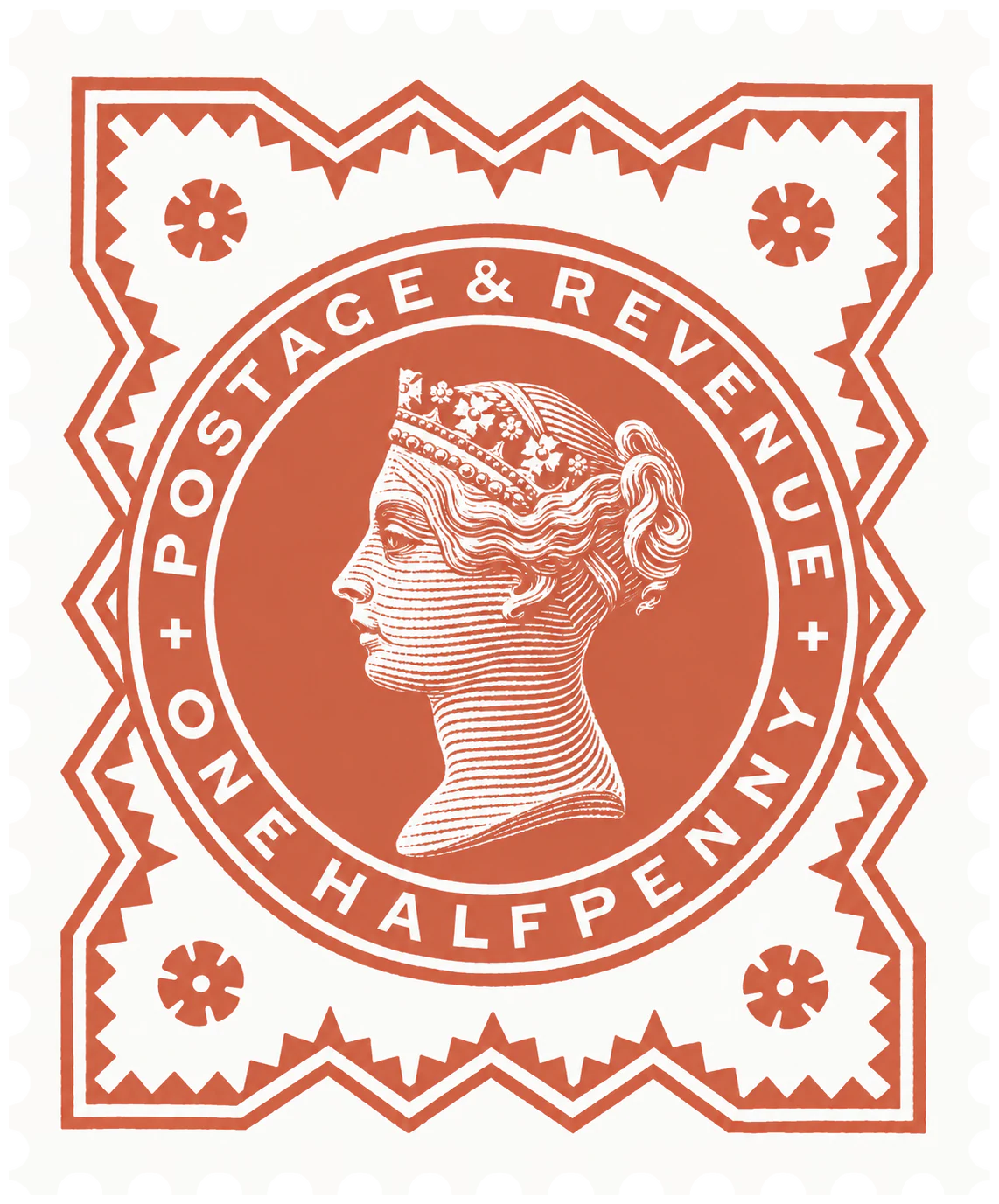
A new circular frame for the Queen
The halfpenny vermilion places Victoria's portrait within a circular frame.
POSTAGE & REVENUE follows the upper curve, while ONE HALFPENNY occupies the lower section.
The surrounding design combines ornamental scrollwork with a strongly defined rectangular outline.
It is more elaborate than the angular frame of the slate-blue halfpenny it replaced.
The new arrangement was part of De La Rue's effort to give British stamps more attractive and distinctive designs following the Stamp Committee's recommendations. [1]
The youthful likeness belongs to the earlier surface-printed portrait tradition: Joubert’s engraving followed Corbould’s drawing after Wyon’s medal. These earlier artistic sources are distinct from De La Rue’s small-head dies and new Jubilee frame; no individual engraver of this later design is established here. [2, 3, 4, 1]
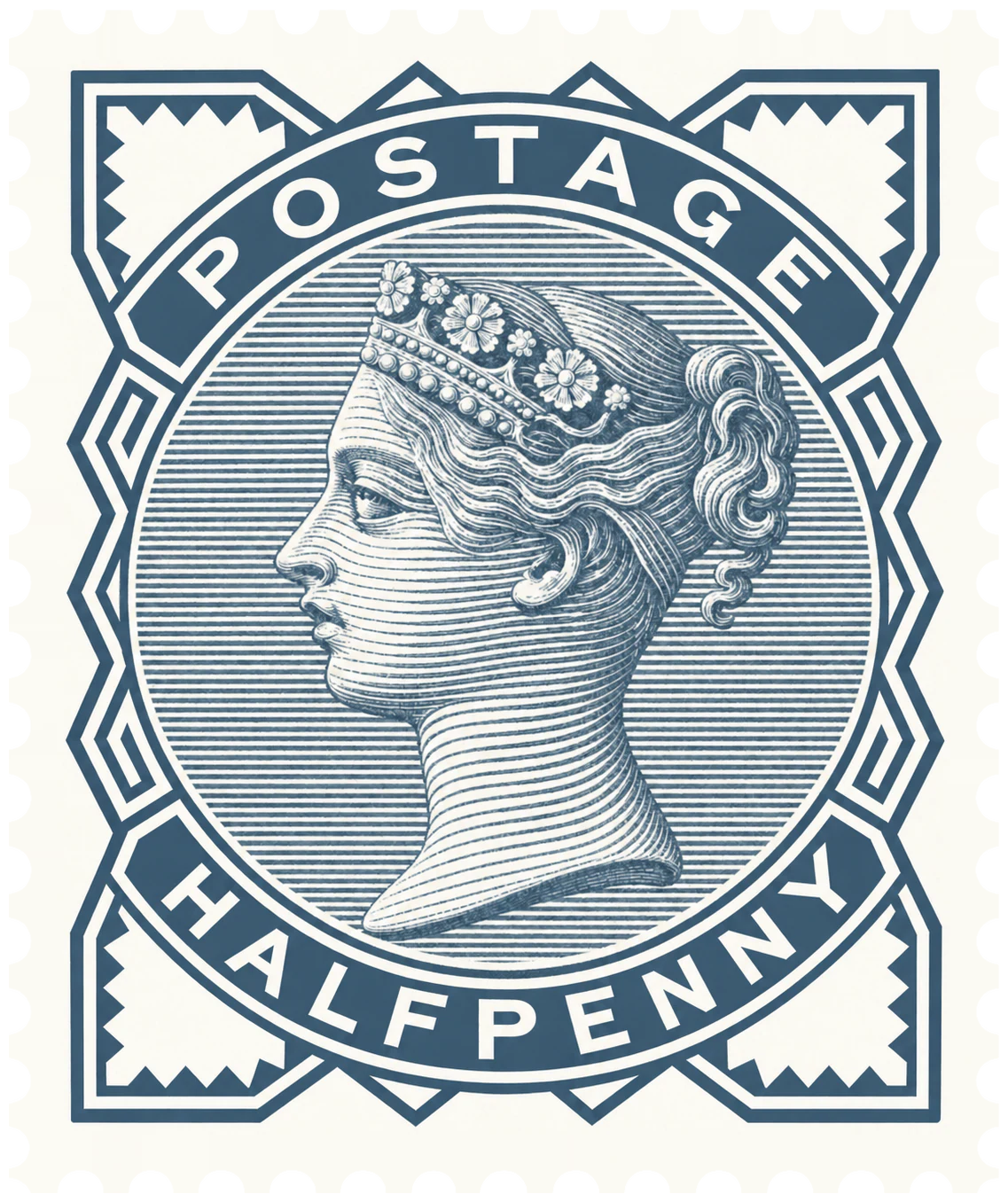
The successive halfpenny designs illustrate the move to the Jubilee series.
Click either stamp to magnify
The stamp without corner letters
Unlike many earlier Victorian stamps, the halfpenny has no identifying letters in its corners.
Instead, the corners contain ornamental patterns, completing the decorative frame.
The omission simplified the preparation of printing plates. The same design could be repeated without changing individual letters for every position. [5]
The printing plates were identified through registration records and marginal markings rather than by numbers on individual stamps.
The arrangement gave De La Rue greater freedom to use ornament in the corners.
The proof before the die was hardened
A surviving proof dated 5 February 1886 shows the halfpenny design in black.
It was printed on glazed white card and marked BEFORE HARDENING. [6]
The impression records the completed engraving before the steel die was prepared for repeated use.
The black proof also makes the fine lines of Victoria's hair and the surrounding ornament easier to study than on the issued vermilion stamp.
It reveals the engraver's work before printing colour became part of the design.
The lines that guarded the printing plate
Later printing sheets have narrow coloured lines surrounding the panes of stamps.
These are Jubilee lines, introduced to protect the outer edges of the printing plates from damage during repeated printing. [7]
They were printed from raised rules placed outside the individual stamp impressions.
The lines were absent from the first plates but became a familiar feature of later production.
They do not appear on an ordinary single stamp. A marginal example can reveal this otherwise hidden improvement in manufacturing.
The letters beneath the printing sheet
From 1887, De La Rue added small control letters beneath the halfpenny printing sheets.
The sequence began with A and continued through Q during the life of the vermilion stamp. [8]
These letters were not part of Victoria's portrait or the decorative frame.
They helped the printers keep track of the paper supplied for production.
A small letter below an ordinary stamp can therefore provide evidence of how De La Rue monitored a manufacturing operation involving billions of impressions.
The crown concealed within the paper
The halfpenny was printed on machine-made paper carrying the Imperial Crown watermark.
The paper came from R. D. Turner & Co. of Roughway Mill in Kent. The crowns were formed during manufacture rather than printed in ink. [7]
The watermark helped make the stamps more difficult to imitate.
Each printed sheet was arranged in two panes of 120 stamps, separated by an unprinted gutter.
The royal portrait was therefore accompanied by another emblem, hidden within the paper itself.
The diamond diadem made for a king
The ornament in Victoria's hair was commissioned for George IV's coronation in 1821. [9]
It contains 1,333 diamonds, with crosses and the national emblems of the rose, thistle and shamrock.
Victoria later wore the diadem in portraits, and it became a familiar feature of British postage stamps.
On the halfpenny vermilion, its jewels are reduced to tiny printed marks. A magnificent royal ornament had become part of an everyday stamp worth half a penny.

Image information
Click image to magnify
Digitally created illustration of the diamond diadem, with crosses, floral emblems and rows of pearls, resting on a blue cushion.
- Credit
- Stunning Stamps.
- Notes
- Digitally created.
Sources
- Philip Waud and David Willmer: The Story of the QV Jubilees (2019)
- Robert B. Galland, The First Low Value Surface Printed Postage Stamps of Great Britain (RPSL, 2014), p. 3: earlier Joubert portrait engraving after Corbould
- Douglas N. Muir, William Wyon & the Penny Black, Royal Mint Museum
- Philip Waud and David Willmer, The Story of the QV Jubilees, GBPS display at RPSL (2019), development and frames 4–6
- Allan Oliver: Life Span of the Printing Plates for Queen Victoria Stamps (2015)
- Spink: Halfpenny die proof, 5 February 1886
- The 1887 Jubilee Issue: Technical Information
- Royal Philatelic Society London: The Story of the QV Jubilees, frame 4
- Royal Collection Trust: George IV's Diamond Diadem