
The design of the 9d dull purple and blue
Queen Victoria · Great Britain · Thomas De La Rue & Co. · 1887
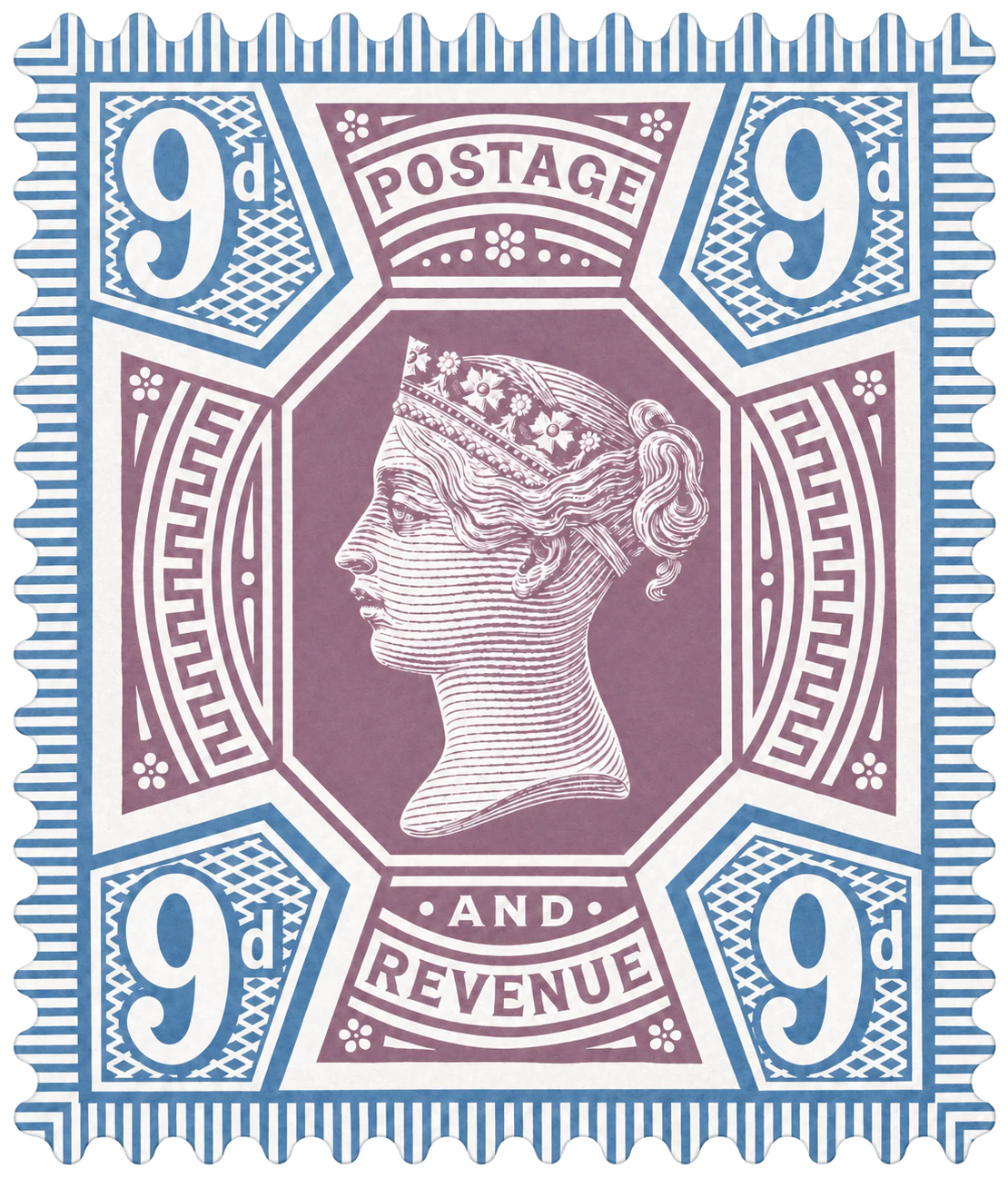
The curl that changed between two portraits
The ninepenny's royal portrait was prepared in two versions.
The first shows a relatively small pendant curl at the back of Victoria's head. The second has a larger curl. [1]
The alteration is easier to examine on surviving die proofs than on the finished stamps.
Both portraits retain the familiar youthful Victoria and her diamond diadem.
The difference reveals how the engravers could reconsider a very small feature of an established image without changing its overall character.
The youthful likeness inherits the earlier surface-printed portrait through Joubert’s engraving after Corbould’s drawing from Wyon’s medal. Those earlier artistic sources are distinct from De La Rue’s Jubilee head dies, including the two pendant-curl versions, and the separate duty engraving. No individual engraver of the later dies is established here. [2, 3, 4, 1]
Purple and blue from separate plates
The ninepenny was printed in two colours.
Dull purple supplied Victoria's portrait and the main framework, while blue provided contrasting details of the denomination and ornament.
Each colour came from a separate printing plate. The head plate and duty plate had to be brought together accurately. [5]
The two colours were chosen to give the stamp a more distinctive appearance than the earlier Lilac and Green issue.
The finished design appears to be one image, but it is the result of two carefully aligned impressions.
Ninepence in four corners
The stamp gives its denomination prominence in figures.
The value 9d appears in each of the four corner panels. [6]
POSTAGE appears above Victoria's portrait, with AND REVENUE below it. [7]
The repeated value makes the denomination recognisable without relying on the colour alone.
The arrangement was part of the Jubilee designers' attempt to make the different values easier to distinguish.
The design that existed before the engraving
A surviving hand-painted essay from 1884 shows a possible ninepenny in lilac and orange.
Its square format and ornamental arrangement are different from those of the issued stamp. The artist used Chinese white to pick out details against the coloured background. [8]
The essay was not adopted.
It nevertheless reveals how the design developed before engraving began.
The printer could compare hand-painted alternatives long before committing to the expensive manufacture of steel dies and printing plates.
The protective lines in two colours
Some ninepenny printing sheets have narrow coloured rules around their panes.
These are Jubilee lines, added to protect the edges of the printing plates from damage during repeated printing.
The head and duty plates required separate arrangements. In August 1887, Warren William De La Rue prepared instructions specifying how the marginal rules should be adjusted. [1]
The lines were outside the individual stamps.
A marginal block can reveal the printer's efforts to maintain accurate two-colour production while protecting expensive equipment.
A sheet assembled from small panes
The ninepenny was printed in panes of twenty stamps, arranged in four rows of five.
Several panes were assembled into larger sheets, allowing the head and duty plates to be used together. [9]
The wide gutters provided space for dividing the sheets and arranging protective rules.
They also created difficulties because the paper needed support as it passed through the printing machinery.
The arrangement of the full sheet was therefore an important part of the design's manufacture.
The crown beneath the two colours
The ninepenny was printed on paper carrying the Imperial Crown watermark.
The crown was formed within the paper during manufacture rather than printed in ink.
It helped make the finished stamp more difficult to imitate.
The paper already contained this hidden royal emblem before receiving the purple and blue impressions. [10]
The stamp combined the work of papermaker, engraver and printer in one small object.
The diamond diadem made for a king
The ornament in Victoria's hair was commissioned for George IV's coronation in 1821. [11]
It contains 1,333 diamonds, with crosses and the national emblems of the rose, thistle and shamrock.
Victoria later wore the diadem in portraits, and it became a familiar feature of British postage stamps.
On the ninepenny purple and blue, its jewels are reduced to tiny engraved marks. A magnificent royal ornament had become part of an everyday stamp worth ninepence.
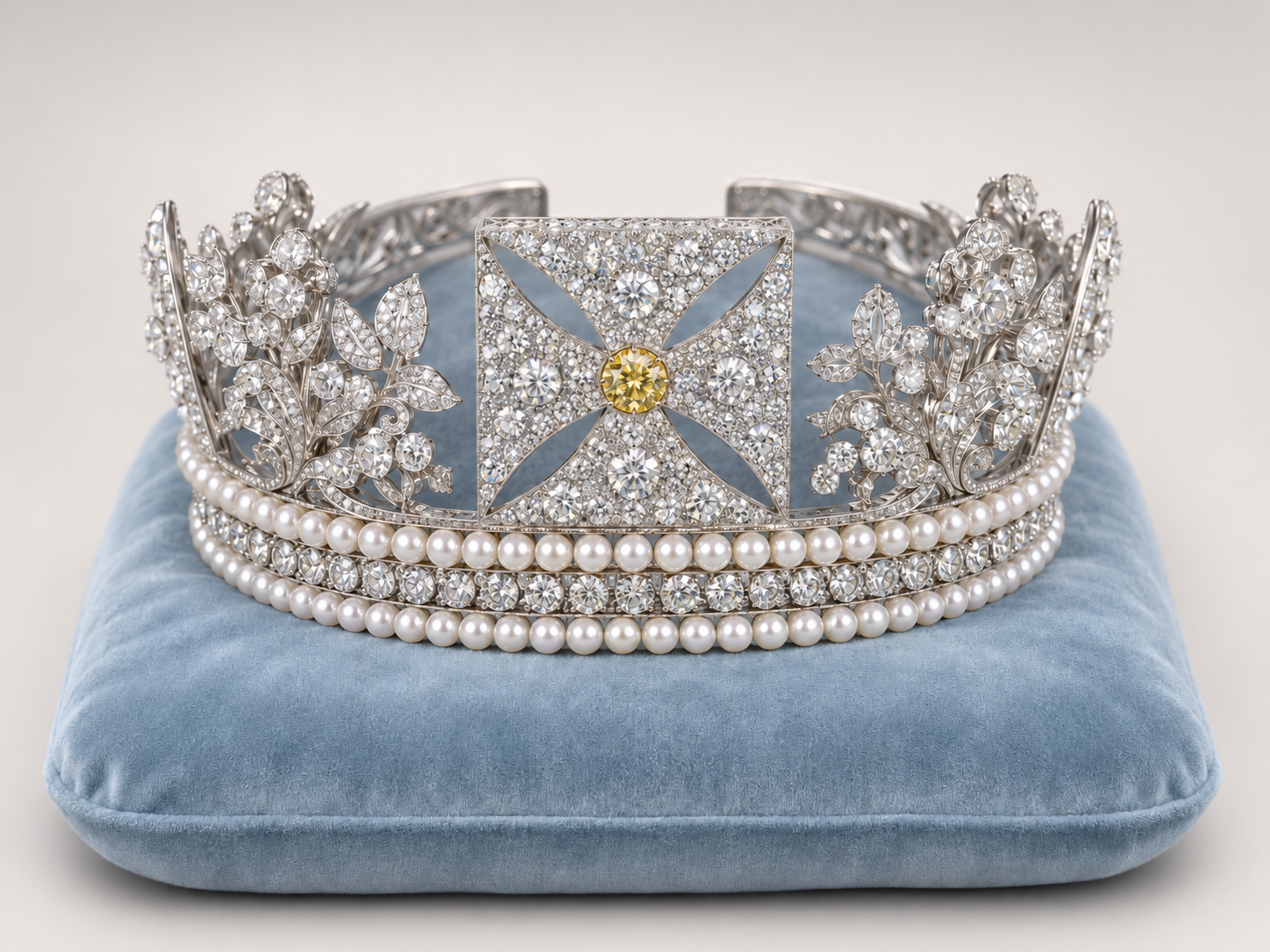
Image information
Click image to magnify
Digitally created illustration of the diamond diadem, with crosses, floral emblems and rows of pearls, resting on a blue cushion.
- Credit
- Stunning Stamps.
- Notes
- Digitally created.
Sources
- Stanley Gibbons: The Aureum Collection — ninepenny die proofs and marginal-rule instructions
- Robert B. Galland, The First Low Value Surface Printed Postage Stamps of Great Britain (RPSL, 2014), p. 3: earlier Joubert portrait engraving after Corbould
- Douglas N. Muir, William Wyon & the Penny Black, Royal Mint Museum
- Philip Waud and David Willmer, The Story of the QV Jubilees, GBPS display at RPSL (2019), development, laydown 2 frames 2–3 and chronology
- The 1887 Jubilee Issue: Background — development of bicoloured printing
- RPSL/GBPS: The Story of the QV Jubilees (2020), p. 7 — ninepenny design
- RPSL/GBPS: The Story of the QV Jubilees (2020), p. 7 — ninepenny design
- Stanley Gibbons: The Royal Palm Collection of Great Britain (2022), p. 36, lot 151 — 1884 hand-painted ninepenny essay
- Great Britain Philatelic Society: Postal Museum registration sheets — ninepenny
- The 1887 Jubilee Issue: Technical Information
- Royal Collection Trust: George IV's Diamond Diadem