
The design of the 1s dull green
Queen Victoria · Great Britain · Thomas De La Rue & Co. · 1887
A new frame for the familiar Queen
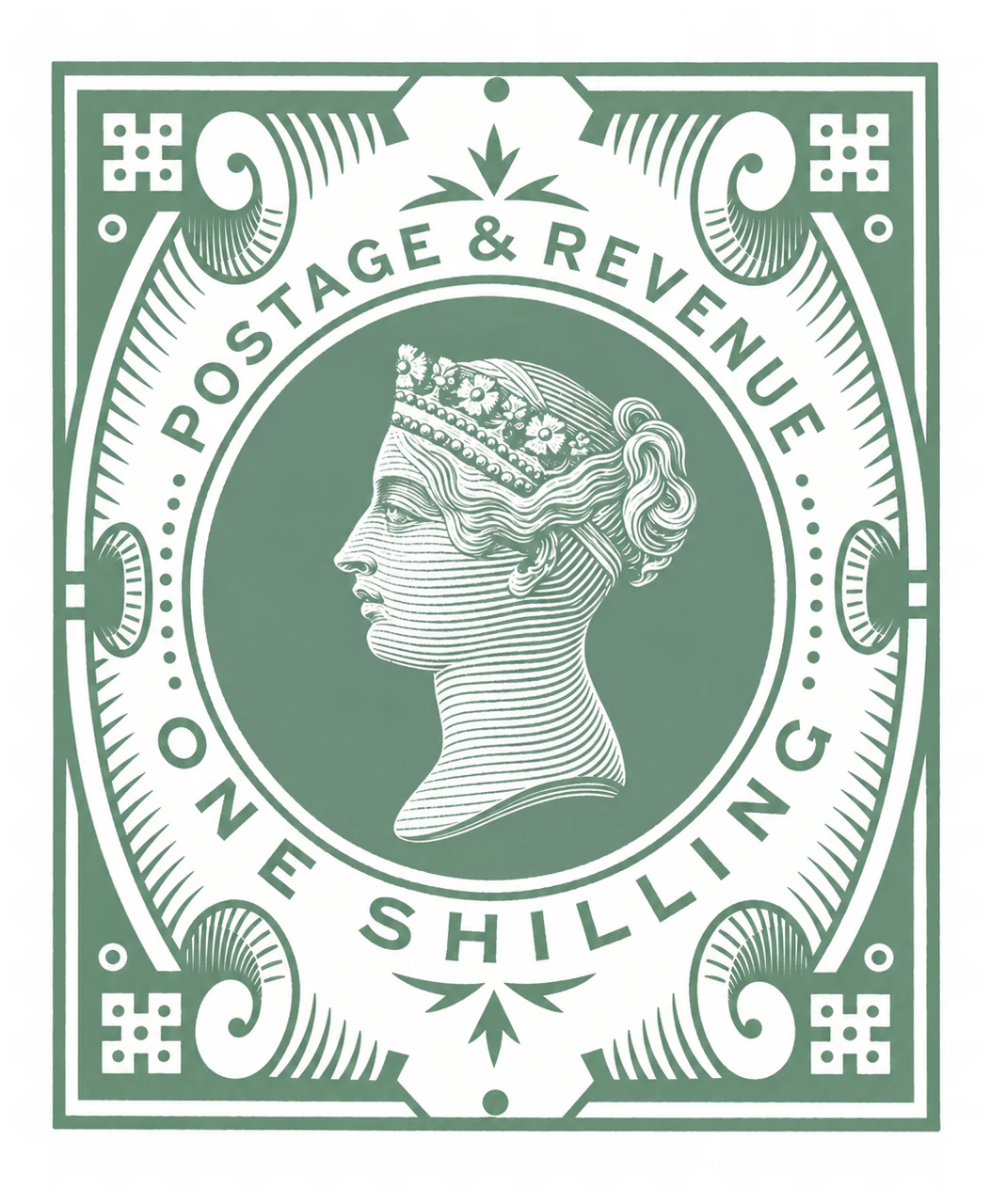
The one-shilling dull green introduced a different arrangement from the geometric design of 1884.
Victoria's portrait occupies a large central oval, surrounded by an ornamental inscription band.
POSTAGE & REVENUE follows the upper curve, while ONE SHILLING appears below. [1]
The combination of curved lettering and bold scrollwork gives the design a more balanced appearance than its predecessor.
The new arrangement was developed following the Stamp Committee's criticism of the earlier Lilac and Green stamps.
The portrait inherits the earlier surface-printed likeness through Joubert’s engraving, Corbould’s drawing and Wyon’s medal. Their contributions belong to that earlier model, separate from De La Rue’s later Jubilee die and frame. G. R. Smith’s proposed designs are evidence of development, rather than a confirmed personal credit for the issued engraving. [2, 3, 4]
The seven designs that might have been chosen
G. R. Smith prepared several hand-painted proposals for the one-shilling.
Seven different designs are recorded, including arrangements with the value beneath Victoria's portrait and others with lettering beside her. [5]
The drawings used green and other colours, with details highlighted in Chinese white.
The surviving essays show how the designers experimented with the proportions of portrait, frame and denomination.
The issued stamp represents one solution among several carefully considered alternatives.
Why the shilling used only green
Many Jubilee values were printed in two colours or used specially coloured paper.
The one-shilling retained a single ink on white paper.
The dull green was deliberately fugitive, intended to react to water and chemical solvents used to remove cancellations. [5]
This allowed the stamp to meet the government's security requirements without the complication of separate printing operations.
The green therefore served a practical purpose as well as giving the stamp its familiar appearance.
The engraving before it entered production
A surviving die proof dated 24 March 1886 shows the shilling design printed in black.
The impression was made on glazed white card and marked BEFORE HARDENING. [6]
Without the green printing ink, the fine engraved lines around Victoria's portrait are easier to examine.
The proof records the stage before the steel die was hardened and used to prepare printing plates.
It shows the engraver's work before the design became part of a large manufacturing operation.
The little notes beside the engraving
Several shilling proofs survive mounted on pieces from De La Rue's striking books.
One striking-book proof records 240 leads struck on 29 January and another 240 on 7 February. A separate proof records 240 leads on 2 June for plate 8. [7, 8]
These handwritten notes document the preparation of printing equipment.
They were not part of the stamp design.
Yet they reveal how the portrait moved from a single engraved die to lead moulds used to prepare the printing plates. [9]
The protective rules around the printing sheet
The earliest shilling printing sheets had plain margins.
Protective rules, known as Jubilee lines, appeared on the dull-green shilling's final printing in May 1899. [10]
The lines helped prevent damage to the edges of printing plates caused by repeated contact with the inking rollers. [11]
They were not intended to appear on the individual stamps.
A marginal example can therefore reveal an improvement made to the printing equipment while the actual design remained unchanged.
The many colours of the experimental shilling
Before changing the shilling to green and carmine in 1900, De La Rue experimented with other colours.
Surviving trials show the existing design printed in pale blue, emerald green, orange-brown and slate. [7]
The portrait and ornamental frame were retained.
Only the printing ink changed.
Placed beside the issued dull green, these alternatives reveal how much the appearance of the design could change without further engraving.
They also show the work undertaken before the government selected a two-colour replacement.
The crown hidden beneath the green
The shilling was printed on paper carrying the Imperial Crown watermark.
The crown was formed within the paper during manufacture, rather than printed in ink.
It helped make the stamp more difficult to imitate. [11]
The watermark remained unchanged through the stamp's working life.
Victoria's printed portrait was therefore accompanied by another royal emblem, normally invisible without examining the paper against transmitted light.
The diamond diadem made for a king
The ornament in Victoria's hair was commissioned for George IV's coronation in 1821. [12]
It contains 1,333 diamonds, with crosses and the national emblems of the rose, thistle and shamrock.
Victoria later wore the diadem in portraits, and it became a familiar feature of British postage stamps.
On the one-shilling dull green, its jewels are reduced to tiny printed marks. A magnificent royal ornament had become part of an everyday stamp worth one shilling.

Image information
Click image to magnify
Digitally created illustration of the diamond diadem, with crosses, floral emblems and rows of pearls, resting on a blue cushion.
- Credit
- Stunning Stamps.
- Notes
- Digitally created.
Sources
- Samwells Postal History: photographed SG211 dull-green shilling
- Robert B. Galland, The First Low Value Surface Printed Postage Stamps of Great Britain (RPSL, 2014), p. 3: earlier Joubert portrait engraving after Corbould
- Douglas N. Muir, William Wyon & the Penny Black, Royal Mint Museum
- Philip Waud and David Willmer, The Story of the QV Jubilees, GBPS display at RPSL (2019), development, laydown 2 frames 2–3 and chronology
- The Shilling's Tale: Jubilee issue — hand-painted essays and design development
- Tony Lester Philatelic Auctions: Shilling die proof, 24 March 1886
- Stanley Gibbons: The Aureum Collection — shilling proofs and 1900 colour trials
- Stanley Gibbons: The Aureum Collection (2016), striking-book records, pp. 57, 59, 64–65
- Stanley Gibbons: The Aureum Collection (2016), striking-book records, pp. 57, 59, 64–65
- Stanley Gibbons: The Aureum Collection (2016), striking-book records, pp. 57, 59, 64–65
- The 1887 Jubilee Issue: Technical Information
- Royal Collection Trust: George IV's Diamond Diadem