
The design of the 1½d dull purple and pale green
Queen Victoria · Great Britain · Thomas De La Rue & Co. · 1887
Two colours from two printing plates
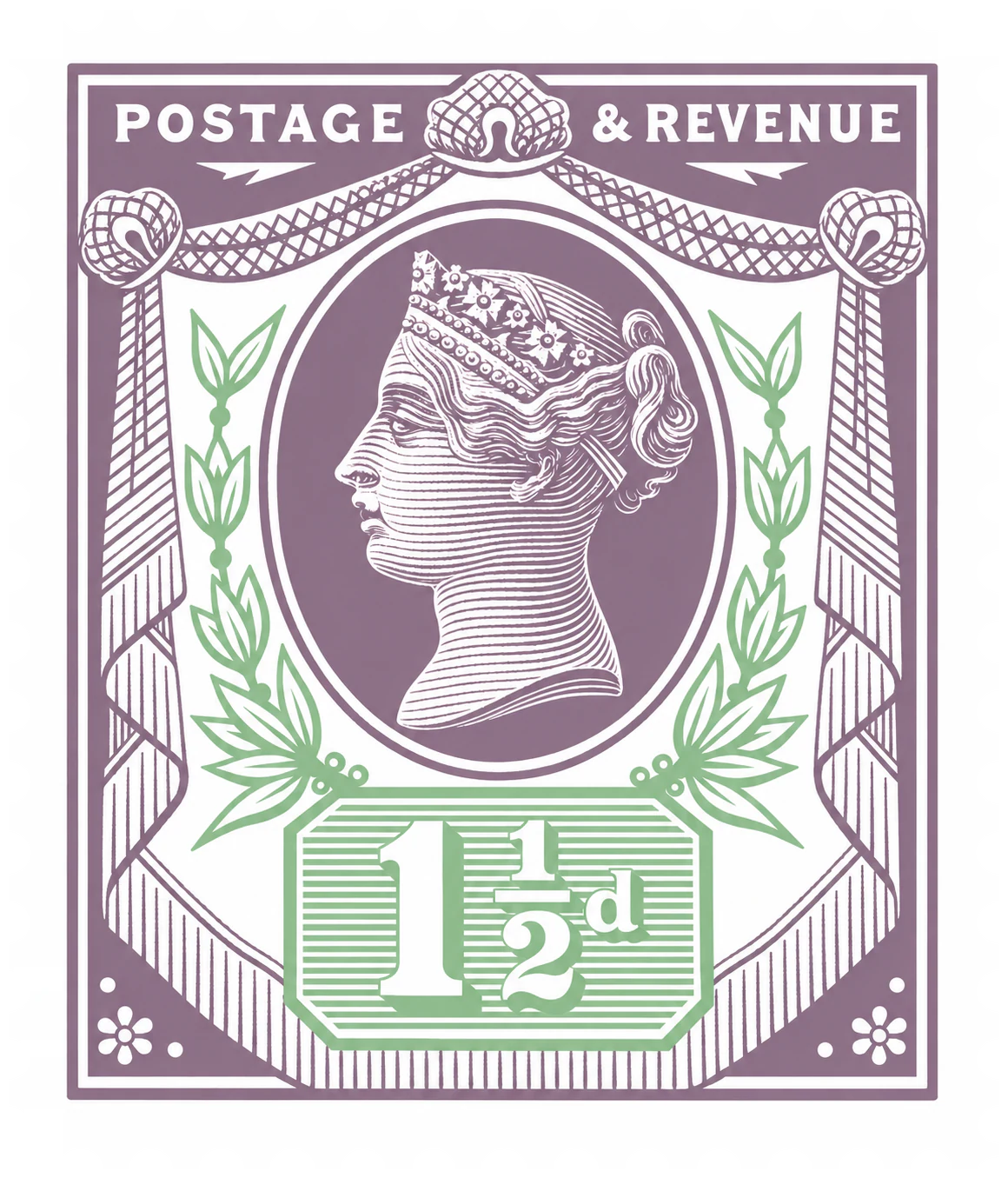
The three-halfpenny combines dull purple and pale green.
Victoria's portrait and much of the surrounding design are purple, while the denomination and decorative foliage appear in green.
The colours were produced using separate printing plates. The purple head plate and green duty plate had to be brought together accurately. [1]
The method allowed De La Rue to create a design more distinctive than the largely monochrome Lilac and Green issue of 1884.
The finished stamp appears to be one image, but it is actually the result of two printing operations.
The green leaves around Victoria
The foliage is one of the most attractive features of the three-halfpenny.
Pale green leaves and ornamental details soften the purple frame surrounding Victoria's portrait.
Their colour also makes them stand out from the darker lines of the royal head.
The leaves were printed from the duty plate, separately from the purple portrait. [2]
This division is important because imperfections in one colour need not affect the other.
The decorative foliage was therefore more than an artistic detail: it was part of the second printing operation.
The youthful portrait belongs to the earlier surface-printed tradition established by Joubert’s engraving after Corbould’s drawing and Wyon’s medal. These inherited artistic sources are separate from De La Rue’s Jubilee small-head work and the preparation of the purple head and green duty engravings; no individual engraver of those later dies is established here. [3, 4, 5, 2]
The damaged leaf on one stamp position
Look closely at the green foliage.
On duty plate 4, one small leaf developed a distinctive distorted shape. The flaw occurred at row 19, position 1. [6]
The alteration was not present in the intended design.
Because the green ornament and purple portrait were printed separately, the defect affected only the green portion.
A stamp with a perfectly normal royal portrait could therefore carry an unusual leaf.
The flaw reveals the independent nature of the two plates used to manufacture the design.
The proofs that show each colour separately
Surviving die proofs allow the two parts of the stamp to be examined independently.
The head engraving was proofed in April 1886, while the duty engraving was proofed in June.
The head proof shows Victoria and the permanent purple design. The duty proof contains the value and green ornament without the royal portrait. [7]
Both were printed in black during preparation, making the engraved details easier to examine.
Placed beside the issued stamp, the proofs reveal how two separate designs were combined into one finished image.
The protective lines in both colours
Some original printing sheets have narrow purple and green lines around their panes.
These are Jubilee lines, added to protect the printing plates from wear. [1]
Because the three-halfpenny was printed in two colours, each plate could carry its own protective rule.
The rules were outside the individual stamp impressions and normally disappeared when the sheets were separated.
A marginal example reveals an aspect of production that cannot be seen on a single stamp.
The portrait reused for an experimental double stamp
In 1894, De La Rue proposed adapting the three-halfpenny design for a reply-paid postage stamp.
The plan was to make a 20-subject printing plate from the existing three-halfpenny die, retaining only Victoria’s head. [8]
New plates would supply the lettering and ornamental background for a double stamp. [9]
The experiment produced several designs, including joined stamps printed in blue and combinations with different backgrounds.
None was issued.
The surviving impressions show how the original portrait could be separated from its frame and reused in a completely different arrangement.
The crown hidden beneath the two colours
The three-halfpenny was printed on paper carrying the Imperial Crown watermark.
The crown was formed within the paper during manufacture rather than printed in ink.
The paper came from R. D. Turner & Co. of Roughway Mill, Kent, and was supplied in large sheets carrying 480 watermarks. [1]
The printed sheets were divided into smaller panes for perforating and distribution.
The watermark supplied a hidden royal emblem beneath the two-colour design, helping protect the stamp against imitation.
The diamond diadem made for a king
The ornament in Victoria's hair was commissioned for George IV's coronation in 1821. [10]
It contains 1,333 diamonds, with crosses and the national emblems of the rose, thistle and shamrock.
Victoria later wore the diadem in portraits, and it became a familiar feature of British postage stamps.
On the three-halfpenny purple and green, its jewels are reduced to tiny printed marks. A magnificent royal ornament had become part of an everyday stamp worth one and a half pence.

Image information
Click image to magnify
Digitally created illustration of the diamond diadem, with crosses, floral emblems and rows of pearls, resting on a blue cushion.
- Credit
- Stunning Stamps.
- Notes
- Digitally created.
Sources
- The 1887 Jubilee Issue: Technical Information
- Philip Waud and David Willmer: The Story of the QV Jubilees (2019), frame 6
- Robert B. Galland, The First Low Value Surface Printed Postage Stamps of Great Britain (RPSL, 2014), p. 3: earlier Joubert portrait engraving after Corbould
- Douglas N. Muir, William Wyon & the Penny Black, Royal Mint Museum
- Philip Waud and David Willmer, The Story of the QV Jubilees, GBPS display at RPSL (2019), development and frames 4–6
- Corinphila: The Besançon Collection, Deformed Leaf variety
- Stanley Gibbons: The Aureum Collection — three-halfpenny die proofs
- 1887 Jubilee Issue: 1894 Reply-Paid Essays, correspondence of 7 and 20 November 1894
- The 1887 Jubilee Issue: 1894 Reply-Paid Essays
- Royal Collection Trust: George IV's Diamond Diadem