
The design of the 5d dull green · Die II
Queen Victoria · Great Britain · Thomas De La Rue & Co. · 1884
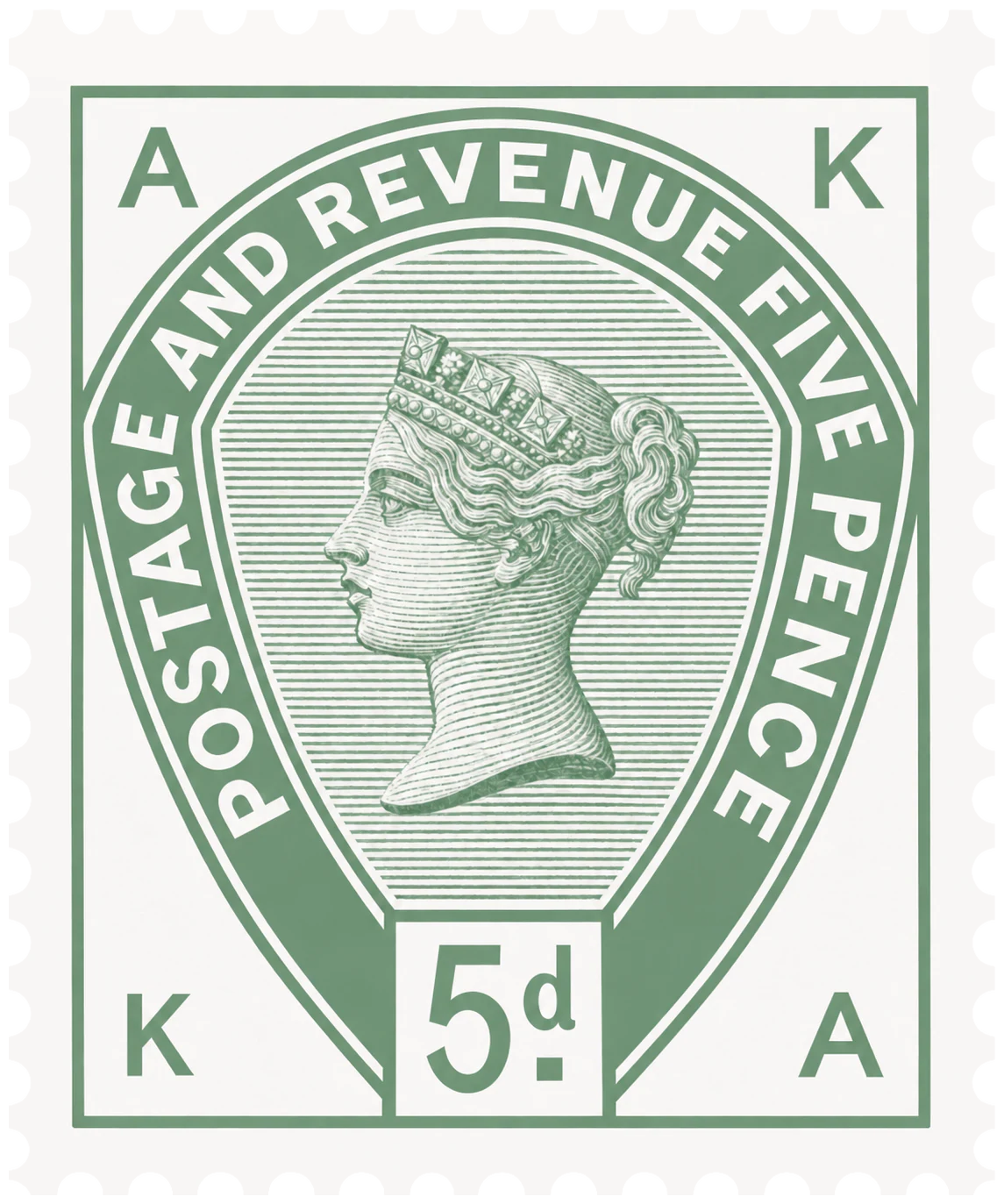
A tiny dot marks the replacement engraving
Look at the denomination beneath Victoria's portrait.
On the issued fivepenny, the numeral 5 is followed by a small sans-serif d with a dot below it.
The original engraving had a different appearance. Its d was more conventional, with a short horizontal line beneath it. [1]
The first die cracked before the stamp was issued, forcing De La Rue to prepare another.
The altered value figures provide a visible difference between the abandoned design and the issued Die II.
A tiny dot is evidence of a much larger setback in production.
The pointed frame around the Queen
The fivepenny has an angular frame with a pointed upper section and a lower panel containing the value.
POSTAGE AND REVENUE follows the upper and side portions of the frame, while FIVE PENCE appears beneath.
Victoria's portrait sits within the central space, surrounded by fine horizontal shading.
The design is closely related to the three-halfpenny lilac, although the value and proportions were adapted for the fivepenny. [1]
The unusual arrangement gave the stamp a recognisable appearance within De La Rue's new series.
The earlier surface-printed likeness traces back through Joubert’s engraving and Corbould’s drawing to Wyon’s medal. These inherited portrait sources are distinct from De La Rue’s replacement fivepenny die and frame; no individual engraver of Die II is established here. [2, 3, 4, 1]
The proof before the die was hardened
A surviving proof dated 15 August 1883 shows the revised fivepenny engraving before its corner letters were inserted.
It is printed in black on glazed white card and bears the instruction BEFORE HARDENING. [5]
The corners were deliberately left blank. They would later receive interchangeable metal plugs carrying the identifying letters.
The proof records the stage at which the permanent portrait, frame and denomination were finished.
The individual corner letters were added only when preparing the impressions needed for printing plates.
Four letters and a hidden crown
The fivepenny has coloured letters against white square panels in all four corners.
The lower pair identifies its position within the printing sheet. Those above repeat the same letters in reverse order. [6]
The letters helped expose attempts to construct fraudulent stamps from pieces of used examples.
The paper also carried the Imperial Crown watermark, formed during manufacture rather than printed in ink.
The crown normally appears upright on this vertically arranged stamp.
The design combined visible identification in the corners with a second royal emblem hidden within the paper.
The green ink that could be damaged by washing
The fivepenny was printed in dull green, using ink intended to discourage fraudulent reuse.
The new stamps could serve both postage and revenue purposes. The authorities therefore wanted inks that would be damaged by attempts to remove cancellations or handwritten markings. [6]
The drawback was that the green could be altered by careless washing.
The intended colour was not necessarily preserved on stamps exposed to water or chemicals.
The unusual ink shows how security requirements influenced the appearance and durability of the finished design.
The original engraving that nearly reached the public
The first fivepenny die had been approved and used to prepare two printing plates.
But the die cracked, and the printing was abandoned. Six reams of stamps were delivered to Somerset House as waste. [1]
Surviving impressions allow the first and second dies to be compared.
The original has a line beneath the d, while the replacement has a dot.
The two designs are otherwise closely related, revealing the engraver's effort to preserve an accepted appearance while replacing a damaged tool.
The diamond diadem made for a king
The ornament in Victoria's hair was commissioned for George IV's coronation in 1821. [7]
It contains 1,333 diamonds, with crosses and the national emblems of the rose, thistle and shamrock.
Victoria later wore the diadem in portraits, and it became a familiar feature of British postage stamps.
On the fivepenny dull green, its jewels are reduced to tiny printed marks. A magnificent royal ornament had become part of an everyday stamp worth fivepence.
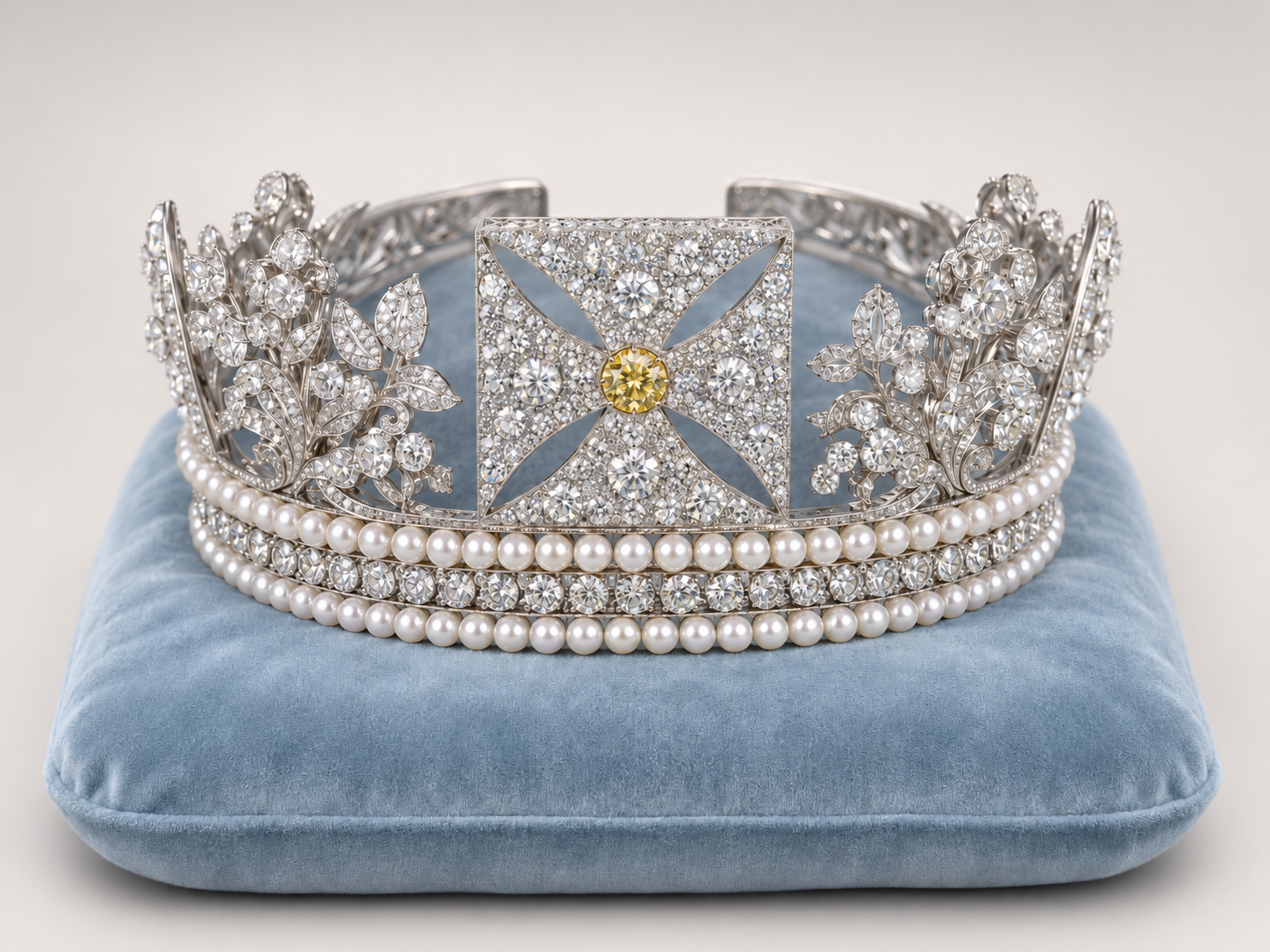
Image information
Click image to magnify
Digitally created illustration of the diamond diadem, with crosses, floral emblems and rows of pearls, resting on a blue cushion.
- Credit
- Stunning Stamps.
- Notes
- Digitally created.
Sources
- Hastings E. Wright and A. B. Creeke: A History of the Adhesive Stamps of the British Isles (1899), p. 158
- Robert B. Galland, The First Low Value Surface Printed Postage Stamps of Great Britain (RPSL, 2014), p. 3: earlier Joubert portrait engraving after Corbould
- Douglas N. Muir, William Wyon & the Penny Black, Royal Mint Museum
- Wright and Creeke, A History of the Adhesive Stamps of the British Isles (1899), pp. 69 and 157–159: De La Rue manufacture and the 1884 fourpenny, fivepenny Die II and sixpenny designs
- Bill Barrell: Fivepenny Die II die proof, 15 August 1883
- John F. Roe: Lilacs and Greens — A Collector's Guide
- Royal Collection Trust: George IV's Diamond Diadem