
The design of the ½d slate-blue
Queen Victoria · Great Britain · Thomas De La Rue & Co. · 1884
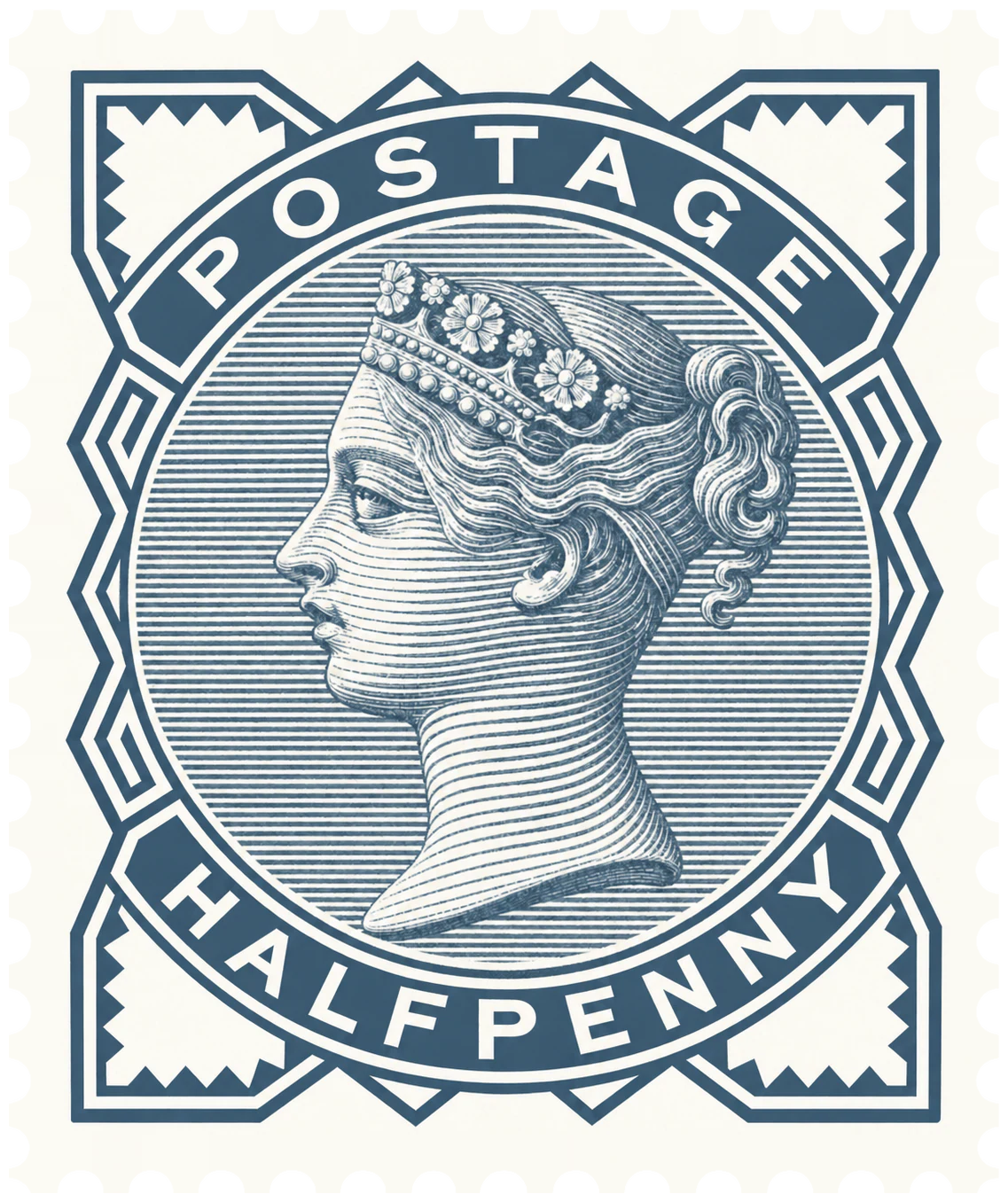
The green stamp becomes slate-blue
The 1884 halfpenny retained the engraving used for the green stamp introduced in 1880.
Victoria's portrait, circular frame, inscriptions and zigzag ornament were unchanged. Only the printing ink was different. [1]
The new colour was described as slate-blue, although its strength varied between printings.
De La Rue could therefore introduce the replacement without preparing a new portrait or decorative frame.
A change in the ink-making department had transformed the appearance of a familiar stamp.
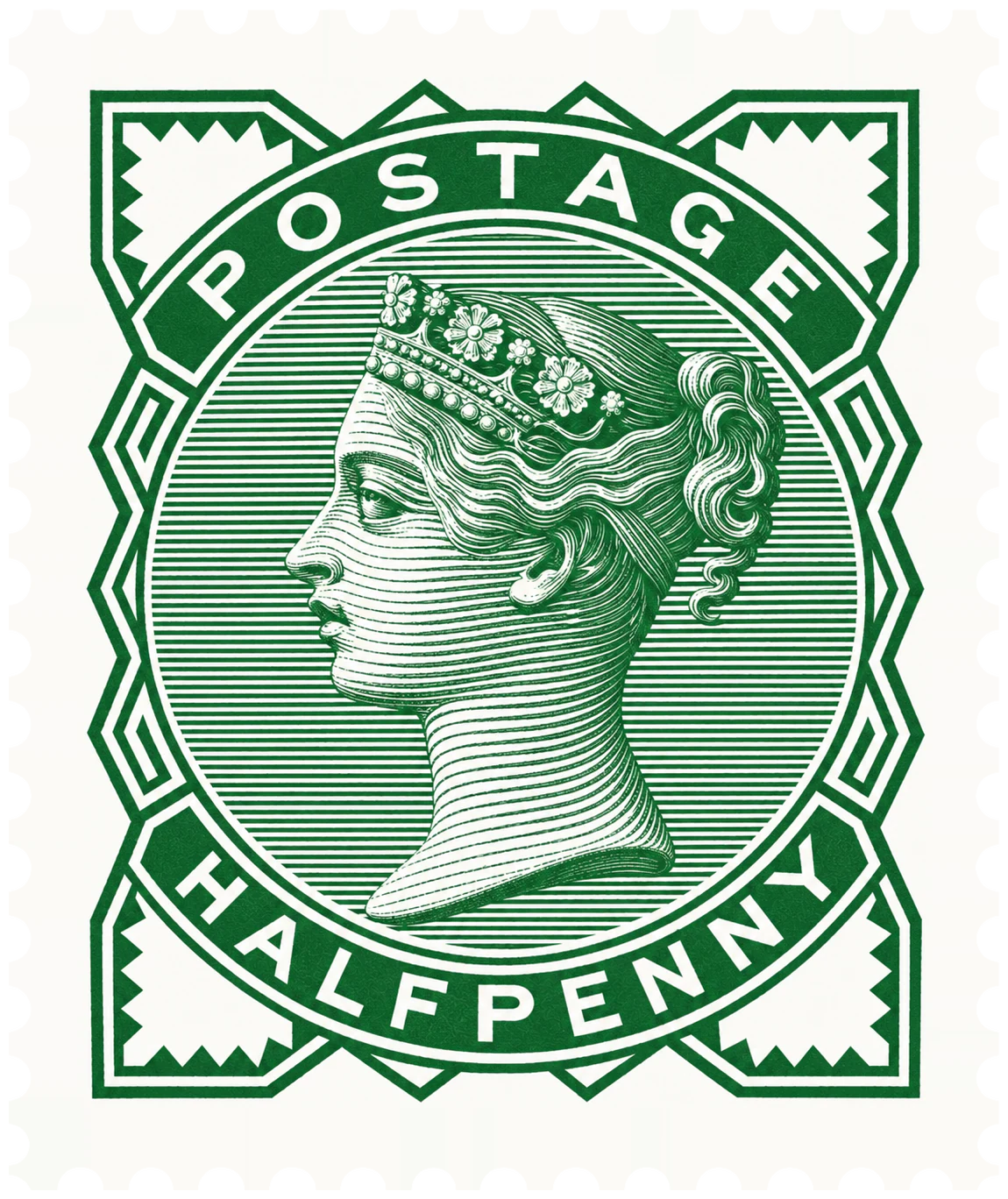
The circular portrait and zigzag border continued unchanged.
Click either stamp to magnify
The unusual zigzag frame
The halfpenny has a distinctive angular framework.
Victoria's head sits inside a circle, with POSTAGE following the upper curve and HALFPENNY below. Around the circle, a zigzag border creates a strong geometric outline. [1]
The surrounding spaces contain fine engraved patterns.
This design had been created in 1880 to replace the tiny line-engraved Bantam.
Its unusual frame remained unchanged when the stamp became slate-blue in 1884.
The stamp without corner letters
Unlike the other Lilac and Green stamps, the halfpenny has no identifying letters in its corners.
The earlier Bantam had carried four letters and tiny plate numbers, but De La Rue omitted both when preparing the new surface-printed halfpenny in 1880. [1]
The corners became part of the geometric ornament instead.
The same arrangement was retained in 1884.
Among a series otherwise distinguished by coloured corner letters, the slate-blue halfpenny remained an exception.
The plates that kept their old numbers
The first slate-blue printing plates were numbered 7 and 8.
They were not new tools. Both had previously been registered for the green halfpenny, and De La Rue registered them again in slate-blue on 20 February 1884. [2]
Later plates continued the sequence through 14.
The numbers were not printed on the individual stamps. They appeared in official records and on the retained registration sheets.
The plate sequence provides a link between two differently coloured stamps made from the same design.
A crown hidden beneath the blue
The slate-blue halfpenny was printed on paper carrying the Large Crown watermark.
The crown was formed within the paper during manufacture, rather than printed in ink. It could be examined by holding the stamp against transmitted light. [1]
The watermark had already been used for the green halfpenny and other provisional stamps.
It remained unchanged when the colour became blue.
The visible design was therefore altered by the printer's ink, while the hidden royal emblem continued beneath it.
A portrait that survived another change
Victoria's youthful profile ultimately derived from William Wyon's medal portrait, based on an image made when she was fifteen.
Henry Corbould adapted Wyon's likeness for Britain's first postage stamps. Later engravers developed versions suitable for De La Rue's surface-printing machinery. [3]
The slate-blue halfpenny retained this familiar royal image.
Victoria was sixty-four when the stamp appeared, but the portrait still recalled the young princess of the 1830s.
Joubert’s earlier surface-printed Queen’s head after Corbould’s drawing forms part of this inherited portrait tradition. The halfpenny retains De La Rue’s 1880 adaptation; no individual engraver of that later die is established here. [4, 5]
The diamond diadem made for a king
The ornament in Victoria's hair was commissioned for George IV's coronation in 1821. [6]
It contains 1,333 diamonds, with crosses and the national emblems of the rose, thistle and shamrock.
Victoria later wore the diadem in portraits, and it became a familiar feature of British postage stamps.
On the slate-blue halfpenny, its jewels are reduced to tiny printed marks. A magnificent royal ornament had become part of an everyday stamp worth half a penny.
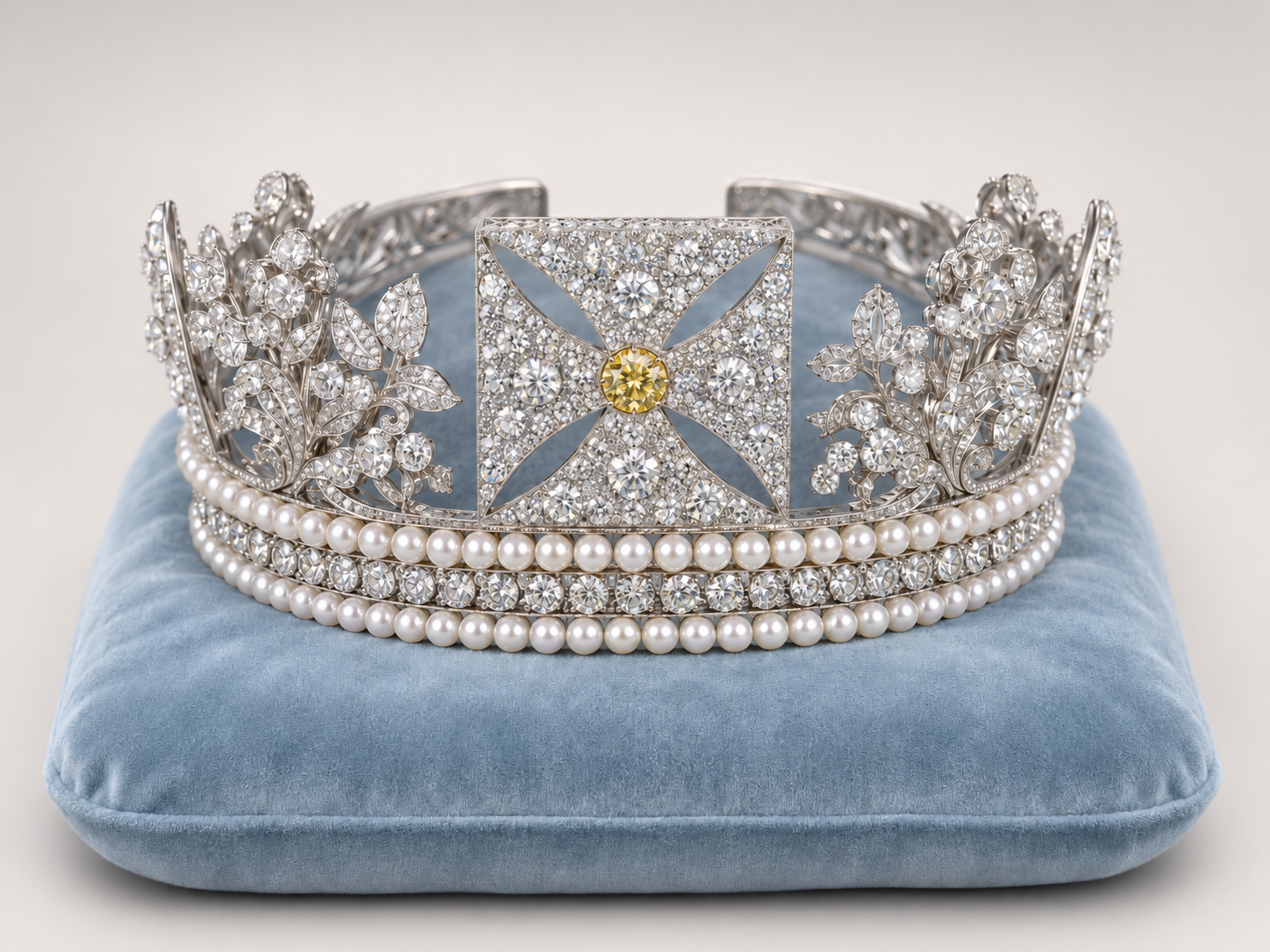
Image information
Click image to magnify
Digitally created illustration of the diamond diadem, with crosses, floral emblems and rows of pearls, resting on a blue cushion.
- Credit
- Stunning Stamps.
- Notes
- Digitally created.
Sources
- Hastings E. Wright and A. B. Creeke: A History of the Adhesive Stamps of the British Isles (1899), halfpenny issues
- Great Britain Philatelic Society: Postal Museum registration sheets — slate-blue halfpenny
- Douglas N. Muir, Royal Mint Museum: William Wyon & the Penny Black
- Robert B. Galland, The First Low Value Surface Printed Postage Stamps of Great Britain (RPSL, 2014), p. 3: earlier Joubert portrait engraving after Corbould
- Wright and Creeke, A History of the Adhesive Stamps of the British Isles (1899), pp. 69, 146–147 and 154–155: De La Rue manufacture, the reused halfpenny and new 1884 designs
- Royal Collection Trust: George IV's Diamond Diadem