
The design of the 9d dull green
Queen Victoria · Great Britain · Thomas De La Rue & Co. · 1883
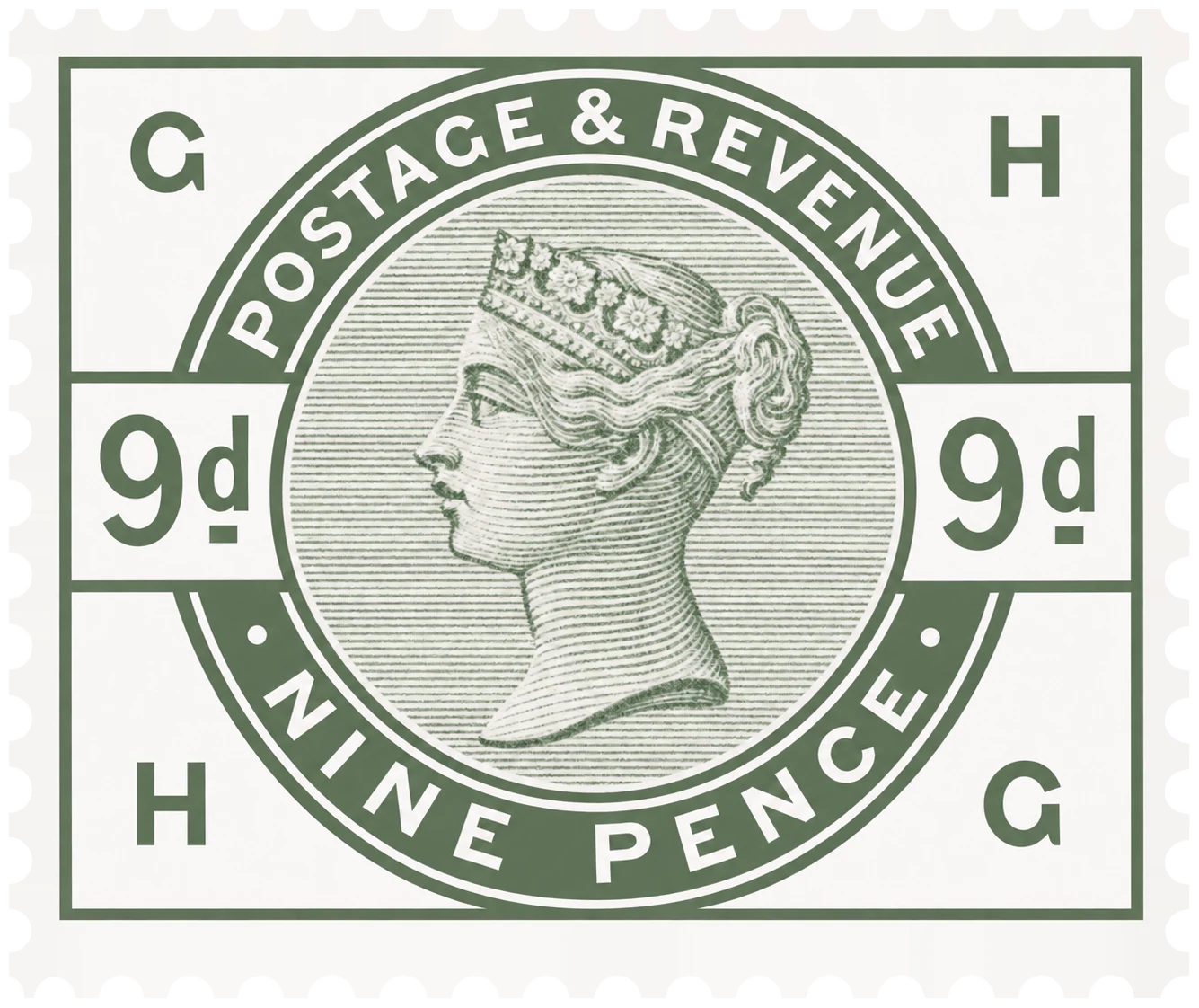
The Queen inside a broad circular frame
The ninepenny places Victoria's portrait inside a large circular frame.
POSTAGE & REVENUE follows the upper curve, while NINE PENCE appears below. A prominent 9d occupies each side of the portrait.
The arrangement closely resembles the two-and-a-halfpenny lilac introduced the following year, with the denominations and frame details adapted for each value. [1]
The large figures make the denomination immediately visible, while the circular inscription band provides a strong boundary around the Queen.
The design belongs to De La Rue's attempt to give the new series a consistent appearance without making every stamp identical.
The earlier surface-printed likeness traces back through Joubert’s engraving and Corbould’s drawing to Wyon’s medal. These inherited portrait sources are distinct from De La Rue’s new ninepenny die and frame of 1883; no individual engraver of that later design is established here. [2, 3, 4, 1]
Four letters that destroyed two plates
The ninepenny has coloured letters against white squares in all four corners.
The lower pair identifies the stamp's position in its printing sheet. Those above repeat the same letters in reverse order.
The letters were produced using interchangeable metal plugs during plate preparation.
When plates 1 and 2 were completed, some letters had been incorrectly positioned. Both plates were rejected and destroyed. [1]
The ordinary stamps were produced from replacement plates 3 and 4.
A close inspection of the corners therefore reveals a security feature that had already caused considerable trouble in the engraving workshop.
The engraving before its letters appeared
Surviving die proofs show the ninepenny before its individual corner letters were inserted.
One was dated 18 June 1883, its original date having been altered by hand. Another, dated 6 July, carries the initials W.G. [5, 6]
The proofs were printed in black on glazed white card.
They show the portrait, inscriptions and permanent ornament as a completed design, while the spaces intended for identifying characters remain blank.
The separation allowed De La Rue to prepare one master engraving and adapt it for hundreds of positions on the printing plates.
The crown that lies sideways
The ninepenny was printed on paper carrying the Large Crown watermark.
The crown was formed within the paper during manufacture rather than printed in ink. It helped make the paper difficult to imitate.
The printing sheets contained 240 stamps in two panes of 120, each arranged in twelve rows of ten. [7]
Because of this arrangement, the watermark normally appears sideways relative to the printed design.
The hidden crown reveals something about the positioning of the stamps on the original sheet.
The green ink that was designed to run
The ninepenny was printed in dull green, using an ink selected for its security properties.
The authorities wanted stamps usable for both postage and revenue purposes. Their inks therefore needed to react to attempts to remove either postal or handwritten cancellations.
De La Rue developed doubly fugitive inks that could be damaged by water and suitable chemical solvents. [8]
The drawback was that the original green could also be altered by careless washing.
A faded impression is not necessarily evidence of a different printing colour. It may reflect the deliberately vulnerable nature of the ink itself.
The counterfeiters who borrowed the real paper
The ninepenny's design was intended to be difficult to reproduce, with fine lettering, intricate backgrounds and a hidden watermark.
Some counterfeiters avoided the watermark problem by reusing genuine stamps.
They removed the original printing from lower-value stamps and substituted a counterfeit ninepenny design, retaining the authentic paper. [9]
This makes an interesting comparison with the issued stamp. The original was printed by De La Rue using carefully prepared plates; the imitation sought to reproduce its appearance while borrowing the genuine manufacturer's paper.
The fraud demonstrates why the engravers devoted such attention to seemingly insignificant details.
The diamond diadem made for a king
The ornament in Victoria's hair was commissioned for George IV's coronation in 1821. [10]
It contains 1,333 diamonds, with crosses and the national emblems of the rose, thistle and shamrock.
Victoria later wore the diadem in portraits, and it became a familiar feature of British postage stamps.
On the ninepenny dull green, its jewels are reduced to tiny printed marks. A magnificent royal ornament had become part of an everyday stamp worth ninepence.

Image information
Click image to magnify
Digitally created illustration of the diamond diadem, with crosses, floral emblems and rows of pearls, resting on a blue cushion.
- Credit
- Stunning Stamps.
- Notes
- Digitally created.
Sources
- Hastings E. Wright and A. B. Creeke: A History of the Adhesive Stamps of the British Isles (1899), p. 159
- Robert B. Galland, The First Low Value Surface Printed Postage Stamps of Great Britain (RPSL, 2014), p. 3: earlier Joubert portrait engraving after Corbould
- Douglas N. Muir, William Wyon & the Penny Black, Royal Mint Museum
- Wright and Creeke, A History of the Adhesive Stamps of the British Isles (1899), pp. 69 and 159–160: De La Rue manufacture and the ninepenny and one-shilling designs
- Bill Barrell: Ninepenny die proof, 18 June 1883
- Bill Barrell: Ninepenny die proof, 6 July 1883
- Great Britain Philatelic Society: Postal Museum registration sheets — ninepenny plates 3 and 4
- The Shilling's Tale: Unified Series, 1884–87
- Evert Klaseboer: Lucien (Lucian?) Smeets; Stamp Forger — Great Britain 9d forgery paragraph
- Royal Collection Trust: George IV's Diamond Diadem