
The design of the 1½d lilac
Queen Victoria · Great Britain · Thomas De La Rue & Co. · 1884
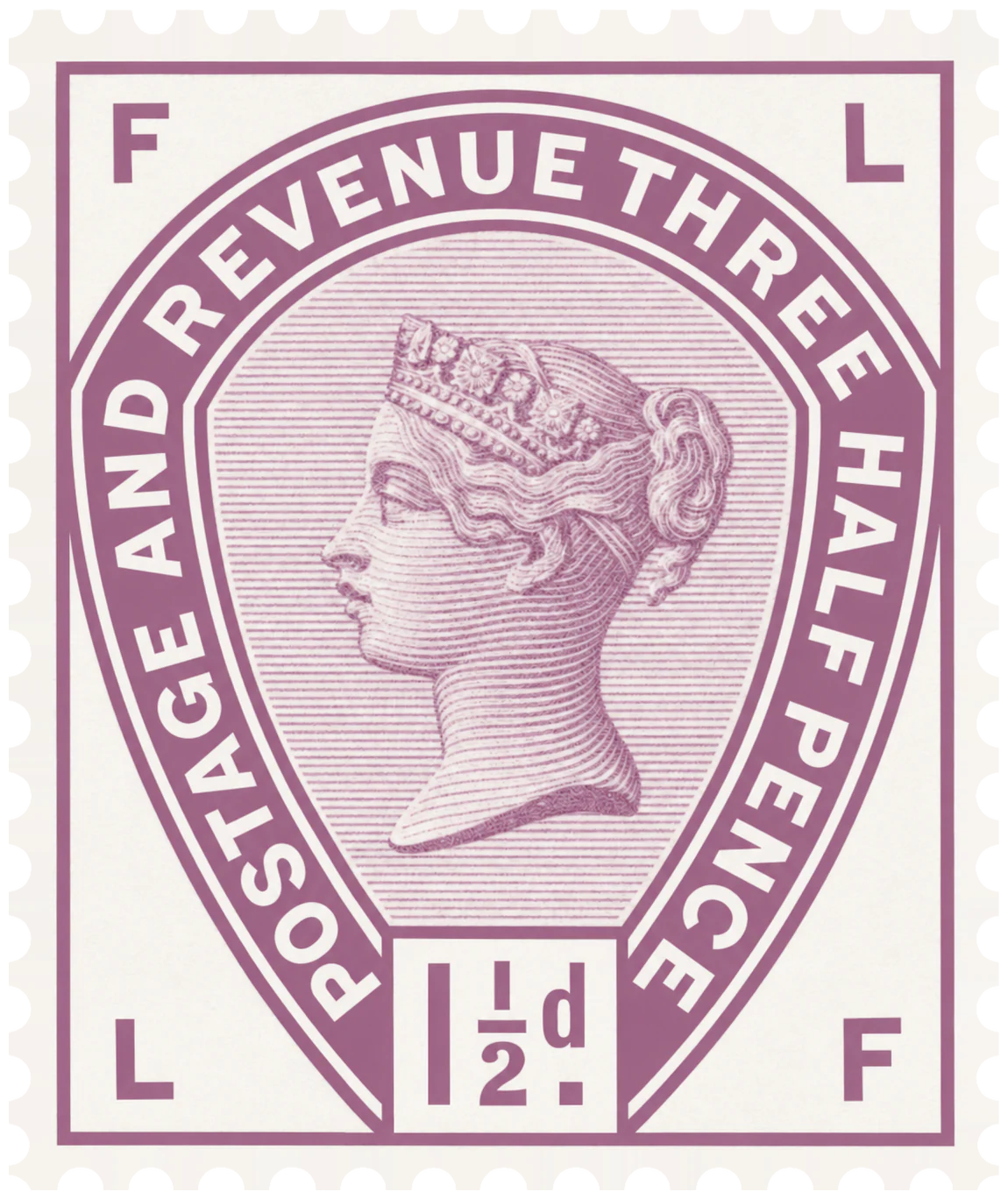
The unusual heart-shaped frame
The three-halfpenny has one of the more distinctive frames in the Lilac and Green series.
Victoria's portrait sits inside a curved border that resembles a heart, although the lower end is squared off to accommodate the value.
The inscription POSTAGE AND REVENUE THREE HALFPENCE follows the surrounding band.
The frame gives the portrait an unusual setting, quite different from the rectangular provisional three-halfpenny of 1880.
The arrangement was selected from the designs prepared by De La Rue for the new unified issue. [1]
The value tucked beneath the portrait
The denomination is repeated in a small panel at the foot of the design.
Here the value appears as 1½d, providing a compact alternative to the words THREE HALFPENCE around the frame.
The engraver had to accommodate an unusually long denomination within a small space.
Placing the fraction at the bottom allowed it to be read without disturbing Victoria's portrait.
The mixture of words and figures is a distinctive feature of the stamp.
The corners that reveal the printer's tools
The three-halfpenny carries coloured letters against white backgrounds in all four corners.
The lower pair identifies the stamp's position in the printing sheet. Those above repeat the same letters in reverse order. [1]
The letters were produced with removable metal plugs.
Sometimes a plug was fitted unevenly, leaving faint arcs around the character. These marks can be seen on surviving impressions.
The little imperfections reveal something that the finished design normally conceals: the individual work involved in preparing hundreds of stamp positions.
The lilac ink that was meant to be vulnerable
The lilac colour was chosen for its security properties rather than simply its appearance.
The Post Office wanted inks that would be damaged by attempts to remove cancellations. Such inks are called fugitive because they can react to washing or chemicals. [1]
The difficulty was that several denominations were now printed in closely related lilac shades.
The stamps were consequently hard to distinguish, particularly after cancellation.
During 1884, De La Rue experimented with printing the three-halfpenny in other inks and on coloured paper.
A security decision had created a design problem that the printers were soon asked to solve.
The crown hidden inside the paper
The three-halfpenny was printed on paper carrying the Imperial Crown watermark.
The crown was formed during papermaking rather than printed in ink. Its outline could be seen when the paper was examined against transmitted light. [1]
For this upright design, the crown normally appears in its upright position.
The watermark helped make the paper more difficult to imitate.
The stamp therefore contained two designs: Victoria's visible portrait and a hidden royal emblem.
A portrait of a fifteen-year-old princess
Victoria's portrait originated before she became Queen. William Wyon, Chief Engraver at the Royal Mint, created a medal commemorating her visit to the City of London in November 1837. Its portrait drew on a sketch made in 1834, when Victoria was fifteen. The medal was issued in 1838. [2]
Henry Corbould adapted the likeness for Britain's early postage stamps, while De La Rue's engravers later developed versions suited to surface printing.
The three-halfpenny lilac retained the familiar youthful Queen, although Victoria was now in her sixties.
Joubert’s earlier engraving after Corbould’s drawing supplied a model for the surface-printed royal likeness. This is an inherited portrait credit, separate from De La Rue’s new three-halfpenny frame and die; their individual engraver is not established here. [3, 4, 5, 6]
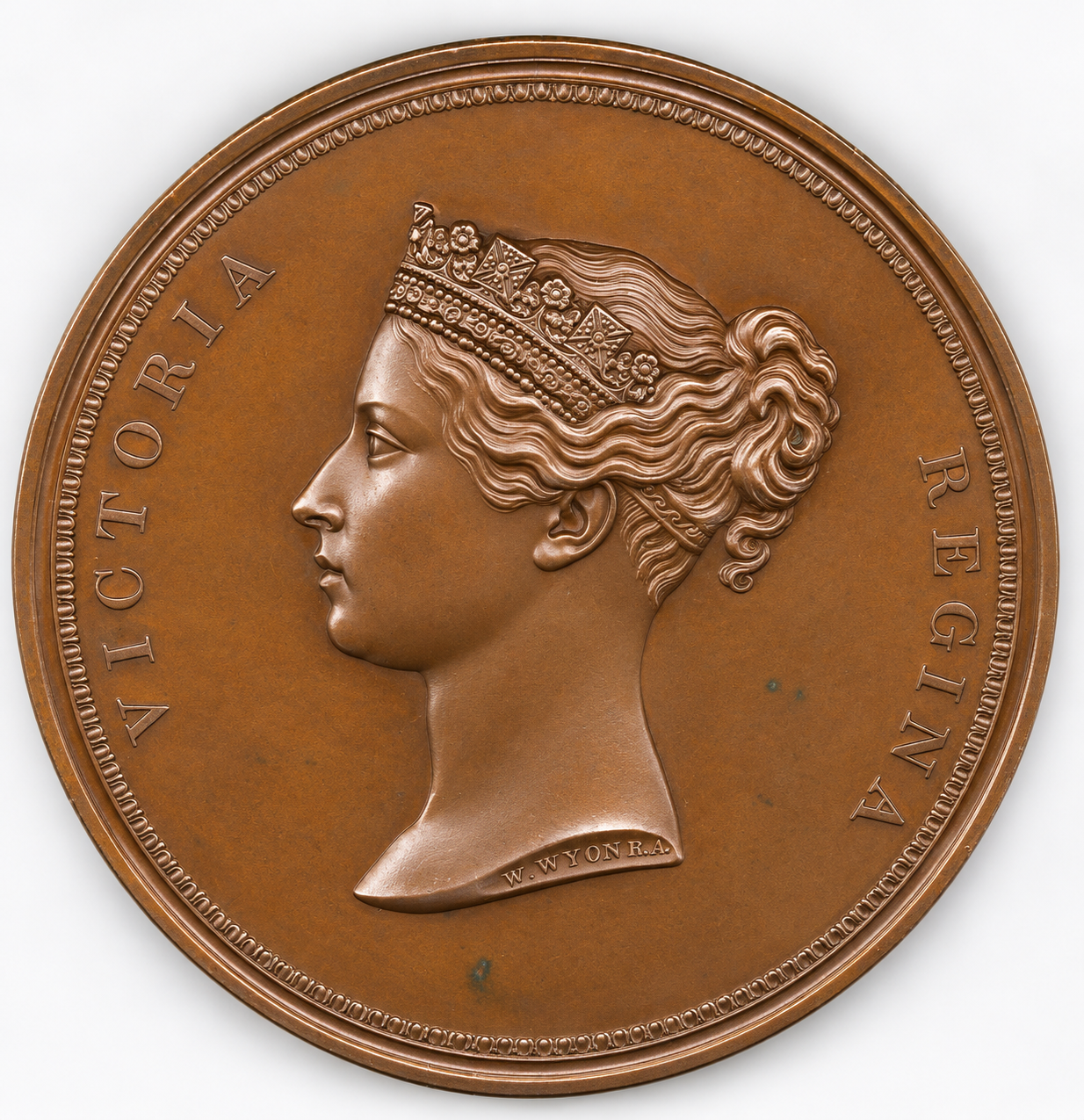
Image information
Click image to magnify
Bronze medal showing the young Victoria in left-facing profile, wearing the diamond diadem, with the inscription VICTORIA REGINA.
- Credit
- Heritage Auctions, via Wikimedia Commons. CC BY 3.0.
- Notes
- Brightness, contrast, sharpness and colour balance adjusted by Stunning Stamps.
The diamond diadem made for a king
The ornament in Victoria's hair was commissioned for George IV's coronation in 1821. [7]
It contains 1,333 diamonds, with crosses and the national emblems of the rose, thistle and shamrock.
Victoria later wore the diadem in portraits, and it became a familiar feature of British postage stamps.
On the three-halfpenny lilac, its elaborate jewels are reduced to tiny printed marks. A magnificent royal ornament had become part of an everyday stamp worth one and a half pence.
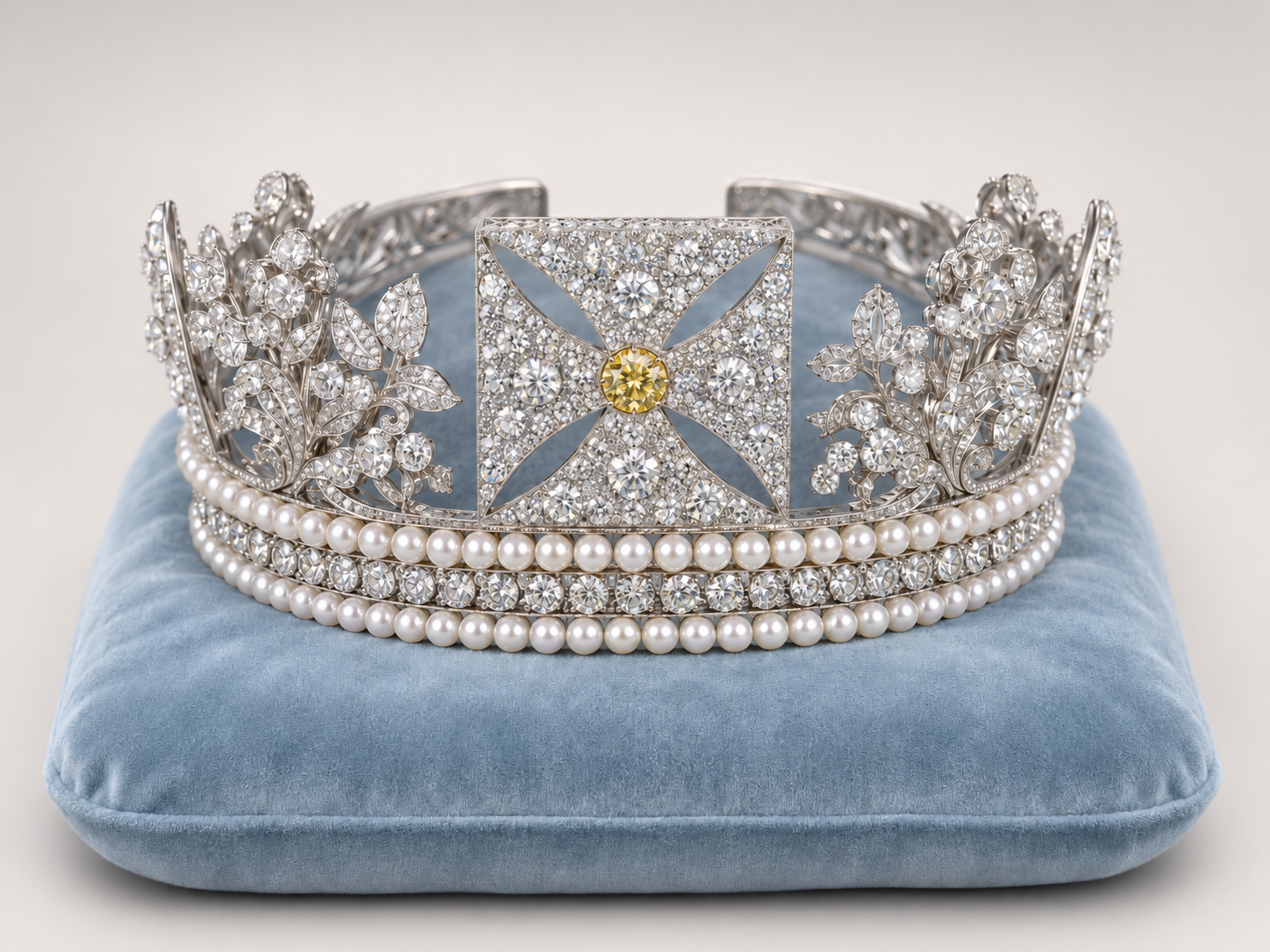
Image information
Click image to magnify
Digitally created illustration of the diamond diadem, with crosses, floral emblems and rows of pearls, resting on a blue cushion.
- Credit
- Stunning Stamps.
- Notes
- Digitally created.
Sources
- John F. Roe: Lilacs and Greens — A Collector's Guide, Gibbons Stamp Monthly
- Douglas N. Muir, Royal Mint Museum: William Wyon & the Penny Black
- Robert B. Galland, The First Low Value Surface Printed Postage Stamps of Great Britain (RPSL, 2014), p. 3: earlier Joubert portrait engraving after Corbould
- Wright and Creeke, A History of the Adhesive Stamps of the British Isles (1899), pp. 69, 146–147 and 154–155: De La Rue manufacture, the reused halfpenny and new 1884 designs
- Heritage Auctions, William Wyon medal photograph, via Wikimedia Commons (enhanced for display)
- Wyon medal photograph: Creative Commons Attribution 3.0 licence
- Royal Collection Trust: George IV's Diamond Diadem
