
The design of the 2½d lilac
Queen Victoria · Great Britain · Thomas De La Rue & Co. · 1884
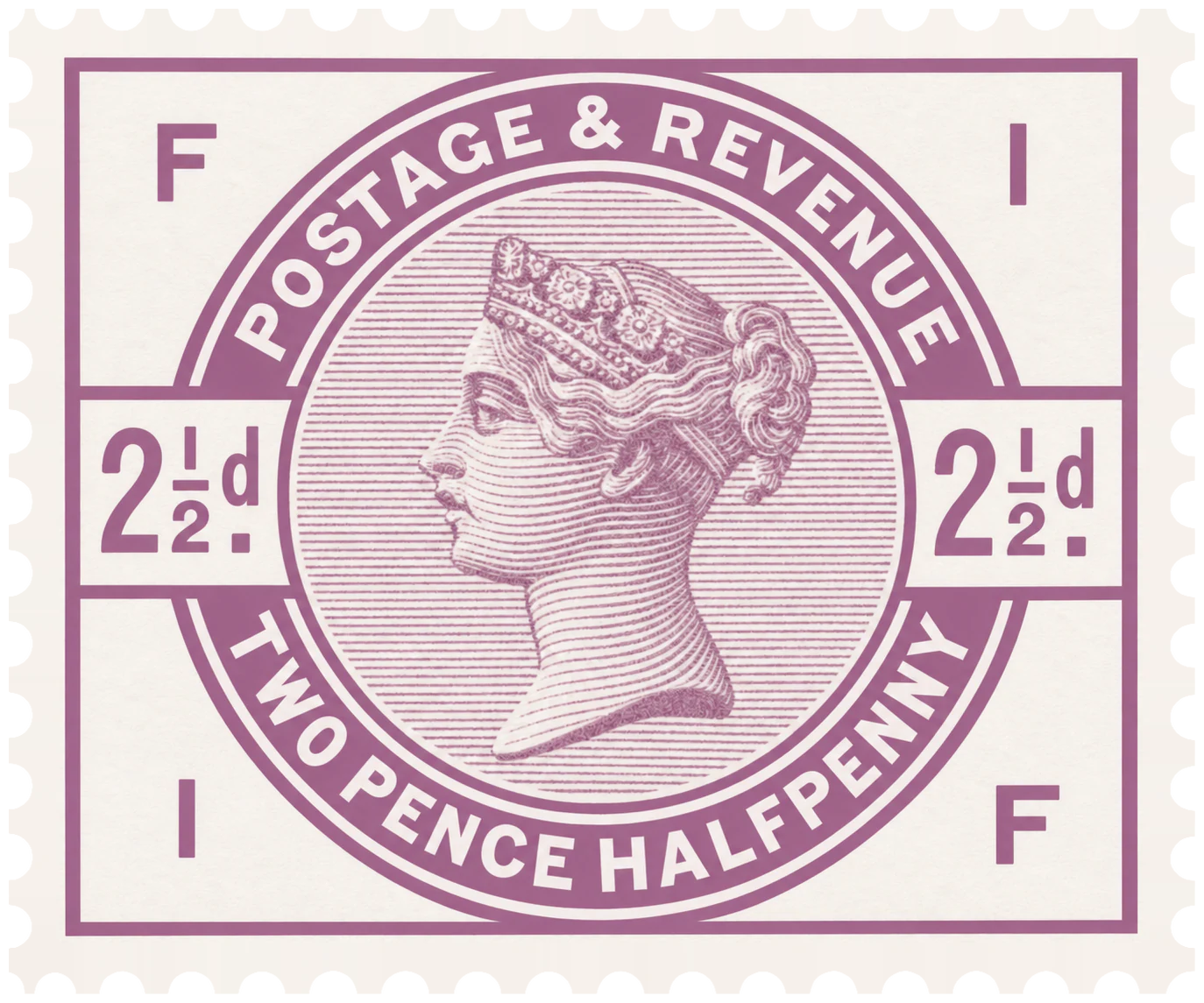
Two large fractions beside the Queen
The two-and-a-halfpenny places Victoria's portrait within a large circular frame.
The denomination appears twice, with a prominent 2½d in the panels on either side of the portrait. POSTAGE & REVENUE follows the upper curve, while TWO PENCE HALFPENNY occupies the lower.
The arrangement gives the stamp a strong, symmetrical appearance.
De La Rue had to accommodate a long denomination without crowding the portrait. Repeating the value in figures provided another way of making it recognisable.
The royal portrait used for eight values
The Queen's head was not engraved separately for every stamp in the Lilac and Green series.
De La Rue prepared a small master portrait die, numbered 269, with a corresponding punch numbered 270. The same head was used for eight values, including the two-and-a-halfpenny. [1]
A surviving proof dated 7 January 1883 carries the instruction BEFORE HARDENING. Another is mounted on an engraver's card, with 269 written above the portrait.
The printers could reproduce the same royal image within different ornamental frames.
This system helped give the series a consistent appearance while avoiding the expense of engraving Victoria's head repeatedly.
The earlier surface-printed likeness traces back through Joubert’s engraving and Corbould’s drawing to Wyon’s medal. These inherited portrait sources are distinct from De La Rue’s master die 269 and the new two-and-a-halfpenny frame; no individual engraver of those later tools is established here. [2, 3, 4, 1]
The corners with reversible letters
The stamp has coloured letters against white squares in all four corners.
The lower pair identifies its position in the printing sheet. Those above repeat the same letters in reverse order. [5]
The arrangement was intended to expose attempts to construct fraudulent stamps from pieces of used examples.
De La Rue used interchangeable letter plugs while preparing the printing plates, allowing the same portrait to be reproduced with different identifying characters.
The lettering therefore combined a security function with a practical method of mass production.
The crown that lies sideways
The two-and-a-halfpenny was printed on paper carrying the Imperial Crown watermark.
Unlike the upright three-halfpenny, this stamp was arranged horizontally on its printing sheet. Consequently, its watermark normally appears sideways. [5]
Viewed from the back, the top of the crown normally points to the right.
The orientation was not a mistake. It resulted from the way the printers arranged the stamps relative to the paper.
The hidden crown reveals something about the manufacture of the sheet that is not apparent from the printed portrait.
A word hidden in the sheet margin
The paper carried another feature that is normally invisible on an individual stamp.
Along the margin of the original sheet, the papermaker incorporated a large watermarked inscription. Surviving blocks from the two-and-a-halfpenny show portions of the word POSTAGE. [5]
The letters were formed within the paper rather than printed in ink.
They disappeared from most stamps when the sheets were divided.
A marginal block therefore preserves evidence of the papermaker's work that would otherwise be lost.
The purple-and-lilac alternative
The issued stamp was lilac, but De La Rue experimented with other combinations during 1884.
One striking trial printed the design in purple ink on lilac paper. Others used purple-brown on white or green on buff-yellow. [6]
The same portrait and ornament were retained.
The experiments reveal how much the appearance of a stamp depended on the colour of both ink and paper.
They also show why the government eventually moved away from the largely uniform colours of the Lilac and Green issue.
The diamond diadem made for a king
The ornament in Victoria's hair was commissioned for George IV's coronation in 1821. [7]
It contains 1,333 diamonds, with crosses and the national emblems of the rose, thistle and shamrock.
Victoria later wore the diadem in portraits, and it became a familiar feature of British postage stamps.
On the two-and-a-halfpenny lilac, its jewels are reduced to tiny engraved marks. A magnificent royal ornament had become part of an everyday object worth two and a half pence.

Image information
Click image to magnify
Digitally created illustration of the diamond diadem, with crosses, floral emblems and rows of pearls, resting on a blue cushion.
- Credit
- Stunning Stamps.
- Notes
- Digitally created.
Sources
- Grosvenor Auctions: Sale 121, lot 858 — De La Rue master portrait die 269, January 1883
- Robert B. Galland, The First Low Value Surface Printed Postage Stamps of Great Britain (RPSL, 2014), p. 3: earlier Joubert portrait engraving after Corbould
- Douglas N. Muir, William Wyon & the Penny Black, Royal Mint Museum
- Wright and Creeke, A History of the Adhesive Stamps of the British Isles (1899), pp. 69 and 154–156: De La Rue manufacture and the 1884 two-and-a-halfpenny and threepenny designs
- John F. Roe: Lilacs and Greens — A Collector's Guide, Gibbons Stamp Monthly (2025)
- Grosvenor Auctions: Sale 121, lot 859 — 2½d purple on lilac colour trials
- Royal Collection Trust: George IV's Diamond Diadem