
The design of the ½d rose-red
Queen Victoria · Great Britain · Perkins, Bacon & Co. · 1870
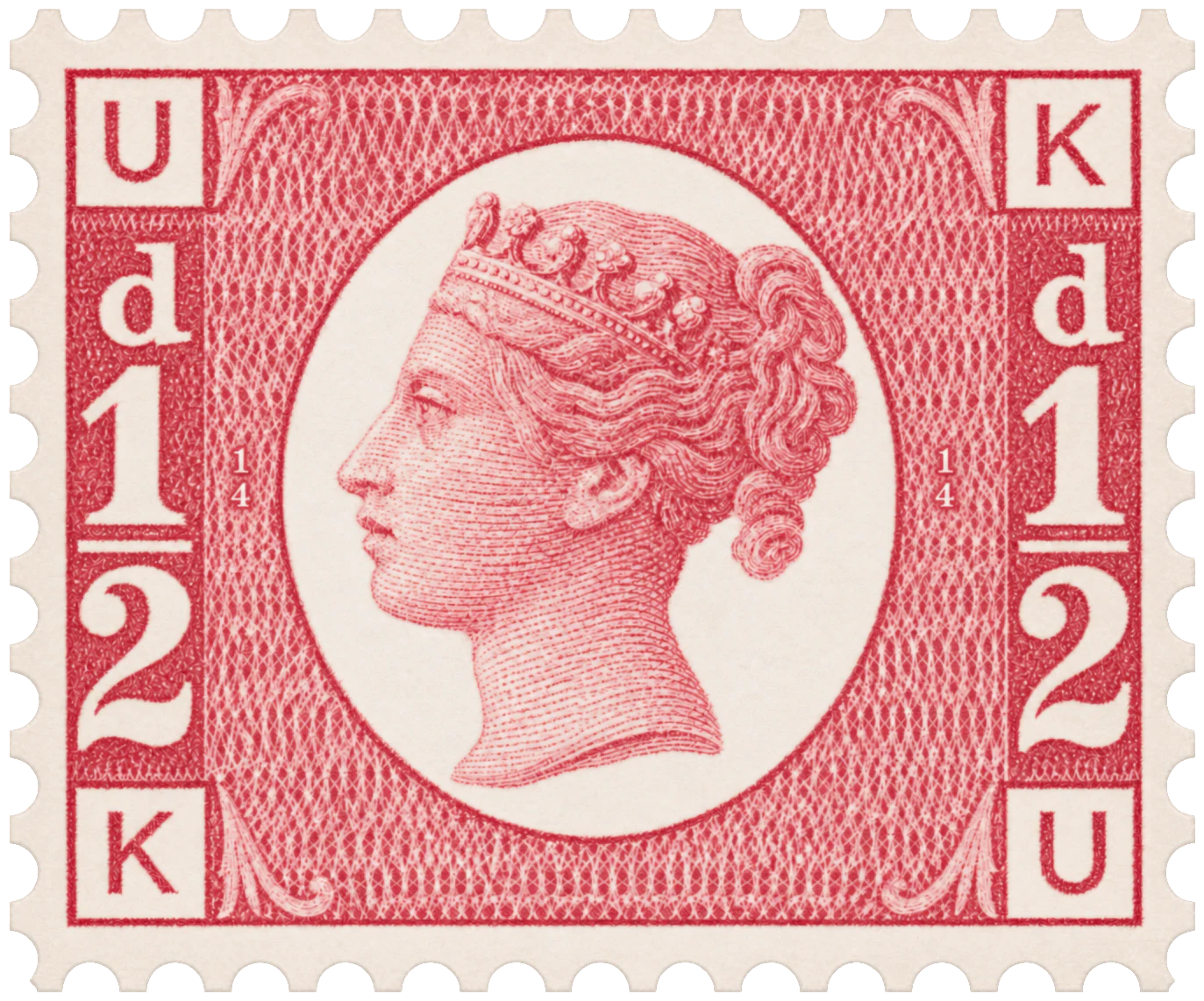
A miniature portrait surrounded by enormous figures
The Bantam was deliberately made much smaller than an ordinary Penny Red.
Victoria's head sits within a little white oval, surrounded by a dense engraved background. On either side, an enormous fraction shows the value: ½. [1]
The unusually prominent figures dominate the design.
In 1945, the stamp historian John Easton criticised the arrangement, describing the tiny head as floating within its frame. He found the disproportionate figures particularly unattractive. [2]
The Bantam was clearly not admired by everyone. But its unusual proportions gave it a character unlike any other British stamp.
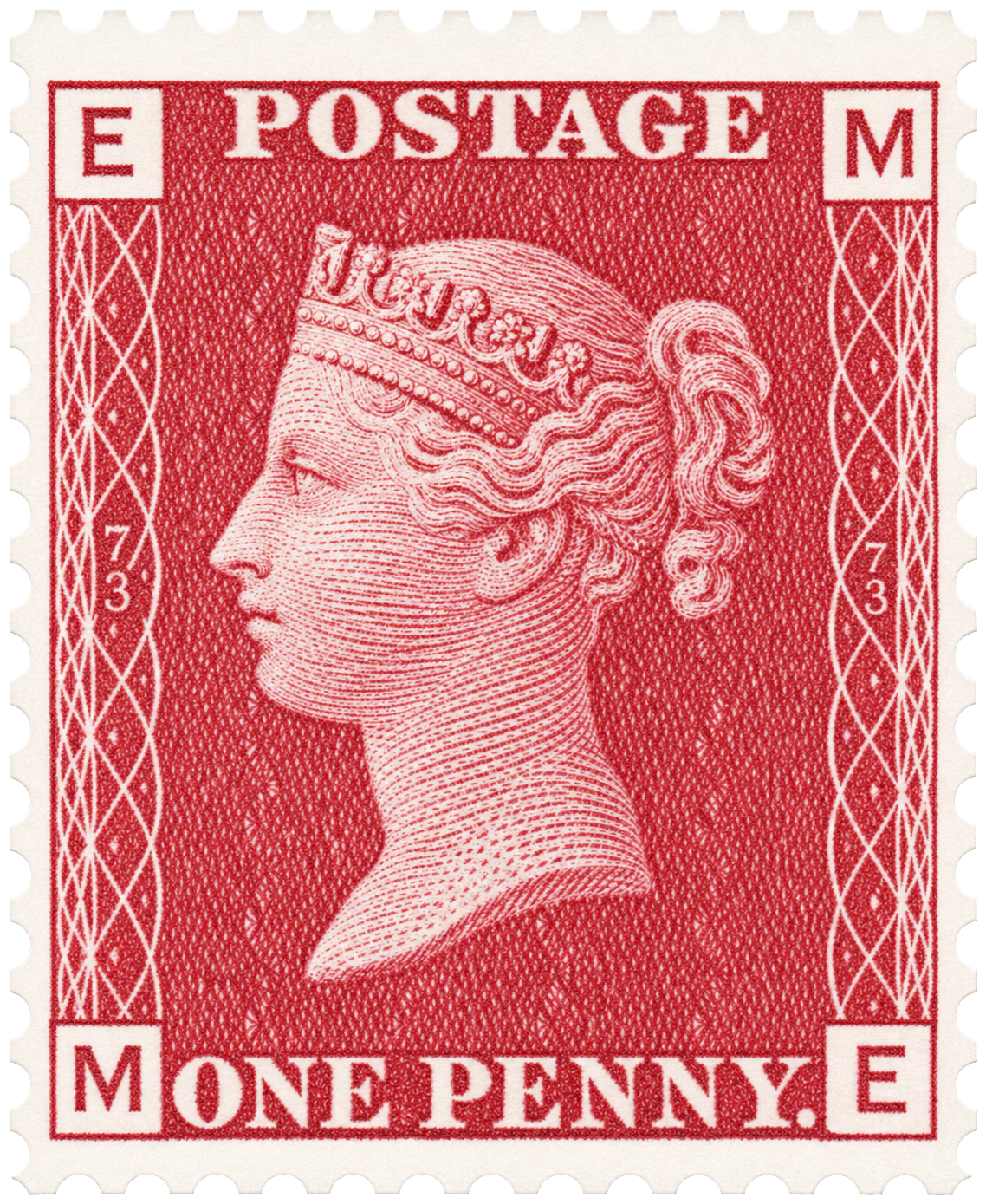
Contrasting formats, shown at different enlargements. These images are not a measured size comparison.
Click either stamp to magnify
The background that was almost reversed
During the design trials, Perkins, Bacon & Co. experimented with the fine lattice pattern surrounding Victoria's portrait.
The engravers considered reversing the pattern so that the background would contain less ink and consequently appear lighter. [3]
This was particularly important while green was being considered as the stamp's colour.
The trial impressions explored how different inks and background patterns affected the appearance of the miniature design.
The issued stamp retained a dense rose-red pattern, making the little white portrait and large figures stand out strongly.
The watermark written across three stamps
The Bantam had one of Britain's most unusual watermarks.
Instead of a crown, the papermaker incorporated the words half penny in flowing handwritten-style lettering. Each watermark extended across three neighbouring stamps. [1]
A complete sheet contained 160 repetitions of the words, arranged across twenty rows.
This meant that an individual stamp usually displayed only part of the watermark.
The design was deliberately hidden within the paper, but it required careful coordination between the papermaker's layout and the printer's arrangement of the stamps.
The perforations that ran sideways
The Bantam's small size created a problem for the perforating machinery.
Ordinary Victorian stamps were perforated in successive horizontal rows. For the halfpenny, the operators worked from the side, perforating vertical rows instead. [1]
The process left one outside column of stamps without perforations along its outer edge.
Depending on how the sheet entered the machine, this could be the left or right side.
The unusual edges were not a printing error. They were a consequence of adapting existing machinery to a stamp unlike any previously produced.
Four letters in a very small space
Despite its size, the halfpenny carried identifying letters in all four corners.
The lower pair showed the stamp's position in the sheet. Those above repeated the same letters in reverse order. [1]
A sheet contained 480 stamps, arranged in twenty rows of twenty-four.
The letters had to be small enough to fit into the miniature design yet clear enough to perform their security function.
Tiny plate numbers were also engraved into the patterned background, immediately beside the portrait.
The printer had compressed the familiar Victorian security markings into a space scarcely half that of the ordinary penny stamp.
The Queen's portrait returns to its original engraver
The Bantam's portrait was engraved by Frederick Heath, who had helped create the original Penny Black.
Heath worked from the established youthful likeness of Victoria, adapting it to a much smaller format. Surviving proofs show how he strengthened the engraved lines before the die was completed. [3]
The portrait's ancestry reached back to William Wyon's medal, based on an image of Victoria made when she was fifteen. [4]
The miniature halfpenny therefore retained a direct connection with the world's first postage stamp, even though its proportions and surrounding ornament were entirely different.
The diamond diadem made for a king
The ornament in Victoria's hair was commissioned for George IV's coronation in 1821. [5]
It contains 1,333 diamonds, with crosses and the national emblems of the rose, thistle and shamrock.
Victoria later wore the diadem in portraits, and it became a familiar feature of British postage stamps.
On the tiny Bantam, its jewels are reduced to only a handful of engraved marks. A magnificent royal ornament had become part of Britain's smallest postage stamp.

Image information
Click image to magnify
Digitally created illustration of the diamond diadem, with crosses, floral emblems and rows of pearls, resting on a blue cushion.
- Credit
- Stunning Stamps.
- Notes
- Digitally created.
Sources
- Hastings E. Wright and A. B. Creeke: A History of the Adhesive Stamps of the British Isles (1899), pp. 13–16
- Royal Mail, British Philatelic Bulletin, vol. 17 no. 10, June 1980: Britain's Smallest Stamp and the First 1½d
- Royal Mail, British Philatelic Bulletin, January 2020: The Birth of the Bantam
- Douglas N. Muir, Royal Mint Museum: William Wyon & the Penny Black
- Royal Collection Trust: George IV's Diamond Diadem