
The design of the 1½d rose-red
Queen Victoria · Great Britain · Perkins, Bacon & Co. · 1870
The Penny Red transformed into a shield
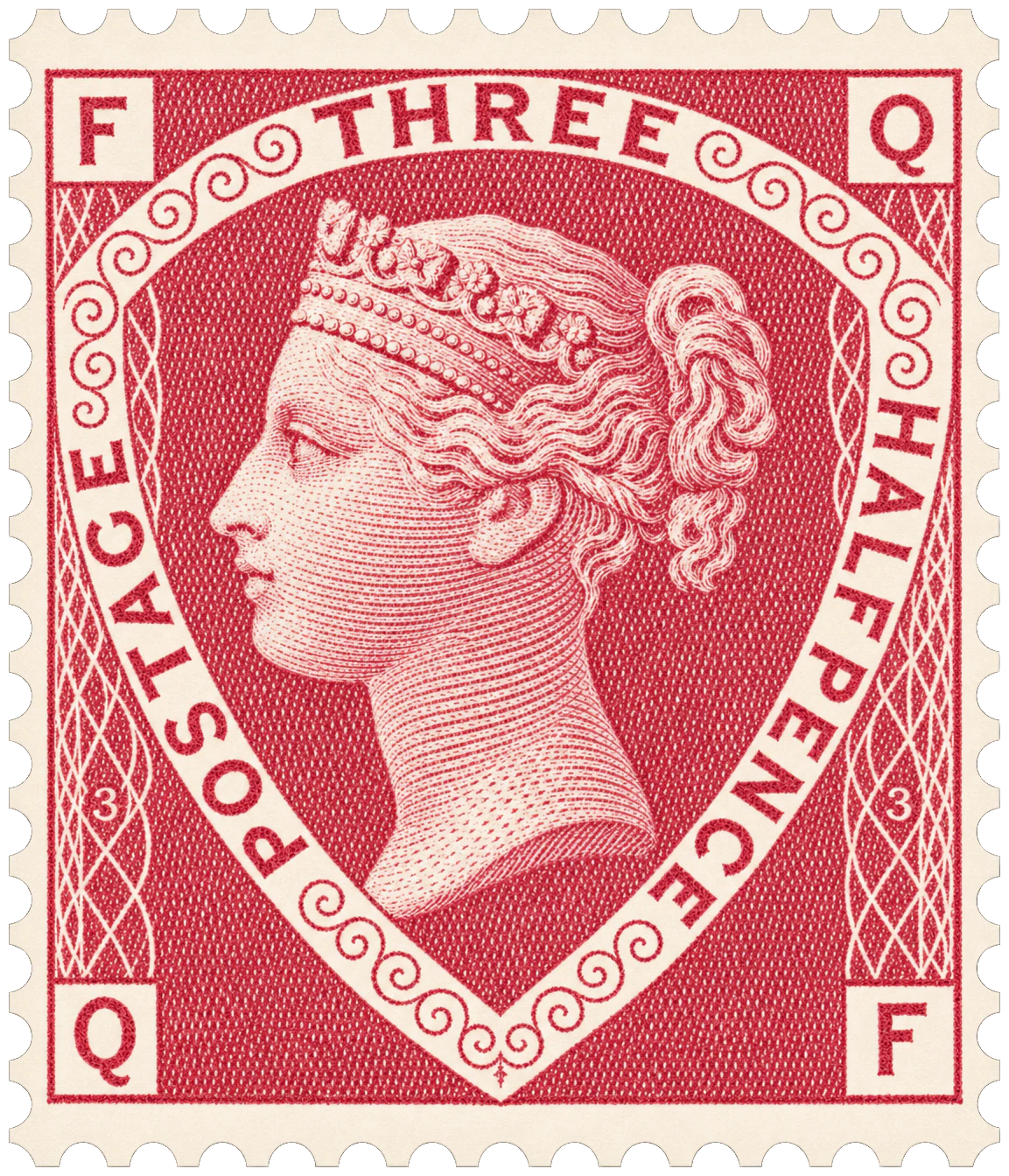
The three-halfpenny design began as a copy of the Penny Red's Die II.
Perkins, Bacon & Co. removed the two upper stars and the rectangular panels containing POSTAGE and ONE PENNY. In their place, the engravers introduced a curved triangular band, pointing downwards. [1]
The new frame carried POSTAGE on the left, THREE across the top and HALFPENCE on the right.
Victoria's portrait was retained, but the lower part of her bust had to be shortened to fit within the new shape.
The design was therefore an adaptation rather than an entirely new engraving. The familiar Queen had been given an unfamiliar frame.
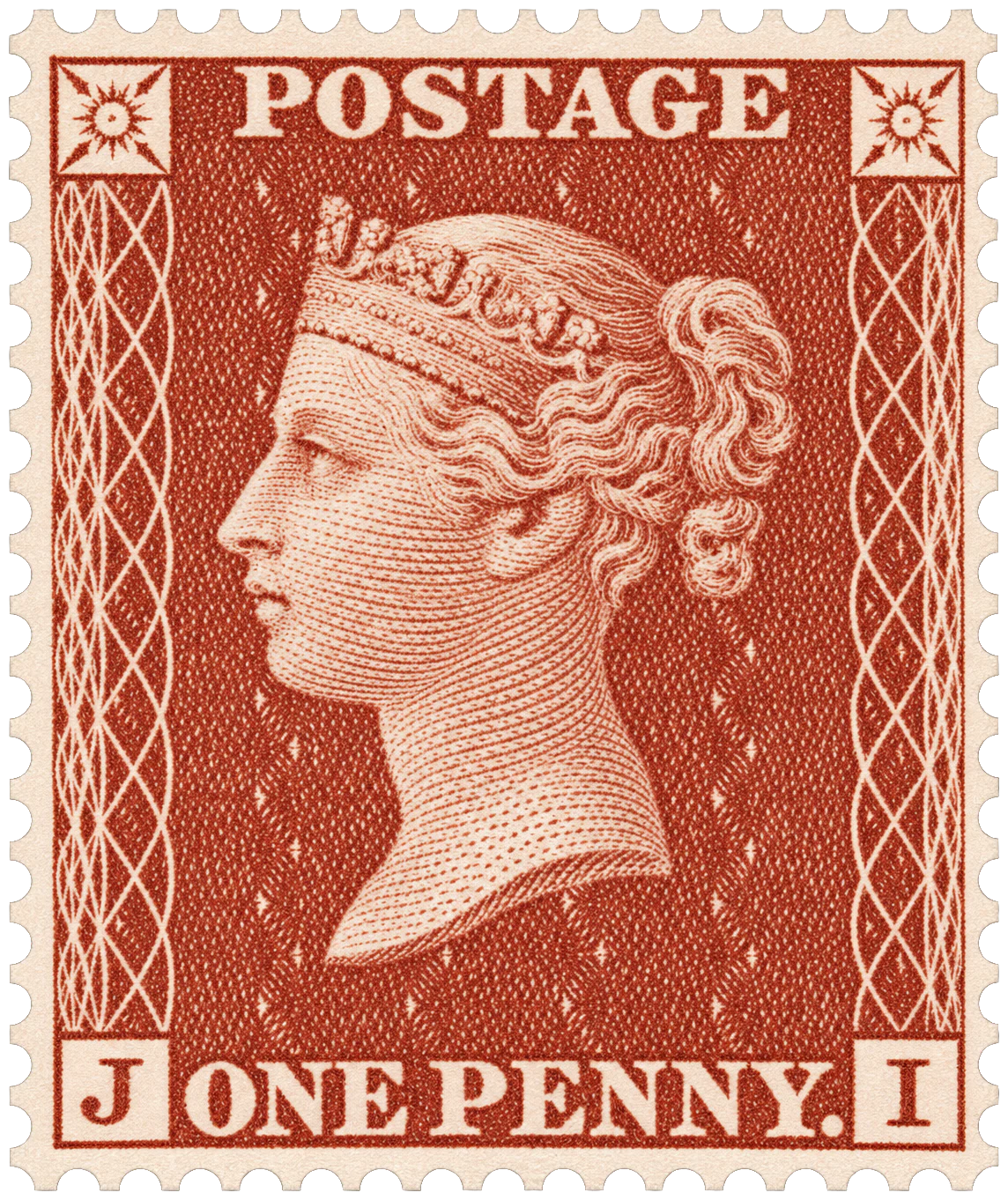
Compare the rectangular inscription panels with the curved triangular band.
Click either stamp to magnify
Traces of the old stamp still visible
Removing the Penny Red's inscriptions did not always erase every trace of the original engraving.
Wright and Creeke noted that faint remains of the old rectangular inscription panels could sometimes be seen on impressions of the three-halfpenny. The traces were particularly clear on certain die proofs. [1]
These marks reveal how the engravers had reused an existing design.
Instead of starting with a blank piece of steel, they had removed parts of the Penny Red and engraved new features over the remaining image.
A close examination can therefore reveal the ghost of another postage stamp beneath the finished design.
The scrollwork that fills the gaps
The white triangular frame contains three inscriptions, separated by ornamental scrolls.
The engravers used the curved decorations to fill the spaces between POSTAGE, THREE and HALFPENCE. The scrolls also help the lettering follow the unusual shape of the frame. [1]
The surrounding background retains the intricate engine-turned pattern familiar from the Penny Red, including the narrow reticulated borders at each side.
The result combines two very different elements: the dense geometric security engraving of the earlier stamp and the more flowing ornament of the new denomination.
The scrolls were not simply embellishment. They helped make an awkward arrangement of words fit into a small space.
Four letters, including one mistake
The three-halfpenny has letters in all four corners.
The lower pair identifies the stamp's position in the printing sheet. Those above repeat the same pair in reverse order, helping expose attempts to construct fraudulent stamps from pieces of used examples. [1]
On plate 1, one position was incorrectly lettered. A stamp that should have had C in the upper-left corner received O instead.
The error was made in 1860 and remained when the plate returned to production in 1870.
The incorrect letter is a small but revealing piece of evidence about the manual work involved in preparing the printing plates.
The plate number that appeared later
The original three-halfpenny stamps from plate 1 have no plate number printed within the design.
When plate 3 was prepared in 1874, small white figures were added to the patterned side borders, following the practice used for contemporary Penny Reds. [1]
The change did not alter Victoria's portrait or the triangular frame.
It introduced a practical identifying feature that had been absent from the original engraving.
The two plates therefore provide an interesting comparison: the same design, prepared more than fourteen years apart, with a small difference reflecting developments in security printing.
The crown hidden beneath the rose-red
The issued three-halfpenny was printed on paper carrying the Large Crown watermark.
The crown was formed within the paper during manufacture, rather than printed in ink. It made the paper more difficult to imitate.
The same paper was used for the contemporary Penny Red. [1]
The earlier lilac-rose printing of 1860 had been made on similar paper, but the official registration sheet shows strong blue discolouration.
The red stamps of 1870 did not normally display this blueing.
The change of ink had altered the appearance of the stamp without requiring any modification to the watermark.
A portrait of a fifteen-year-old princess
Victoria's portrait originated before she became Queen. William Wyon, Chief Engraver at the Royal Mint, created a medal commemorating her visit to the City of London in November 1837. Its portrait drew on a sketch made in 1834, when Victoria was fifteen. The medal was issued in 1838. [2]
Henry Corbould prepared a drawing based on Wyon's portrait, which became the model for the original Penny Black engraving.
The three-halfpenny inherited this youthful likeness through the Penny Red's revised Die II.
Although Victoria was over fifty when the stamp appeared, her portrait still represented the young princess of the 1830s. [3, 4]
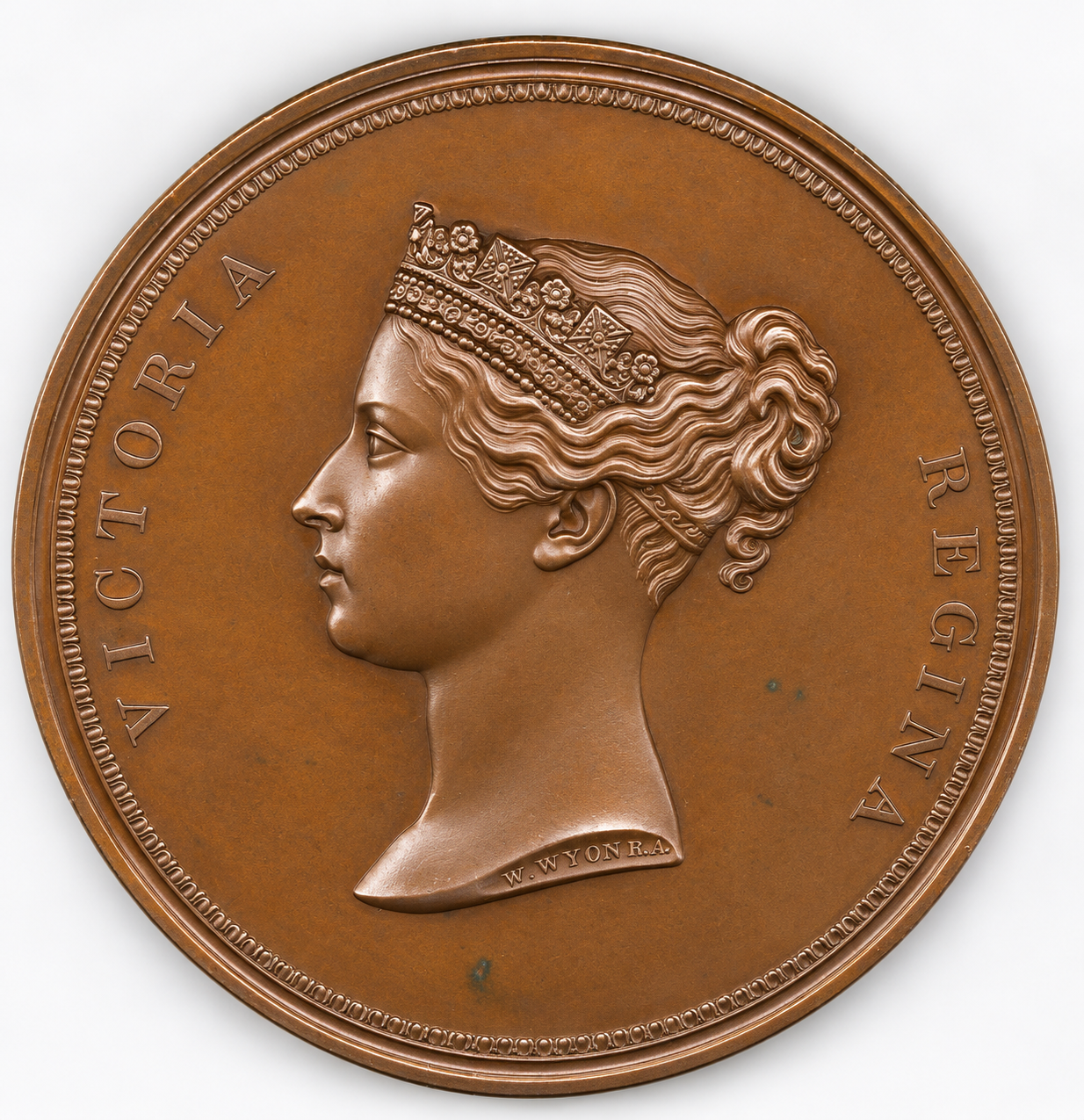
Image information
Click image to magnify
Bronze medal showing the young Victoria in left-facing profile, wearing the diamond diadem, with the inscription VICTORIA REGINA.
- Credit
- Heritage Auctions, via Wikimedia Commons. CC BY 3.0.
- Notes
- Brightness, contrast, sharpness and colour balance adjusted by Stunning Stamps.
The diamond diadem made for a king
The ornament in Victoria's hair was commissioned for George IV's coronation in 1821. [5]
It contains 1,333 diamonds, with crosses and the national emblems of the rose, thistle and shamrock.
Victoria later wore the diadem in portraits, and it became a familiar feature of British postage stamps.
On the three-halfpenny, its elaborate jewels are reduced to tiny engraved marks. A magnificent royal ornament had become part of an everyday object worth one and a half pence.

Image information
Click image to magnify
Digitally created illustration of the diamond diadem, with crosses, floral emblems and rows of pearls, resting on a blue cushion.
- Credit
- Stunning Stamps.
- Notes
- Digitally created.
People behind the engraving
William Humphrys had revised the Penny Red’s portrait for Die II. The three-halfpenny inherited that work when Perkins Bacon adapted the die in 1860; this does not establish a new portrait commission to Humphrys for the three-halfpenny. [6]
Behind Die II lay the original portrait engraving attributed to Charles Heath or his son Frederick. Their individual roles in that earlier work remain unresolved. The three-halfpenny’s inherited portrait should be distinguished from Frederick’s newly engraved miniature head for the Bantam. [7, 8]
Sources
- Hastings E. Wright and A. B. Creeke: A History of the Adhesive Stamps of the British Isles (1899), pp. 42–44
- Douglas N. Muir, Royal Mint Museum: William Wyon & the Penny Black
- Heritage Auctions, William Wyon medal photograph, via Wikimedia Commons (enhanced for display)
- Wyon medal photograph: Creative Commons Attribution 3.0 licence
- Royal Collection Trust: George IV's Diamond Diadem
- Wright and Creeke, A History of the Adhesive Stamps of the British Isles (1899), pp. 13–16, 34–35 and 42–44: halfpenny plates, Die II and three-halfpenny adaptation
- Douglas N. Muir, William Wyon & the Penny Black, Royal Mint Museum
- Royal Mail, British Philatelic Bulletin, January 2020, pp. 150–154: The Birth of the Bantam, including Frederick Heath’s miniature portrait
