
The design of the ½d deep green
Queen Victoria · Great Britain · Thomas De La Rue & Co. · 1880
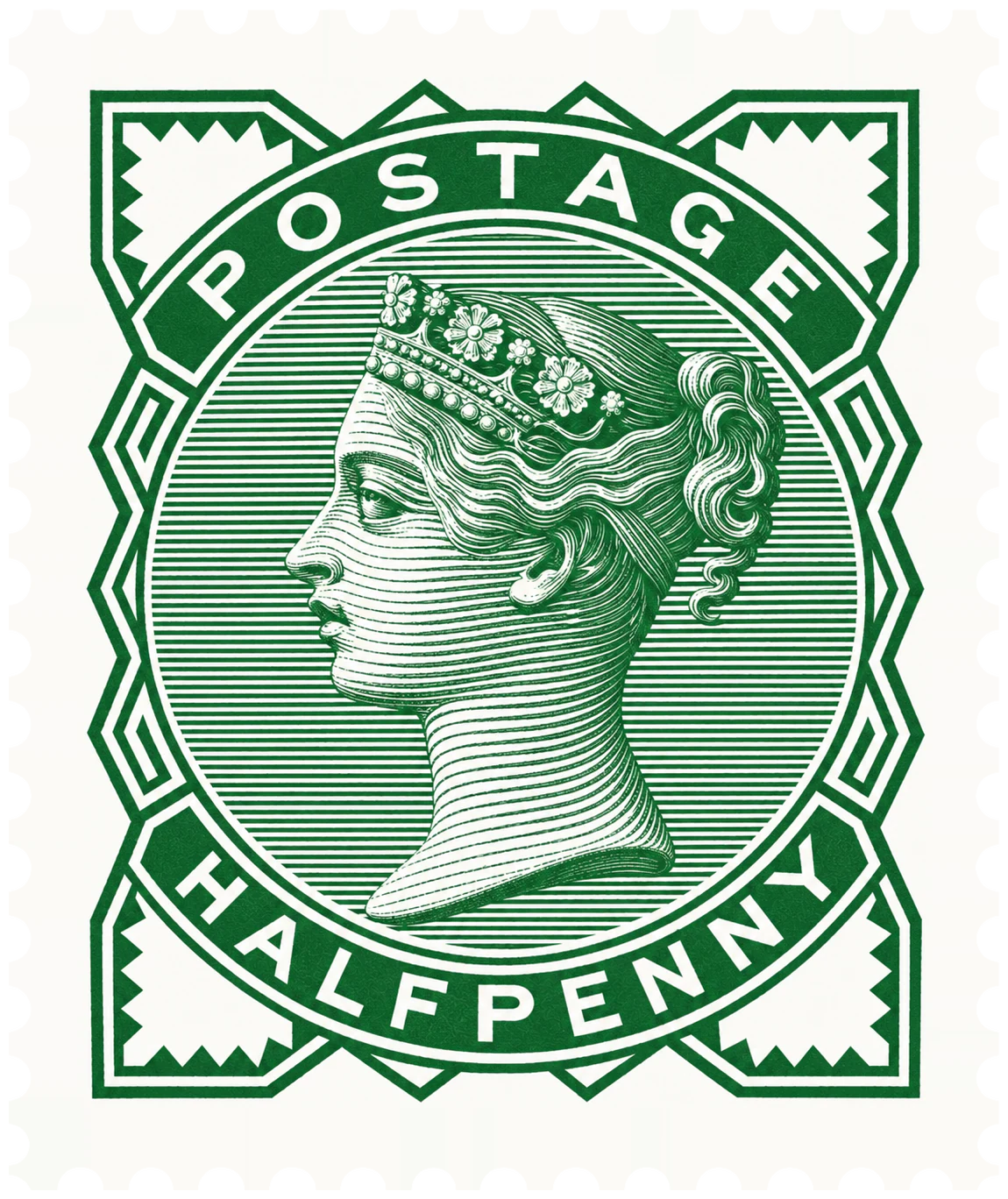
The zigzag frame around Victoria
The halfpenny has an unusually angular frame.
Victoria's portrait sits inside a circle against horizontal shading. POSTAGE follows the upper curve, while HALFPENNY follows the lower.
Outside the circle, the remaining space is filled with a bold zigzag pattern, giving the design a rectangular outline. [1]
The arrangement differs markedly from the delicate engraving of the earlier Bantam.
The new design was intended for surface printing, where stronger lines could be reproduced more reliably by machinery.
The alternative design that survived
De La Rue did not arrive at the new halfpenny design without experimentation.
A surviving die proof, described in an auction catalogue as Design B, was printed in green on glazed card. It records one of the designs considered during preparation of the 1880 stamp. [2]
Other surviving proofs came from De La Rue's own striking books, where the firm recorded the progress of engraving and plate preparation.
These preliminary impressions offer a glimpse of the design before the familiar halfpenny entered mass production.
Why there are no corner letters
The preceding Bantam had four corner letters and tiny numbers identifying its printing plate.
De La Rue omitted both features from the new halfpenny.
The corners instead became part of the zigzag ornament, while the printing plates were identified in official records rather than by figures on individual stamps. [1]
The change simplified the design and reduced the work of preparing each plate.
It also distinguished the halfpenny from the Venetian-red penny, which retained corner letters.
A crown replaces the handwritten watermark
The old Bantam had an extraordinary watermark: the words half penny in flowing handwriting, extending across three neighbouring stamps.
The 1880 halfpenny instead used paper carrying a Large Crown watermark. [1]
The crown was formed within the paper during manufacture rather than printed in ink.
It was part of a wider move towards using the same kind of paper for Britain's ordinary postage stamps.
A distinctive feature of the earlier halfpenny had disappeared, replaced by a standard royal emblem hidden beneath the new design.
The printing sheet with almost no instructions
The halfpenny was printed in sheets of 240 stamps, divided into two panes of 120.
Earlier British printing sheets often carried elaborate inscriptions explaining the value of rows and panes. The new halfpenny had almost none. [1]
A small T-shaped mark at the foot helped guide the perforating machinery.
The plate numbers and other identifying information were recorded in pen and ink on the official registration sheets rather than printed around the margins.
The simplified layout reveals how the printers were adapting their methods for faster production.
A portrait with a long history
Victoria's youthful profile can be traced back to William Wyon's medal portrait, derived from a sketch made in 1834 when she was fifteen.
Henry Corbould adapted Wyon's likeness for the original British postage stamps. Jean Ferdinand Joubert de la Ferté subsequently engraved a version for De La Rue's surface-printed issues. [3]
The halfpenny of 1880 belonged to this long tradition, although its coarser engraving was adapted to newer printing machinery.
The Queen was sixty-one when the stamp appeared, but the familiar youthful profile remained.
The diamond diadem made for a king
The ornament in Victoria's hair was commissioned for George IV's coronation in 1821. [4]
It contains 1,333 diamonds, with crosses and the national emblems of the rose, thistle and shamrock.
Victoria later wore the diadem in portraits, and it became a familiar feature of British postage stamps.
On the green halfpenny, its elaborate jewels are reduced to small printed lines. A magnificent royal ornament had become part of an everyday stamp worth half a penny.
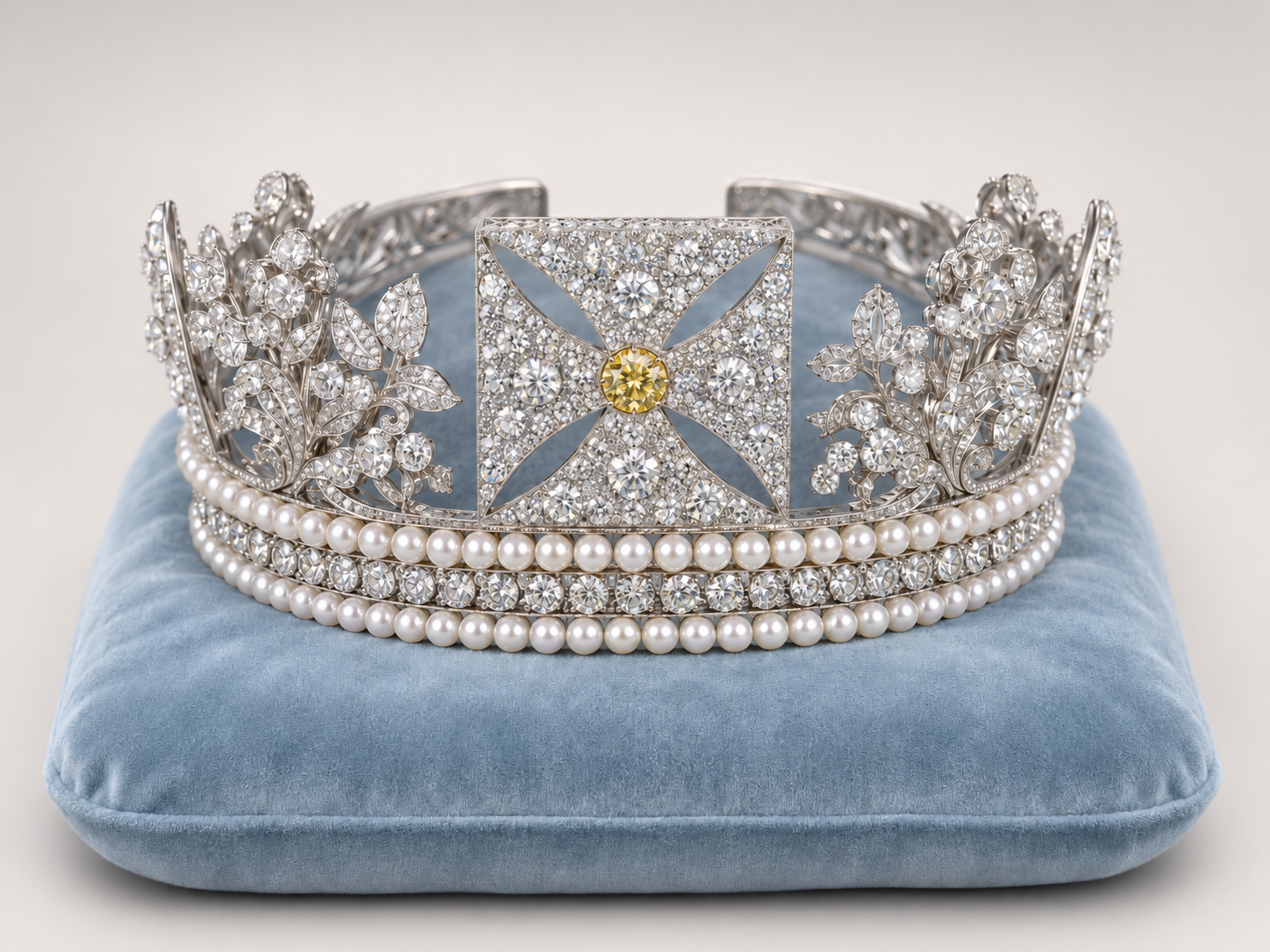
Image information
Click image to magnify
Digitally created illustration of the diamond diadem, with crosses, floral emblems and rows of pearls, resting on a blue cushion.
- Credit
- Stunning Stamps.
- Notes
- Digitally created.
Sources
- Hastings E. Wright and A. B. Creeke: A History of the Adhesive Stamps of the British Isles (1899), pp. 146–147
- David Feldman: Great Britain auction catalogue, lot 40550 — halfpenny Design B proof
- Douglas N. Muir, Royal Mint Museum: William Wyon & the Penny Black
- Royal Collection Trust: George IV's Diamond Diadem