
The design of the 2d pale rose
Queen Victoria · Great Britain · Thomas De La Rue & Co. · 1880
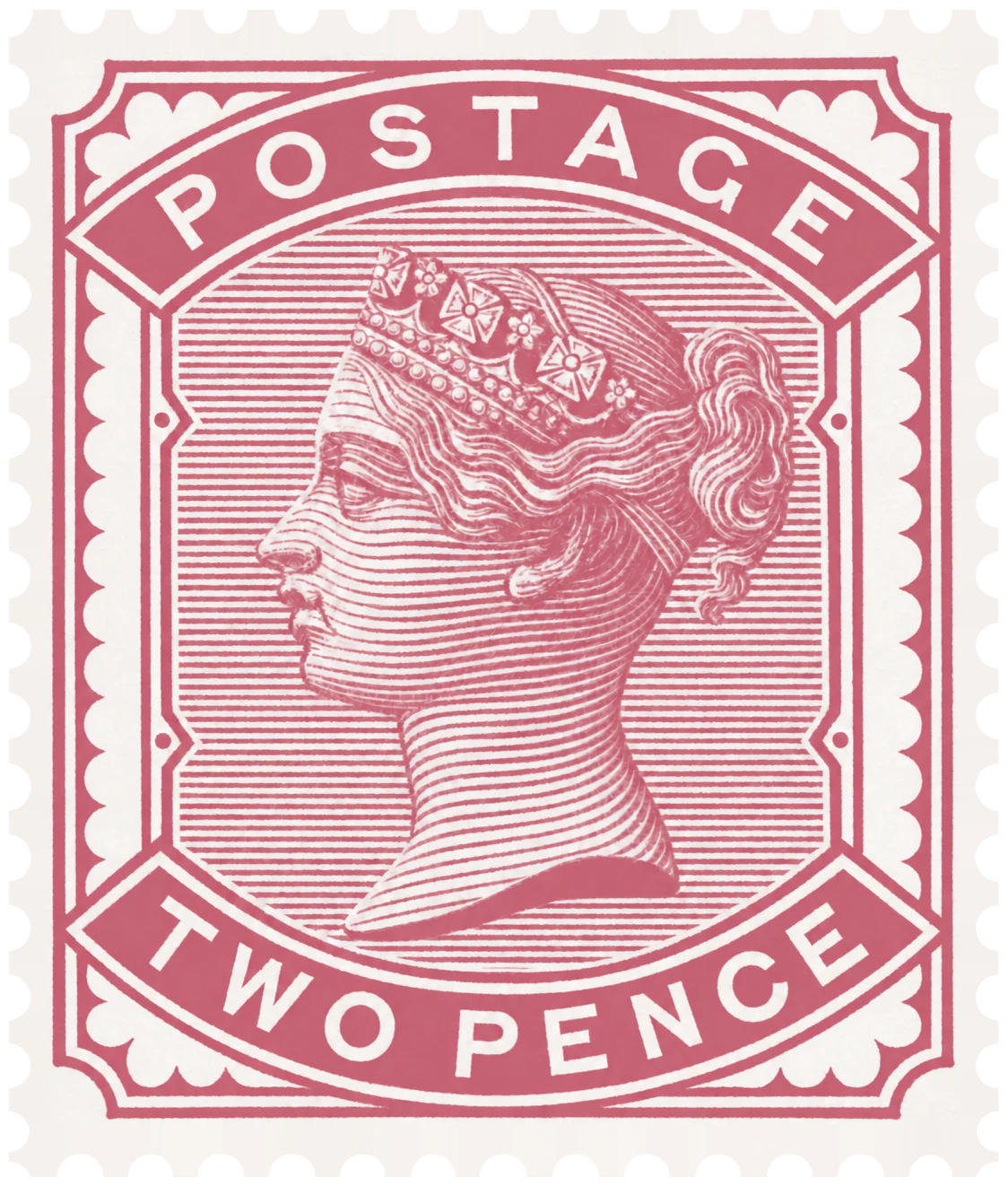
Two curved panels replace the white lines
The new twopenny has a very different arrangement from the line-engraved blue stamp it replaced.
Victoria's portrait sits against horizontal shading inside a frame with straight sides and curved upper and lower ends.
POSTAGE follows the upper curve, while TWO PENCE follows the lower. Both inscriptions appear in white capitals against solid rose-coloured panels. [1]
The two white horizontal rules of the earlier Two Pence Blue disappeared entirely.
A familiar denomination had acquired a design intended for a different printing process.
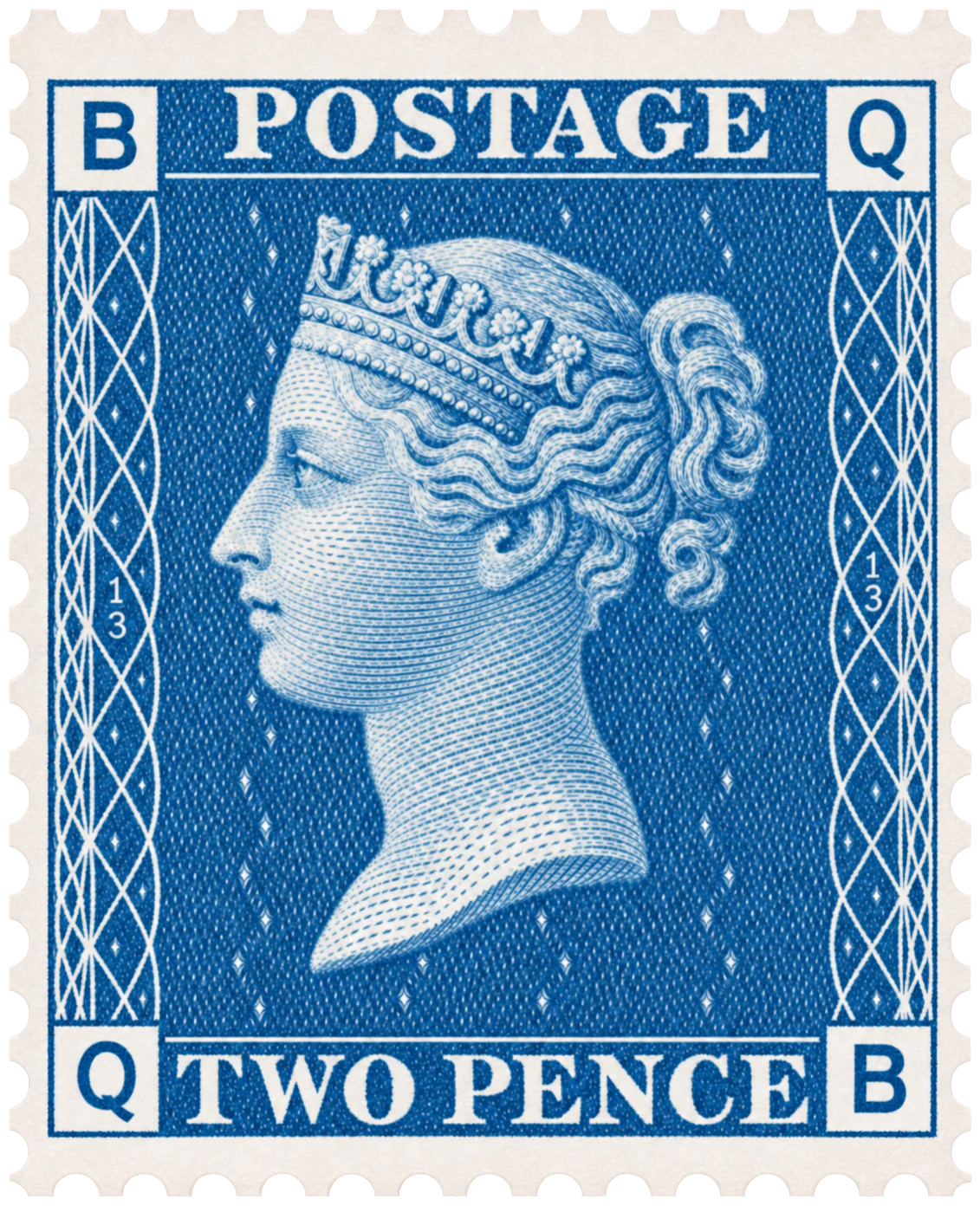
Compare the white rules and rectangular panels with the new curved inscriptions.
Click either stamp to magnify
The corners with little scallops
Look at the outer corners of the stamp. Their edges have small inward and outward curves, rather than forming perfectly straight angles.
The inner border is also denticulated, with a row of tiny tooth-like projections. [1]
These features give the otherwise simple rectangular design a decorative finish.
The ornament is much less elaborate than the engine-turned borders of the earlier Two Pence Blue.
De La Rue's designers used a few strong shapes to frame the Queen, leaving the portrait as the central feature.
The mauve colour that was rejected
The issued stamp is pale rose, but the printers considered other colours.
One surviving colour trial was printed in dull mauve on Crown-watermarked paper and perforated fourteen. It can be compared directly with the issued rose impression. [2]
The same engraving appears in both colours.
The difference demonstrates how strongly printing ink affects the character of a stamp, even when every line of the design remains unchanged.
The surviving trial also shows that the eventual rose colour was selected from alternatives rather than being the only possibility.
Why there are no corner letters
The earlier line-engraved twopenny had four corner letters and tiny plate numbers.
De La Rue omitted both features from the new design. The corners became decorative, while the printing plates were identified through official records. [1]
Only two plates were needed for the rose-coloured twopenny, and both were registered in September 1880.
The simplified arrangement reduced the work involved in preparing printing plates.
The absence of letters is therefore a visible feature of a new approach to manufacture.
A crown hidden within the paper
The twopenny was printed on paper carrying the Large Crown watermark introduced for the provisional series.
The crown was formed within the paper during manufacture, not printed in ink. It could be examined by holding the stamp against transmitted light. [1]
The same paper was used for the other new low denominations.
Its adoption helped standardise materials and simplify production.
The visible design had changed, but a hidden royal emblem still helped protect the stamp against imitation.
A portrait with a long history
The youthful likeness of Victoria had its origins in William Wyon's medal portrait, derived from a sketch made in 1834 when she was fifteen.
Henry Corbould adapted the image for the first British postage stamps. Jean Ferdinand Joubert de la Ferté later engraved a version for De La Rue's surface-printed issues. [3, 4]
The twopenny of 1880 belonged to this long tradition, although its stronger lines were suited to modern printing machinery.
Victoria was sixty-one when the stamp appeared, but her youthful image remained familiar.
The diamond diadem made for a king
The ornament in Victoria's hair was commissioned for George IV's coronation in 1821. [5]
It contains 1,333 diamonds, with crosses and the national emblems of the rose, thistle and shamrock.
Victoria later wore the diadem in portraits, and it became a familiar feature of British postage stamps.
On the twopenny pale rose, its jewels are reduced to small printed lines. A magnificent royal ornament had become part of an everyday stamp worth two pence.
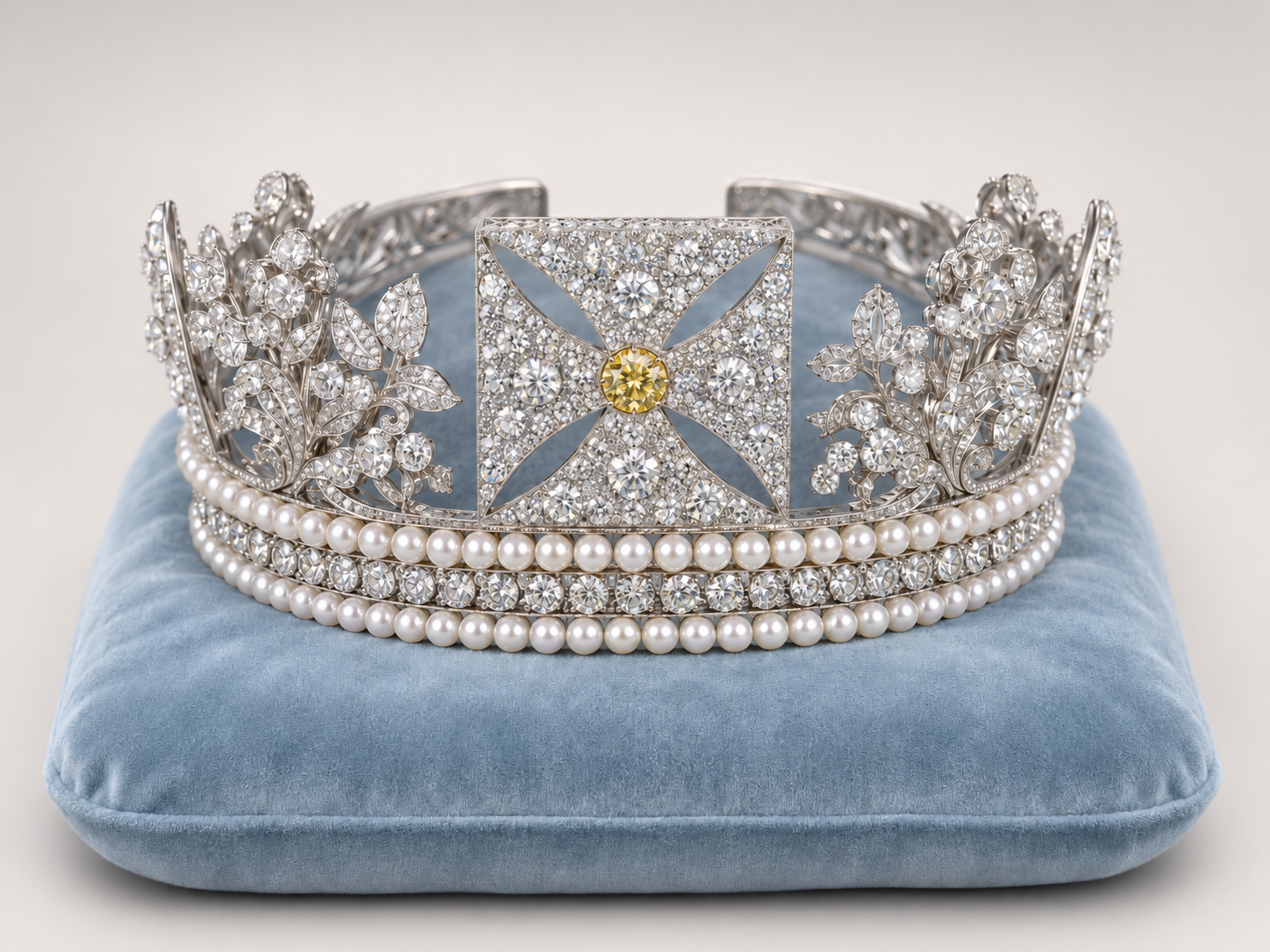
Image information
Click image to magnify
Digitally created illustration of the diamond diadem, with crosses, floral emblems and rows of pearls, resting on a blue cushion.
- Credit
- Stunning Stamps.
- Notes
- Digitally created.
Sources
- Hastings E. Wright and A. B. Creeke: A History of the Adhesive Stamps of the British Isles (1899), p. 149
- Corinphila: 1880 Twopenny dull-mauve colour trial
- Douglas N. Muir, Royal Mint Museum: William Wyon & the Penny Black
- Robert B. Galland: The First Low Value Surface Printed Postage Stamps of Great Britain (2014)
- Royal Collection Trust: George IV's Diamond Diadem