
The design of the 1s green
Queen Victoria · Great Britain · Thomas De La Rue & Co. · 1873
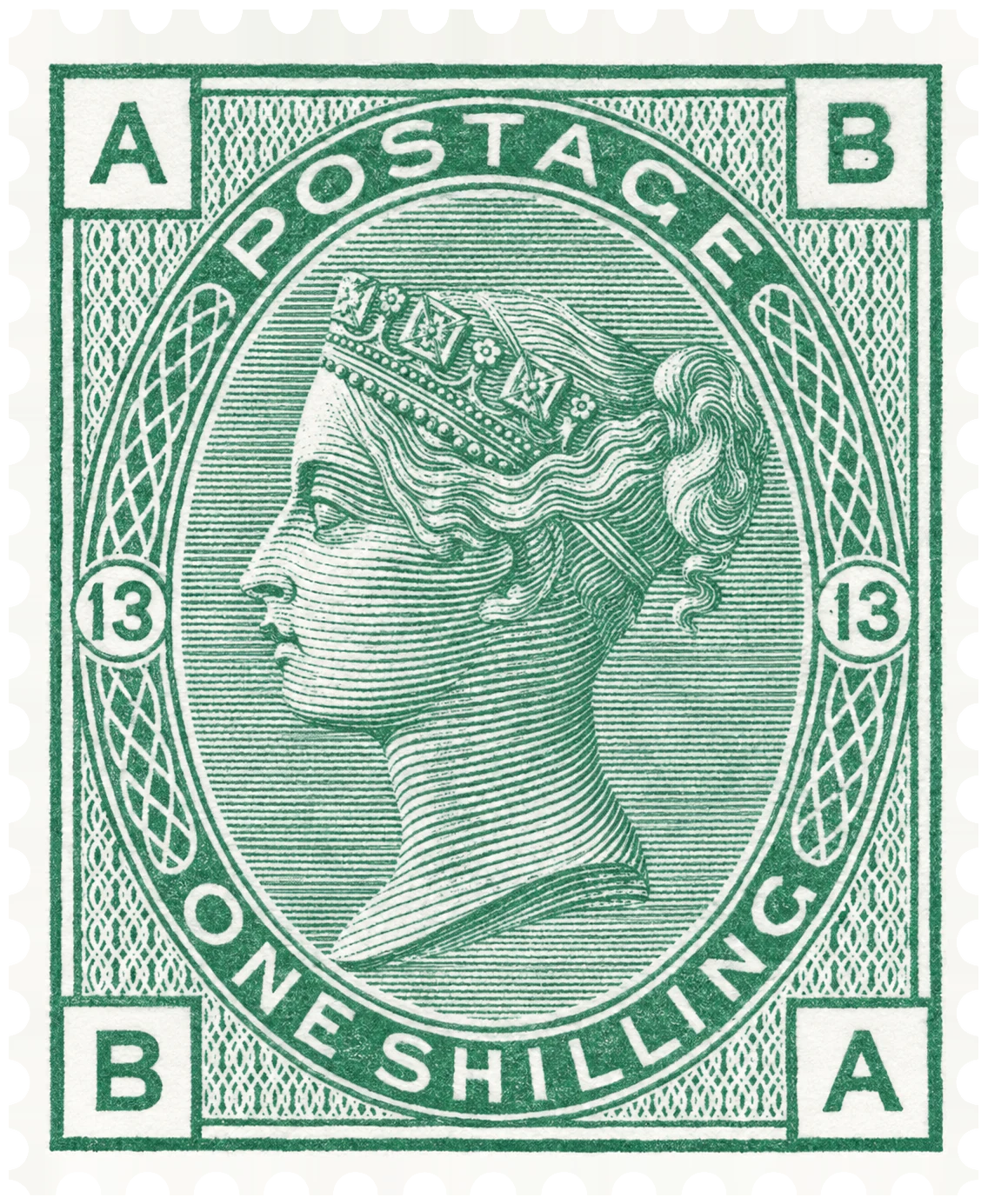
The corners change from white to green
The earlier one-shilling had white letters against solid green corner squares.
In 1873, De La Rue reversed the arrangement. The new stamp had green letters against white backgrounds. [1]
The lower letters identified the stamp's position in the printing sheet. Those above repeated the pair in reverse order.
The change was made to simplify the preparation of printing plates, allowing interchangeable letter plugs to be inserted more efficiently.
The new appearance was therefore a direct consequence of an improvement in manufacturing methods.
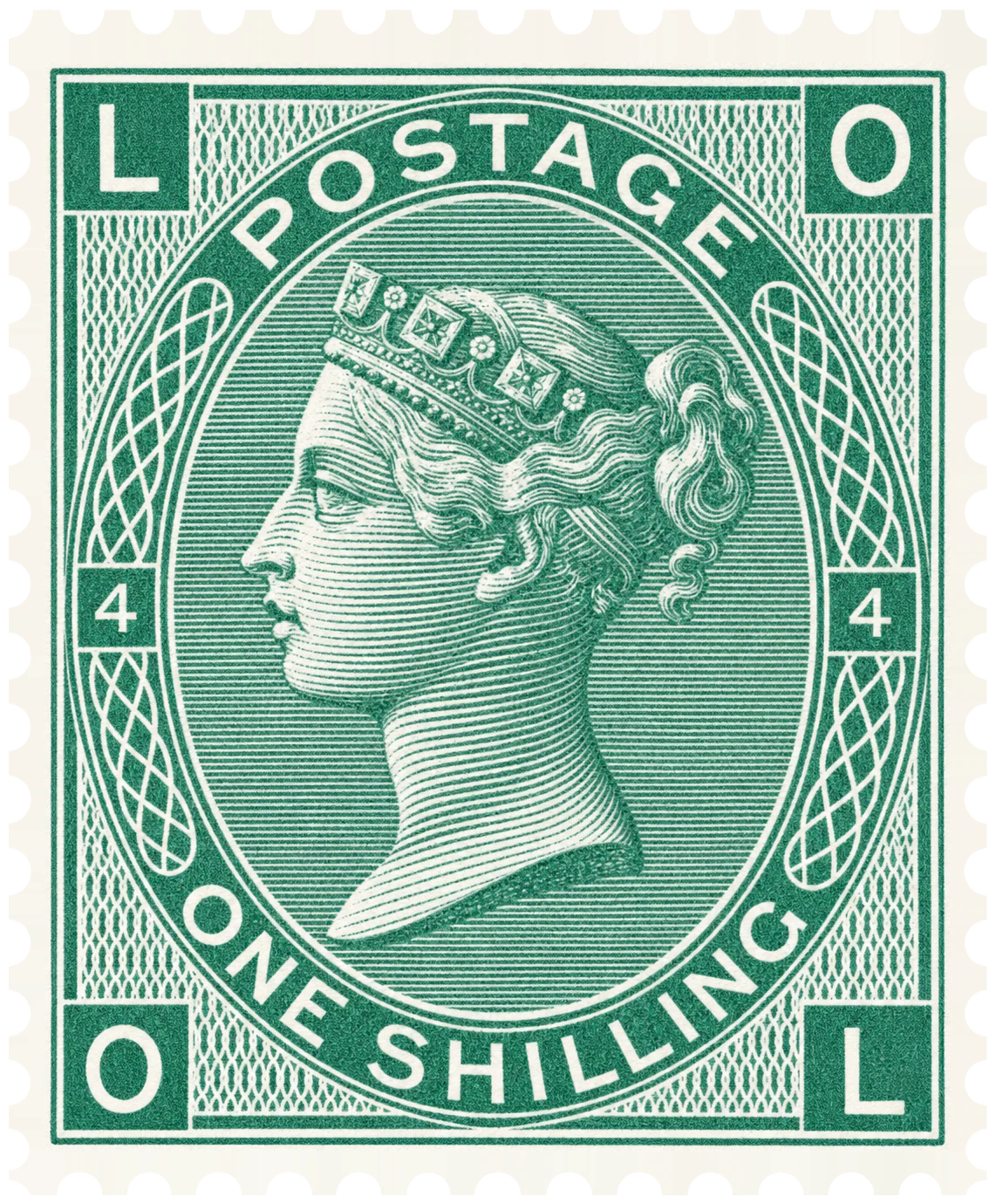
Compare the four corner panels and the changes to the surrounding frame.
Click either stamp to magnify
The engraver reconstructs the oval
The 1873 shilling was made from a new die, known as Die IV.
Victoria's head was retouched, while the ornamental oval surrounding her was reconstructed. The inscriptions were revised and the outer frame made heavier. [2]
The fine background patterns in the corners were also altered.
The result was recognisably the same one-shilling design, but with a stronger framework.
The engravers had done considerably more than reverse the corner lettering.
The pattern between the frame and the corners
The spaces between the oval portrait and rectangular outer frame are called spandrels.
On the 1873 shilling, these contain a fine reticulated pattern, made from intersecting engraved lines.
The pattern was altered when the design was reconstructed. The lettering of POSTAGE and ONE SHILLING was also modified. [2]
These changes are subtle, but become clearer when the stamp is enlarged.
The delicate pattern helped fill the unused space while making the design more difficult to imitate accurately.
The plate numbers acquire white backgrounds
The small plate numbers appear in circles on either side of Victoria's portrait.
Like the corner letters, they changed in 1873 from white figures on coloured backgrounds to coloured figures on white.
The new arrangement allowed the numbers to be produced using interchangeable metal plugs. [1]
The first plate carried the number 8, followed by later plates.
The numbers became easier to incorporate during plate-making without disturbing the established appearance of the stamp.
The empty spaces in a workshop proof
Surviving De La Rue die proofs show the shilling before its identifying letters and numbers were inserted.
A proof dated 17 May 1872 shows blank white corner squares and empty circles beside Victoria's portrait. It is marked "Before hardening". [1]
These empty spaces were not omissions in an unfinished illustration.
They were deliberately prepared to receive the interchangeable metal plugs that would supply the letters and plate numbers.
The proof reveals the stamp as a working design, before the details needed for mass production had been added.
The rose concealed within the paper
The one-shilling green was printed on paper carrying the Spray of Rose watermark.
The rose was formed within the paper during manufacture rather than printed in ink. It made the paper more difficult to imitate. [2]
The watermark had replaced the earlier group of four Heraldic Emblems in 1867.
It remained in use when the corner letters changed in 1873.
The visible design was therefore revised while the hidden security feature continued unchanged.
A portrait of a fifteen-year-old princess
Victoria's portrait originated before she became Queen. William Wyon, Chief Engraver at the Royal Mint, created a medal commemorating her visit to the City of London in November 1837. Its portrait drew on a sketch made in 1834, when Victoria was fifteen. The medal was issued in 1838. [3]
Henry Corbould prepared a drawing based on Wyon's portrait, which later supplied the model for Joubert's surface-printed engraving.
Victoria's youthful likeness remained familiar even as the designs surrounding it changed. [4, 5]
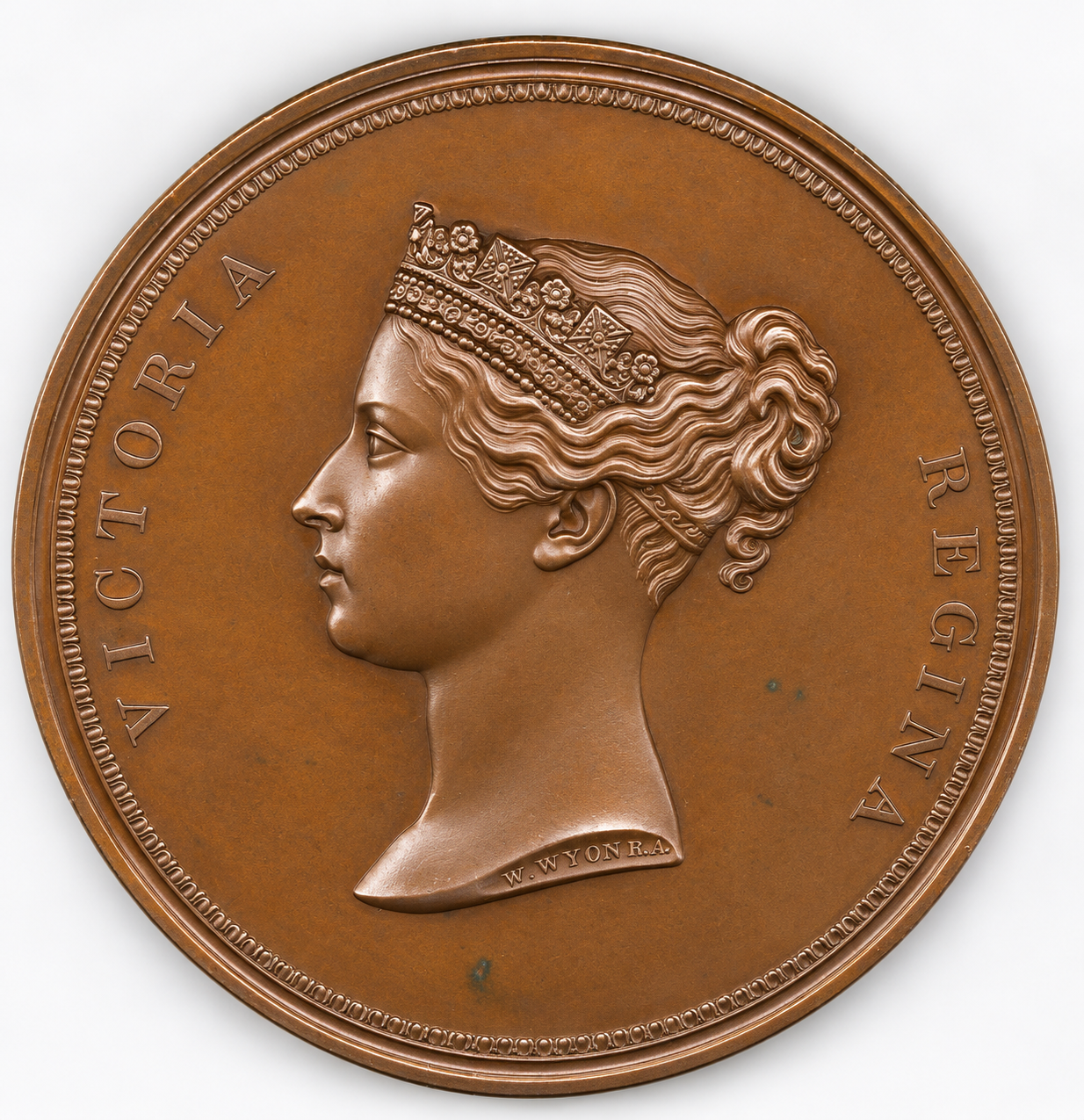
Image information
Click image to magnify
Bronze medal showing the young Victoria in left-facing profile, wearing the diamond diadem, with the inscription VICTORIA REGINA.
- Credit
- Heritage Auctions, via Wikimedia Commons. CC BY 3.0.
- Notes
- Brightness, contrast, sharpness and colour balance adjusted by Stunning Stamps.
The diamond diadem made for a king
The ornament in Victoria's hair was commissioned for George IV's coronation in 1821. [6]
It contains 1,333 diamonds, with crosses and the national emblems of the rose, thistle and shamrock.
Victoria later wore the diadem in portraits, and it became a familiar feature of British postage stamps.
On the one-shilling green, its jewels are reduced to tiny engraved marks. A magnificent royal ornament had become part of an everyday object worth one shilling.

Image information
Click image to magnify
Digitally created illustration of the diamond diadem, with crosses, floral emblems and rows of pearls, resting on a blue cushion.
- Credit
- Stunning Stamps.
- Notes
- Digitally created.
Sources
- The Shilling's Tale: Co-Evolution of Form and Function of the One-Shilling Stamp (2022), frame C: coloured-letter dies and production proofs
- Hastings E. Wright and A. B. Creeke: A History of the Adhesive Stamps of the British Isles (1899), pp. 131–132
- Douglas N. Muir, Royal Mint Museum: William Wyon & the Penny Black
- Heritage Auctions, William Wyon medal photograph, via Wikimedia Commons (enhanced for display)
- Wyon medal photograph: Creative Commons Attribution 3.0 licence
- Royal Collection Trust: George IV's Diamond Diadem
