
The design of the 1s orange-brown
Queen Victoria · Great Britain · Thomas De La Rue & Co. · 1880
The green stamp becomes orange-brown
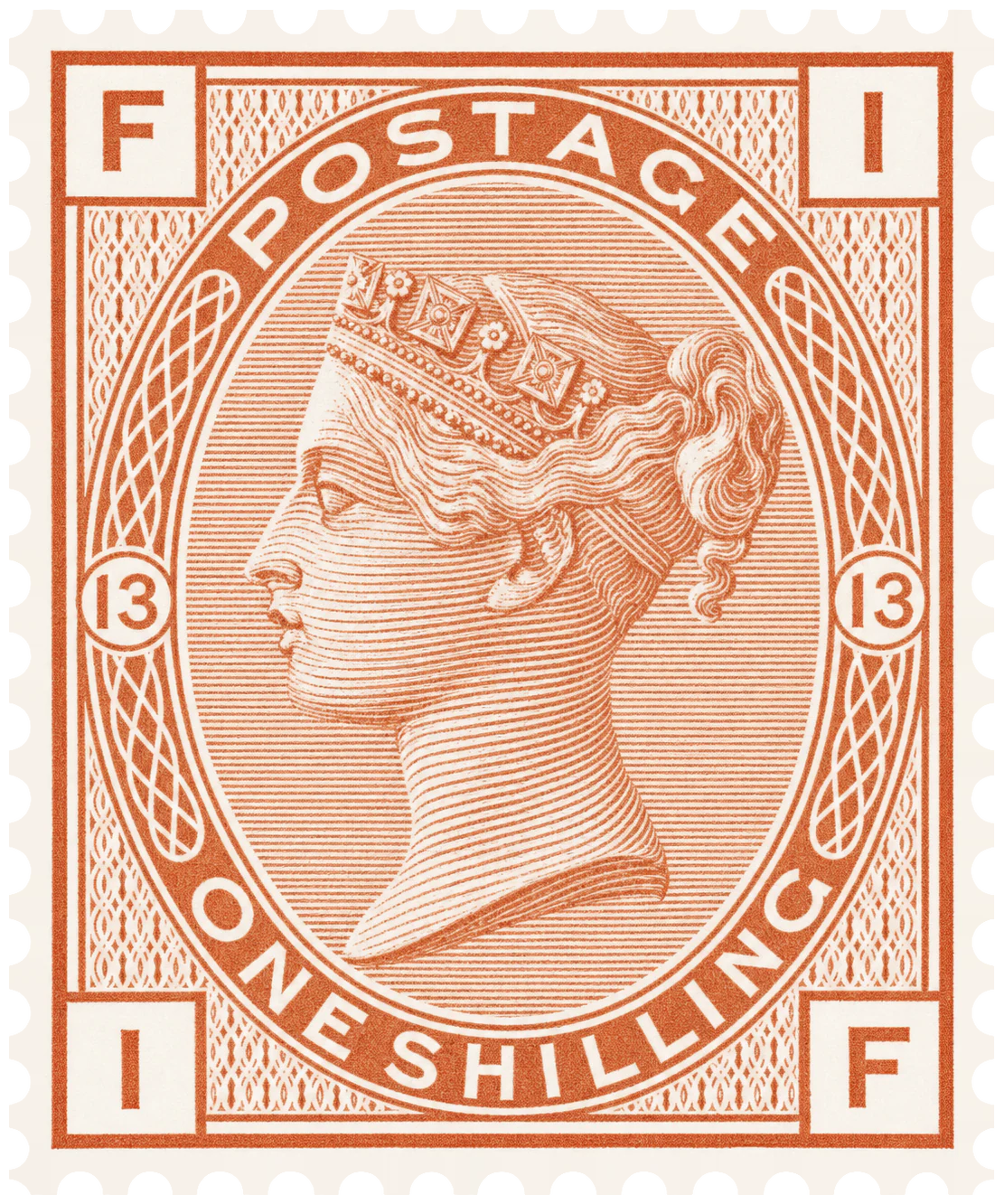
The orange-brown shilling of 1880 retained the design introduced in 1873.
Victoria's portrait, ornamental oval, inscriptions, corner letters and plate numbers remained unchanged. Only the ink colour was different.
The change followed the international decision to reserve green for stamps used at the common printed-matter rate. Britain's new halfpenny was to be green, so the shilling needed another colour. [1]
De La Rue selected a pale orange-brown, also described as red-brown or salmon.
The same printing plate was used in both colours. The altered appearance was therefore entirely the result of the printer's ink.
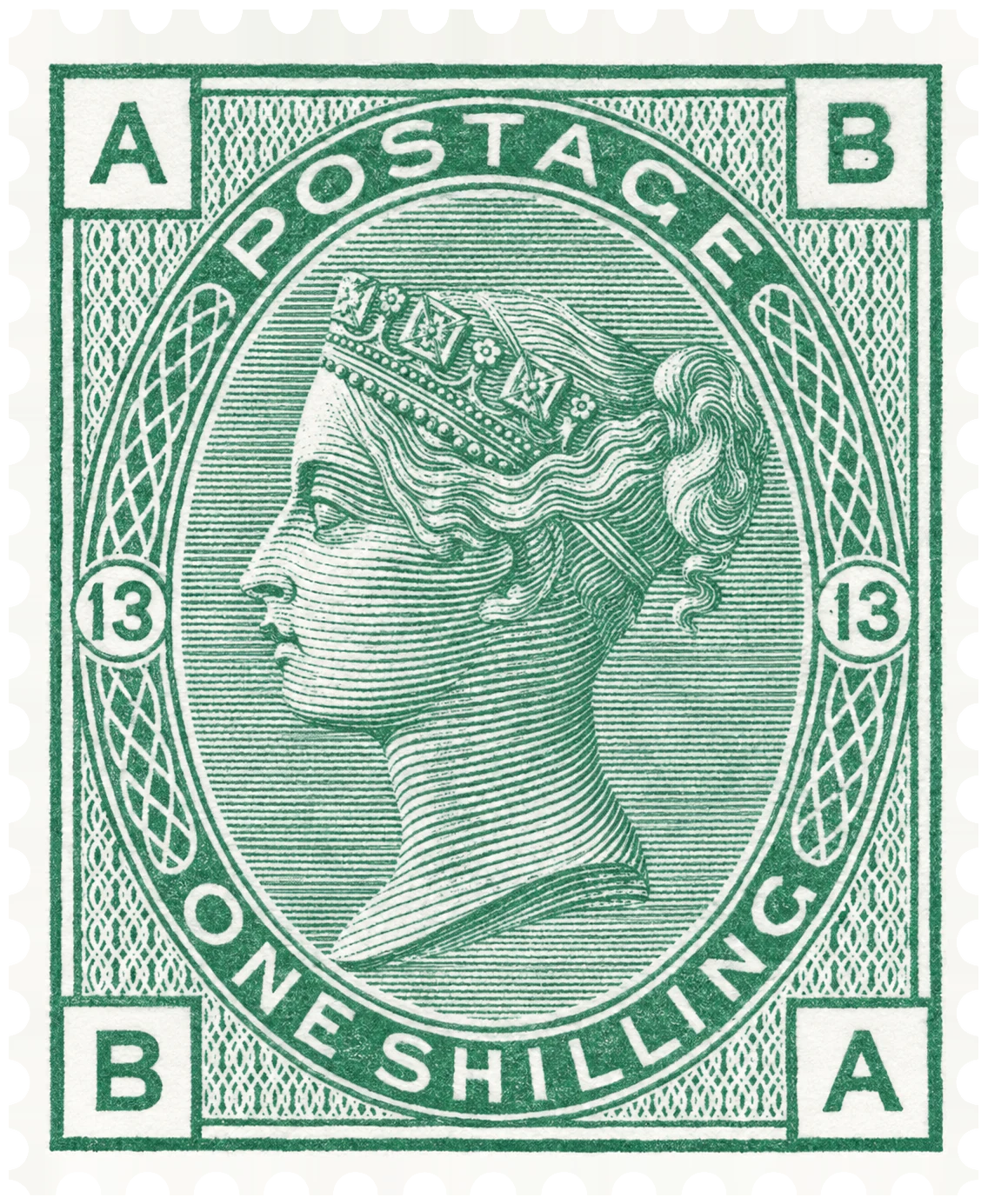
Compare the retained oval design in the two issued colours.
Click either stamp to magnify
A familiar oval and reconstructed frame
Victoria's portrait sits within a tall ornamental oval.
POSTAGE follows the upper curve, while ONE SHILLING occupies the lower portion. Fine reticulated patterns fill the spaces between the oval and the rectangular outer frame.
This arrangement had been revised in 1873, when De La Rue prepared Die IV. The Queen's head was retouched, the oval reconstructed and the surrounding ornament strengthened. [2]
The orange-brown stamp retained that engraving without alteration.
Placed beside the earlier green shilling, it demonstrates how the same fine lines could produce a different visual effect when printed in another colour.
Four coloured letters on white
The four corner letters are printed in orange-brown against white backgrounds.
The lower pair identifies each stamp's position within the printing sheet. Those above repeat the same letters in reverse order.
The arrangement was intended to expose attempts to construct apparently unused stamps from pieces of used examples. [2]
De La Rue had introduced coloured letters in 1873 to simplify plate-making. Interchangeable metal plugs could supply the individual characters more efficiently than the earlier white-letter arrangement.
The orange-brown shilling retained this practical improvement.
The printing plate number stays the same
Two small circles appear on either side of Victoria's portrait, containing the plate number.
The first orange-brown stamps show 13, identifying the plate already used for the green shilling. [2]
When the paper changed in 1881, plate 14 also entered production. Its stamps carry the corresponding number.
The figures are coloured against white backgrounds, matching the treatment of the corner letters.
The small numbers provide a visible link between stamps produced at different stages of the design's history.
The rose replaced by a crown
The original orange-brown shilling was printed on paper carrying the Spray of Rose watermark.
The rose was formed during papermaking, rather than printed in ink. It helped make the paper difficult to imitate.
In 1881, the authorities introduced a Large Crown watermark. [1]
The printing plates had to be dismantled and rearranged to accommodate the new paper.
The stamp's printed appearance remained unchanged, but its hidden design was different.
Two orange-brown shillings can therefore look identical from the front while revealing different stages of production when their watermarks are examined.
The wing margins that disappeared
The original shilling printing sheets contained twelve panes of twenty stamps, separated by unprinted gutters.
When the sheets were divided and perforated, stamps adjoining those gutters could retain unusually wide margins, known as wing margins.
The introduction of Crown-watermarked paper in 1881 required De La Rue to rearrange the plates into two larger panes of 120 stamps. [1]
The old gutters disappeared, and with them the characteristic wing margins.
The edge of a stamp could therefore reveal an alteration made to the printing equipment, even though Victoria's portrait and the surrounding design were unchanged.
The lilac design that never appeared
In 1883, De La Rue experimented with printing the existing shilling design in lilac.
Plates 13 and 14 were registered again in the new colour as part of preparations for stamps that could serve both postal and revenue purposes. [1]
The proposed stamps were not issued.
Instead, the authorities adopted an entirely new design in 1884, printed in dull green.
The lilac impressions preserve a possible alternative future for the familiar orange-brown stamp: the same portrait and ornamental frame, but in another security ink.
A portrait of a fifteen-year-old princess
Victoria's portrait originated before she became Queen. William Wyon, Chief Engraver at the Royal Mint, created a medal commemorating her visit to the City of London in November 1837. Its portrait drew on a sketch made in 1834, when Victoria was fifteen. The medal was issued in 1838. [3]
Henry Corbould prepared a drawing based on Wyon's portrait, which later supplied the model for Joubert's surface-printed engraving.
Victoria's youthful likeness remained familiar even as the designs surrounding it changed. [4, 5]
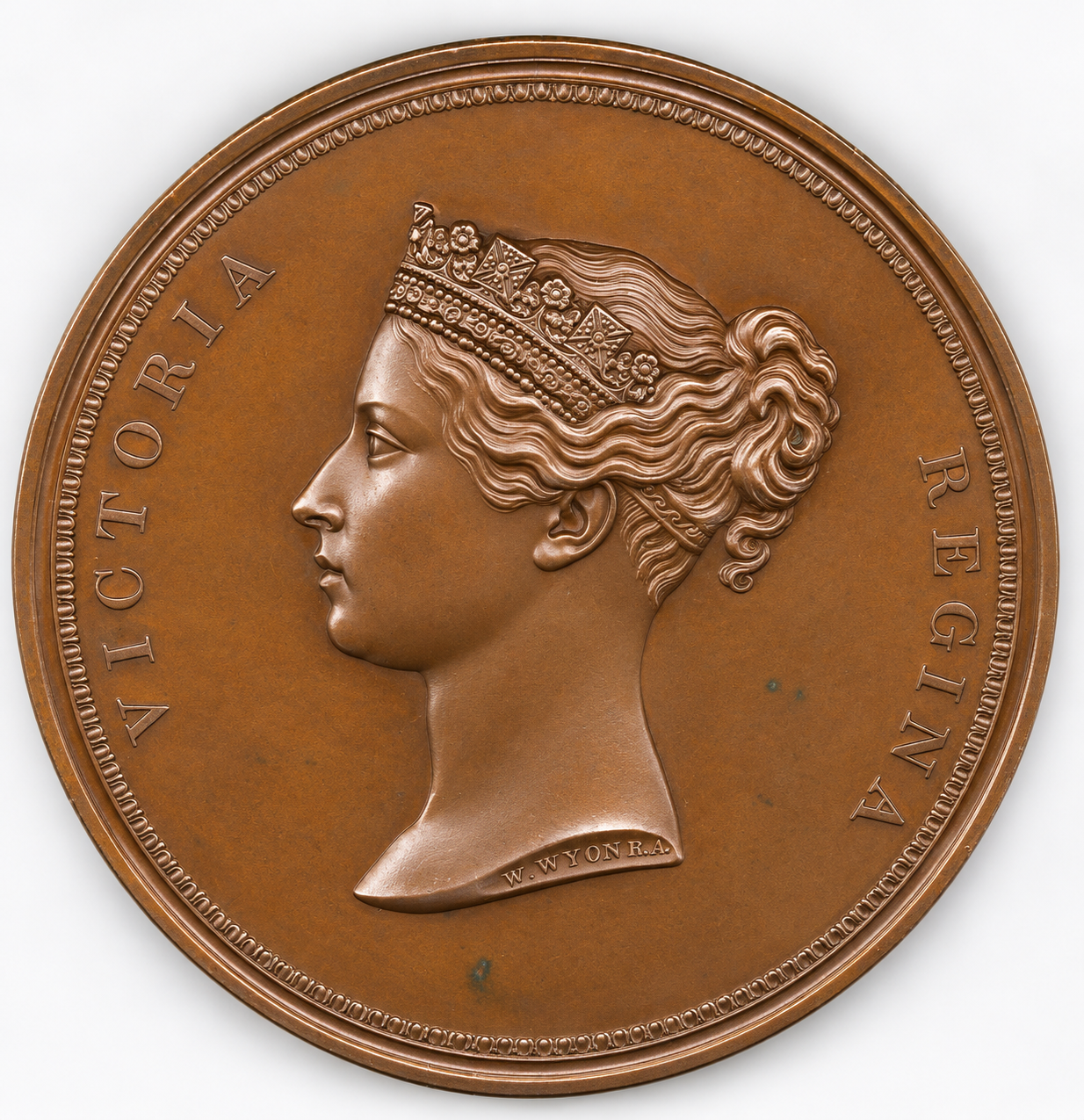
Image information
Click image to magnify
Bronze medal showing the young Victoria in left-facing profile, wearing the diamond diadem, with the inscription VICTORIA REGINA.
- Credit
- Heritage Auctions, via Wikimedia Commons. CC BY 3.0.
- Notes
- Brightness, contrast, sharpness and colour balance adjusted by Stunning Stamps.
The diamond diadem made for a king
The ornament in Victoria's hair was commissioned for George IV's coronation in 1821. [6]
It contains 1,333 diamonds, with crosses and the national emblems of the rose, thistle and shamrock.
Victoria later wore the diadem in portraits, and it became a familiar feature of British postage stamps.
On the orange-brown shilling, its jewels are reduced to tiny engraved marks. A magnificent royal ornament had become part of an everyday object worth one shilling.
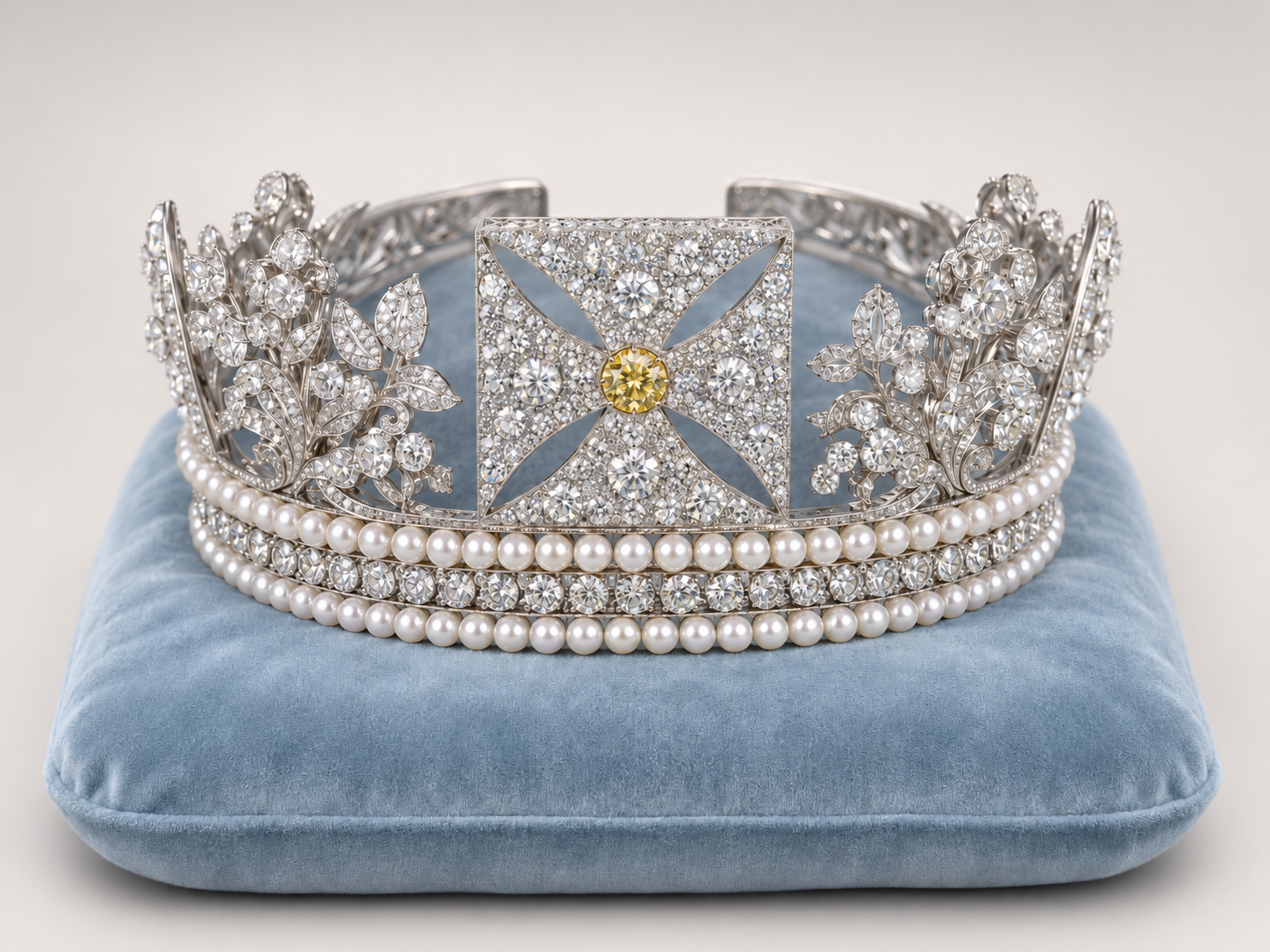
Image information
Click image to magnify
Digitally created illustration of the diamond diadem, with crosses, floral emblems and rows of pearls, resting on a blue cushion.
- Credit
- Stunning Stamps.
- Notes
- Digitally created.
Sources
- The Shilling's Tale: Co-Evolution of Form and Function of the One-Shilling Stamp (2022), frame D, pp. 5–7 and 14
- Hastings E. Wright and A. B. Creeke: A History of the Adhesive Stamps of the British Isles (1899), pp. 131–133
- Douglas N. Muir, Royal Mint Museum: William Wyon & the Penny Black
- Heritage Auctions, William Wyon medal photograph, via Wikimedia Commons (enhanced for display)
- Wyon medal photograph: Creative Commons Attribution 3.0 licence
- Royal Collection Trust: George IV's Diamond Diadem
