
The design of the 3d rose
Queen Victoria · Great Britain · Thomas De La Rue & Co. · 1873
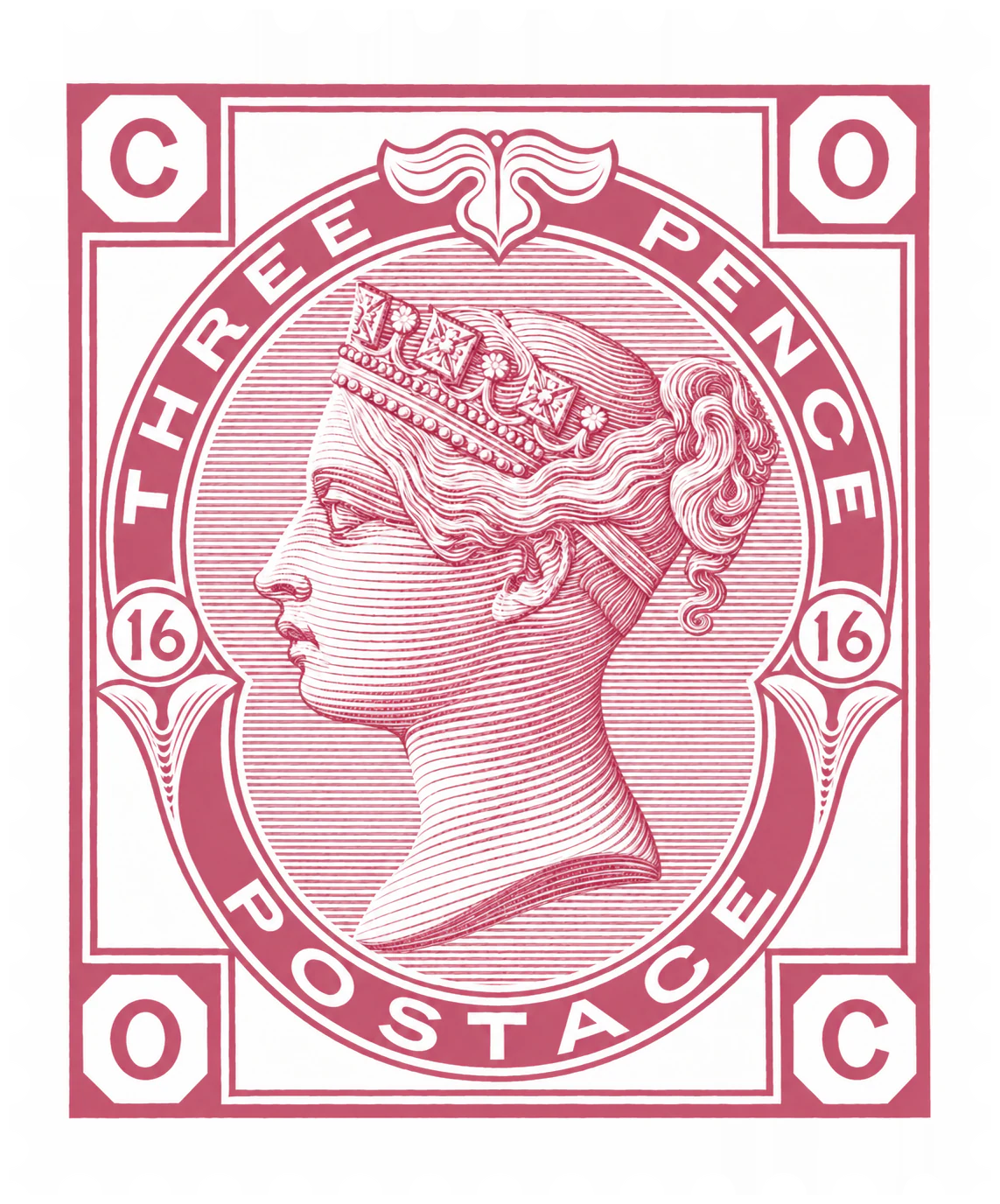
Coloured letters replace white
The 1873 threepenny has coloured letters against white corner squares.
Its predecessor had white letters on coloured backgrounds. The arrangement was reversed to simplify the preparation of printing plates. [1]
The lower pair identifies the stamp's position within the sheet. The upper letters repeat the same pair in reverse order.
The new method allowed the engravers to insert interchangeable letter plugs into the die more efficiently.
The change was therefore not simply decorative. It was a visible consequence of improvements made behind the scenes.
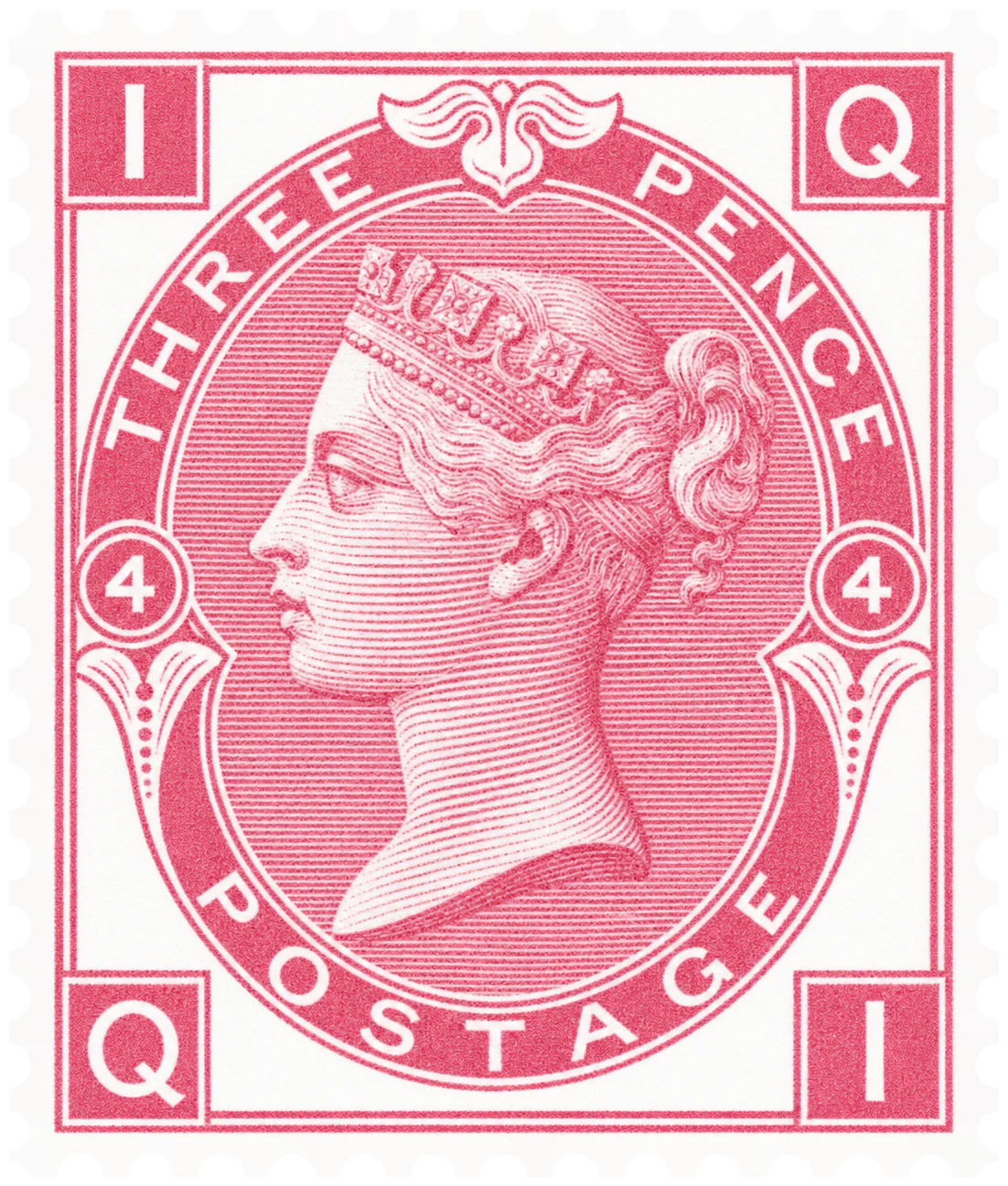
Compare the four corner panels and the changes to the surrounding frame.
Click either stamp to magnify
Victoria's portrait is remodelled
The new threepenny used a revised die, known as Die III.
The engravers retouched Victoria's bust and reduced the size of the three-lobed frame around it. The alteration made the portrait more prominent within the available space. [2]
The surrounding inscriptions and ornament remained recognisable.
The changes were subtle, but the new die was more than the old design with different corner letters.
Placed beside the 1865 threepenny, the stamp reveals the engravers' continuing refinement of Victoria's portrait.
A smaller ornamental frame
The threepenny retained its unusual three-lobed border.
THREE PENCE follows the upper portion, while POSTAGE curves beneath Victoria's head. Small scrolls and ornaments occupy the spaces between the words. [2]
For the 1873 version, the frame was made smaller, allowing the portrait to occupy a slightly different position.
The general arrangement had survived since 1862, when the first threepenny was redesigned after officials considered it too similar to the fourpenny.
The familiar frame had proved useful enough to survive another alteration.
The plate numbers change colour too
The corner letters were not the only details reversed in 1873.
The small plate numbers beside Victoria's portrait also changed from white figures on coloured discs to coloured figures on white. [2]
The first ordinary plate carried the number 11, followed by subsequent plates.
These figures identify the printing equipment used to manufacture the stamp.
Their new appearance was part of the same effort to simplify the preparation of plates without losing the practical information already included in the design.
A rose hidden inside the paper
The threepenny was printed on paper carrying the Spray of Rose watermark.
The design was formed during papermaking, not printed in ink. It helped make the paper more difficult to imitate. [2]
An earlier proposal had included a rose, shamrock and thistle growing from one stalk, but that arrangement was rejected in favour of the rose alone.
The watermark remained unchanged when the coloured corner letters appeared.
The printed design had acquired a new appearance, while the hidden floral emblem continued beneath it.
A portrait of a fifteen-year-old princess
Victoria's portrait originated before she became Queen. William Wyon, Chief Engraver at the Royal Mint, created a medal commemorating her visit to the City of London in November 1837. Its portrait drew on a sketch made in 1834, when Victoria was fifteen. The medal was issued in 1838. [3]
Henry Corbould prepared a drawing based on Wyon's portrait, which later supplied the model for Joubert's surface-printed engraving.
Victoria's youthful likeness remained familiar even as the designs surrounding it changed. [4, 5]
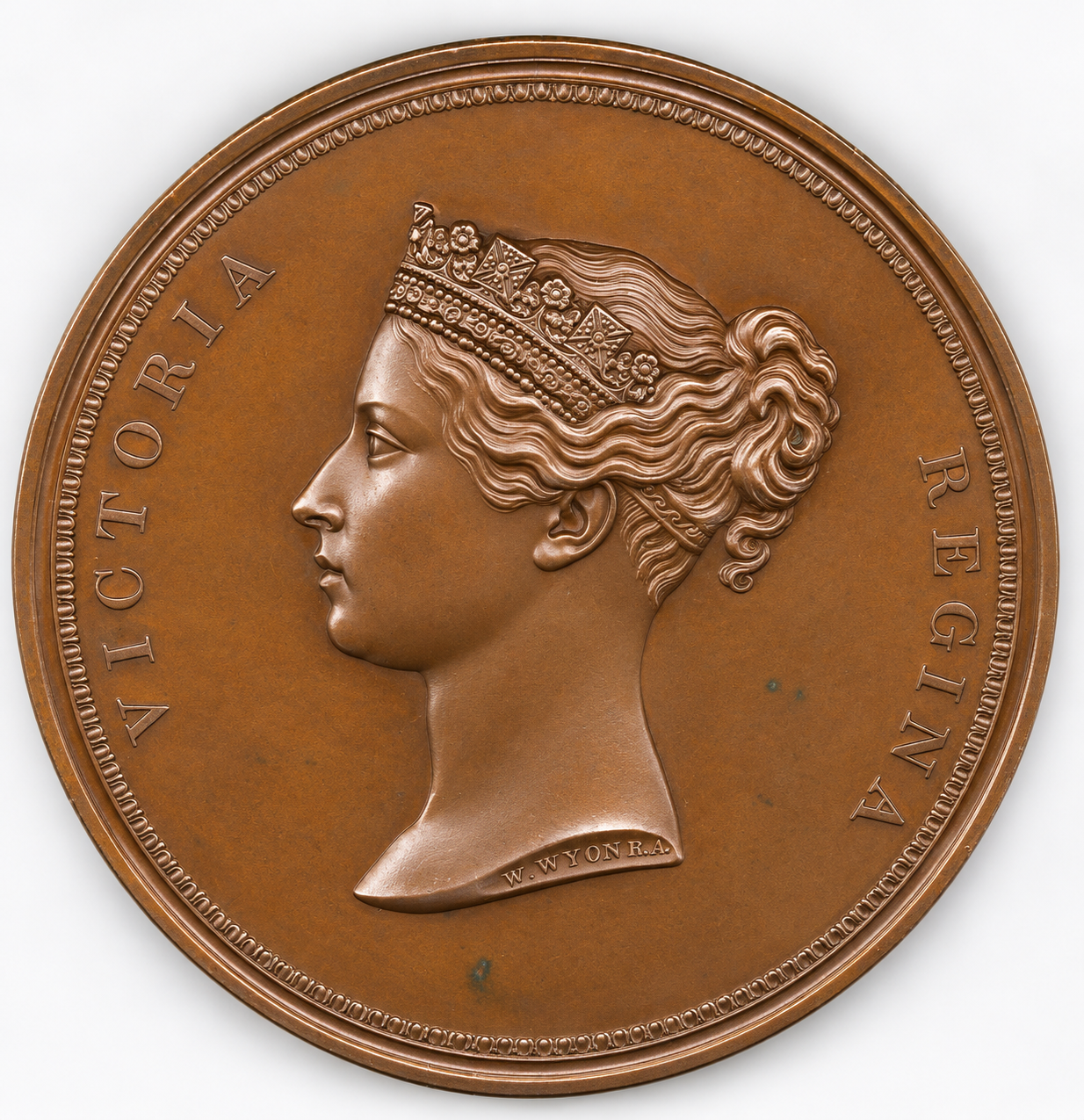
Image information
Click image to magnify
Bronze medal showing the young Victoria in left-facing profile, wearing the diamond diadem, with the inscription VICTORIA REGINA.
- Credit
- Heritage Auctions, via Wikimedia Commons. CC BY 3.0.
- Notes
- Brightness, contrast, sharpness and colour balance adjusted by Stunning Stamps.
The diamond diadem made for a king
The ornament in Victoria's hair was commissioned for George IV's coronation in 1821. [6]
It contains 1,333 diamonds, with crosses and the national emblems of the rose, thistle and shamrock.
Victoria later wore the diadem in portraits, and it became a familiar feature of British postage stamps.
On the threepenny rose, its jewels are reduced to tiny engraved marks. A magnificent royal ornament had become part of an everyday object worth threepence.

Image information
Click image to magnify
Digitally created illustration of the diamond diadem, with crosses, floral emblems and rows of pearls, resting on a blue cushion.
- Credit
- Stunning Stamps.
- Notes
- Digitally created.
Sources
- The Shilling's Tale: Co-Evolution of Form and Function of the One-Shilling Stamp (2022), coloured-corner-letter production proofs
- Hastings E. Wright and A. B. Creeke: A History of the Adhesive Stamps of the British Isles (1899), pp. 82–84
- Douglas N. Muir, Royal Mint Museum: William Wyon & the Penny Black
- Heritage Auctions, William Wyon medal photograph, via Wikimedia Commons (enhanced for display)
- Wyon medal photograph: Creative Commons Attribution 3.0 licence
- Royal Collection Trust: George IV's Diamond Diadem
