
The design of the 9d straw
Queen Victoria · Great Britain · Thomas De La Rue & Co. · 1865
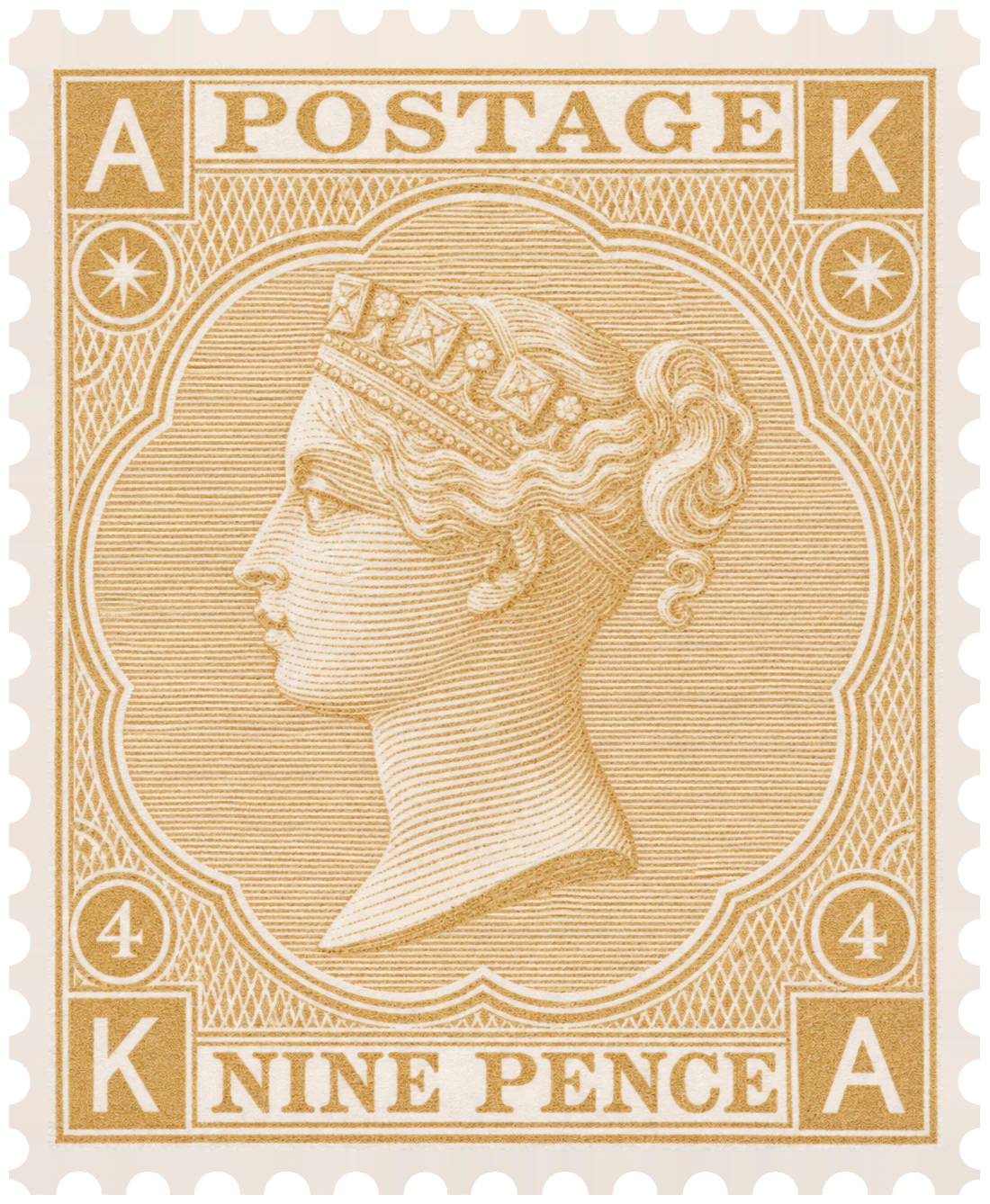
The portrait within nine curves
The ninepenny has a distinctive frame unlike the circles and ovals used on other surface-printed stamps.
Victoria's head sits within a border formed from nine inward-curving sections, enclosed by a rectangular frame. [1]
The 1865 redesign retained the general arrangement while refining the portrait and surrounding ornament.
The nine curves provide an intriguing visual connection with the denomination, although there is no surviving evidence that their number was deliberately chosen for that reason.
The unusual border gave the ninepenny a recognisable identity without requiring an entirely different royal portrait.
Four larger corner letters
The original ninepenny had small white corner letters. In 1865, these were replaced by larger, stronger characters.
The lower letters identify the stamp's position in its printing sheet. Those above repeat the same pair in reverse order. [1]
The arrangement was intended to help expose stamps fraudulently assembled from pieces of used examples.
The larger characters were also easier to read and less vulnerable to damage during printing.
Their introduction made the revised ninepenny visibly different from its predecessor.
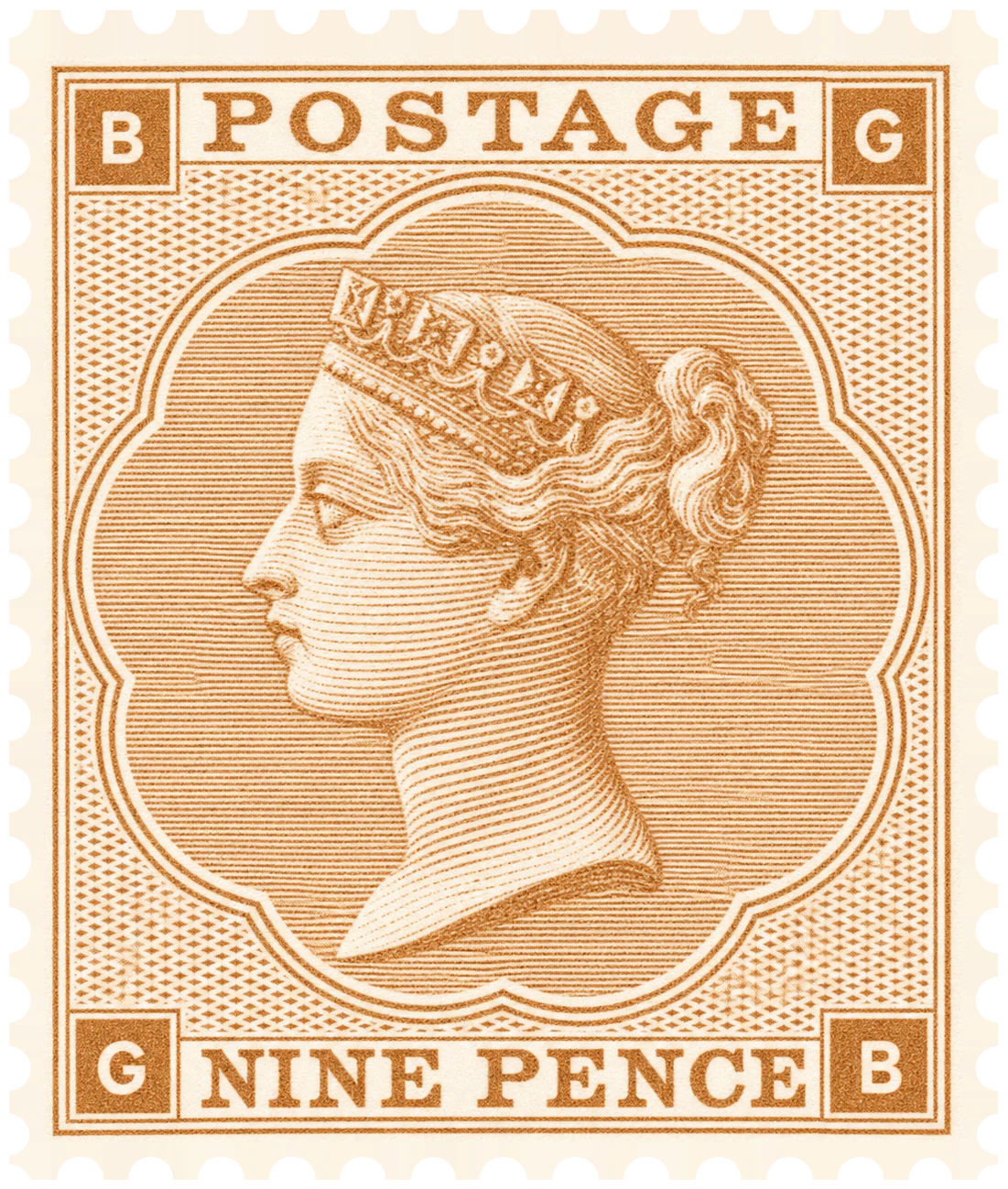
Compare the size of the corner letters in the two designs; individual damaged letters are not shown.
Click either stamp to magnify
Stars above, numbers below
The revised ninepenny acquired small bracket-like ornaments in the spaces surrounding the central frame.
The upper ornaments contain eight-rayed stars. Those below hold the printing plate number in small white figures. [1]
Plate 4 produced the ordinary stamps, while plate 5 was prepared but never used for regular production.
The numbers were incorporated into the stamp itself, rather than appearing only in the sheet margins.
These tiny details combined ornament with the practical need to identify the printing equipment.
The background changes direction
The fine engraved pattern around Victoria's portrait was also altered in 1865.
On the earlier ninepenny, the lines forming the reticulated background ran horizontally. On the revised design, they ran vertically. [1]
The difference is subtle but becomes clear under magnification.
It shows how De La Rue could revise the ornamental framework while preserving the main elements of the composition.
The altered background was another small contribution to making the new design distinct from its predecessor.
A printing plate that was never needed
Plate 5 was registered in April 1866 but never entered regular production.
Its impressions were nevertheless preserved in the official registration sheet. Decades later, thirty-six stamps were cut from that sheet and perforated for presentation booklets. [2]
These impressions carry the same basic design as the normal ninepenny, but their unusual history reveals how the printing equipment was prepared and documented.
The stamps were products of an official proofing process rather than an ordinary production run.
The paper's hidden design changes
The first large-letter ninepenny stamps were printed on paper watermarked with four heraldic emblems: two roses, a shamrock and a thistle.
In 1867, the paper changed to the Spray of Rose watermark. [1]
Both designs were formed within the paper during manufacture, rather than printed in ink.
The printing plate and visible design remained unchanged.
The transition shows how the papermaker could introduce a new security feature without requiring the engraver to alter the stamp.
A portrait passed between three artists
Victoria's likeness originated in a portrait by William Wyon, Chief Engraver at the Royal Mint. His medal portrait drew on a sketch made in 1834, when Victoria was fifteen. [3]
Henry Corbould prepared a drawing based on Wyon's portrait, which later supplied the model for Jean Ferdinand Joubert de la Ferté's surface-printed engraving.
The ninepenny straw retained Joubert's interpretation.
The stamp brought together the work of artists whose contributions extended across nearly thirty years.
The diamond diadem made for a king
The ornament in Victoria's hair was commissioned for George IV's coronation in 1821. [4]
It contains 1,333 diamonds, with crosses and the national emblems of the rose, thistle and shamrock.
Victoria later wore the diadem in portraits, and it became a familiar feature of British postage stamps.
On the ninepenny, its jewels are reduced to tiny engraved marks. A magnificent royal ornament had become part of an everyday object worth ninepence.
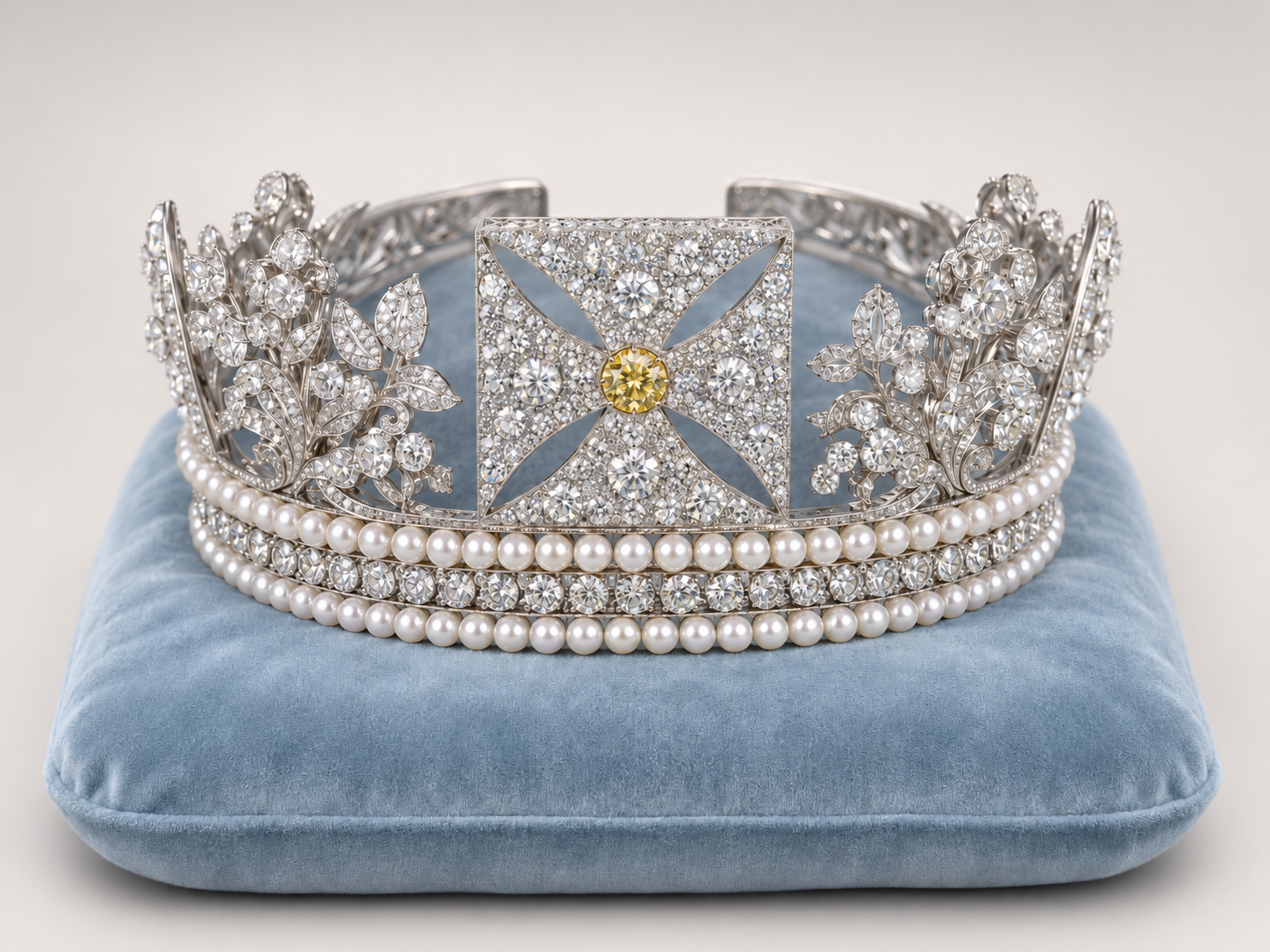
Image information
Click image to magnify
Digitally created illustration of the diamond diadem, with crosses, floral emblems and rows of pearls, resting on a blue cushion.
- Credit
- Stunning Stamps.
- Notes
- Digitally created.