
The design of the 1s green
Queen Victoria · Great Britain · Thomas De La Rue & Co. · 1865
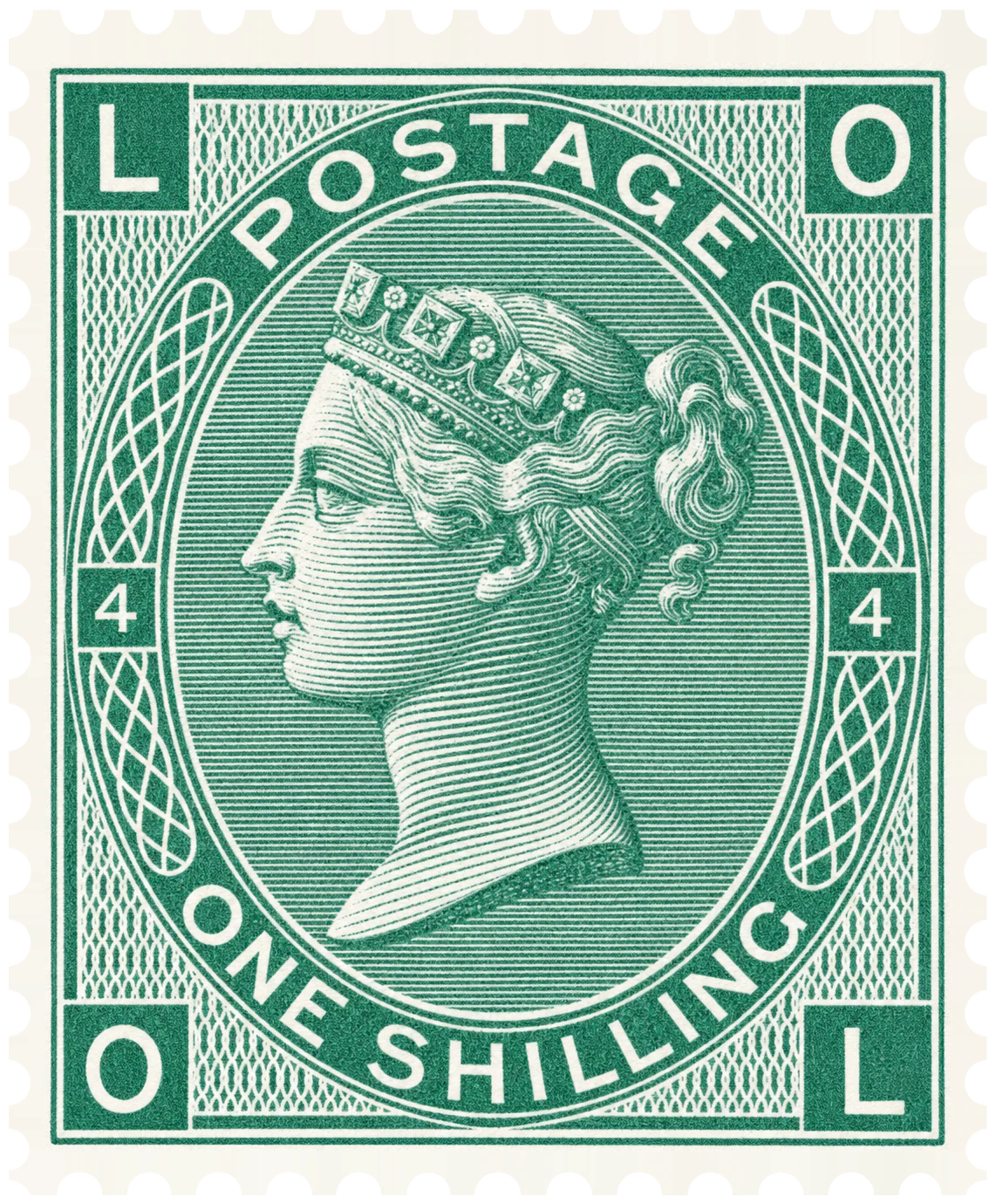
A new engraving of the Queen
The large-letter one-shilling was not simply the previous stamp with bigger letters.
De La Rue prepared a substantially revised die. Victoria's head was re-engraved, the corner panels enlarged and the fine ornamental patterns around the oval rearranged. [1]
The royal portrait remained recognisably the same young Victoria, but the engraving was stronger and better suited to continued production.
Placed beside the 1862 shilling, the revised stamp reveals how a familiar design could change through the work of the engraver.
The letters that became easier to read
The 1862 stamp had four small white corner letters. Their delicate construction made them vulnerable to wear and damage during printing.
In 1865, De La Rue introduced large white capitals against solid green corner panels. [1]
The lower letters identified the stamp's position in the printing sheet. Those above repeated the pair in reverse order.
The arrangement helped expose attempts to construct apparently unused stamps from pieces of used examples.
The new lettering made the security feature clearer and more durable.
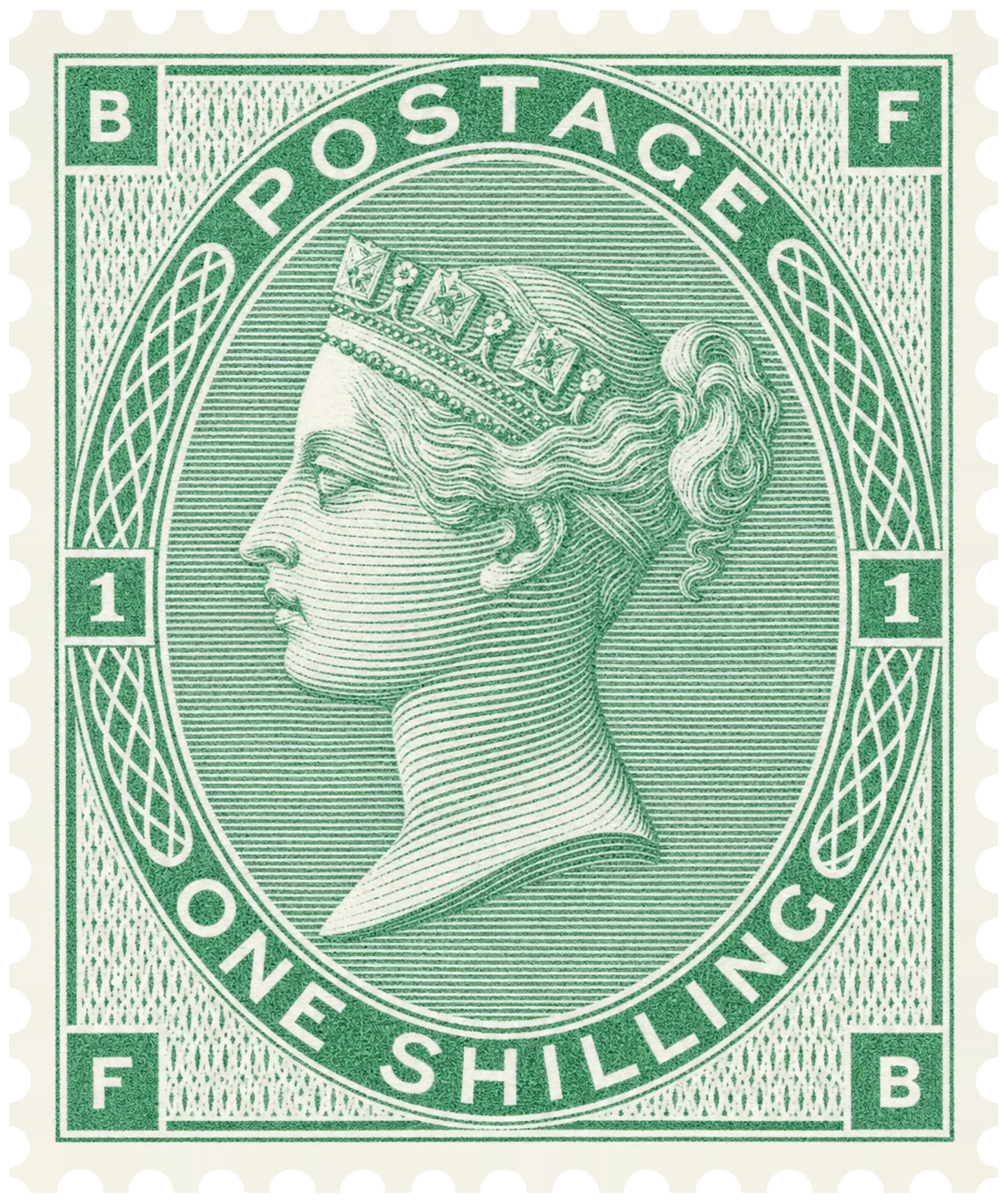
Compare the size of the corner letters in the two designs; individual damaged letters are not shown.
Click either stamp to magnify
The plate number finally agrees
The earlier small-letter shilling had carried a curious discrepancy. Its first printing plate was numbered 2, but the figures beside Victoria's portrait read 1.
The 1865 redesign corrected the arrangement. Plate 4 carried the number 4, repeated in small panels on both sides of the oval. [2]
Later plates continued the sequence through 7.
The numbers were small enough to blend into the ornament, but they allowed individual stamps to be traced to their printing plates.
The hidden flowers become a single rose
The first large-letter shillings were printed on paper watermarked with four Heraldic Emblems: two roses, a shamrock and a thistle.
In 1867, the authorities introduced a different watermark, the Spray of Rose. [3]
The change coincided with developments in machine-made papermaking. Small devices used for the earlier Emblems watermark could become detached from the papermaking mould, sometimes producing mistakes. [4]
The new watermark used a single floral design instead of four separate emblems.
Victoria's portrait and the printed frame remained unchanged. Only the design hidden within the paper was different.
The counterfeiters who copied the wrong details
The Stock Exchange forgeries of 1872–73 reproduced the appearance of the large-letter one-shilling green remarkably well.
But the counterfeiters missed some details. The corner letters were less sharply defined, and the first opening in the fine pattern following the E of POSTAGE was too large. [5]
Some forged stamps even carried impossible combinations of corner letters.
The paper was also unwatermarked.
These differences eventually helped expose the fraud. The forgeries are a useful demonstration of how much precision was built into De La Rue's genuine design.
A portrait of a fifteen-year-old princess
Victoria's portrait originated before she became Queen. William Wyon, Chief Engraver at the Royal Mint, created a medal commemorating her visit to the City of London in November 1837. Its portrait drew on a sketch made in 1834, when Victoria was fifteen. The medal was issued in 1838. [6]
Henry Corbould prepared a drawing based on Wyon's portrait, which later supplied the model for Joubert's surface-printed engraving.
Victoria's youthful likeness remained familiar even as the stamps surrounding it changed. [7, 8]
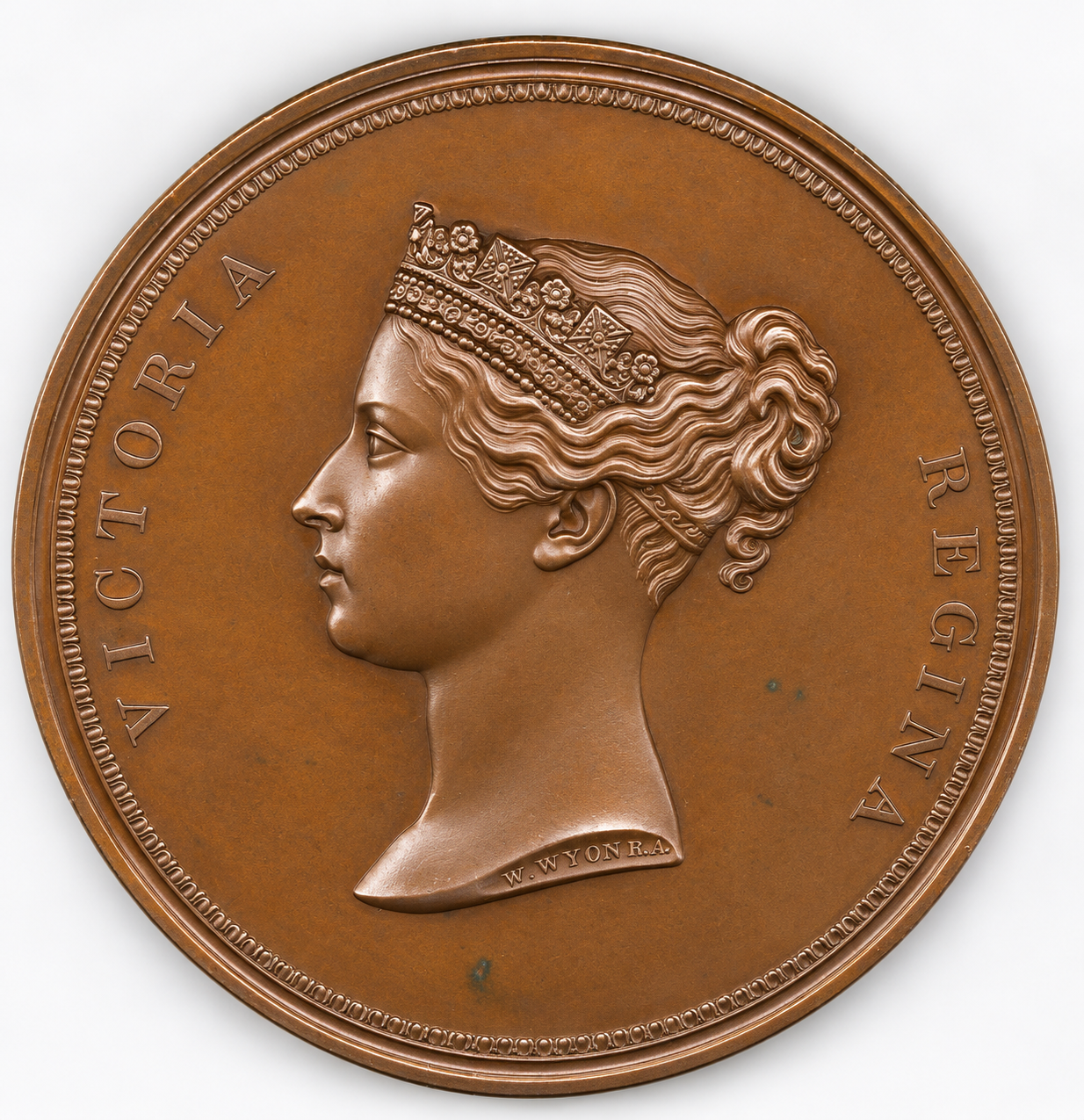
Image information
Click image to magnify
Bronze medal showing the young Victoria in left-facing profile, wearing the diamond diadem, with the inscription VICTORIA REGINA.
- Credit
- Heritage Auctions, via Wikimedia Commons. CC BY 3.0.
- Notes
- Brightness, contrast, sharpness and colour balance adjusted by Stunning Stamps.
The diamond diadem made for a king
The ornament in Victoria's hair was commissioned for George IV's coronation in 1821. [9]
It contains 1,333 diamonds, with crosses and the national emblems of the rose, thistle and shamrock.
Victoria later wore the diadem in portraits, and it became a familiar feature of British postage stamps.
On the one-shilling green, its jewels are reduced to tiny printed lines. A magnificent royal ornament had become part of an everyday object worth one shilling.

Image information
Click image to magnify
Digitally created illustration of the diamond diadem, with crosses, floral emblems and rows of pearls, resting on a blue cushion.
- Credit
- Stunning Stamps.
- Notes
- Digitally created.
Sources
- Hastings E. Wright and A. B. Creeke: A History of the Adhesive Stamps of the British Isles (1899), pp. 129–131
- Fred J. Melville: Stamps of Great Britain — The One Shilling
- The Shilling's Tale: Co-Evolution of Form and Function of the One-Shilling Stamp (2022)
- Wright and Creeke (1899), pp. 69–70 and 79: handmade papermaking moulds and machine-made paper
- British Philatelic Bulletin: The Stock Exchange Forgery
- Douglas N. Muir, Royal Mint Museum: William Wyon & the Penny Black
- Heritage Auctions, William Wyon medal photograph, via Wikimedia Commons (enhanced for display)
- Wyon medal photograph: Creative Commons Attribution 3.0 licence
- Royal Collection Trust: George IV's Diamond Diadem
