
The design of the 6d grey
Queen Victoria · Great Britain · Thomas De La Rue & Co. · 1873
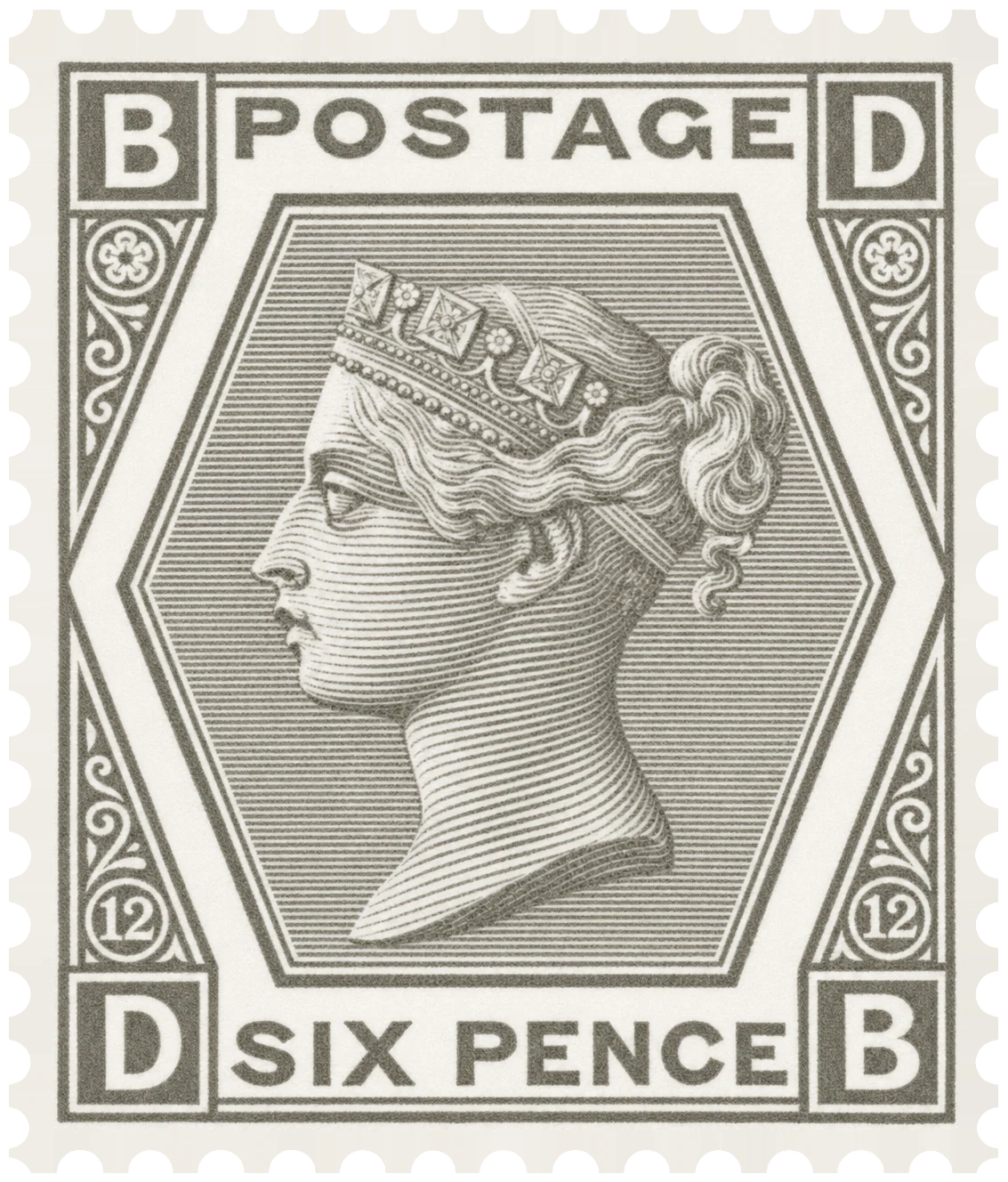
The buff stamp becomes grey
The 1873 sixpenny retained the design used for the chestnut and pale buff stamps of 1872.
Victoria's portrait, hexagonal frame, inscriptions and corner letters remained unchanged. The difference was the greenish-grey printing ink. [1]
The new colour gave the stamp a more subdued appearance.
Depending on the strength of the impression, the fine lines of Victoria's portrait could appear noticeably darker or lighter.
The change demonstrates how greatly colour could influence a stamp's appearance without altering its engraving.
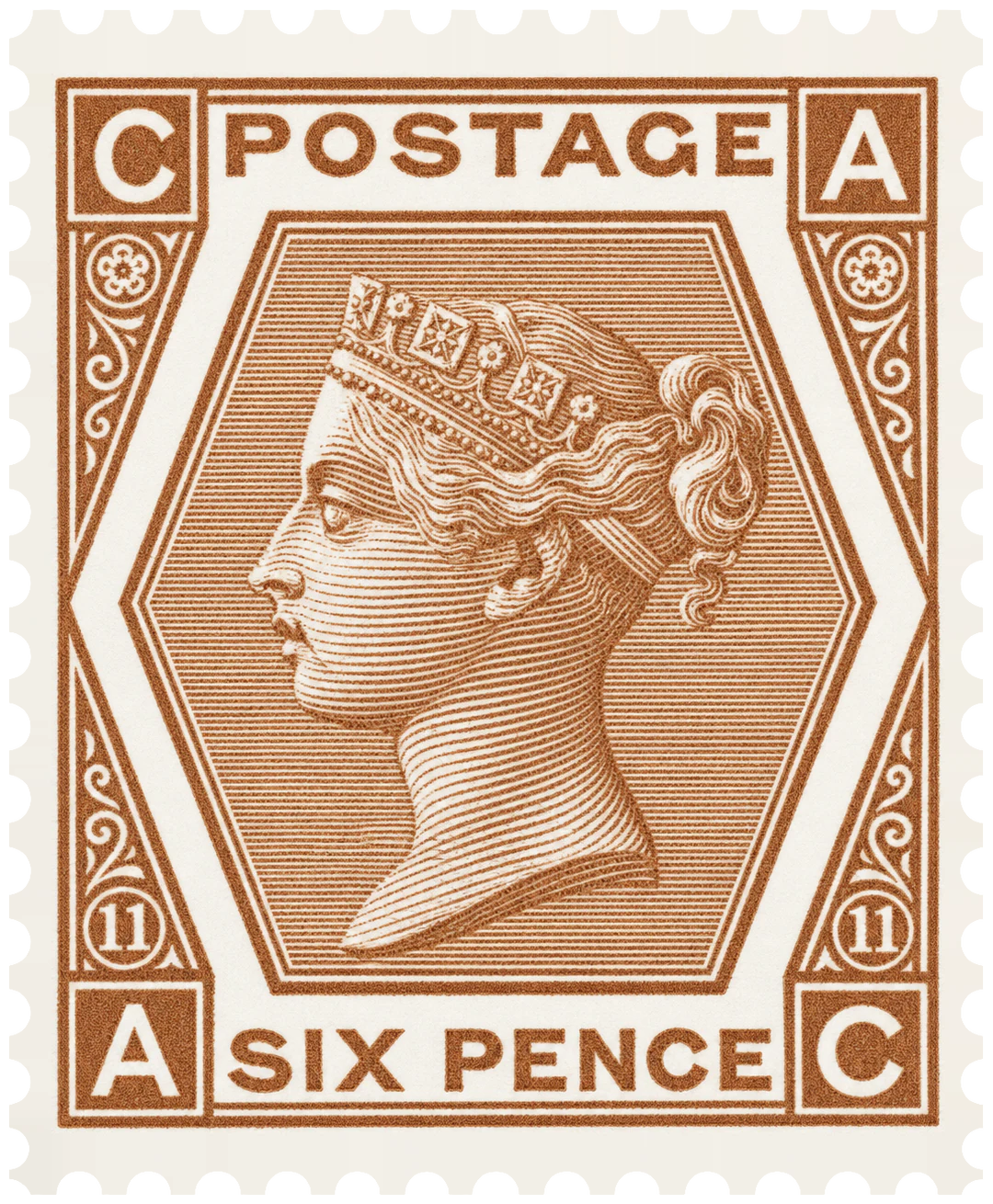
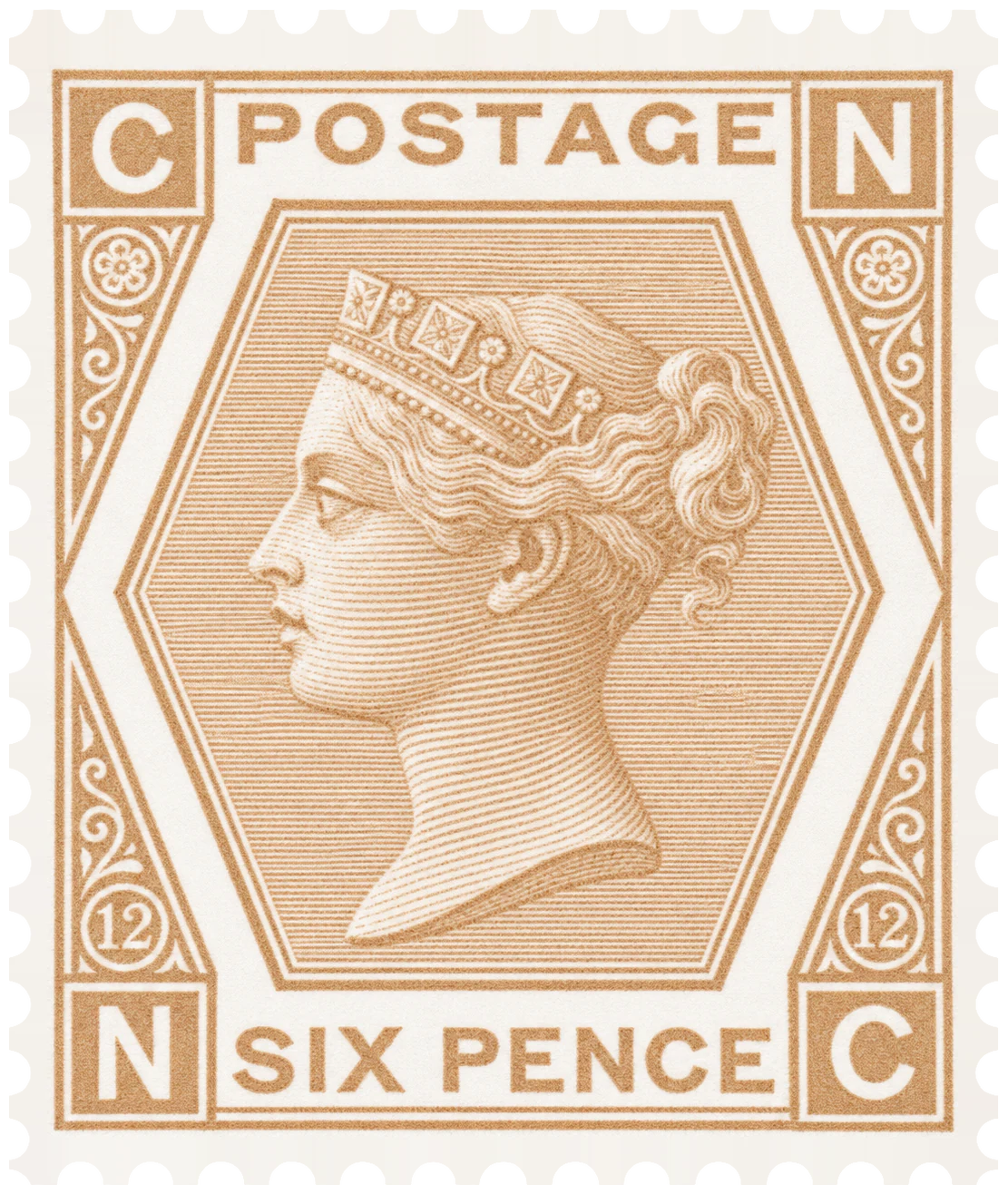
The sequence of issued colours with the hexagonal frame retained. These separate illustrations are not a matched set of plate-12 impressions.
Click a stamp to magnify
The hexagon that survived another change
Victoria's head sits inside a white hexagonal frame, surrounded by ornamental lines and a rectangular border.
The design had been introduced in 1872 after officials complained that the earlier sixpenny resembled other denominations too closely. [1]
POSTAGE appears in a white panel above the portrait, with SIX PENCE in a matching panel below. [2]
The same frame survived three successive colours: chestnut, pale buff and greenish-grey.
The design proved more durable than any one of the inks used to print it.
White letters that would soon disappear
The grey sixpenny of 1873 has large white letters against coloured squares in all four corners.
The lower letters identify its position in the printing sheet. Those above repeat the same pair in reverse order, helping reveal attempts to assemble fraudulent stamps from used pieces.
In August 1873, officials decided that a future sixpenny should instead have coloured letters on white panels. [1]
The change appeared in 1874, together with alterations to the frame.
The grey stamp therefore preserves the final stage of an established lettering arrangement.
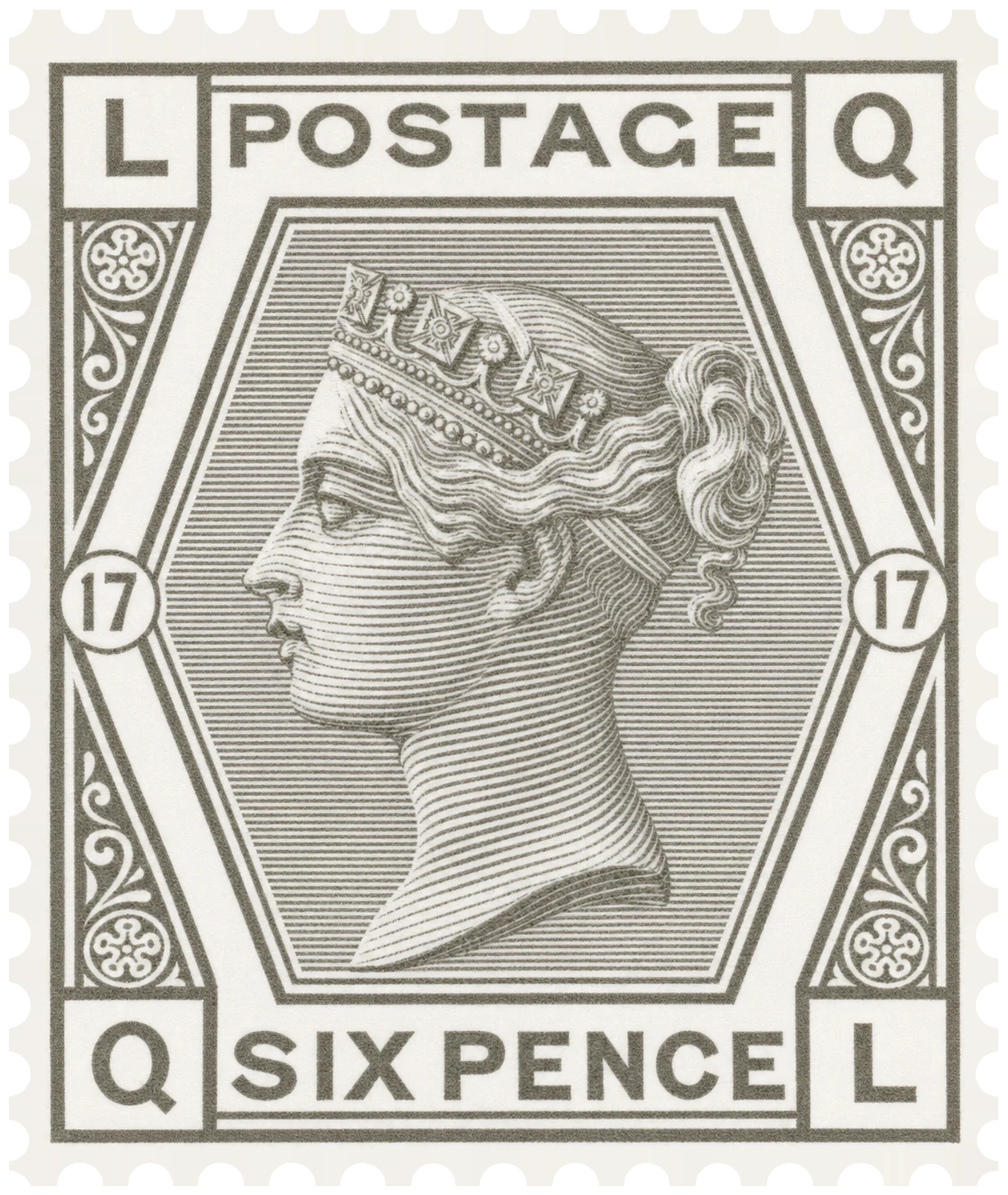
Compare the four corner panels and the changes to the surrounding frame.
Click either stamp to magnify
Rosettes and plate numbers
The hexagonal design leaves spaces for small ornaments above Victoria's portrait.
These contain decorative rosettes and fine patterned lines. Beneath them, circular panels identify the printing plate.
For the grey sixpenny, the figures read 12, appearing in white against the coloured background. [1]
The number was included in the stamp itself rather than appearing only in the margins of the sheet.
It shows how the engravers combined the practical need to identify printing equipment with the decorative conventions of Victorian stamp design.
The rose hidden in the paper
The grey sixpenny was printed on paper carrying the Spray of Rose watermark.
The rose was formed within the paper during manufacture rather than printed in ink. It had replaced the earlier arrangement of four separate heraldic emblems. [1]
The watermark made the paper more difficult to imitate.
It remained unchanged as the sixpenny passed through several different colours.
Although the ink altered the stamp's visible appearance, the hidden design within the paper continued to provide another security feature.
A portrait passed between three artists
Victoria's likeness originated in a portrait by William Wyon, Chief Engraver at the Royal Mint. His medal portrait drew on a sketch made in 1834, when Victoria was fifteen. [3]
Henry Corbould prepared a drawing based on Wyon's portrait, which later supplied the model for Jean Ferdinand Joubert de la Ferté's surface-printed engraving.
The grey sixpenny retained Joubert's interpretation.
The stamp brought together the work of artists whose contributions extended across nearly forty years.
The diamond diadem made for a king
The ornament in Victoria's hair was commissioned for George IV's coronation in 1821. [4]
It contains 1,333 diamonds, with crosses and the national emblems of the rose, thistle and shamrock.
Victoria later wore the diadem in portraits, and it became a familiar feature of British postage stamps.
On the grey sixpenny, its jewels are reduced to tiny printed lines. A magnificent royal ornament had become part of an everyday object worth sixpence.

Image information
Click image to magnify
Digitally created illustration of the diamond diadem, with crosses, floral emblems and rows of pearls, resting on a blue cushion.
- Credit
- Stunning Stamps.
- Notes
- Digitally created.
Sources
- Hastings E. Wright and A. B. Creeke: A History of the Adhesive Stamps of the British Isles (1899), pp. 112–115
- Allan Oliver: Life Span of the Printing Plates for Queen Victoria Stamps (2015), pp. 134–135: plate 12 production and hexagonal sixpence
- Douglas N. Muir, Royal Mint Museum: William Wyon & the Penny Black
- Royal Collection Trust: George IV's Diamond Diadem