
The design of the 6d pale buff
Queen Victoria · Great Britain · Thomas De La Rue & Co. · 1872
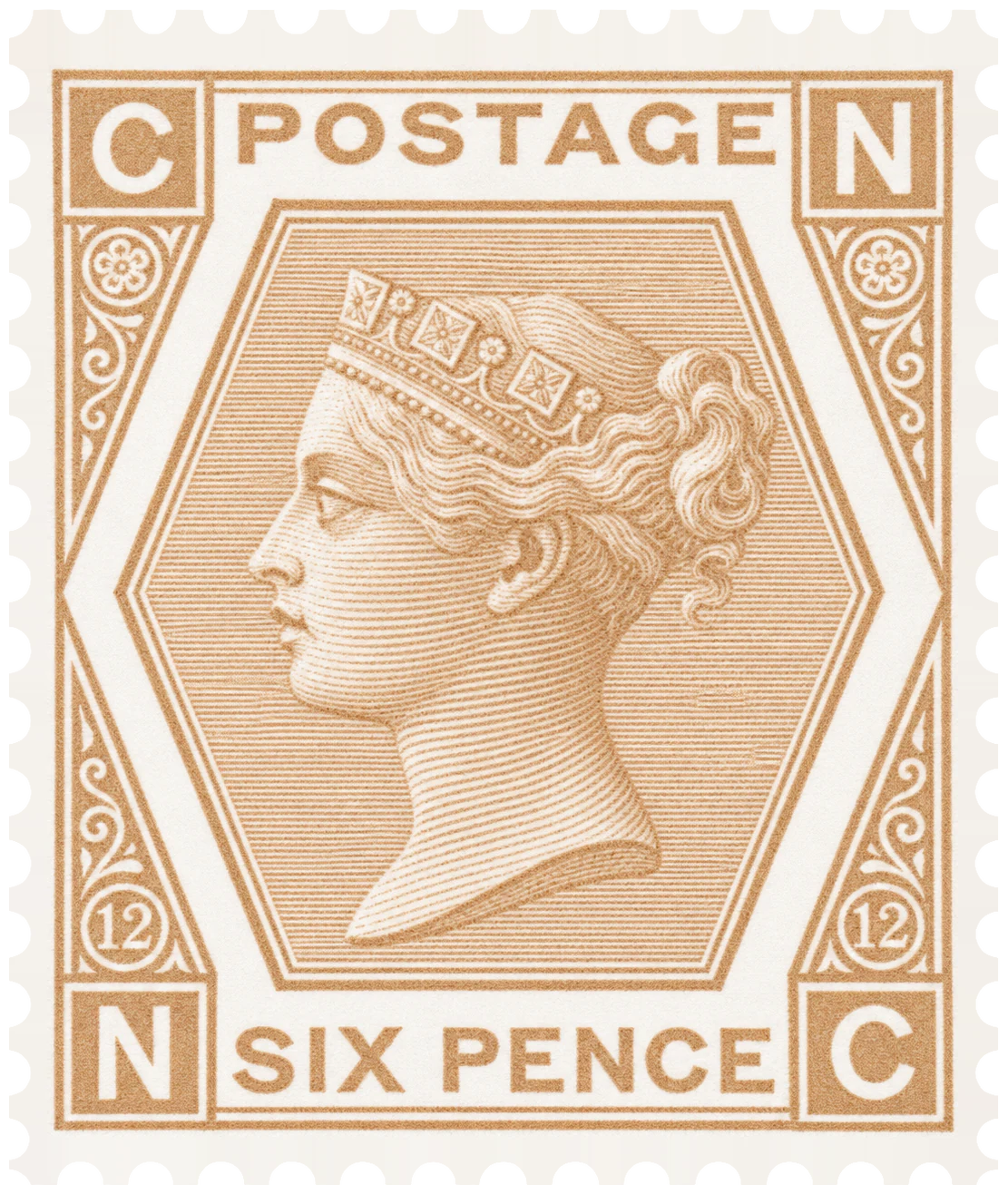
The chestnut stamp becomes pale buff
The pale buff sixpenny retained the hexagonal design introduced for the chestnut stamp earlier in 1872.
Victoria's portrait, the inscriptions, the corner letters and the decorative frame remained unchanged. Only the printing ink was different. [1]
The lighter colour gave the design a noticeably softer appearance.
Fine lines around the portrait and within the ornamental frame could seem less prominent than on the darker chestnut printing.
The change demonstrates how greatly the character of a stamp could be altered without the engraver touching the original design.
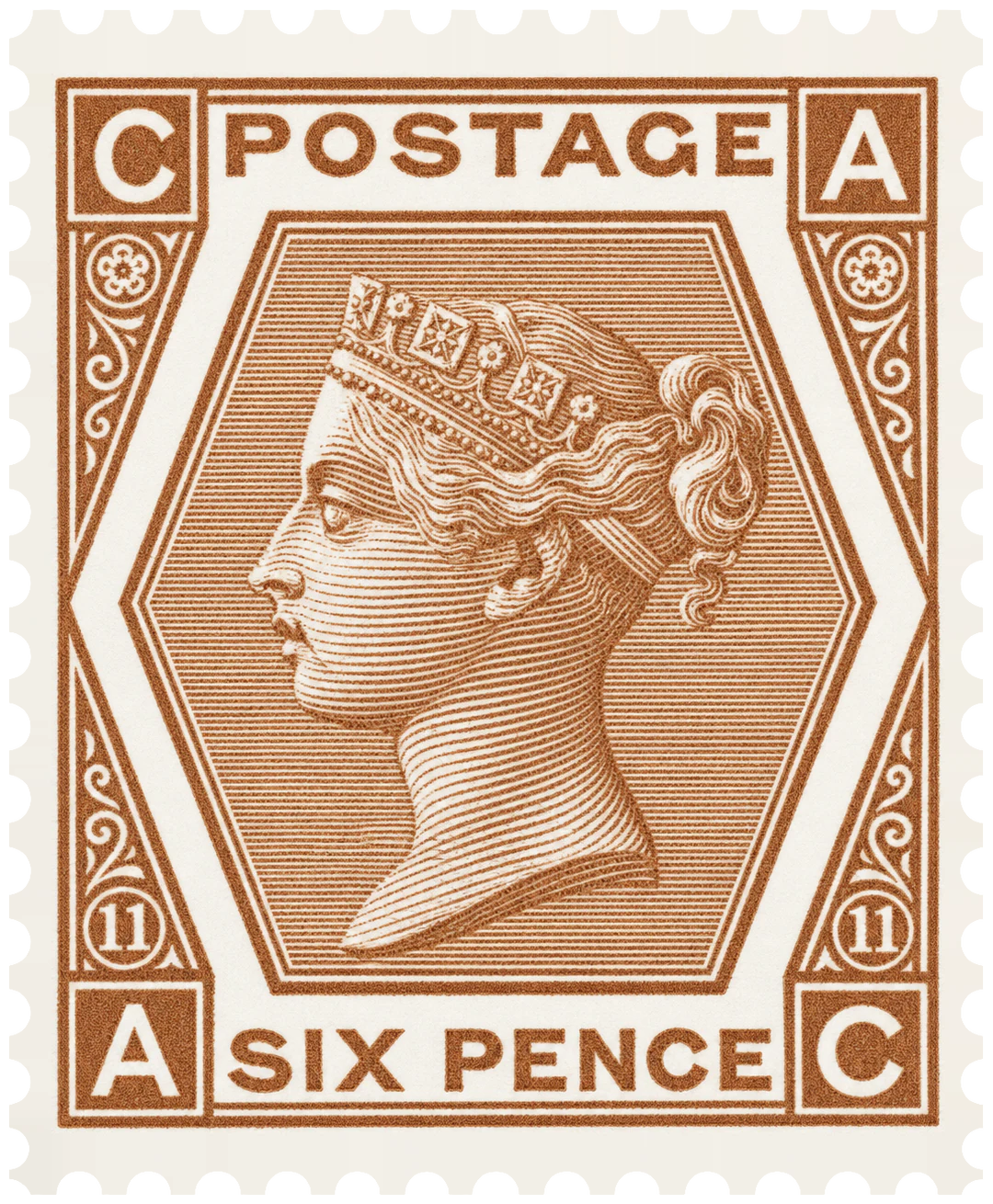
Representative issued colours of the same design; these illustrations do not identify the same plate position.
Click either stamp to magnify
The hexagon that survived three colours
Victoria's portrait sits inside a white hexagonal frame, its points extending towards the sides of the stamp.
This design had been introduced in April 1872 to distinguish the sixpenny from other contemporary stamps. [1]
The same engraving was used in chestnut, pale buff and subsequently greenish-grey.
The upper and lower portions of the hexagon extend into rectangular inscription panels containing POSTAGE and SIX PENCE. [2]
The design proved more durable than its original colour. Once established, it could be reproduced in successive inks without further substantial alteration.
The unusual buff stamp with coloured letters
The ordinary pale buff sixpenny has large white corner letters on coloured square panels.
But a small number of buff impressions were produced from plate 13, prepared for the next redesign.
In this version, the corner letters are coloured and appear against white panels. The hexagonal frame was also altered, with smaller proportions and different positions for the plate numbers. [1]
Plate 13 was registered in December 1872, but did not enter regular production until the following year.
These impressions show how a new design could be tested in the ink of an older issue before its ordinary production began.
Rosettes and tiny numbers
The ordinary pale buff design contains decorative rosettes in the spaces above Victoria's portrait.
The lower spaces contain small circular panels with white figures identifying the printing plate. These normally read 11 or 12. [1]
The plate numbers were incorporated into the design rather than placed only in the sheet margins.
The large white corner letters supplied a further means of identification, showing the position of each stamp in its sheet.
These details combined practical information with the elaborate ornament characteristic of Victorian security printing.
The rose hidden within the paper
The pale buff sixpenny was printed on paper carrying the Spray of Rose watermark.
The design was formed within the paper during manufacture rather than printed in ink. It had replaced the earlier arrangement of separate heraldic emblems. [1]
The watermark made the paper more difficult to imitate.
It was retained through the changes from chestnut to buff and then greenish-grey.
Although the printed colour changed several times, the hidden design within the paper remained the same.
A portrait passed between three artists
Victoria's likeness originated in a portrait by William Wyon, Chief Engraver at the Royal Mint. His medal portrait drew on a sketch made in 1834, when Victoria was fifteen. [3]
Henry Corbould prepared a drawing based on Wyon's portrait, which later supplied the model for Jean Ferdinand Joubert de la Ferté's surface-printed engraving.
The pale buff sixpenny retained Joubert's interpretation.
The stamp brought together the work of artists whose contributions extended across nearly forty years.
The diamond diadem made for a king
The ornament in Victoria's hair was commissioned for George IV's coronation in 1821. [4]
It contains 1,333 diamonds, with crosses and the national emblems of the rose, thistle and shamrock.
Victoria later wore the diadem in portraits, and it became a familiar feature of British postage stamps.
On the pale buff sixpenny, its jewels are reduced to tiny printed lines. A magnificent royal ornament had become part of an everyday object worth sixpence.
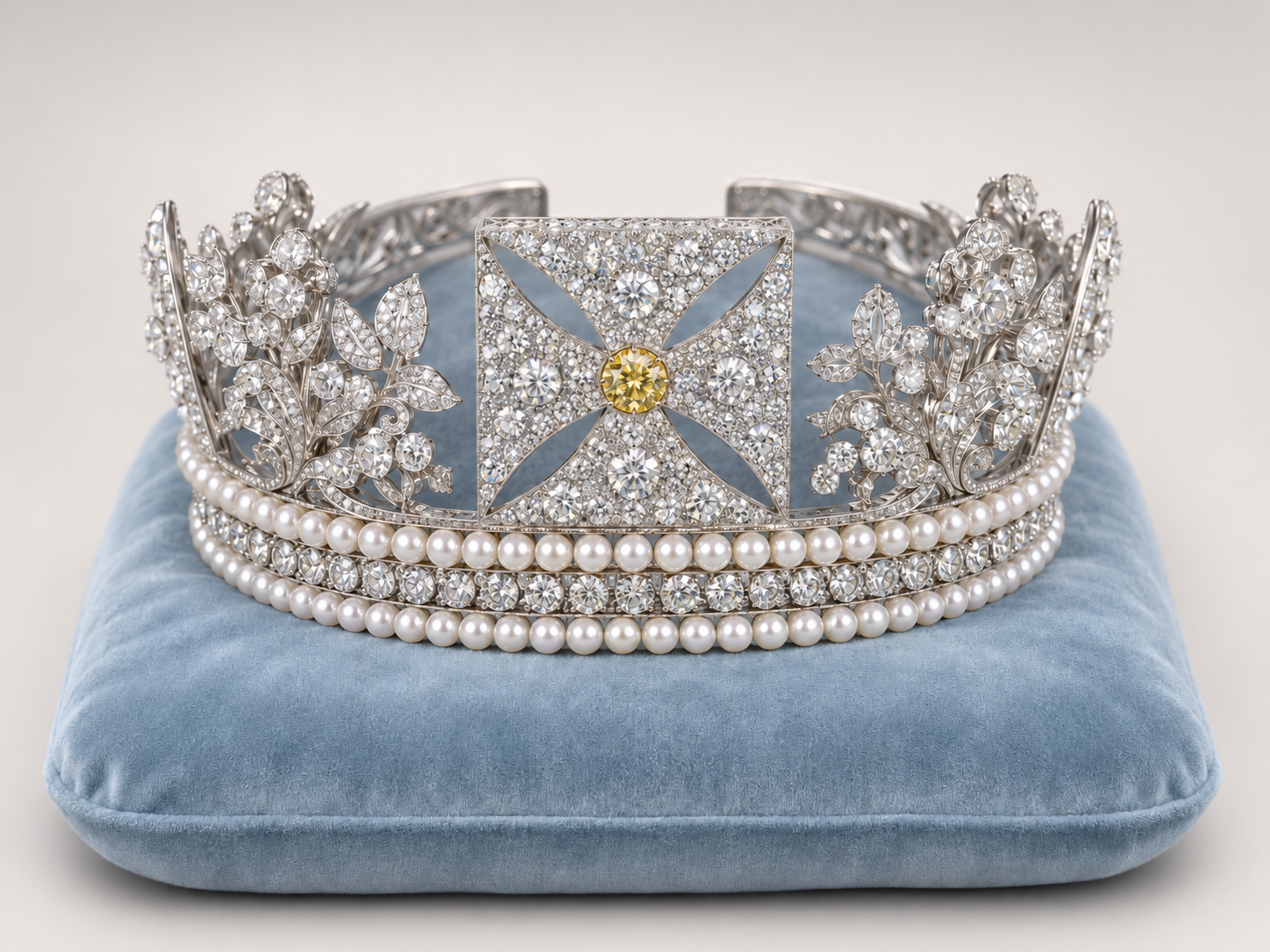
Image information
Click image to magnify
Digitally created illustration of the diamond diadem, with crosses, floral emblems and rows of pearls, resting on a blue cushion.
- Credit
- Stunning Stamps.
- Notes
- Digitally created.
Sources
- Hastings E. Wright and A. B. Creeke: A History of the Adhesive Stamps of the British Isles (1899), pp. 112–115
- Paul Fraser Collectibles: Great Britain 1872 6d pale buff plate 12, SG123, photographed SIX PENCE inscription
- Douglas N. Muir, Royal Mint Museum: William Wyon & the Penny Black
- Royal Collection Trust: George IV's Diamond Diadem