
The design of the 3d rose
Queen Victoria · Great Britain · Thomas De La Rue & Co. · 1865
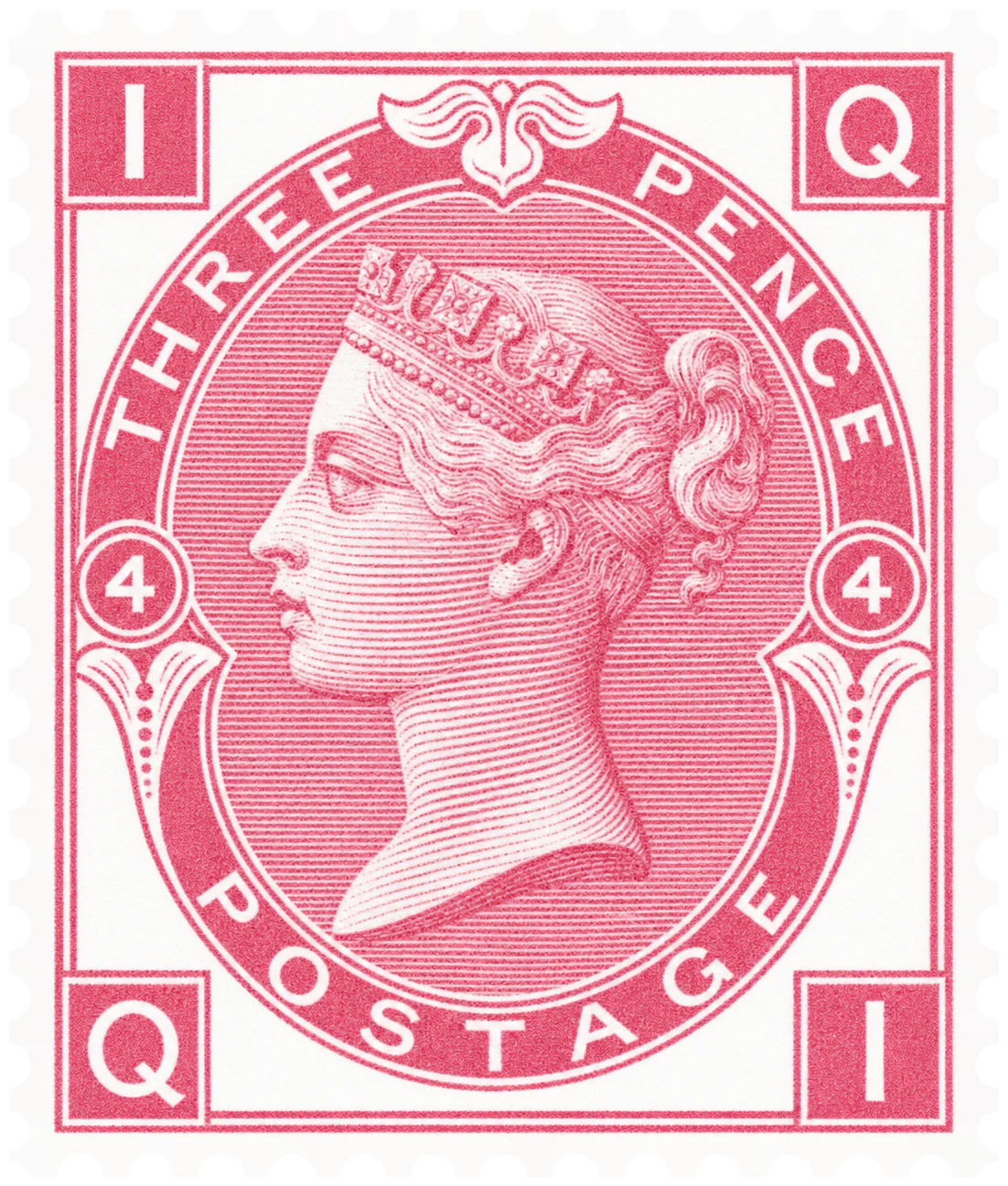
Larger letters in the four corners
The most noticeable alteration to the threepenny in 1865 was the enlargement of its corner letters.
On the preceding design, the white letters were small and difficult to read. They could also break down during printing. The replacement used broader, stronger characters in coloured square panels. [1]
The lower letters identified the stamp's position in the sheet. Those at the top repeated the same pair in reverse order.
This arrangement was intended to expose attempts to construct apparently unused stamps from pieces of used examples.
The new lettering made the security feature easier to recognise and less vulnerable to damage.
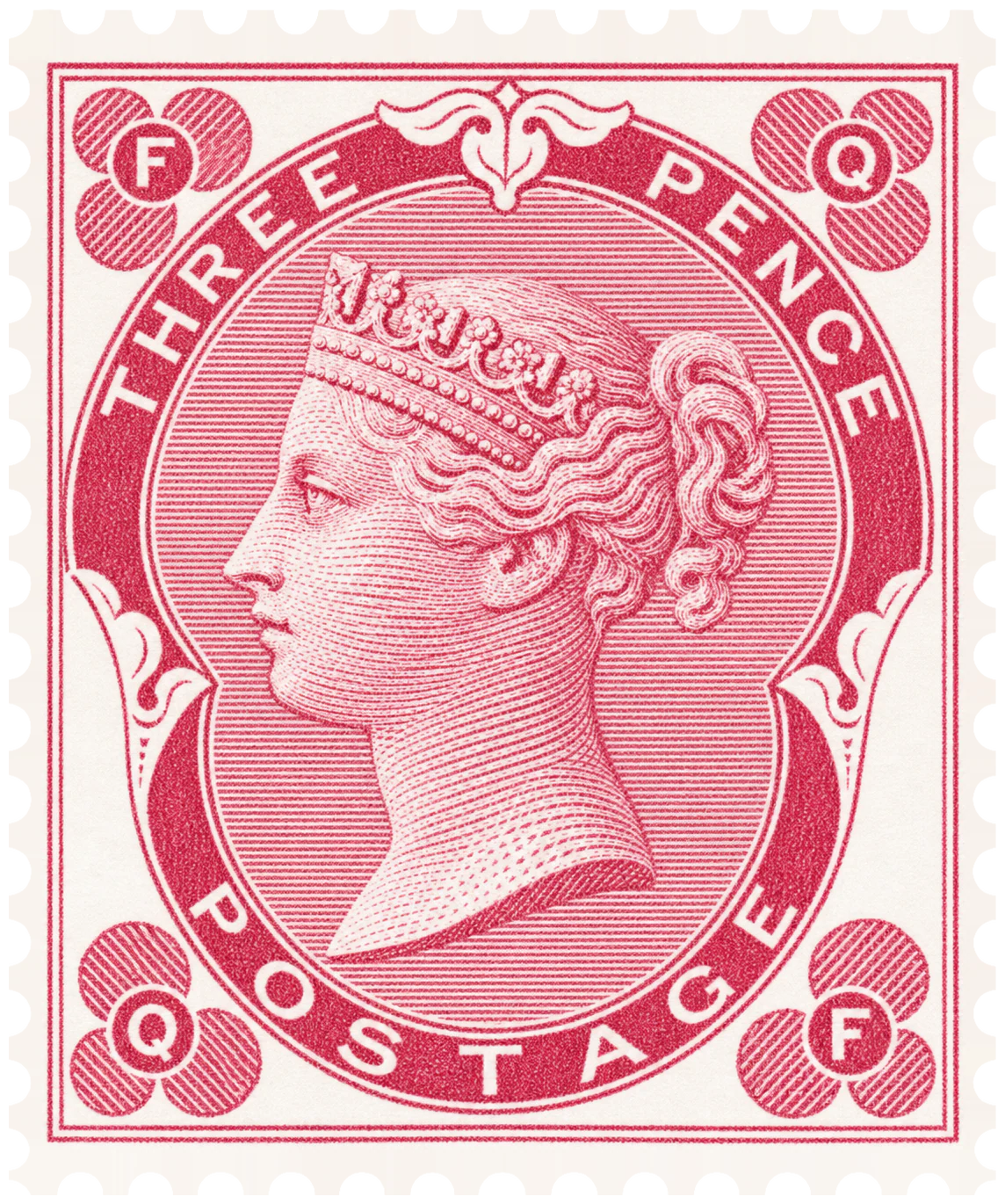
Compare the size of the corner letters in the two designs; individual damaged letters are not shown.
Click either stamp to magnify
Two little circles containing the number 4
Look beside Victoria's portrait, near the centre of the left and right borders. Each side contains a small circular panel with the figure 4.
These identify the printing plate used to produce the stamp. Earlier surface-printed issues had relied on discreet hairlines, dots or numbers placed in the sheet margins. [1]
The large-letter redesign incorporated plate numbers directly into the visible design.
De La Rue prepared plate 4 for the original issue and later registered plate 5.
The little circles are almost lost among the surrounding ornament, but they show how printing information became part of the stamp itself.
The curved frame that survived
The threepenny retained the unusual arrangement created for its introduction in 1862.
Victoria's head sits within a frame formed by rounded curves. THREE PENCE occupies the upper section, while POSTAGE follows the lower curve. Small ornamental forms connect the inscriptions. [2]
The relatively open spaces around the frame were the result of an earlier intervention. In 1861, the printers had removed background decoration from the original plate to make the stamp more easily distinguished from the fourpenny.
The large-letter version preserved this distinctive arrangement.
A design created partly through the removal of engraving had proved successful enough to survive the next revision.
The flowers concealed in the paper
The threepenny rose was printed on paper watermarked with heraldic emblems: two roses, a shamrock and a thistle.
The flowers represented England, Ireland and Scotland. They were formed within the paper during manufacture, not printed on its surface. [3]
The watermark helped make the paper more difficult to imitate.
It remained in use when the larger corner letters appeared in 1865. The visible design had changed, but the hidden floral arrangement was retained.
The paper mill embraces machinery
The large-letter stamps appeared during another change in production.
From around December 1864, machine-made paper began replacing the handmade material previously supplied for surface-printed stamps. [4]
The new paper could still carry the required watermarks, but manufacturing it was more regular and less dependent on individual sheets being formed by hand.
The change did not require a new royal portrait or different inscription.
It was another example of the gradual industrialisation taking place behind an apparently unchanging design.
A portrait passed between three artists
Victoria's likeness originated in an image by William Wyon, Chief Engraver at the Royal Mint. His medal portrait drew on a sketch made in 1834, when Victoria was fifteen. [5]
Henry Corbould prepared a drawing based on Wyon's portrait, which later supplied the model for Jean Ferdinand Joubert de la Ferté's surface-printed engraving.
The threepenny rose retained Joubert's interpretation.
The stamp therefore brought together the work of artists whose contributions extended across nearly thirty years.
The diamond diadem made for a king
The ornament in Victoria's hair was commissioned for George IV's coronation in 1821. [6]
It contains 1,333 diamonds, with crosses and the national emblems of the rose, thistle and shamrock.
Victoria later wore the diadem in portraits, and it became a familiar feature of British postage stamps.
On the threepenny, its jewels are reduced to tiny engraved marks. A magnificent royal ornament had become part of an everyday object worth threepence.
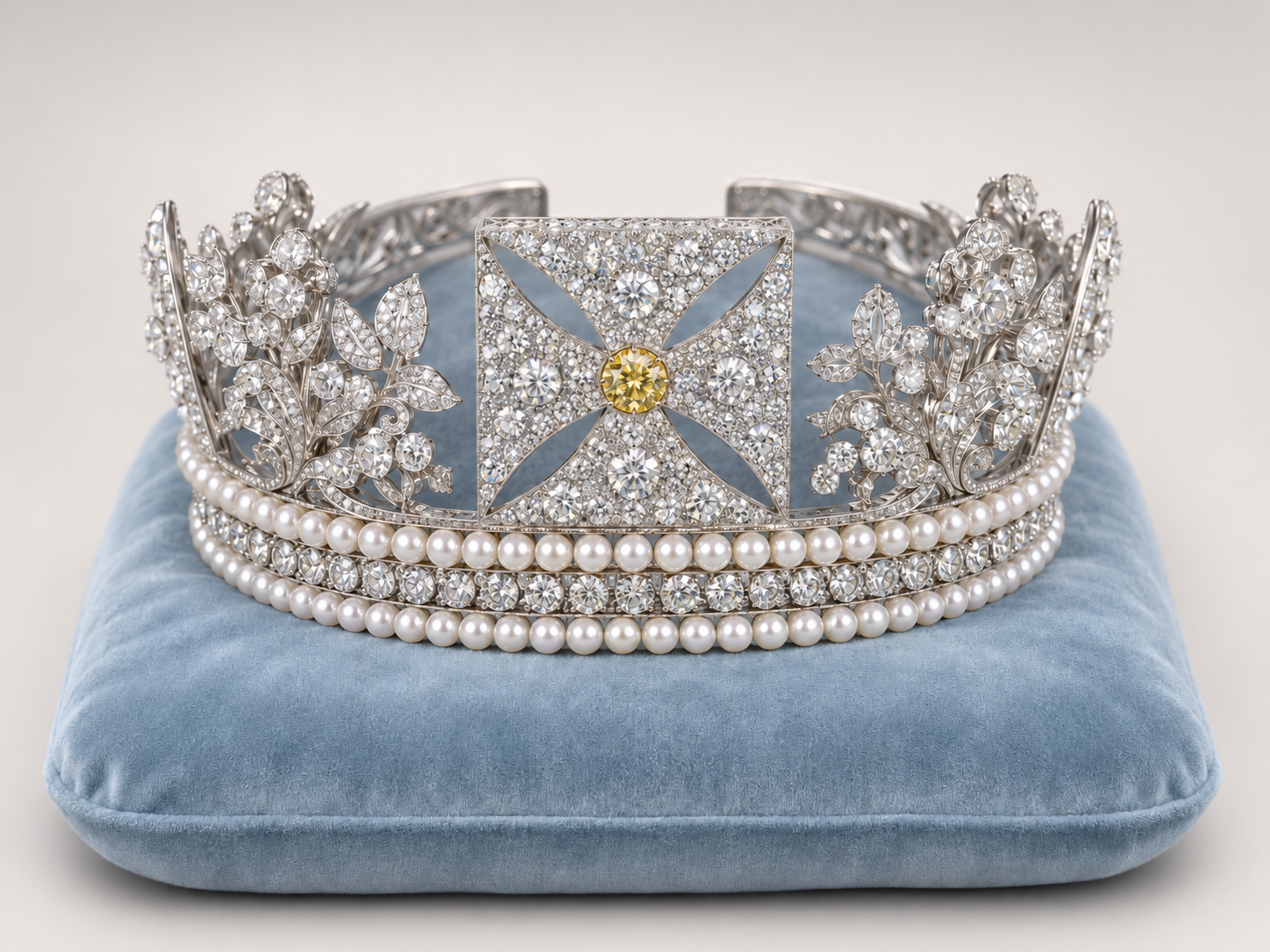
Image information
Click image to magnify
Digitally created illustration of the diamond diadem, with crosses, floral emblems and rows of pearls, resting on a blue cushion.
- Credit
- Stunning Stamps.
- Notes
- Digitally created.
Sources
- Robert B. Galland: The First Low Value Surface Printed Postage Stamps of Great Britain, Royal Philatelic Society London (2014)
- Hastings E. Wright and A. B. Creeke: A History of the Adhesive Stamps of the British Isles (1899)
- Royal Mail Philatelic Bulletin: Collecting the Victorians — The Surface-Printed Issues
- Allan Oliver: Life Span of the Printing Plates for Queen Victoria Stamps (2015), p. 121
- Douglas N. Muir, Royal Mint Museum: William Wyon & the Penny Black
- Royal Collection Trust: George IV's Diamond Diadem