
The design of the 2s blue
Queen Victoria · Great Britain · Thomas De La Rue & Co. · 1867
A designer from the Crystal Palace
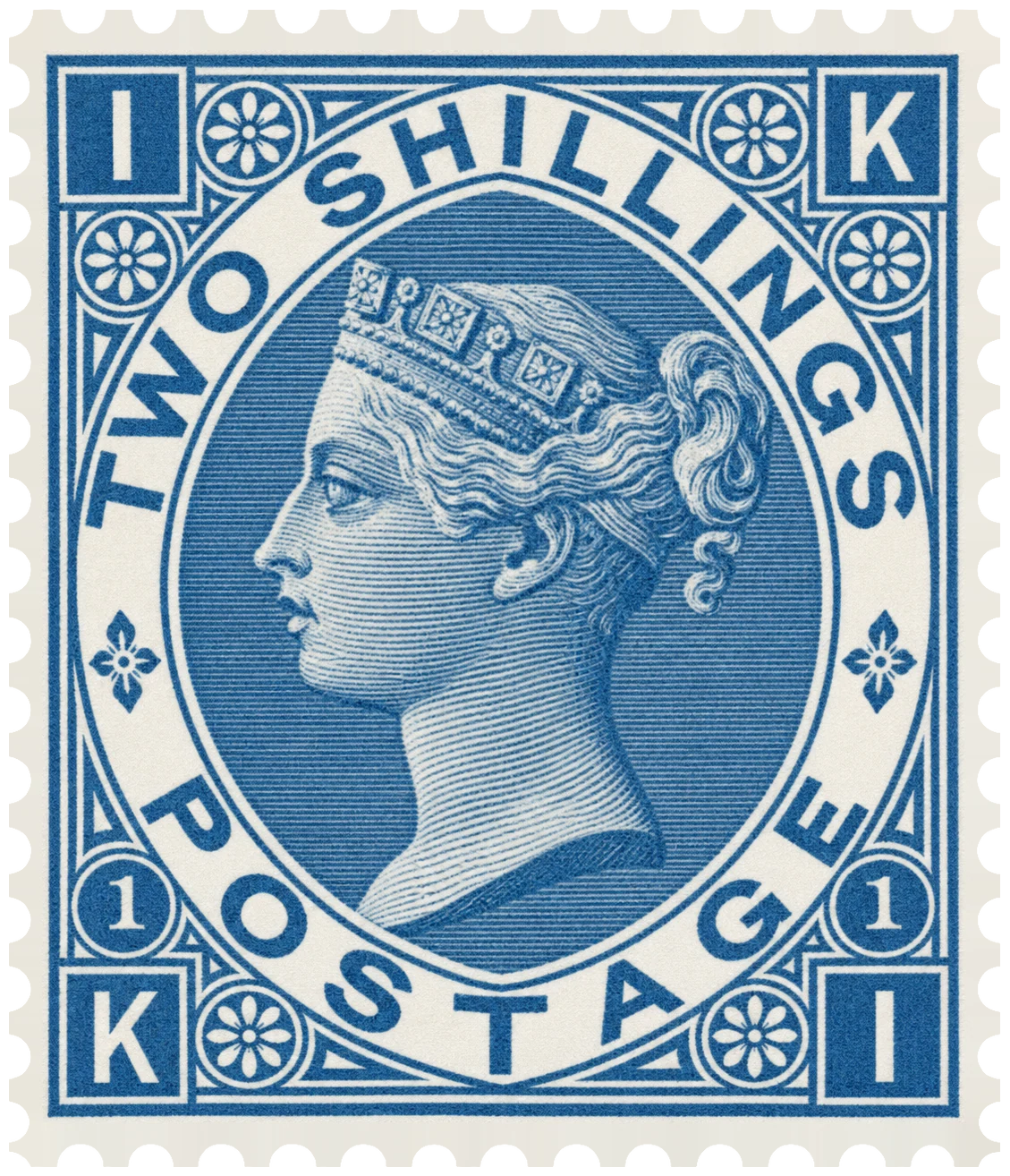
The two-shilling blue was designed by Owen Jones, whose work ranged from architecture to decorative printing.
Jones was fascinated by geometry, colour and ornament. His studies of historic decorative patterns helped shape his influential book The Grammar of Ornament, published in 1856. [1]
The two-shilling stamp reflects his interest in organising decoration around a strong central form.
Victoria's portrait sits within a pointed oval, surrounded by carefully arranged inscriptions, geometric patterns and small ornamental devices.
The design was approved in November 1866, bringing the work of a celebrated Victorian designer into British postage.
An oval with pointed ends
Unlike the circular portrait frames on several earlier surface-printed stamps, the two-shilling uses an upright oval with pointed upper and lower ends.
The surrounding white band carries TWO SHILLINGS above Victoria's head and POSTAGE below. Small ornaments separate the inscriptions on either side. [2]
The unusual shape gives the design a strong vertical emphasis.
Fine horizontal lines provide shading behind the Queen, while geometric ornament fills the spaces between the oval and rectangular outer frame.
The result is a distinctive combination of portraiture and decorative geometry.
Stars above, plate numbers below
Look at the small circular panels close to the four corners.
Those beneath the upper letter blocks contain star-like ornaments. The corresponding panels above the lower letters contain the printing plate number. [2]
The ordinary stamps were printed almost entirely from plate 1.
These tiny details were incorporated into the engraved design, rather than added later to individual stamps.
The arrangement allowed the printers to include identifying information without interrupting the overall composition.
Four large white corner letters
The two-shilling was introduced with large white letters in all four corners.
The lower letters identify the stamp's position within the printing sheet. Those above repeat the same pair in reverse order.
The system was intended to make fraudulent alteration more difficult. [2]
Each letter sits against a solid blue square.
Unlike earlier surface-printed stamps, which had acquired corner letters through successive redesigns, the two-shilling carried the fully developed arrangement from its introduction.
The blue that changed its character
The two-shilling was printed in several shades of blue.
The earliest impressions were relatively pale, while printings from about 1868 to 1878 became much darker, sometimes approaching Prussian blue. The final printings returned to lighter tones. [2]
The engraved portrait and surrounding ornament remained unchanged.
A darker ink could make Victoria's head appear more strongly defined, while pale impressions produced a softer image.
These variations illustrate how the printer's materials could influence the appearance of a design without requiring a new engraving.
The rose hidden in the paper
The two-shilling blue was printed on paper watermarked with a Spray of Rose.
The design was formed during papermaking, rather than printed in ink. It helped protect the stamp against forgery. [2]
Unlike the earlier paper carrying four separate Heraldic Emblems, the Spray of Rose used a single floral motif.
The printed ornament was therefore accompanied by another design, concealed within the paper.
A portrait of a fifteen-year-old princess
Victoria's portrait originated before she became Queen. William Wyon, Chief Engraver at the Royal Mint, created a medal commemorating her visit to the City of London in November 1837. Its portrait drew on a sketch made in 1834, when Victoria was fifteen. The medal was issued in 1838. [3]
Henry Corbould prepared a drawing based on Wyon's portrait, which later supplied the model for the royal head used on De La Rue's surface-printed stamps.
Victoria's youthful likeness remained familiar even as artists such as Owen Jones redesigned the frames surrounding it. [4, 5]
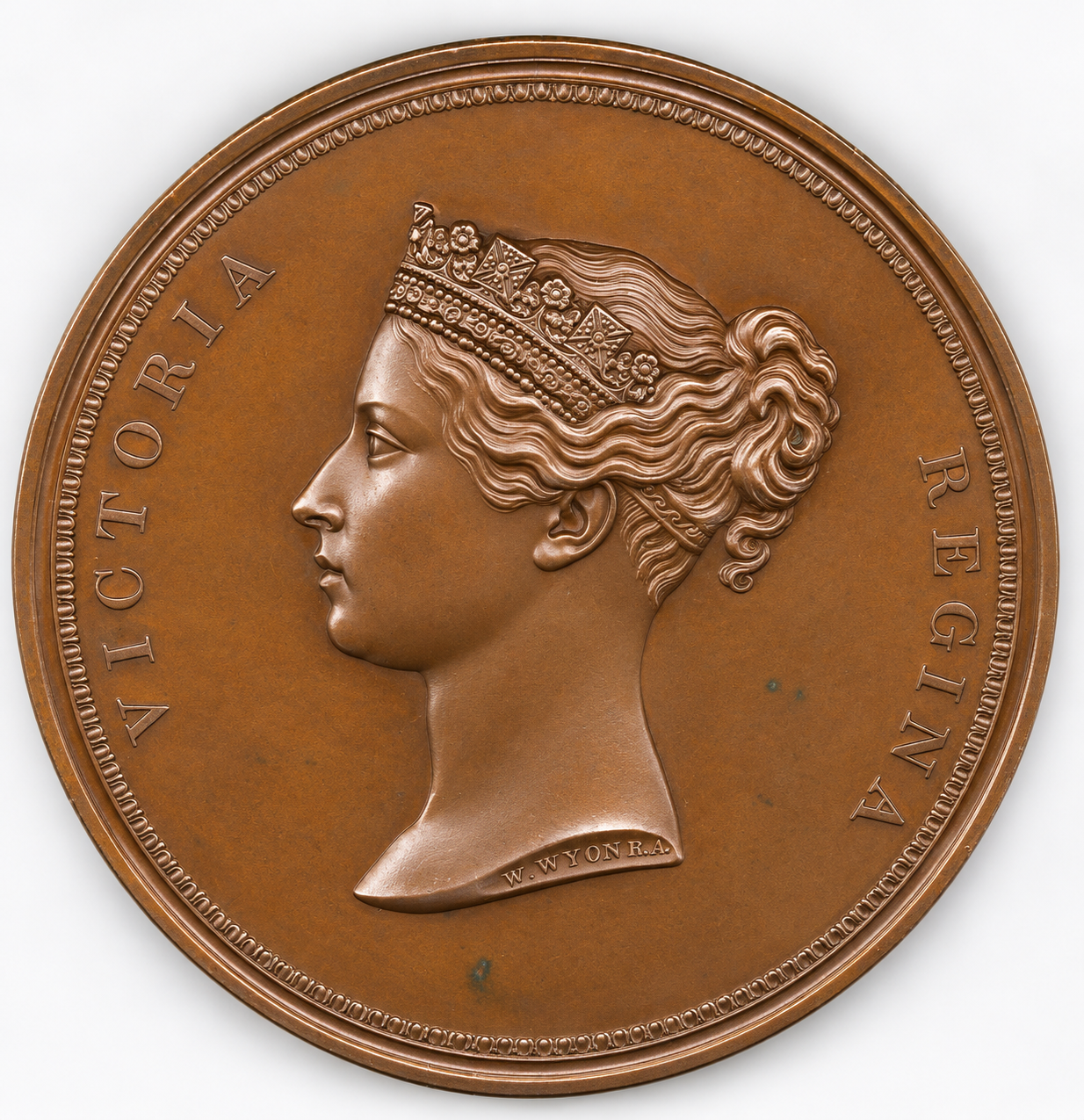
Image information
Click image to magnify
Bronze medal showing the young Victoria in left-facing profile, wearing the diamond diadem, with the inscription VICTORIA REGINA.
- Credit
- Heritage Auctions, via Wikimedia Commons. CC BY 3.0.
- Notes
- Brightness, contrast, sharpness and colour balance adjusted by Stunning Stamps.
The diamond diadem made for a king
The ornament in Victoria's hair was commissioned for George IV's coronation in 1821. [6]
It contains 1,333 diamonds, with crosses and the national emblems of the rose, thistle and shamrock.
Victoria later wore the diadem in portraits, and it became a familiar feature of British postage stamps.
On the two-shilling blue, its jewels are reduced to tiny printed lines. A magnificent royal ornament had become part of an everyday object worth two shillings.
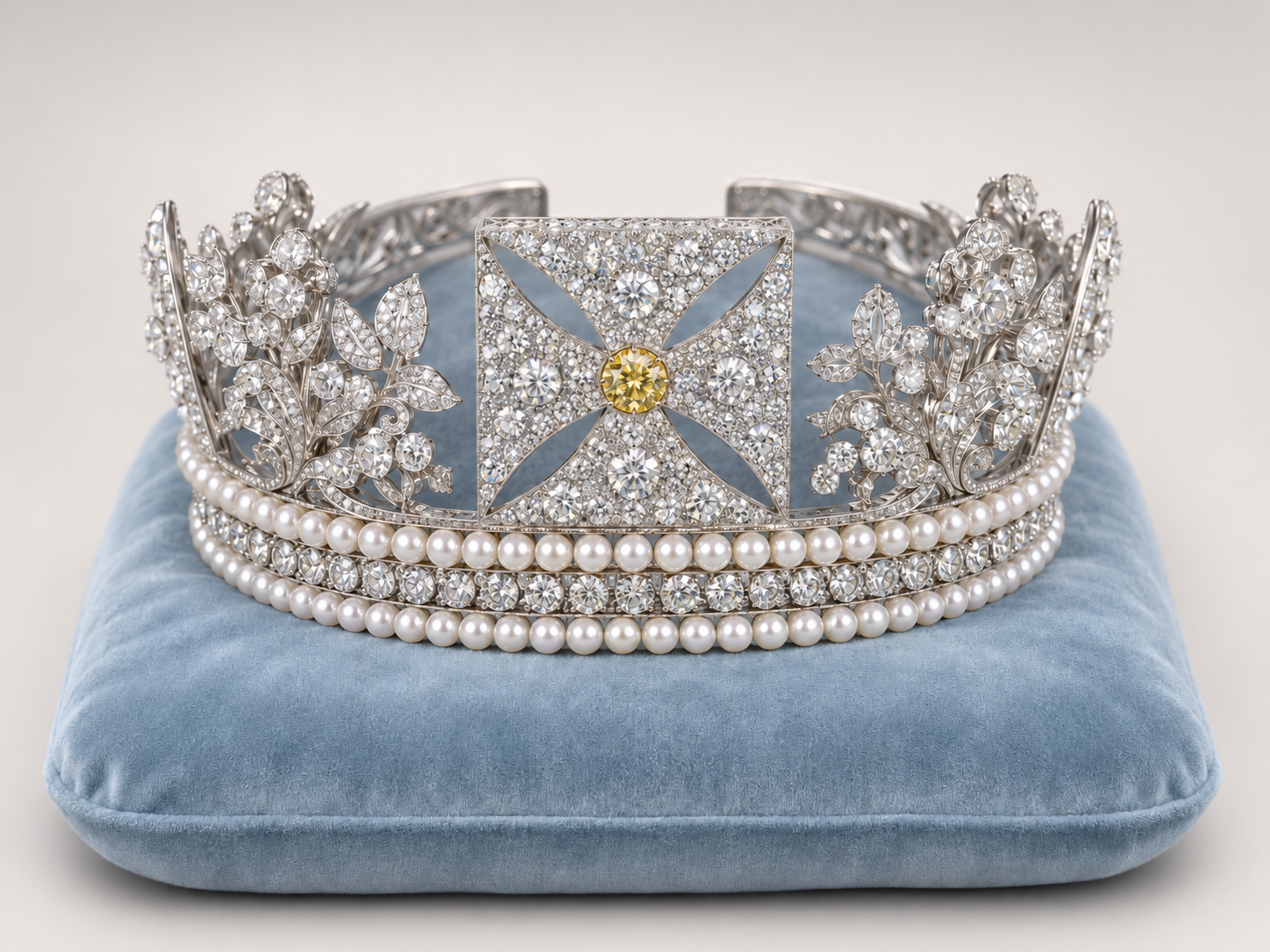
Image information
Click image to magnify
Digitally created illustration of the diamond diadem, with crosses, floral emblems and rows of pearls, resting on a blue cushion.
- Credit
- Stunning Stamps.
- Notes
- Digitally created.
Sources
- Victoria and Albert Museum: Owen Jones and The Grammar of Ornament
- Hastings E. Wright and A. B. Creeke: A History of the Adhesive Stamps of the British Isles (1899), pp. 134–136
- Douglas N. Muir, Royal Mint Museum: William Wyon & the Penny Black
- Heritage Auctions, William Wyon medal photograph, via Wikimedia Commons (enhanced for display)
- Wyon medal photograph: Creative Commons Attribution 3.0 licence
- Royal Collection Trust: George IV's Diamond Diadem
