
The design of the 2s brown
Queen Victoria · Great Britain · Thomas De La Rue & Co. · 1880
The blue stamp becomes brown
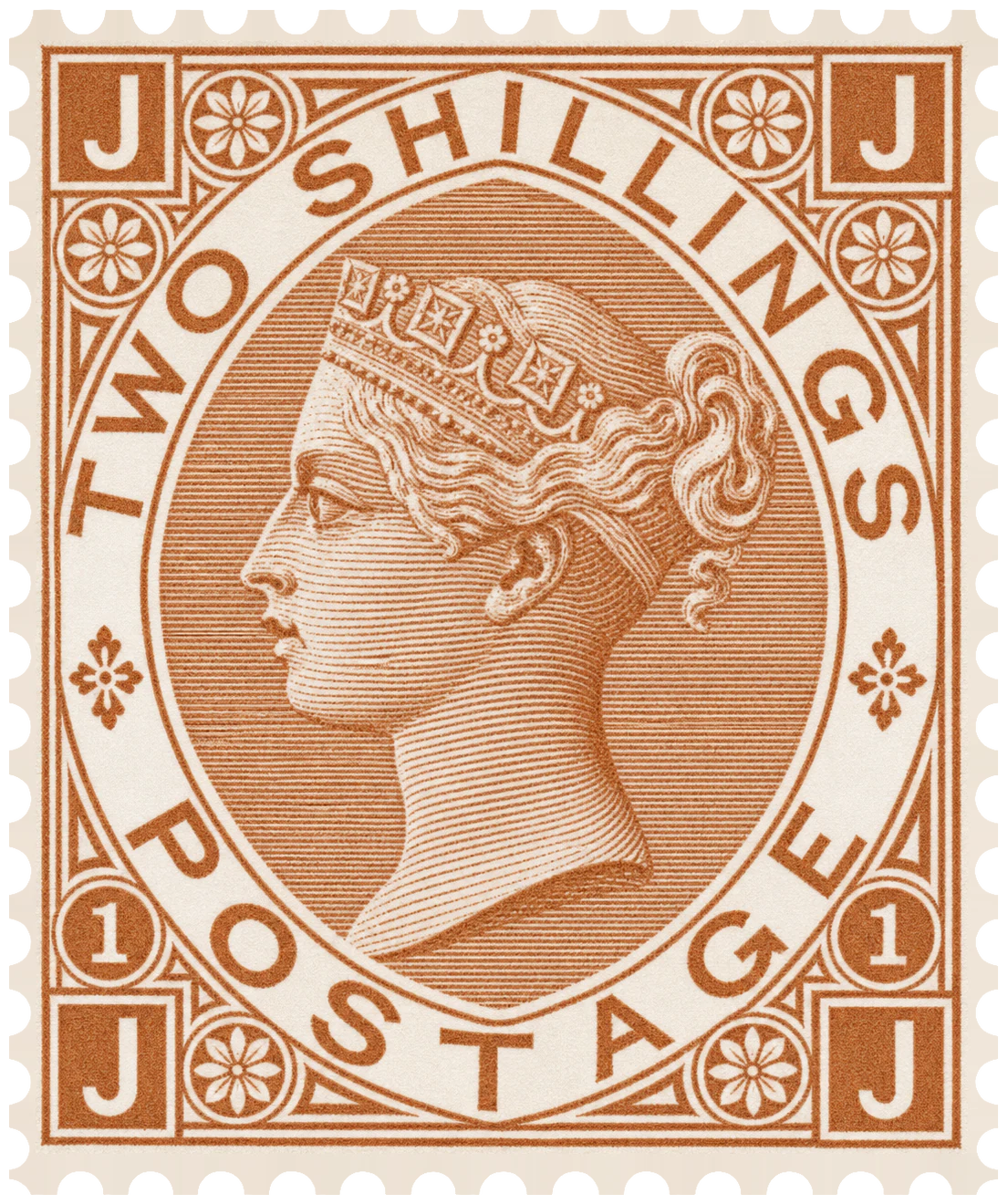
The two-shilling brown used exactly the same engraved design as the blue stamp introduced in 1867.
Victoria's portrait, the pointed oval, inscriptions, corner letters and plate numbers remained unchanged.
Only the printing ink was different. [1]
The change followed the introduction of a blue 2½d stamp, which made the existing two-shilling blue less distinctive.
The brown ink gave the design a warmer appearance without requiring a new engraving or printing plate.
An established Victorian stamp had been transformed simply by changing its colour.
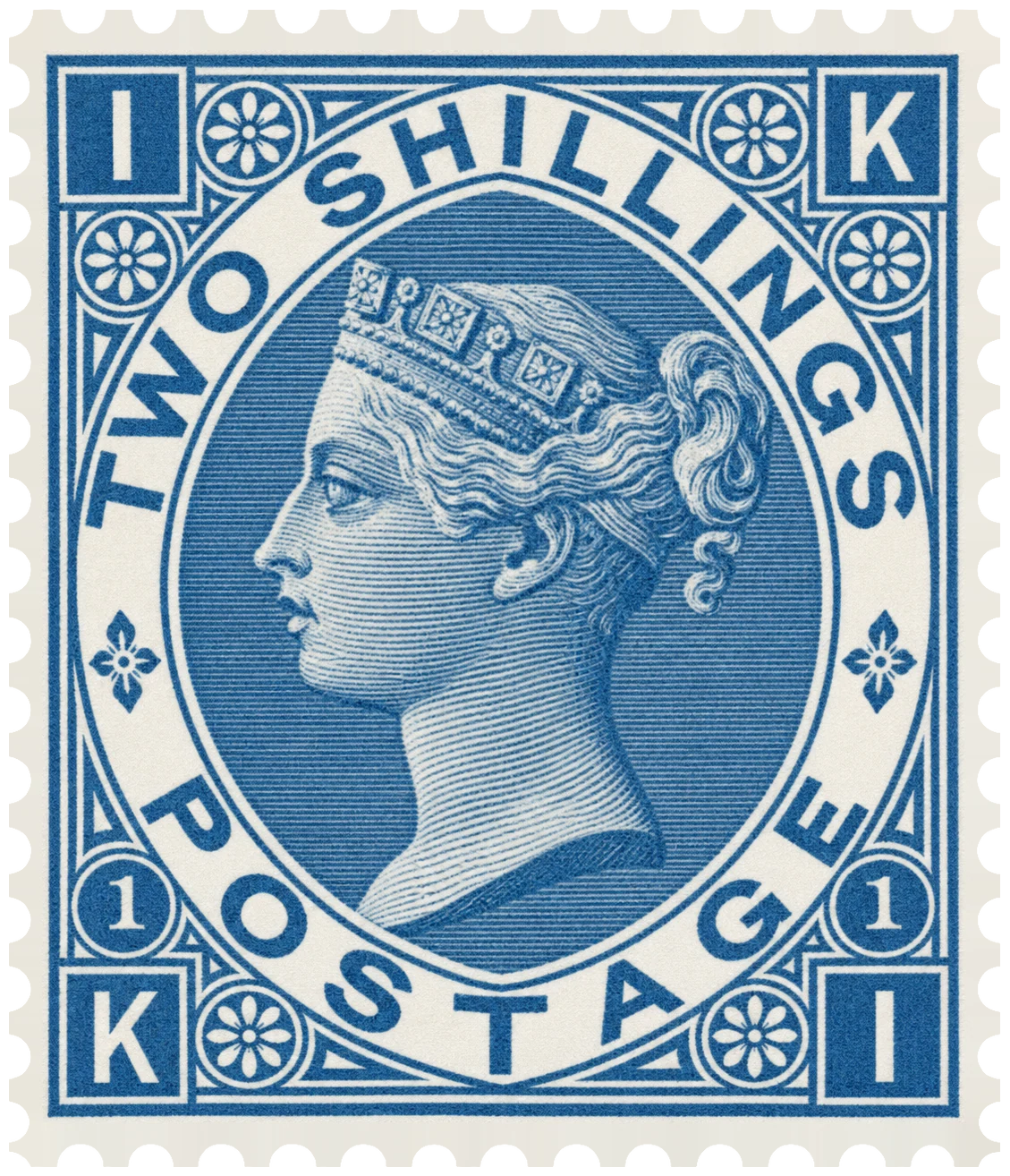
The portrait and frame continued in a different colour.
Click either stamp to magnify
The improved design that was never issued
In December 1872, De La Rue completed another two-shilling die.
The proposed version replaced the large white corner letters with coloured letters against white panels. The plate numbers were also redesigned to match. [1]
The engravers corrected a minor imperfection in the original inscription. The first letter I in SHILLINGS had not been ideally positioned at the top of the curved band; the new die improved its alignment.
But no printing plate was ever constructed.
When the brown two-shilling appeared eight years later, the old design was retained.
The unused die preserves an alternative version that might have looked more consistent with De La Rue's later Victorian stamps.
Owen Jones and the pointed oval
The two-shilling was designed by Owen Jones, whose work brought together geometry, ornament and colour.
Jones had studied historic decorative patterns and published The Grammar of Ornament in 1856. He believed that good design depended on understanding the principles behind ornament rather than simply copying old motifs. [2]
On the stamp, Victoria sits within a pointed oval, surrounded by curved inscriptions and symmetrical ornament.
The arrangement gives the portrait a strong central position while allowing decorative detail to occupy the surrounding spaces.
Jones's design survived unchanged when the stamp became brown in 1880.
Two shillings above, postage below
The inscription TWO SHILLINGS follows the upper portion of the white oval band surrounding Victoria's portrait.
POSTAGE curves around the lower part. Small ornamental devices separate the two inscriptions at the sides. [1]
This arrangement differs from many earlier British stamps, where POSTAGE appears at the top and the value below.
The large oval dominates the composition, while the rectangular outer frame provides space for the corner letters and additional ornament.
The result is one of the more distinctive arrangements among Victoria's surface-printed stamps.
Stars and tiny plate numbers
The four corners contain large white letters, but additional details appear immediately beside them.
Small circular panels beneath the upper letters contain star-like ornaments. Similar circles above the lower letters carry the printing plate number. [1]
On the ordinary brown stamp, both plate numbers read 1.
This is the same plate that produced almost all the blue two-shilling stamps from 1867 onwards.
The repeated number provides a small visible link between two stamps produced more than twelve years apart.
The rose hidden beneath the brown ink
The two-shilling brown was printed on paper watermarked with a Spray of Rose.
The watermark was formed during papermaking rather than printed in ink. It was intended to make the paper more difficult to imitate. [1]
The same watermark had been used for the earlier blue stamp.
De La Rue therefore changed neither the paper's hidden design nor the engraving when it introduced the brown colour.
The stamp's appearance changed, but the security features beneath it remained familiar.
A portrait of a fifteen-year-old princess
Victoria's portrait originated before she became Queen. William Wyon, Chief Engraver at the Royal Mint, created a medal commemorating her visit to the City of London in November 1837. Its portrait drew on a sketch made in 1834, when Victoria was fifteen. The medal was issued in 1838. [3]
Henry Corbould prepared a drawing based on Wyon's portrait, which later supplied the model for the royal head used on De La Rue's surface-printed stamps.
Victoria's youthful likeness remained familiar even as artists such as Owen Jones redesigned the frames surrounding it. [4, 5]
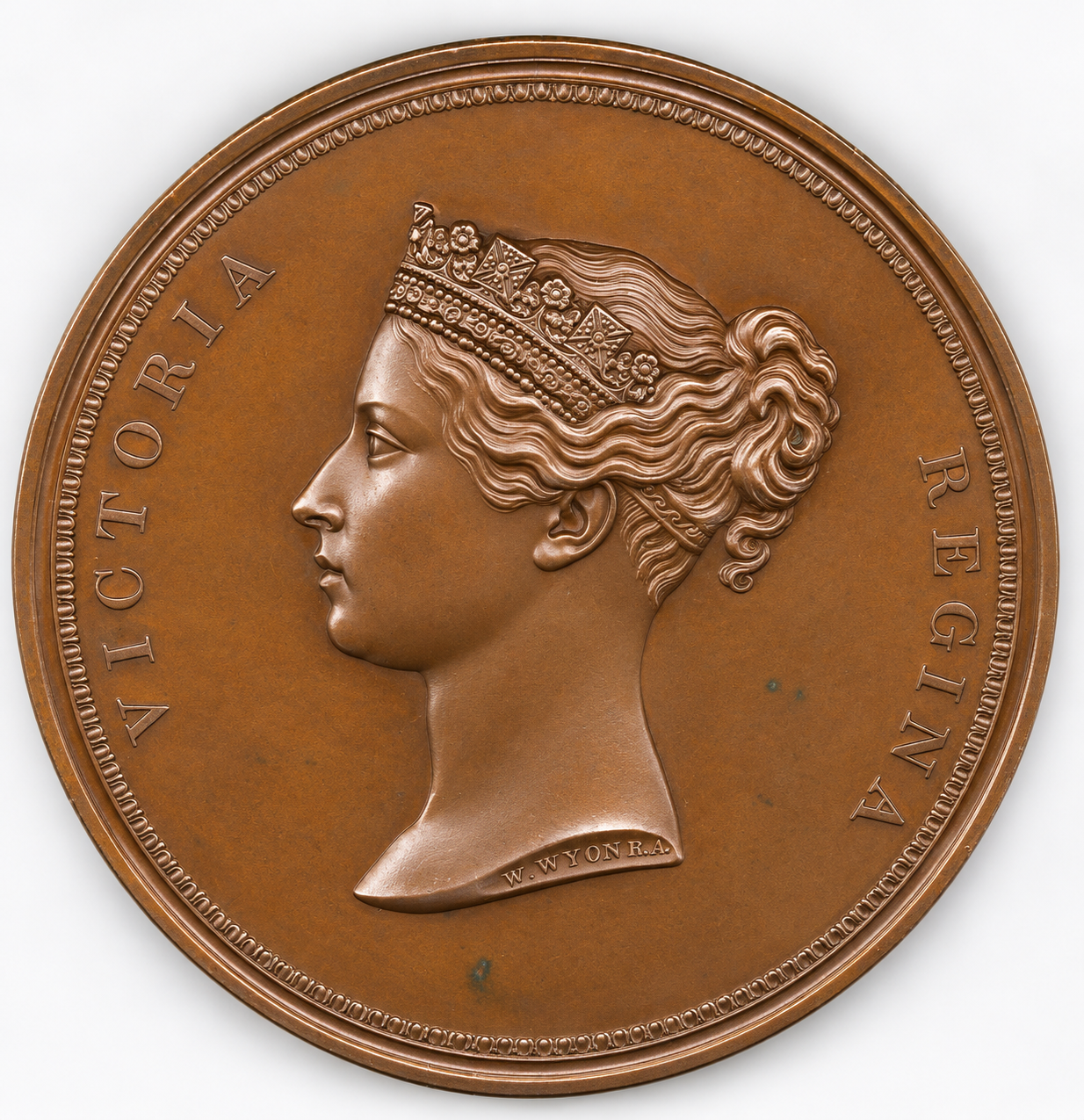
Image information
Click image to magnify
Bronze medal showing the young Victoria in left-facing profile, wearing the diamond diadem, with the inscription VICTORIA REGINA.
- Credit
- Heritage Auctions, via Wikimedia Commons. CC BY 3.0.
- Notes
- Brightness, contrast, sharpness and colour balance adjusted by Stunning Stamps.
The diamond diadem made for a king
The ornament in Victoria's hair was commissioned for George IV's coronation in 1821. [6]
It contains 1,333 diamonds, with crosses and the national emblems of the rose, thistle and shamrock.
Victoria later wore the diadem in portraits, and it became a familiar feature of British postage stamps.
On the two-shilling brown, its jewels are reduced to tiny printed lines. A magnificent royal ornament had become part of an everyday object worth two shillings.

Image information
Click image to magnify
Digitally created illustration of the diamond diadem, with crosses, floral emblems and rows of pearls, resting on a blue cushion.
- Credit
- Stunning Stamps.
- Notes
- Digitally created.
Sources
- Hastings E. Wright and A. B. Creeke: A History of the Adhesive Stamps of the British Isles (1899), pp. 134–137
- Victoria and Albert Museum: Owen Jones and The Grammar of Ornament
- Douglas N. Muir, Royal Mint Museum: William Wyon & the Penny Black
- Heritage Auctions, William Wyon medal photograph, via Wikimedia Commons (enhanced for display)
- Wyon medal photograph: Creative Commons Attribution 3.0 licence
- Royal Collection Trust: George IV's Diamond Diadem
