
The design of the 4d rose
Queen Victoria · Great Britain · Thomas De La Rue & Co. · 1856
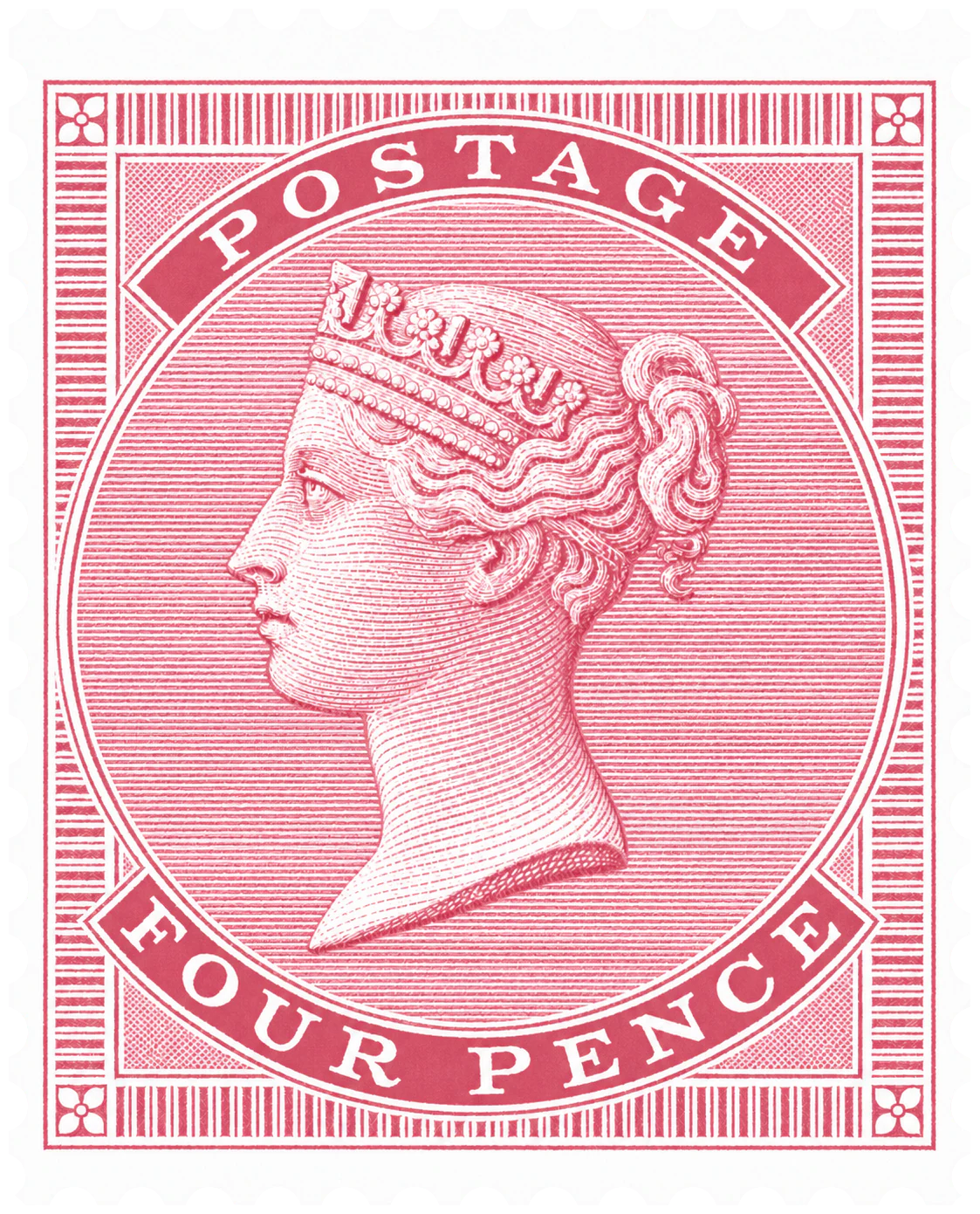
Why the fourpenny changed from carmine to rose
The rose colour introduced in November 1856 was not simply an aesthetic choice. It accompanied the development of a more secure printing ink.
The original carmine ink had proved vulnerable to attempts to remove postal cancellations. De La Rue therefore experimented with more fugitive inks, designed to be damaged by the chemicals used to clean stamps. [1]
The resulting rose ink was printed on ordinary white paper, rather than the heavily glazed security paper used previously.
Although the colour changed, the engraved design remained the same. Victoria's portrait, the surrounding circle and the lettering were all retained.
The new appearance was therefore the visible result of experiments in chemistry, rather than a new commission for the engraver.
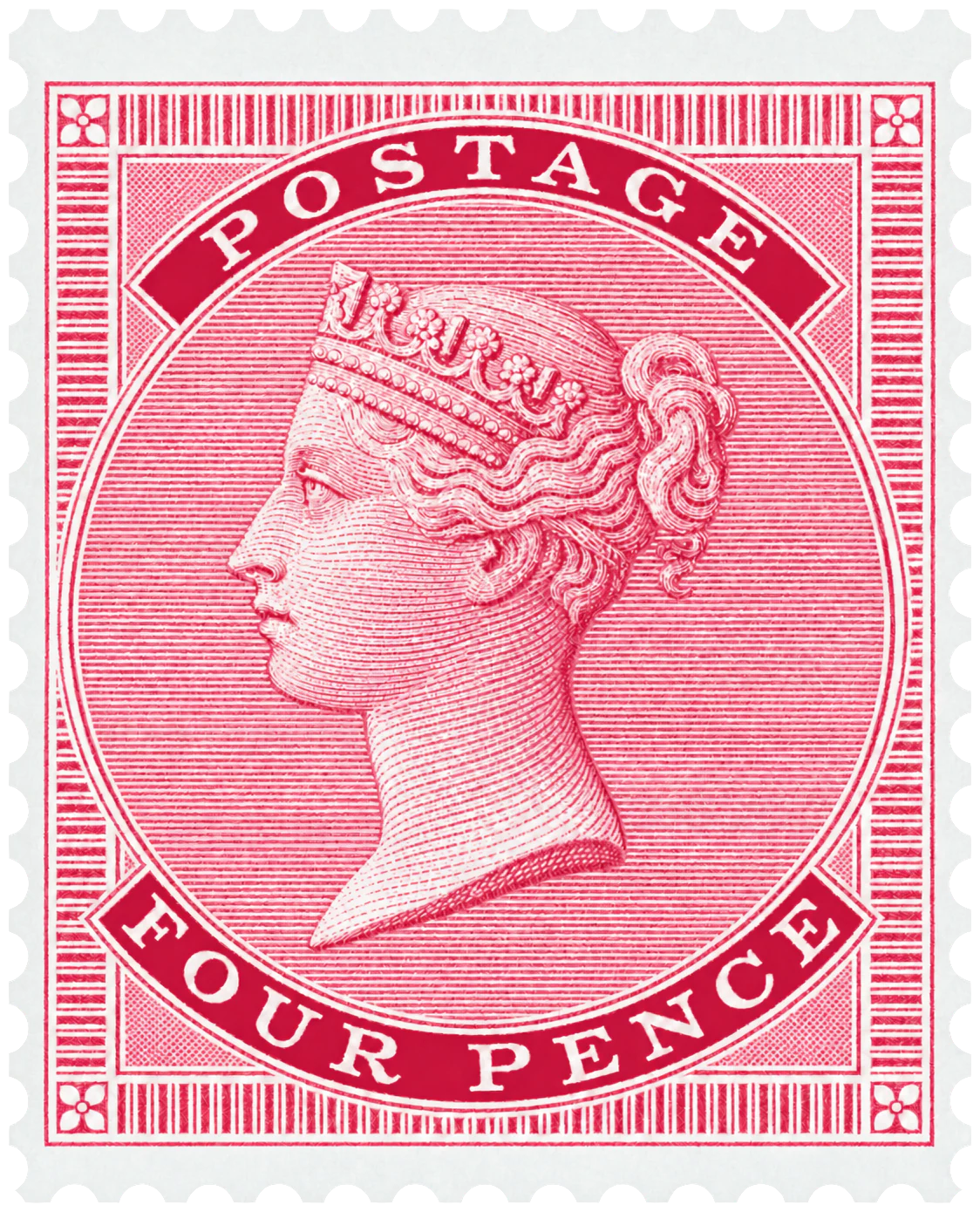
The issued designs before and after the change. These illustrations do not demonstrate the paper surfaces or the security tests.
Click either stamp to magnify
The paper that no longer looked blue
The original fourpenny carmine was printed on thick security paper that often developed a noticeable blue tint.
The paper contained prussiate of potash, added to help expose attempts to remove cancellations. Unfortunately, chemical reactions could discolour the paper, while its highly glazed surface prevented ink from adhering properly. [2]
During 1856, the authorities moved towards ordinary white paper and a specially prepared printing ink.
The resulting rose-coloured stamps had a cleaner appearance. Without the bluish background, the printed colour looked noticeably different from the earlier carmine.
The change illustrates how the appearance of a stamp could be shaped by the materials beneath the design. The paper was not merely something on which to print; it formed part of the security system.
A larger Garter hidden beneath the portrait
The fourpenny stamp carried a watermark based on the insignia of the Order of the Garter.
The original 1855 stamp used a Small Garter watermark. In February 1856, the design was enlarged to a Medium Garter, which remained in use for the new rose-coloured printing later that year. [2]
A further enlargement followed in January 1857, producing the Large Garter watermark.
The reason for these changes is not established. One suggestion is that the larger watermark helped keep its design clear of Victoria's head, but this remains uncertain.
The watermark was formed within the paper during manufacture, not printed onto its surface. Its changing dimensions reveal a sequence of small design decisions made almost entirely out of sight.
The old printing plate that received a new colour
The rose fourpenny was printed from the same electrotype printing plate used for the first carmine stamps of 1855. [3]
Plate 1 had been registered on 13 July 1855. When the paper and ink changed in 1856, the printers continued using it rather than commissioning a new engraving. [4]
The 1856 rose printing amounted to about 7,500 sheets, each containing 240 impressions.
The change was therefore made entirely through the printing materials. Victoria's portrait and the surrounding design remained untouched.
The same plate subsequently produced rose-coloured stamps on the new Large Garter paper introduced in 1857. A piece of equipment prepared for the original carmine issue had successfully adapted to successive changes of colour and paper.
A French influence on a British stamp
The fourpenny rose retained the design created for the original carmine stamp by Jean Ferdinand Joubert de la Ferté.
Joubert had trained in Paris, and his design shows similarities to the French Ceres postage stamps introduced in 1849. Both place a left-facing female portrait inside a circular frame; the French stamp has straight inscription bands, while those of the British stamp are curved. [2]
The fourpenny was not a copy of the French stamp. But the arrangement suggests how Joubert's continental experience influenced his work for De La Rue.
The rose printing of 1856 preserved this design without alteration. Its elegant circular portrait represented a clear departure from the rectangular framework of the Penny Black and Penny Red.
The Queen without corner letters
The Penny Black and Penny Red had letters in their lower corners, identifying each stamp's position on the printing plate. The fourpenny rose had none.
Instead, small decorative crosses occupied the corners, surrounded by a rectangular frame. The inscriptions POSTAGE and FOUR PENCE followed the curves above and below Victoria's portrait. [2]
Why corner letters were omitted is uncertain. Joubert's experience with continental stamp design may have influenced the decision, but no definitive explanation survives.
The absence of letters helped give the design its uncluttered appearance.
Corner letters were eventually introduced in 1862, but the rose fourpenny of 1856 retained the original arrangement.
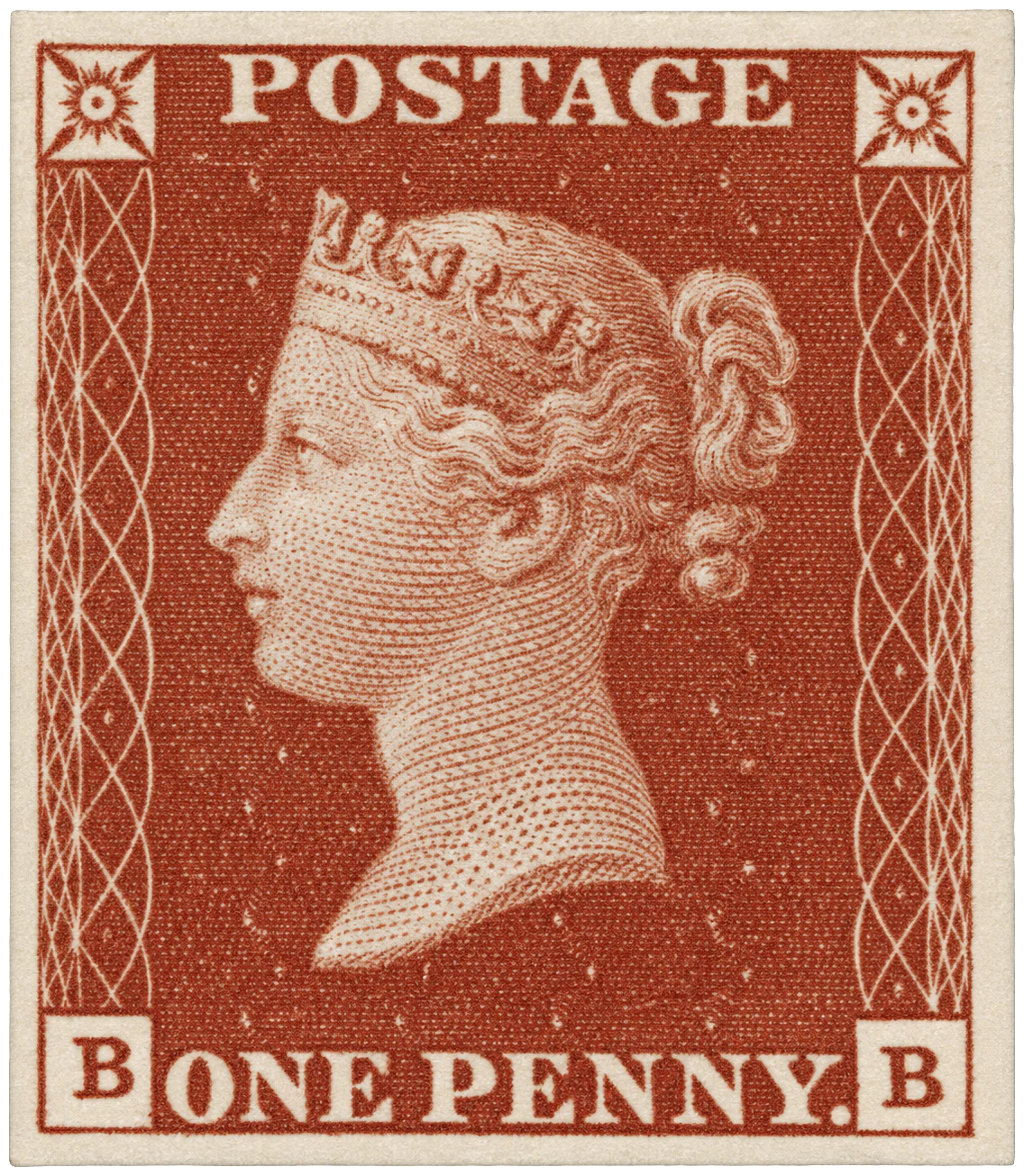
Compare the treatment of the corners on the engraved penny and the early surface-printed design.
Click either stamp to magnify
The printer who no longer needed wet paper
The fourpenny rose was printed by typography, or letterpress. Unlike the earlier line-engraved stamps, it did not require the paper to be dampened before printing.
With line engraving, wetting helped the paper enter the fine recesses of the printing plate. But damp paper could shrink unevenly as it dried, making accurate perforation difficult. [2]
De La Rue's process used the raised parts of the printing plate to transfer ink onto dry paper.
The change made it easier to maintain accurate spacing between stamps and perforate the finished sheets.
It was an important manufacturing advantage. The design could be printed regularly without the complications caused by repeatedly wetting and drying the paper.
A portrait of a fifteen-year-old princess
Victoria's portrait originated before she became Queen. William Wyon, Chief Engraver at the Royal Mint, created a medal commemorating her visit to the City of London in November 1837. Its portrait drew on a sketch made in 1834, when Victoria was fifteen. The medal was issued in 1838. [5]
Rowland Hill chose Wyon's portrait for the first postage stamps. Henry Corbould prepared a drawing from the medal, which became the basis for the engraved design.
For the surface-printed fourpenny, Jean Ferdinand Joubert de la Ferté created a new engraving based on Corbould's drawing.
The profile remained recognisably the same young Victoria. While the Queen grew older, her youthful likeness continued to appear on British postage stamps throughout her reign. [2, 6, 7]
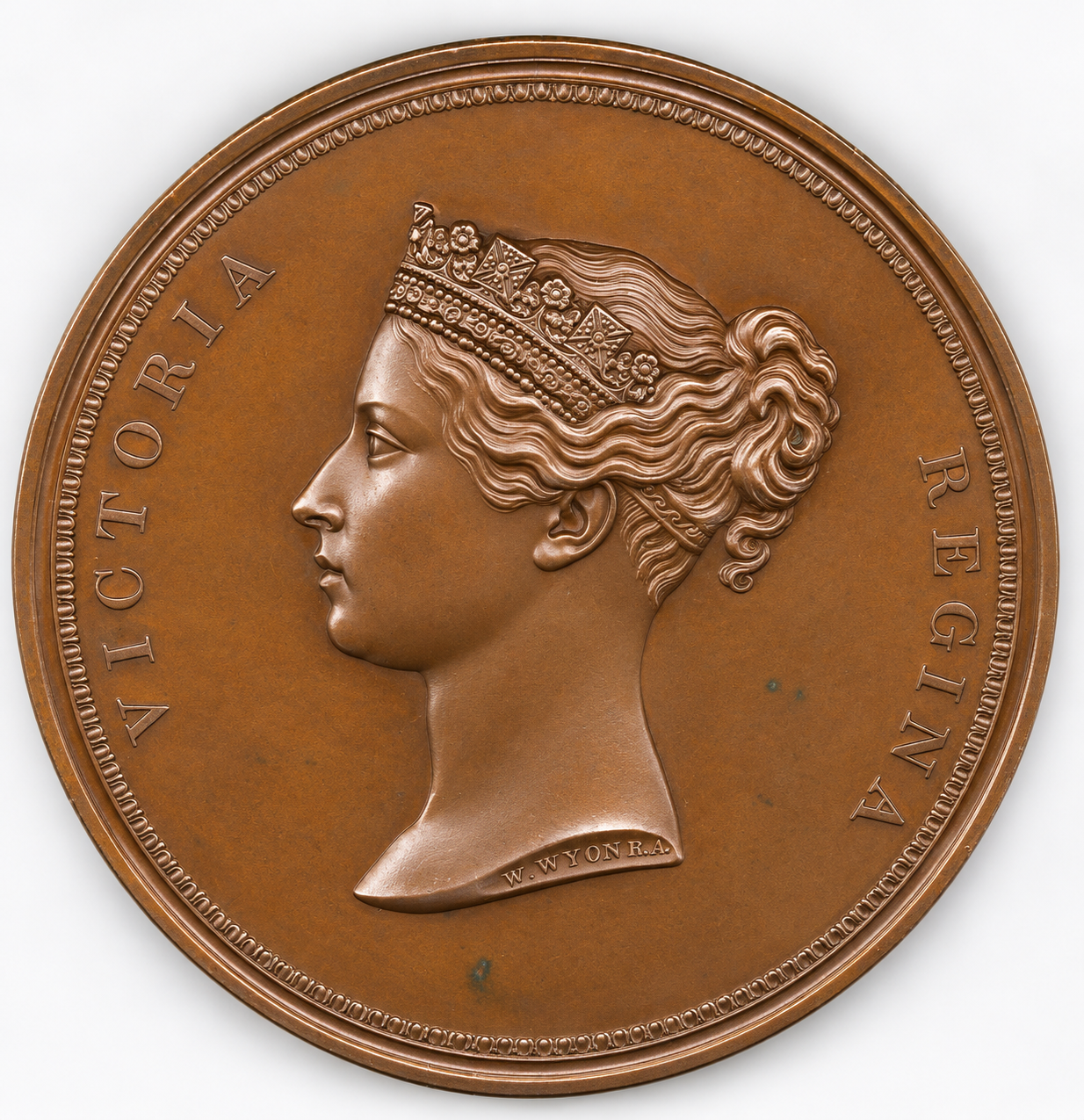
Image information
Click image to magnify
Bronze medal showing the young Victoria in left-facing profile, wearing the diamond diadem, with the inscription VICTORIA REGINA.
- Credit
- Heritage Auctions, via Wikimedia Commons. CC BY 3.0.
- Notes
- Brightness, contrast, sharpness and colour balance adjusted by Stunning Stamps.
The diamond diadem made for a king
The ornament in Victoria's hair was not made for her. The diamond diadem had been commissioned for George IV's coronation in 1821. [8]
It contains 1,333 diamonds, with crosses and the national emblems of the rose, thistle and shamrock. The diamonds were originally hired for George IV's coronation, but he kept them and paid more than £8,000. Queen Adelaide later wore the ornament, establishing its association with royal women.
Victoria wore the diadem in portraits, and Wyon included it in the image used for Britain's first postage stamps. Joubert retained the ornament in his engraving for the fourpenny.
At stamp size, its elaborate jewels became tiny engraved marks. A magnificent royal ornament had become part of an everyday object worth fourpence.

Image information
Click image to magnify
Digitally created illustration of the diamond diadem, with crosses, floral emblems and rows of pearls, resting on a blue cushion.
- Credit
- Stunning Stamps.
- Notes
- Digitally created.
Sources
- John G. Hendy: The History of the Postmarks of the British Isles from 1840 to 1876 (1909), pp. 120–121
- Robert B. Galland: The First Low Value Surface Printed Postage Stamps of Great Britain, Royal Philatelic Society London (2014)
- The Philatelic Record (1890), p. 11, Surface-Printed Stamps: electrotype printing plates
- Allan Oliver: Life Span of the Printing Plates for All the British Postage Stamps of Queen Victoria (2015), pp. 108–110
- Douglas N. Muir, Royal Mint Museum: William Wyon & the Penny Black
- Heritage Auctions, William Wyon medal photograph, via Wikimedia Commons (enhanced for display)
- Wyon medal photograph: Creative Commons Attribution 3.0 licence
- Royal Collection Trust: George IV's Diamond Diadem
