
The design of the 6d lilac
Queen Victoria · Great Britain · Thomas De La Rue & Co. · 1856
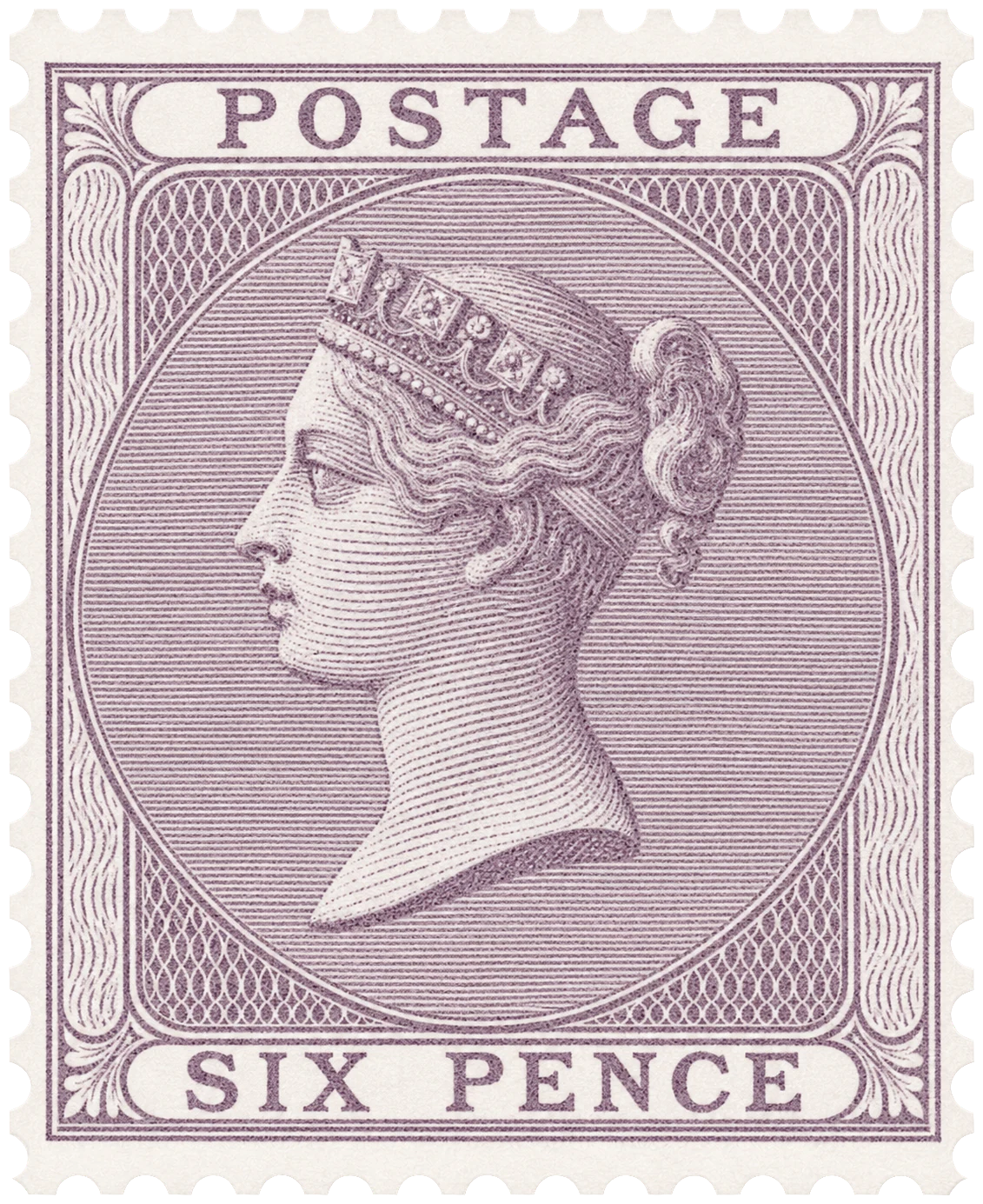
The Queen without corner letters
The Penny Black and Penny Red had letters in their lower corners, identifying each stamp's position on the printing plate. The 6d lilac had none.
Instead, its corners were filled with ornament, while the value appeared in a broad tablet below the portrait and POSTAGE in a matching tablet above. [1]
The result was a calmer, more open design than the crowded line-engraved stamps.
Corner letters would not be added to the sixpence until 1862. In its first form, the stamp was allowed to rely on portrait, colour and ornament alone.
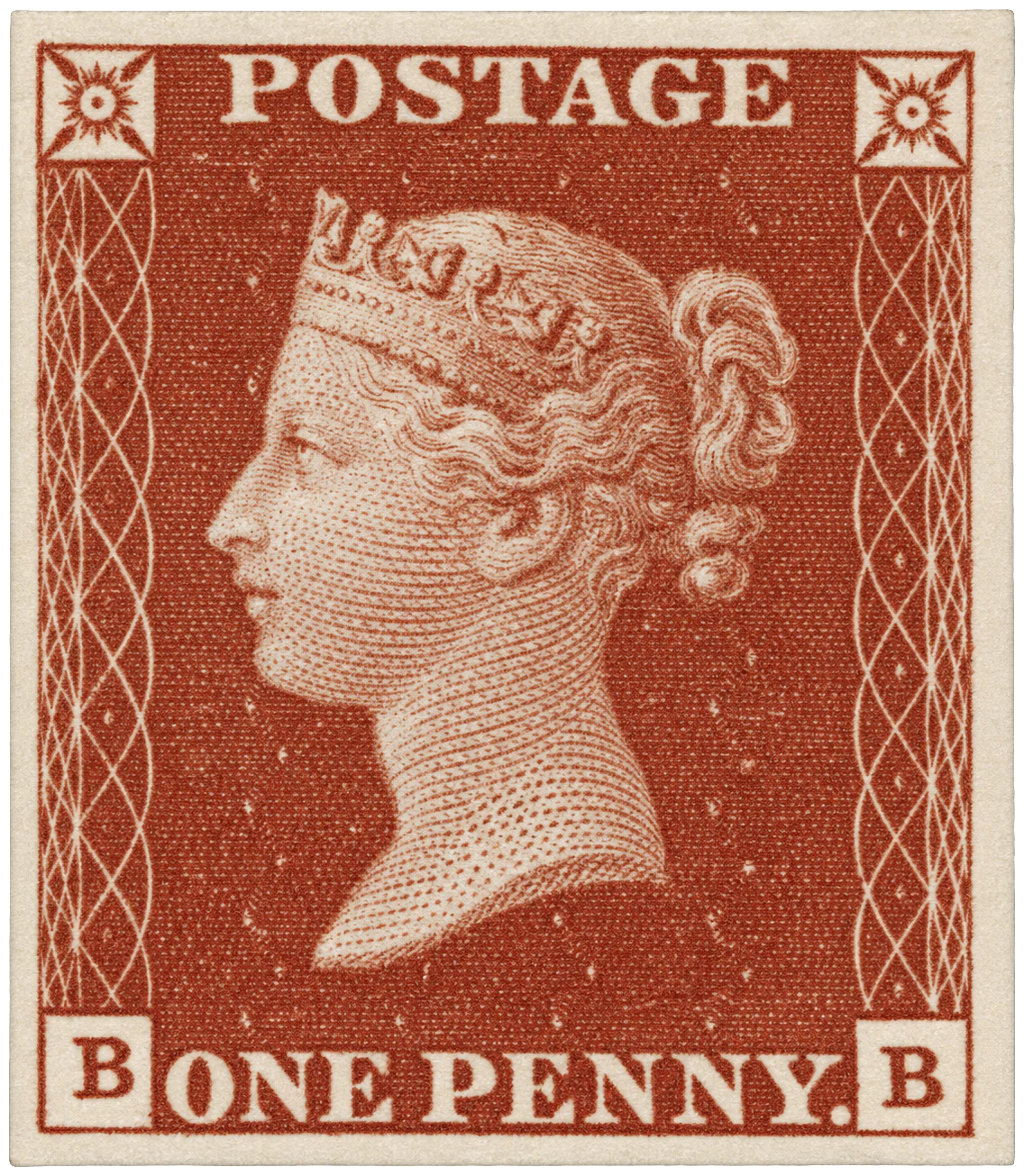
Compare the treatment of the corners on the engraved penny and the early surface-printed design.
Click either stamp to magnify
The heraldic emblems hidden in the paper
The sixpenny lilac was printed on paper watermarked with heraldic emblems.
These were not printed in ink. They were formed in the paper itself during manufacture, and consisted of two roses, a shamrock and a thistle. [2]
The symbols represented the nations of the United Kingdom, turning the paper into part of the design.
The watermark also served a practical purpose. It made the paper harder to imitate and helped protect the stamp against forgery.
The paper-maker who repaired a thistle with a rose
Even the watermark could go wrong.
Later philatelic writers recorded that when one part of the watermark roll became faulty, the damaged thistle was replaced by a rose. The result was the curious watermark known as "three roses and a shamrock". [3]
What matters here is not rarity, but the glimpse it gives of production. When the paper-maker faced a damaged emblem, the solution was not to discard the whole roll, but to repair it.
A tiny improvisation in the paper mill could survive in the finished stamp.
A portrait shaped for surface printing
Jean Ferdinand Joubert de la Ferté designed the sixpenny lilac for De La Rue's surface-printing process.
Victoria's head sits within a large circle, with open space around it and strong engraved lines that could print cleanly by letterpress. The surrounding corners are filled with fine ornament rather than the dense cross-hatching of the Penny Red. [4]
The composition is elegant and spacious. It looks modern beside the older line-engraved issues.
The printer who no longer needed wet paper
The sixpenny lilac was printed by typography, or letterpress. Unlike line engraving, this method did not require the paper to be dampened before printing.
That was a major practical advantage. Damp paper could shrink unevenly as it dried, causing trouble when sheets were perforated. [4]
Surface printing used the raised parts of the plate to transfer ink onto dry paper, making the spacing of the finished stamps more predictable.
The design of the sixpence is therefore tied closely to its production method. It looks different because it was made differently.
The sheet divided into twelve panes
The sixpenny surface-printed stamps were arranged differently from the earlier penny stamps.
Registration sheets show 240 impressions divided into twelve panes, each pane containing twenty stamps in five rows of four. [5]
This arrangement helped clerks handle high-value sheets more easily, and it shaped the layout of the margins surrounding the stamps.
The structure of the sheet is invisible on a single stamp, but it formed part of the printer's planning from the beginning.
A portrait of a fifteen-year-old princess
Victoria's portrait originated before she became Queen. William Wyon, Chief Engraver at the Royal Mint, created a medal commemorating her visit to the City of London in November 1837. Its portrait drew on a sketch made in 1834, when Victoria was fifteen. The medal was issued in 1838. [6]
Rowland Hill chose Wyon's portrait for the first postage stamps. Henry Corbould prepared a drawing from the medal, and Joubert later created a new engraved version for the surface-printed stamps.
The profile remained recognisably the same young Victoria. While the Queen grew older, her youthful likeness continued to appear on British postage stamps throughout her reign. [7, 8]
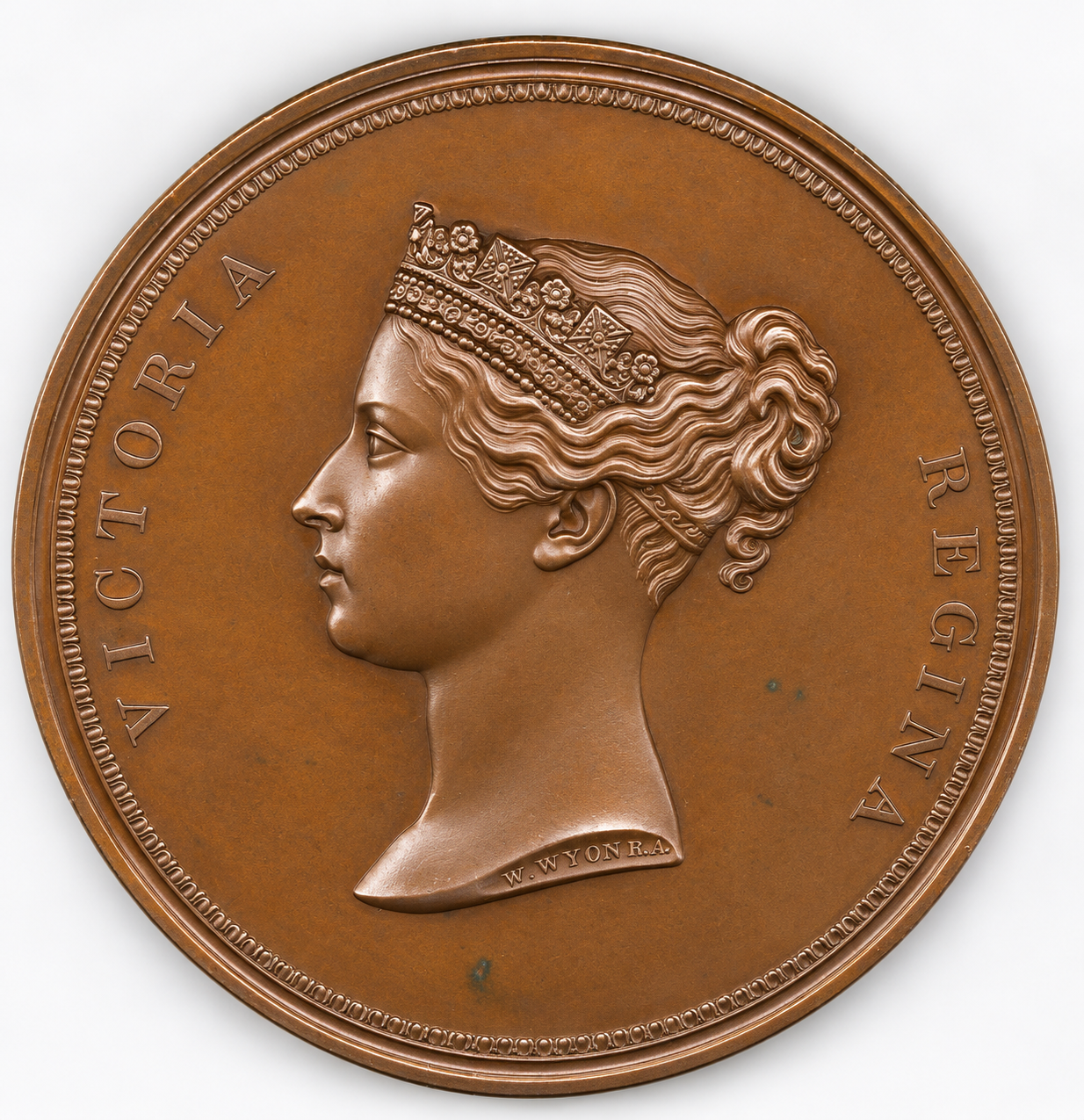
Image information
Click image to magnify
Bronze medal showing the young Victoria in left-facing profile, wearing the diamond diadem, with the inscription VICTORIA REGINA.
- Credit
- Heritage Auctions, via Wikimedia Commons. CC BY 3.0.
- Notes
- Brightness, contrast, sharpness and colour balance adjusted by Stunning Stamps.
The diamond diadem made for a king
The ornament in Victoria's hair was not made for her. The diamond diadem had been commissioned for George IV's coronation in 1821. [9]
It contains 1,333 diamonds, with crosses and the national emblems of the rose, thistle and shamrock. Queen Adelaide later wore it, and Victoria adopted it in portraits.
Joubert retained the diadem in the sixpenny lilac. At stamp size, its elaborate jewels became a handful of engraved lines.
A magnificent royal ornament had become part of an everyday object worth sixpence.

Image information
Click image to magnify
Digitally created illustration of the diamond diadem, with crosses, floral emblems and rows of pearls, resting on a blue cushion.
- Credit
- Stunning Stamps.
- Notes
- Digitally created.
Sources
- Great Britain Philatelic Society: Survey of GB Stamps, GB Journal, vol. 28 no. 2 (1990)
- Fred J. Melville: Stamps of Great Britain — the 6d surface-printed issue
- Royal Mail Philatelic Bulletin, Collecting the Victorians — watermark varieties
- Robert B. Galland: The First Low Value Surface Printed Postage Stamps of Great Britain, Royal Philatelic Society London (2014)
- Great Britain Philatelic Society: Postal Museum registration sheet — 6d deep violet, 29 March 1856
- Douglas N. Muir, Royal Mint Museum: William Wyon & the Penny Black
- Heritage Auctions, William Wyon medal photograph, via Wikimedia Commons (enhanced for display)
- Wyon medal photograph: Creative Commons Attribution 3.0 licence
- Royal Collection Trust: George IV's Diamond Diadem
