
The design of the 9d bistre
Queen Victoria · Great Britain · Thomas De La Rue & Co. · 1862
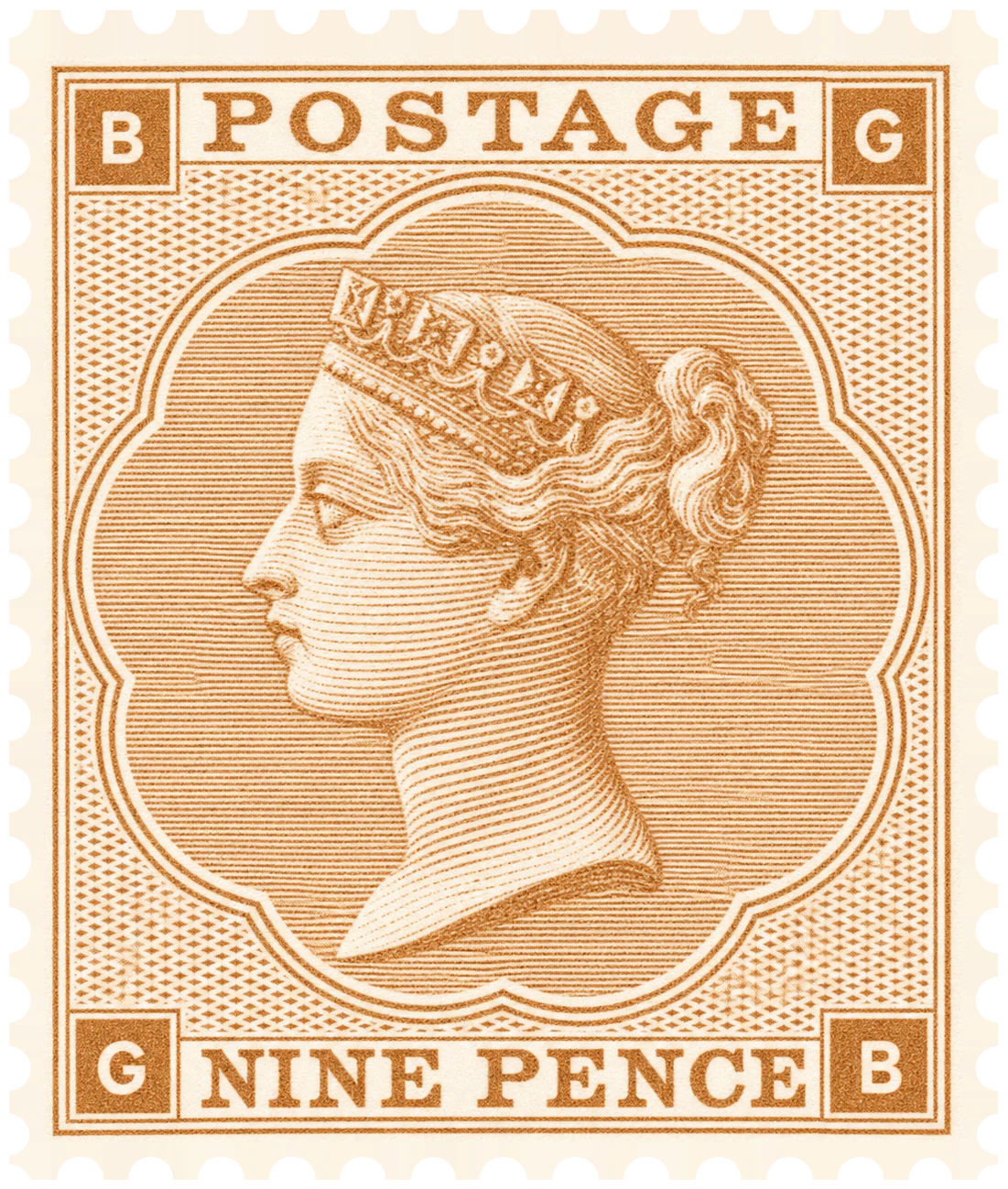
Nine curves around Victoria's portrait
The ninepenny has a distinctive frame unlike the circles and ovals used on other surface-printed stamps.
Victoria's head sits within a border formed from nine inward-curving sections, enclosed by a rectangular frame. The surrounding spaces contain fine horizontal cross-hatching. [1]
The arrangement gives the portrait a gently scalloped outline.
The nine curves provide an intriguing visual connection with the denomination, although there is no surviving evidence that the number was deliberately chosen for that reason.
The design gave the new ninepenny a recognisable appearance without requiring a different engraving of the Queen.
Four letters from the beginning
Unlike the earlier fourpenny, sixpenny and one-shilling stamps, the ninepenny was introduced with letters in all four corners.
The lower letters identify the stamp's position in the printing sheet. Those at the top repeat the same pair in reverse order. [2]
Each letter appears in white against a small coloured square.
The arrangement helped expose attempts to construct fraudulent stamps from uncancelled pieces of used examples.
The ninepenny was therefore designed with a security feature that the older surface-printed denominations had to acquire through later redesigns.
The hairlines added to an unused plate
The ordinary ninepenny has four coloured corner squares containing small white letters.
On an experimental version made from plate 3, a fine white diagonal line crosses the outer corner of each square. These are known as hairlines. [3]
The lines were deliberately incorporated into the design to distinguish the plate from its predecessor.
Plate 3 was registered in May 1862 but never used for regular production. Only impressions from the small preliminary printing survive.
The hairlines reveal a design change that was completed by the engravers but never adopted for ordinary manufacture.
Why the plate number is missing
Look carefully at the ninepenny stamp and you will find no printed plate number.
The authorities still needed to identify the printing equipment, but the numbers were placed in the margins of the sheet rather than on individual stamps. [1]
They appeared in small ovals, accompanied by other markings used to identify the printing plate and guide the perforating machinery.
The individual stamp therefore retained an uncluttered appearance.
A complete sheet reveals information that a single stamp conceals: the practical markings added for the people responsible for printing and finishing it.
The flowers hidden in the paper
The ninepenny was printed on paper watermarked with four heraldic emblems: two roses, a shamrock and a thistle.
These represented England, Ireland and Scotland. They were formed within the paper during manufacture, rather than printed in ink. [4]
The watermark helped make the paper more difficult to imitate.
The printed stamp therefore concealed a second design. Victoria's portrait was visible on the surface, while the national emblems could be discovered by examining the paper against transmitted light.
The colour that changed without changing the design
The ninepenny was initially printed in ochre-brown, later changing to brighter bistre.
The same engraved design and printing plate were retained. Only the printing ink changed. [1]
This makes the two colours an interesting comparison. The finely engraved portrait and frame can appear different simply because of the strength and tone of the ink.
The change illustrates how the printer's materials could influence the appearance of a design without altering any of its engraved lines.
A portrait of a fifteen-year-old princess
Victoria's portrait originated before she became Queen. William Wyon, Chief Engraver at the Royal Mint, created a medal commemorating her visit to the City of London in November 1837. Its portrait drew on a sketch made in 1834, when Victoria was fifteen. The medal was issued in 1838. [5]
Henry Corbould prepared a drawing based on Wyon's portrait, which later supplied the model for Joubert's surface-printed engraving.
Victoria's youthful likeness remained familiar even as the stamps surrounding it changed. [6, 7]
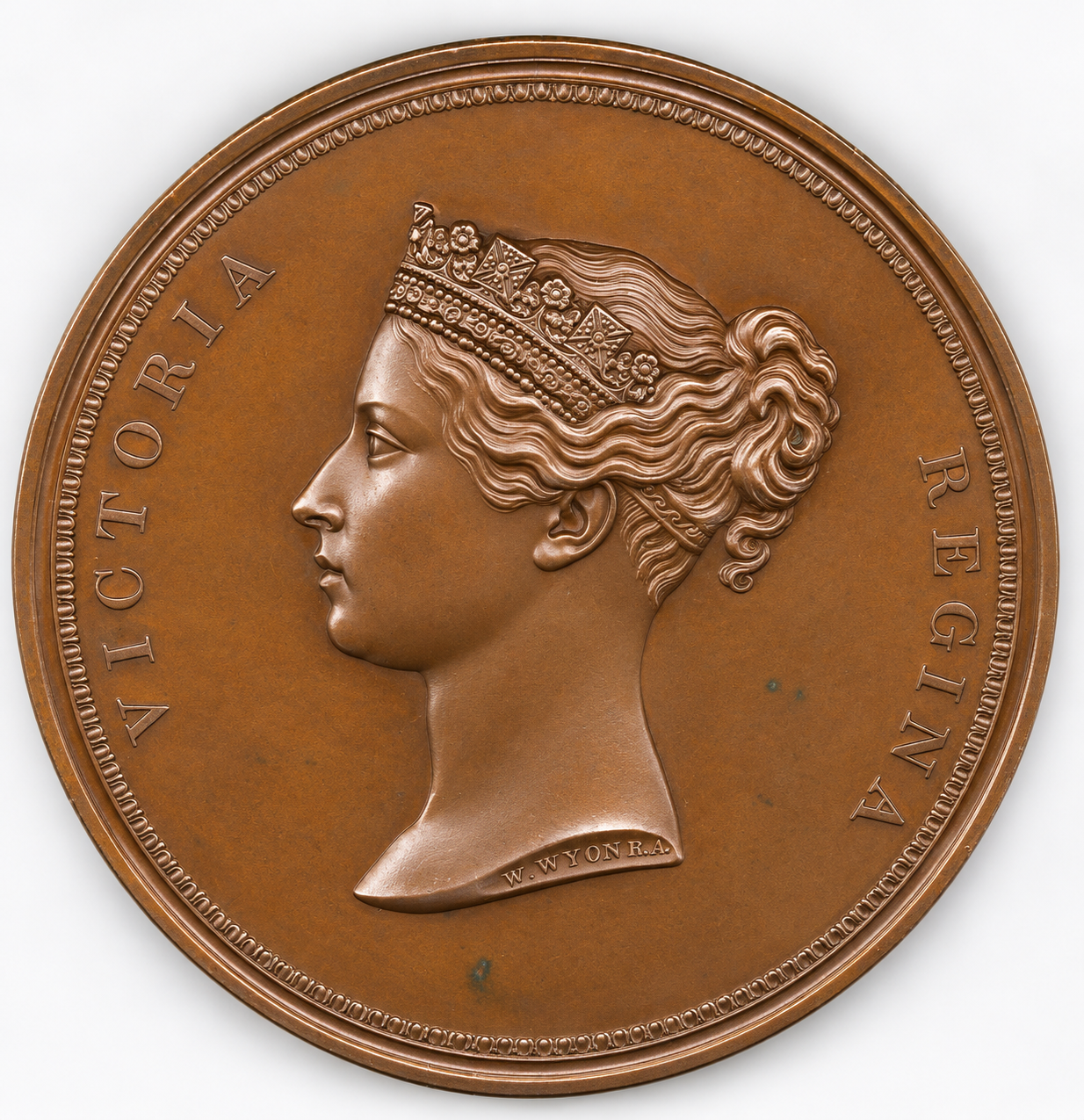
Image information
Click image to magnify
Bronze medal showing the young Victoria in left-facing profile, wearing the diamond diadem, with the inscription VICTORIA REGINA.
- Credit
- Heritage Auctions, via Wikimedia Commons. CC BY 3.0.
- Notes
- Brightness, contrast, sharpness and colour balance adjusted by Stunning Stamps.
The diamond diadem made for a king
The ornament in Victoria's hair was commissioned for George IV's coronation in 1821. [8]
It contains 1,333 diamonds, with crosses and the national emblems of the rose, thistle and shamrock.
Victoria later wore the diadem in portraits, and it became a familiar feature of British postage stamps.
On the ninepenny, its jewels are reduced to tiny engraved marks. A magnificent royal ornament had become part of an everyday object worth ninepence.
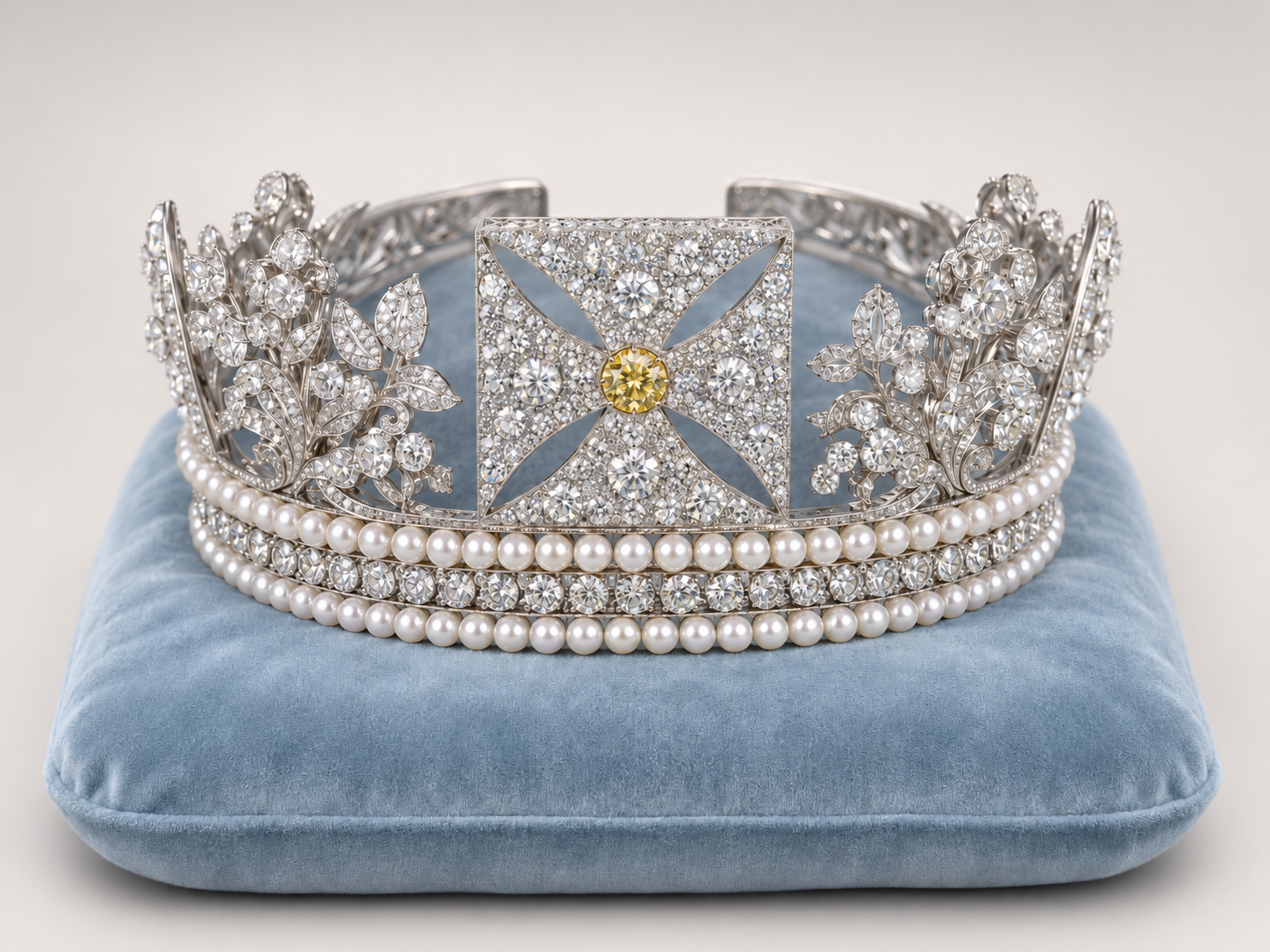
Image information
Click image to magnify
Digitally created illustration of the diamond diadem, with crosses, floral emblems and rows of pearls, resting on a blue cushion.
- Credit
- Stunning Stamps.
- Notes
- Digitally created.
Sources
- Hastings E. Wright and A. B. Creeke: A History of the Adhesive Stamps of the British Isles (1899), pp. 120–122
- Robert B. Galland: The First Low Value Surface Printed Postage Stamps of Great Britain, Royal Philatelic Society London (2014)
- L. N. Williams: The Abnormals of Great Britain, David Feldman (2015)
- Royal Mail Philatelic Bulletin: Collecting the Victorians — The Surface-Printed Issues
- Douglas N. Muir, Royal Mint Museum: William Wyon & the Penny Black
- Heritage Auctions, William Wyon medal photograph, via Wikimedia Commons (enhanced for display)
- Wyon medal photograph: Creative Commons Attribution 3.0 licence
- Royal Collection Trust: George IV's Diamond Diadem
