
The design of the 1s green
Queen Victoria · Great Britain · Thomas De La Rue & Co. · 1862
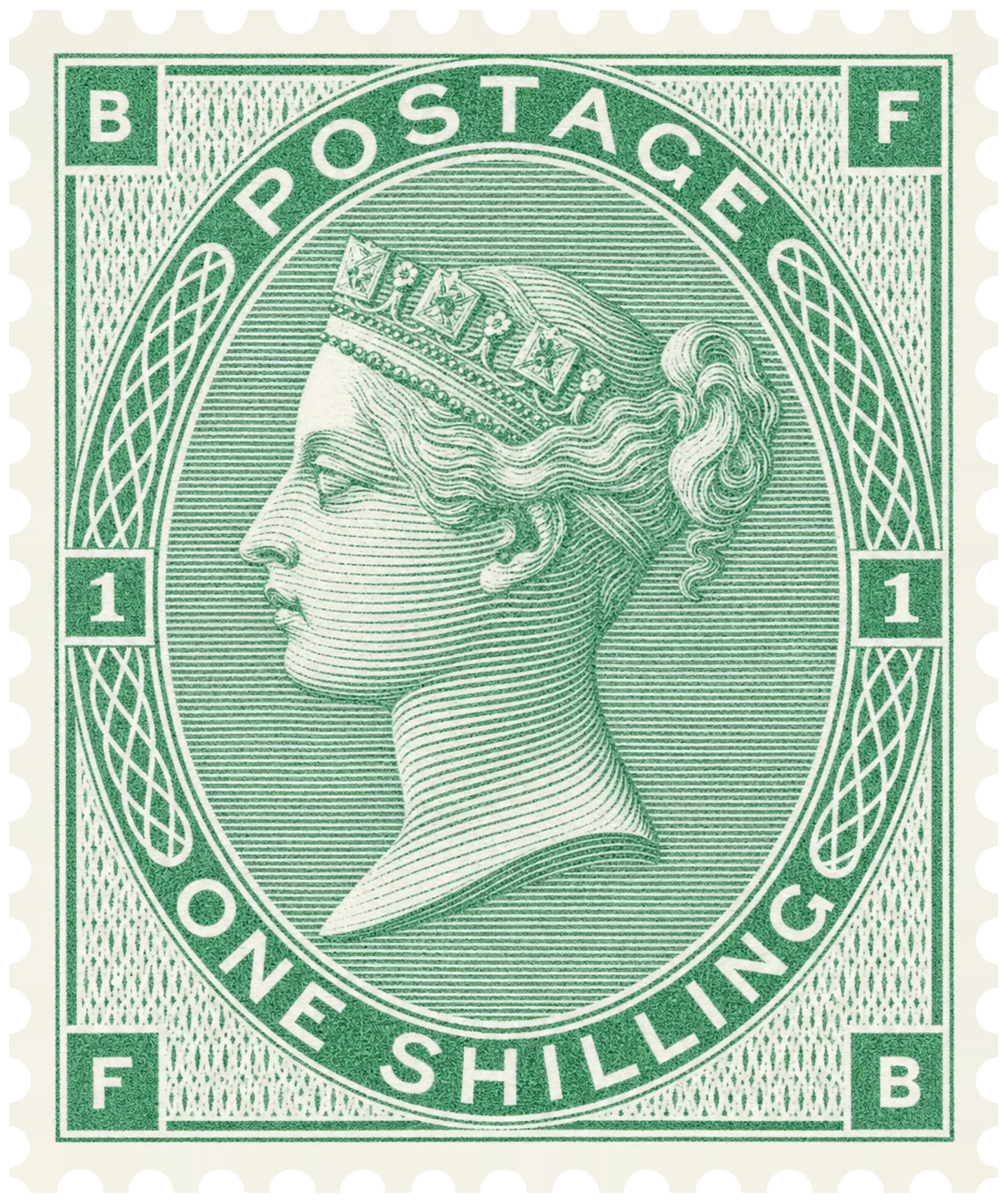
The oval that was redrawn
The 1862 shilling retained the oval frame introduced in 1856, but its details were altered.
Victoria's portrait was retouched and repositioned within the oval. The surrounding frame became more prominent, while the fine cross-hatched background in the corners was made less conspicuous. [1]
The changes gave the design a clearer separation between portrait, lettering and decoration.
Placed beside the original shilling of 1856, the revised stamp reveals how De La Rue refined an existing design without starting again.
Two tiny numbers beside the Queen
Look at the narrow decorative panels on either side of Victoria's portrait. Each contains a small white numeral 1.
These figures were intended to identify the printing plate. But there is a curious discrepancy: the actual plate was numbered 2 in the margins of the printing sheet. [2]
The numbers on the stamps therefore began at 1, while those on the plates continued from the earlier no-corner-letters design.
Another plate, numbered 3, carried the numeral 2 on its stamps.
The figures are easy to overlook, but they preserve an unusual stage in the development of printed plate identification.
Four letters replace the ornament
The original surface-printed shilling had no corner letters. In 1862, four small coloured squares were added, each containing a white capital.
The lower letters identify the stamp's position in the sheet. Those at the top repeat the same pair in reverse order. [1]
The arrangement was intended to make fraudulent alterations easier to detect.
The letters were very small and delicate. Some became damaged during production, prompting their replacement with larger characters in 1865.
The corner panels therefore reveal both a new security measure and the limits of the engraving technology used to reproduce it.
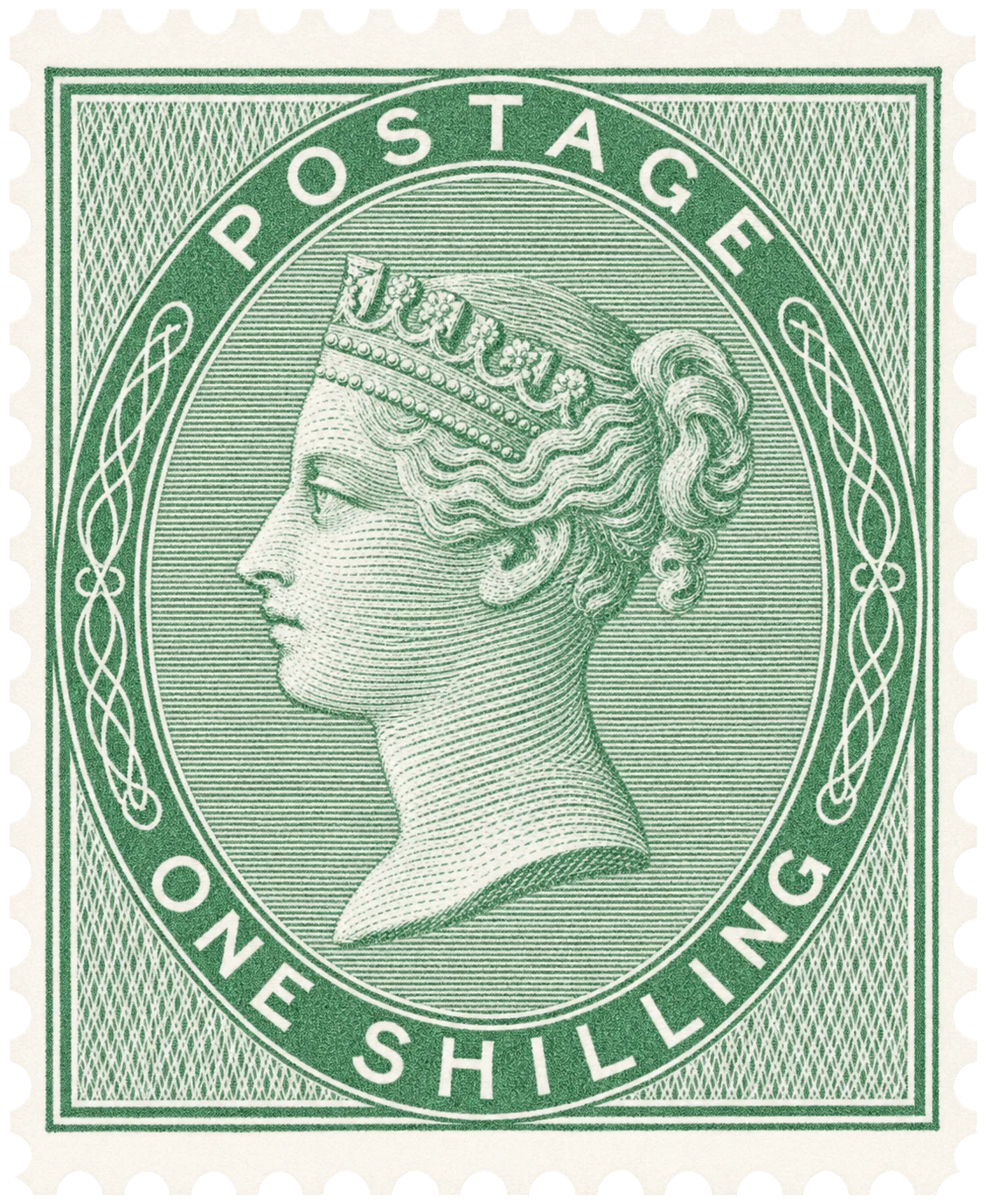
Compare the corners and the surrounding oval. The later enlargement of the letters has its own comparison.
Click either stamp to magnify
The strange white ring around a letter
The letter K in the lower-left corner of one stamp position sometimes appears surrounded by a white circle.
De La Rue explained in 1894 that the removable letter plug had not been fitted deeply enough into the original die. When the printing plate was made, the imperfect fitting left an indentation. [1]
The printer tried to conceal the defect using extra packing beneath the printing surface.
As the packing deteriorated, the circle became visible again.
The mark is not a deliberate part of the design. It records a small error in the handwork used to prepare the printing plate.
The hairlines of an unused design
Plate 3 of the one-shilling green has another distinguishing feature.
Fine white lines cross the outer angles of its four corner-letter blocks. These hairlines were absent from the normal plate 2 stamps. [3]
The plate also carried the numeral 2 beside Victoria's portrait, rather than the numeral 1.
Although registered in June 1862, it was never used for regular production. Only impressions from the small preliminary printing survive.
The hairlines offer a glimpse of a proposed alteration that was completed but never adopted for ordinary manufacture.
The flowers hidden in the paper
The one-shilling green was printed on paper watermarked with four heraldic emblems: two roses, a shamrock and a thistle.
These represented England, Ireland and Scotland. They were formed within the paper during manufacture rather than printed on its surface. [4]
The watermark made the paper more difficult to imitate.
The same floral arrangement had appeared on the earlier shilling without corner letters. It was retained when the visible design was revised in 1862.
Beneath Victoria's portrait, the papermaker's contribution remained unchanged.
A portrait of a fifteen-year-old princess
Victoria's portrait originated before she became Queen. William Wyon, Chief Engraver at the Royal Mint, created a medal commemorating her visit to the City of London in November 1837. Its portrait drew on a sketch made in 1834, when Victoria was fifteen. The medal was issued in 1838. [5]
Henry Corbould prepared a drawing based on Wyon's portrait, which later supplied the model for Joubert's surface-printed engraving.
Victoria's youthful likeness remained familiar even as the stamps surrounding it changed. [6, 7]
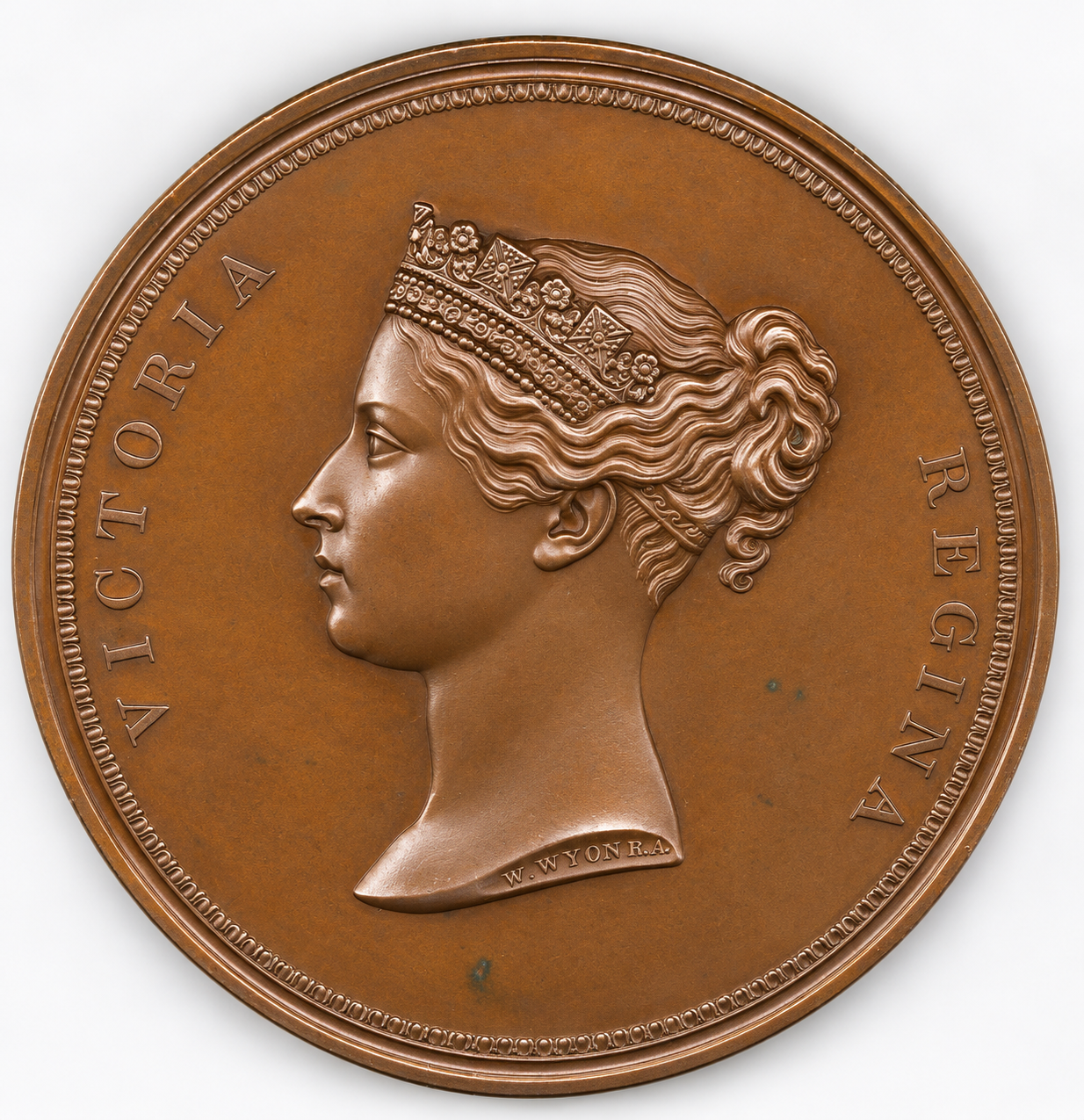
Image information
Click image to magnify
Bronze medal showing the young Victoria in left-facing profile, wearing the diamond diadem, with the inscription VICTORIA REGINA.
- Credit
- Heritage Auctions, via Wikimedia Commons. CC BY 3.0.
- Notes
- Brightness, contrast, sharpness and colour balance adjusted by Stunning Stamps.
The diamond diadem made for a king
The ornament in Victoria's hair was commissioned for George IV's coronation in 1821. [8]
It contains 1,333 diamonds, with crosses and the national emblems of the rose, thistle and shamrock.
Victoria later wore the diadem in portraits, and it became a familiar feature of British postage stamps.
On the one-shilling green, its jewels are reduced to tiny engraved marks. A magnificent royal ornament had become part of an everyday object worth one shilling.

Image information
Click image to magnify
Digitally created illustration of the diamond diadem, with crosses, floral emblems and rows of pearls, resting on a blue cushion.
- Credit
- Stunning Stamps.
- Notes
- Digitally created.
Sources
- Hastings E. Wright and A. B. Creeke: A History of the Adhesive Stamps of the British Isles (1899), pp. 127–129
- The Shilling's Tale: Co-Evolution of Form and Function of the One-Shilling Stamp, 1840–1901 (2022)
- L. N. Williams: The Abnormals of Great Britain, David Feldman (2015)
- Royal Mail Philatelic Bulletin: Collecting the Victorians — The Surface-Printed Issues
- Douglas N. Muir, Royal Mint Museum: William Wyon & the Penny Black
- Heritage Auctions, William Wyon medal photograph, via Wikimedia Commons (enhanced for display)
- Wyon medal photograph: Creative Commons Attribution 3.0 licence
- Royal Collection Trust: George IV's Diamond Diadem
