
The design of the 3d bright carmine-rose
Queen Victoria · Great Britain · Thomas De La Rue & Co. · 1862
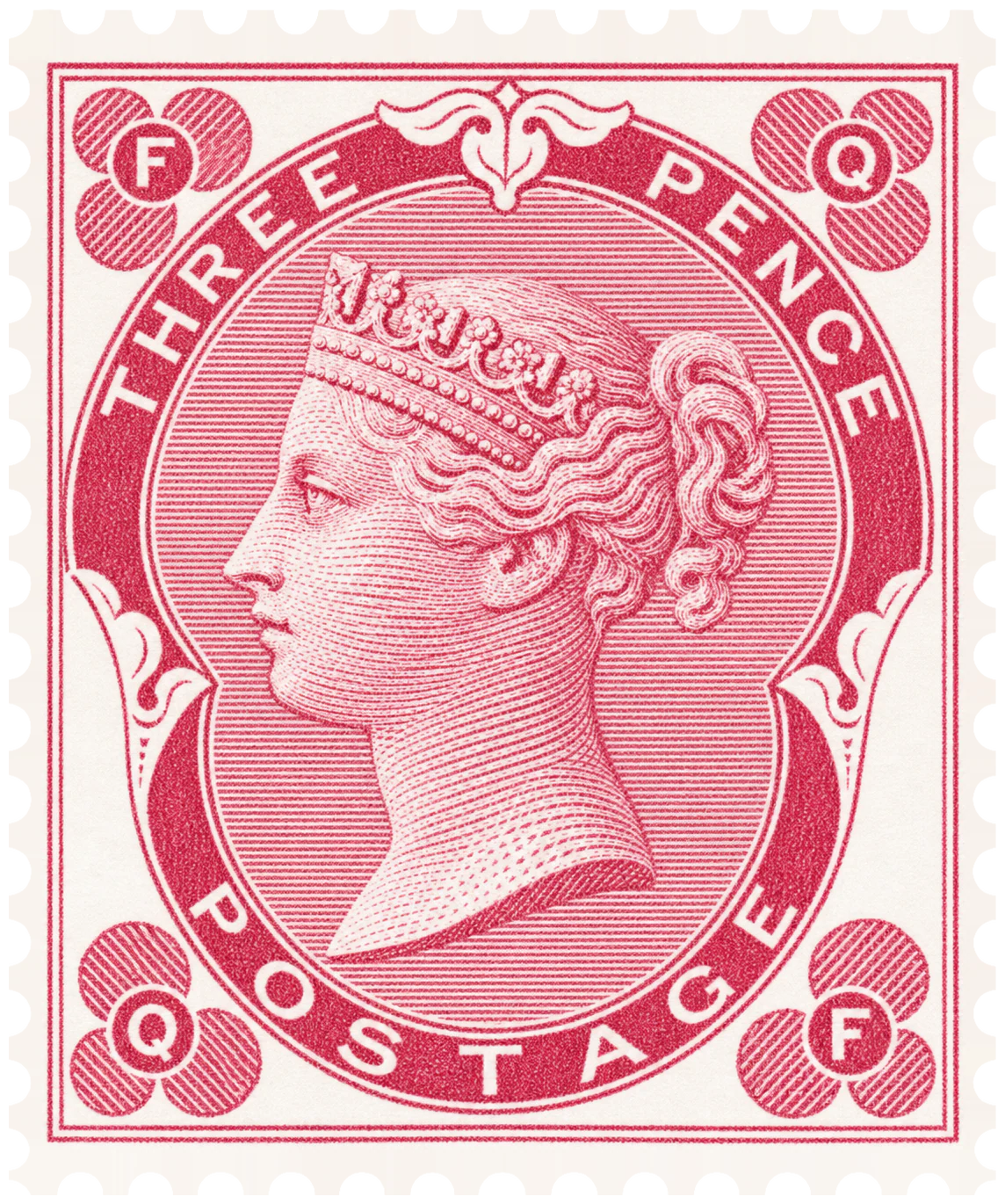
The white spaces created with a drill
The 1862 threepenny stamp has unusually open white spaces between its central ornament and the rectangular outer frame.
These were not part of the original design. In 1861, De La Rue had prepared a printing plate with fine reticulated patterns filling those spaces. But the Postmaster General considered the result too similar to the existing fourpenny stamp. [1]
The printers removed the unwanted pattern from every impression on the plate, using a drill. Several impressions were damaged and needed replacing.
The alteration left the ornate corners standing out against the pale background.
The most distinctive feature of the issued stamp was therefore the result of removing part of an earlier design.
Four letters inside little flowers
The four corners of the threepenny stamp contain small letters enclosed within circular ornaments.
Each letter sits against a solid colour, surrounded by a decorative trefoil resembling three connected leaves. Fine diagonal lines fill the surrounding corners. [1]
The lower letters identify the stamp's position in the printing sheet. The upper letters repeat the same pair in reverse order.
This arrangement helped reveal attempts to assemble fraudulent stamps from pieces of used examples.
The decorative corners therefore served two purposes: they contributed to the appearance of the stamp while carrying a practical security feature.
A frame built from three curves
The threepenny's frame is unlike the simple circle of the fourpenny stamp.
Victoria's portrait sits inside a border formed from three rounded lobes. The upper section carries THREE PENCE, divided by a small three-lobed ornament, while POSTAGE curves beneath the portrait. [1]
Leaf-like decorations connect the upper and lower portions of the frame.
The unusual shape gave the threepenny an appearance of its own, while retaining the royal portrait familiar from other De La Rue stamps.
The design demonstrates how Victorian engravers used decorative geometry to distinguish denominations without commissioning a completely new portrait.
The mysterious white dots
A second printing plate, numbered 3, introduced a tiny alteration to the design.
A small white dot was added on each side of the stamp, immediately beneath the leaf-like ornament beside the portrait. The dots were absent from the normal plate 2 printing. [1]
Plate 3 never entered regular production, although a few impressions were printed for registration and some subsequently reached collectors.
The dots are easy to overlook, but they reveal an attempt to distinguish one plate from another without placing a prominent plate number on the stamp.
The flowers hidden in the paper
The threepenny stamp carries a watermark consisting of two roses, a shamrock and a thistle.
These national emblems were arranged with the roses at the upper corners and the shamrock and thistle below. They were formed within the handmade paper rather than printed on its surface. [1]
The design helped make the paper difficult to imitate.
Occasionally, the rose watermark appeared in a slightly different orientation. Such differences resulted from the way the papermaker arranged the watermark devices.
Even the hidden flowers could reveal something about the work of the people who made the paper.
How the corner letters were produced
De La Rue used a different method of preparing printing plates from the engravers of the Penny Black.
The master die contained openings into which small plugs bearing individual letters could be inserted. These were changed as each stamp position was prepared. [1]
Moulds were taken from the die and assembled to form the printing plate.
The system allowed each stamp to carry its own combination of letters without engraving a completely separate portrait for every position.
The result was a remarkable combination of industrial repetition and individual identification.
A portrait of a fifteen-year-old princess
Victoria's portrait originated before she became Queen. William Wyon, Chief Engraver at the Royal Mint, created a medal commemorating her visit to the City of London in November 1837. Its portrait drew on a sketch made in 1834, when Victoria was fifteen. The medal was issued in 1838. [2]
Henry Corbould prepared a drawing based on Wyon's portrait, which later supplied the model for Joubert's surface-printed engraving.
Victoria's youthful likeness remained familiar even as the stamps surrounding it changed. [3, 4]
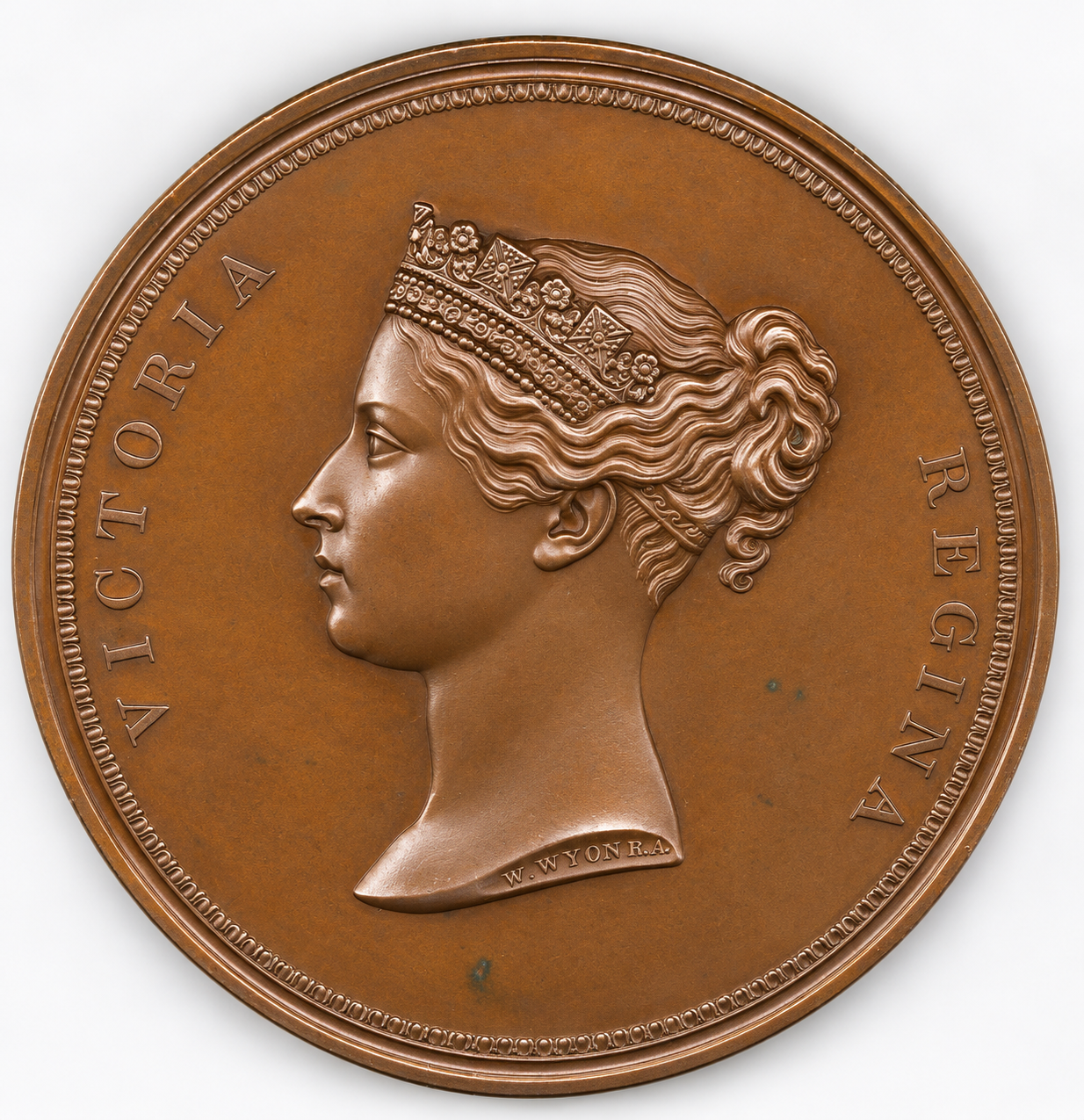
Image information
Click image to magnify
Bronze medal showing the young Victoria in left-facing profile, wearing the diamond diadem, with the inscription VICTORIA REGINA.
- Credit
- Heritage Auctions, via Wikimedia Commons. CC BY 3.0.
- Notes
- Brightness, contrast, sharpness and colour balance adjusted by Stunning Stamps.
The diamond diadem made for a king
The ornament in Victoria's hair was commissioned for George IV's coronation in 1821. [5]
It contains 1,333 diamonds, with crosses and the national emblems of the rose, thistle and shamrock.
Victoria later wore the diadem in portraits, and it became a familiar feature of British postage stamps.
On the threepenny, its jewels are reduced to tiny engraved marks. A magnificent royal ornament had become part of an everyday object worth threepence.

Image information
Click image to magnify
Digitally created illustration of the diamond diadem, with crosses, floral emblems and rows of pearls, resting on a blue cushion.
- Credit
- Stunning Stamps.
- Notes
- Digitally created.
Sources
- Hastings E. Wright and A. B. Creeke: A History of the Adhesive Stamps of the British Isles (1899), pp. 69–70 and 78–81
- Douglas N. Muir, Royal Mint Museum: William Wyon & the Penny Black
- Heritage Auctions, William Wyon medal photograph, via Wikimedia Commons (enhanced for display)
- Wyon medal photograph: Creative Commons Attribution 3.0 licence
- Royal Collection Trust: George IV's Diamond Diadem
