
Edward VII
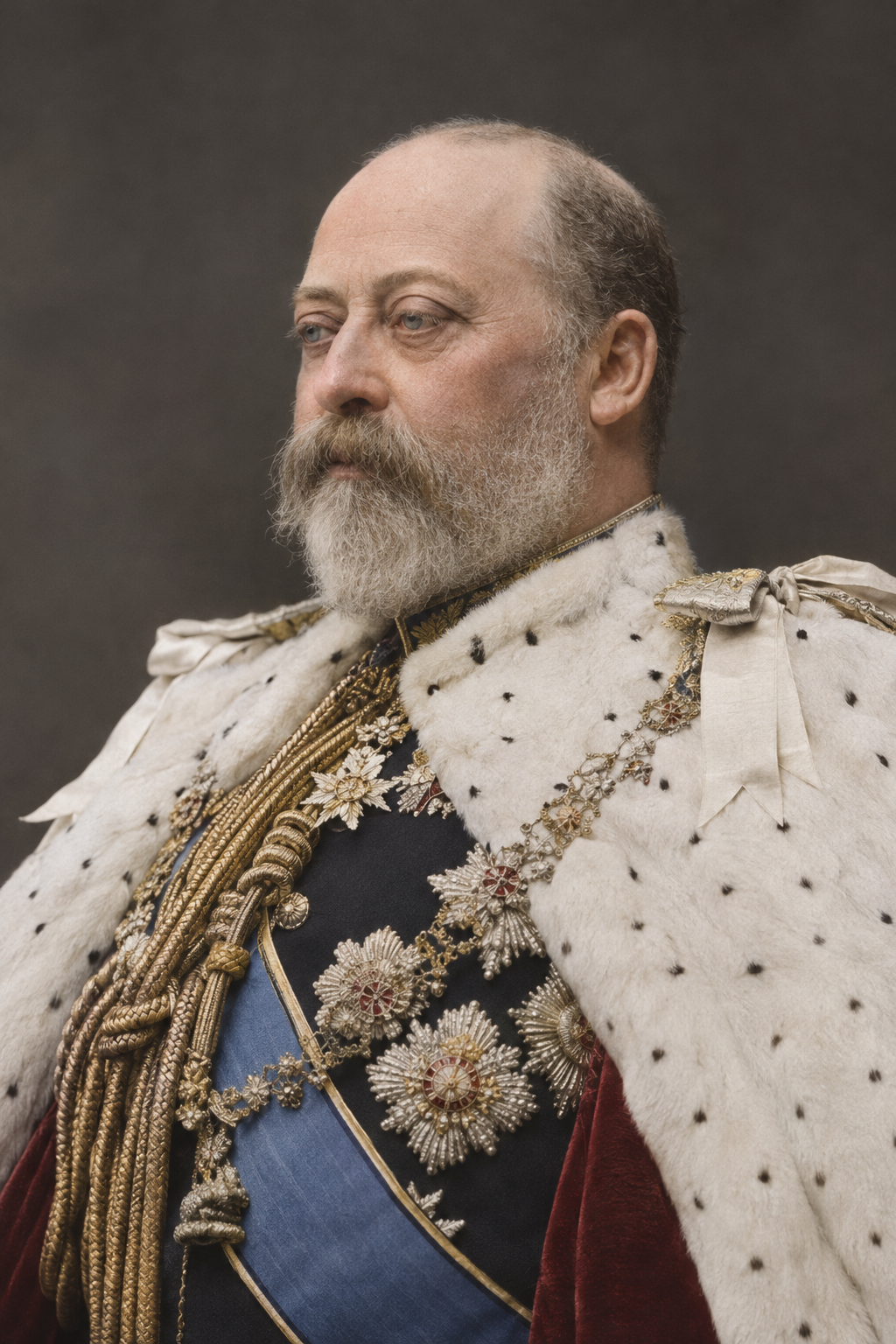
Image information
Click image to magnify
Edward VII in robes of state, photographed by W. & D. Downey in 1901.
- Credit
- W. & D. Downey, 1901. Library of Congress, Bain Collection, LC-DIG-ggbain-04897, via Wikimedia Commons. Public domain.
- Notes
- Digitally reconstructed
1841–1910 · King of the United Kingdom, 1901–1910
Edward VII had firm opinions about stamp design. He personally selected the portrait for his first British stamps, sat for the artist and later asked for alternative designs after expressing a preference for the stamps of the Transvaal.
A prince at the printing works
Edward's connection with stamps began early. On 8 April 1856, the fourteen-year-old Prince of Wales visited De La Rue's printing works with his younger brother Alfred. They watched sixpenny stamps being printed, and two specially endorsed sheets from that visit became the earliest recorded items in the Royal Philatelic Collection.
Alfred became a serious collector. Shortly before his death in 1900, he sold his collection to Edward, who passed it on to his own son George, already an enthusiastic philatelist. [1, 2]
Choosing his own portrait
Edward succeeded his mother, Queen Victoria, in January 1901, aged 59. He and Alexandra of Denmark had been married since 1863.
The Post Office's printers, De La Rue, prepared preliminary designs using photographic portraits, but the King chose a profile made by Emil Fuchs, an Austrian sculptor working in London. Edward granted Fuchs a sitting to prepare a new drawing for the stamps.
The choice of a foreign artist prompted questions in Parliament. On 23 May 1901, the government defended the use of Fuchs's existing portrait and rejected the suggestion that British artists had been considered unsuitable. The King's personal choice was explained in a further answer on 7 June, reproduced in George's later account of the design process.
Edward also approved a photographic composite of Fuchs's portrait and its surrounding frame. His son George, describing the process to the Philatelic Society in 1904, said that the original bearing his father's written approval was in his own collection.
Queen Alexandra may also have contributed. George reported that Fuchs had approved a proof on the King's behalf, subject to a slight reduction in the width of the decorative wreath. George believed that the suggestion came from the Queen. [3, 4, 5]
Preferring the Transvaal stamps
In October 1902 Edward requested trial designs for four British stamps already in circulation: the ½d, 1d, 2½d and 6d. According to George's account, the King was understood to prefer the designs used in the Transvaal, in southern Africa.
De La Rue prepared trial designs using the Transvaal portrait. They were printed in several colours, all bearing the penny denomination to save time.
The proposed replacement was never issued. In his 1904 account, George said that the change had been abandoned or postponed, apparently chiefly because of the expense. [3]
A portrait for Canada
Edward also approved the portrait used on Canada's new stamps. The design was largely the work of his son George and the philatelist J. A. Tilleard. They chose a photograph showing the King shortly before his Coronation, and Edward approved their choice. [6]
Giving philately its royal title
In November 1906, Edward granted the Philatelic Society, London, permission to add the word Royal to its name. The application had been initiated by the Earl of Crawford, with the support of Edward's son George, then the Society's president. The King's approval was formally communicated on 28 November.
Edward died on 6 May 1910, after a nine-year reign. George succeeded him as George V, bringing a devoted stamp collector to the throne. [7, 5]
Sources
- Jim Measures: Jim's Stamp Corner, The Canadian Philatelist, September–October 1999 — drawing on a history supplied by the keeper of the Royal Philatelic Collection
- Dane Garrod: King of Collectors, British Philatelic Bulletin, September 2017
- Prince of Wales (later George V): Notes on the Postal Adhesive Issues of the United Kingdom During the Present Reign, 1904, reproduced in Fred J. Melville's The Postage Stamps of Great Britain, pp. 37–52; portrait and parliamentary answers pp. 42–44, Transvaal trials p. 48
- Hansard: New Postage Stamp Designs, House of Commons, 23 May 1901
- The Royal Family: Edward VII
- Tom Meyerhof: King Edward VII Issue of Canada, Ottawa Philatelic Society, 2017
- Ron Negus: The Earl of Crawford K.T. (1847–1913), The London Philatelist, December 2002 supplement, pp. 18–20 — the Royal Philatelic Society's change of name