
Edward VIII
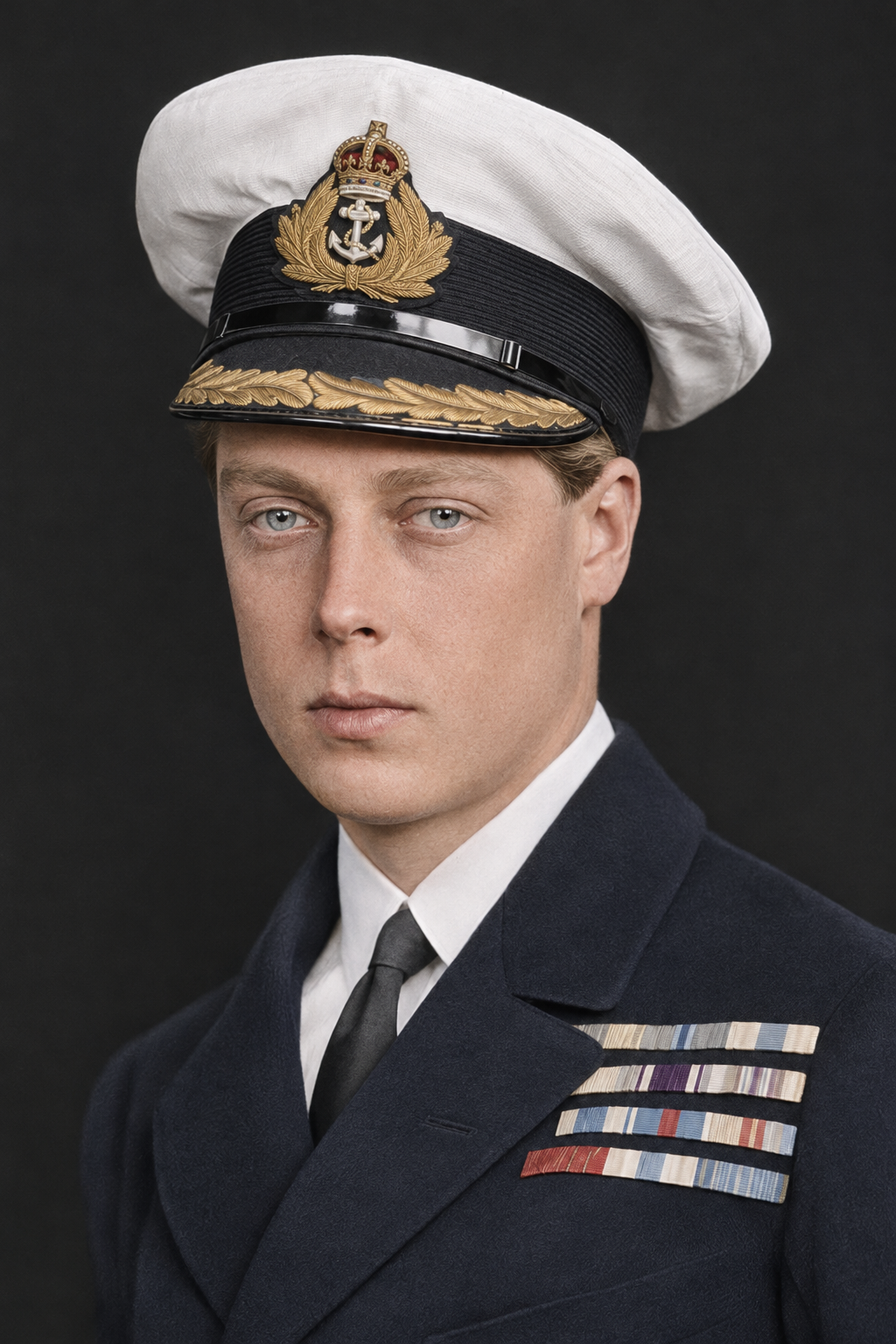
Image information
Click image to magnify
Edward, Prince of Wales (later Edward VIII), in naval uniform, photographed by the Bassano studio on 27 February 1920.
- Credit
- Studio of Alexander Bassano, 27 February 1920. Royal Collection, RCIN 2507732, via Wikimedia Commons. Public domain.
- Notes
- Digitally reconstructed
1894–1972 · King of the United Kingdom, 1936
Edward VIII reigned for just 325 days, but he took an unusually personal interest in the stamps prepared for him. A collector since childhood, he had firm ideas about what a postage stamp should look like—and was prepared to reject the work of the Post Office's designers to get his way.
A royal stamp collector
Edward's interest in stamps began long before he became king. At eleven, he exhibited a collection of Liberian stamps at London's International Philatelic Exhibition of 1906. As Prince of Wales, he was known to visit stamp dealers in the Strand, and in 1919 he became honorary president of the Royal Philatelic Society London. Philately was one of the interests he shared with his father, George V, whose great collection he would eventually inherit. [1, 2, 3]
Too much ornament
When Edward succeeded his father in January 1936, the Post Office struggled to find a portrait he liked. He wanted new photographs taken and asked to examine examples of modern foreign stamps. He also opposed public design competitions, concerned that he might dislike the winning entry.
The printers, Harrison & Sons, spent weeks developing stamps showing the King in military uniform. On 5 June, Edward dismissed their work as "over-ornamented and foreign-looking". He preferred a much plainer arrangement. The design he eventually approved on 26 June had been developed from an unsolicited sketch by Hubert John Brown, a seventeen-year-old stamp collector from Torquay, with a profile photograph by Hugh Cecil. Brown received neither payment nor proper public credit from the Post Office. [4]
His father's collection
Edward also took an interest in the Royal Philatelic Collection. He personally visited its keeper, Sir Edward Denny Bacon, in the Buckingham Palace Stamp Room and confirmed arrangements to sell a pair of duplicate high-value Straits Settlements stamps. The proceeds were intended to help finance further acquisitions. Although he did not share his father's approach to collecting, accounts of purchases made during his reign show that the collection was not simply neglected. [3, 5]
A coronation that never happened
For his planned Coronation stamps, Edward favoured pictures of royal castles and asked that the designs remain simple. In May 1936 he agreed that these pictorial stamps could even omit his portrait if that produced a better result. Later, for other Coronation designs, he requested trials using Percy Metcalfe's crowned effigy, prompting further work by Eric Gill.
The final essays were still arriving in December. On 11 December 1936, Edward abdicated so that he could marry Wallis Simpson, and the Coronation issue was abandoned. He became Duke of Windsor, married Wallis in 1937 and died in Paris in 1972. His four issued British stamps remained as a remarkably restrained expression of his personal taste. [6, 7]
Sources
- The Philatelic Record: International Philatelic Exhibition, 1906, p. 121
- Royal Philatelic Society London: Past and honorary presidents
- John Holman: Edward VIII Philately, British Philatelic Bulletin, December 2016, pp. 106–109
- The Postal Museum: Accession Design of Edward VIII
- Nicholas Courtney: The Queen's Stamps (2004), quoted in British Caribbean Philatelic Journal, April 2018, p. 14
- The Postal Museum: Planned Stamp Issue for the Coronation of King Edward VIII
- The Royal Family: Edward VIII