
George V
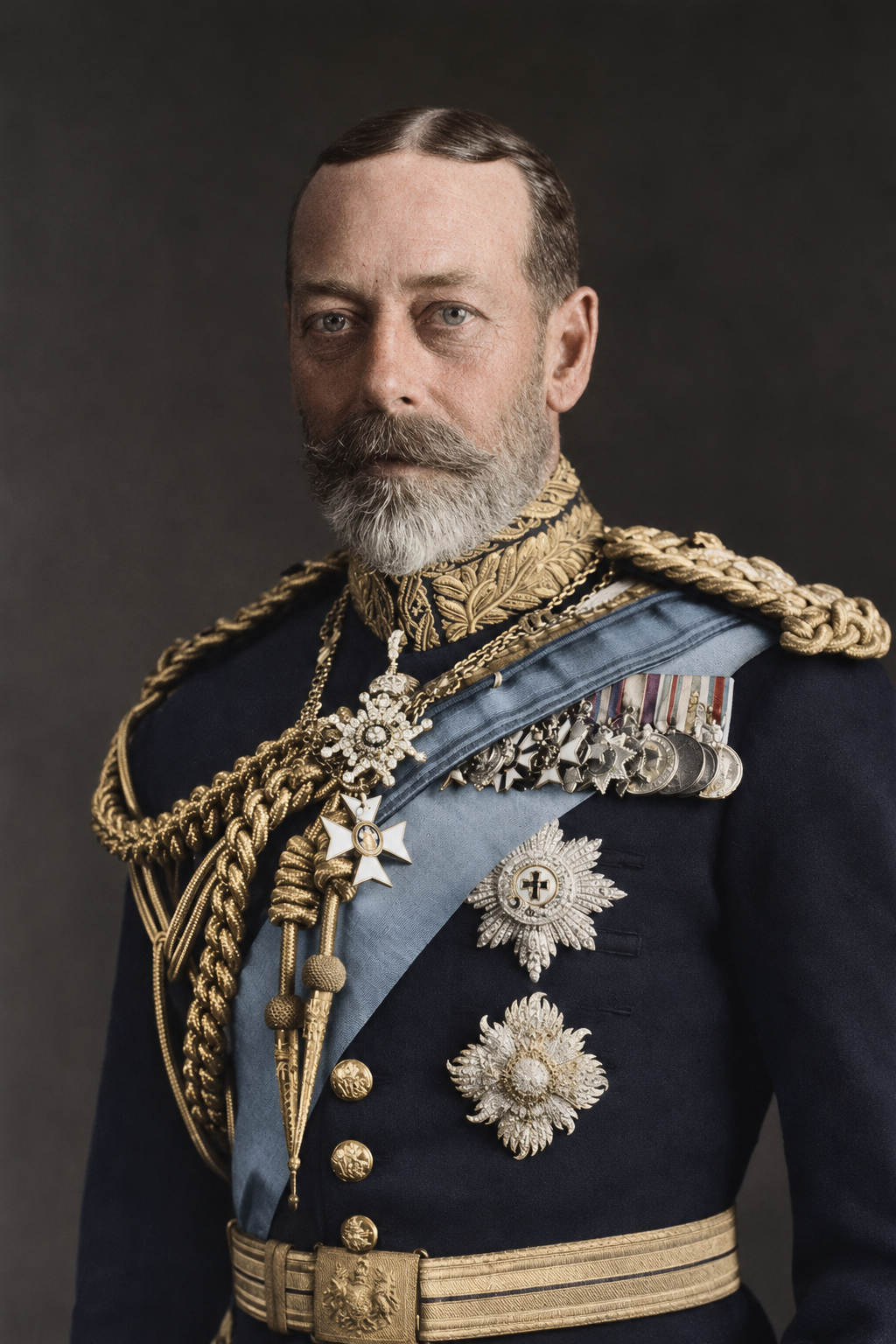
Image information
Click image to magnify
George V in dress uniform, photographed by the Bassano studio, circa 1923.
- Credit
- Bassano Ltd, circa 1923. Library of Congress, Bain Collection, LC-DIG-ggbain-35407, via Wikimedia Commons. Public domain.
- Notes
- Digitally reconstructed
1865–1936 · King of the United Kingdom, 1910–1936 · Philatelist
George V was an accomplished stamp collector long before he became king. His interest extended from acquiring rarities to studying how stamps were designed and printed. Once his own portrait appeared on them, he helped shape their appearance, from the replacement of the Downey Head to the design of the Seahorses.
The collector prince
Born in 1865, George was the second son of the future Edward VII and Queen Alexandra. He entered the Royal Navy as a cadet in 1877 and married Mary of Teck in 1893.
His uncle Alfred, Duke of Edinburgh, encouraged his interest in collecting stamps. By the 1890s George was exhibiting rare material, and in 1896 he became president of the Philatelic Society, London. He held the position until his accession in 1910.
His interest extended to research. In 1904 he presented a paper to the Society on the British stamps of his father’s reign. He was determined to build a collection of exceptional quality, once telling his philatelic adviser J. A. Tilleard that he wanted ‘the best collection & not one of the best collections in England’.
In 1904 he paid £1,450 for an unused 1847 Mauritius two-penny ‘Post Office’ stamp, then a record auction price. The purchase gave rise to a frequently retold story in which George cheerfully admitted to being the foolish collector who had spent so much on a single stamp. [1, 2, 3, 4]
A portrait he came to dislike
When George succeeded Edward VII in May 1910, he took a close interest in the preparation of his own stamps. He initially favoured a three-quarter portrait photographed by W. & D. Downey, showing both eyes rather than the familiar profile.
The first halfpenny and penny stamps appeared on Coronation Day, 22 June 1911. These were definitives for everyday use. Their engraving and printing attracted severe criticism, and George was unhappy too. His private secretary wrote to the Postmaster General expressing the King’s dissatisfaction.
Work began on replacements using a profile portrait by the Australian sculptor Bertram Mackennal. George William Eve also contributed substantially to the surrounding frames. On 21 February 1912 the King initialled a photograph of Mackennal’s sculpted penny design, recording his approval at this stage of development. The Downey Head series was abandoned before the full intended range of values had appeared. [5, 6, 7]
Shaping the Seahorses
George took an equally personal interest in Mackennal’s high-value Seahorses, showing Britannia in a chariot drawn across the sea. He requested several alterations: the value on Britannia’s shield was to be replaced by the Union Flag, the denomination was to move to a separate tablet, and the horses were to be shown in harness.
The King and Mackennal both recommended recess printing, despite its greater expense. Ink held in engraved lines could reproduce the intricate design in fine detail.
The stamps were first issued in 1913. Mackennal supplied the design and J. A. C. Harrison engraved it, incorporating the changes requested during its preparation. [7, 8]
Reluctant commemoratives
George’s enthusiasm for collecting did not make him an automatic supporter of commemorative stamps. He initially resisted the proposal for special stamps for the British Empire Exhibition at Wembley in 1924.
He eventually agreed, but insisted that Edward Denny Bacon, keeper of his collection, sit on the design committee. George also suggested selling the stamps at a surcharge to benefit King Edward’s Hospital Fund, but the Post Office objected on legal grounds.
The committee favoured designs by both Harold Nelson and Eric Gill. George preferred Nelson’s British Lion, which was adopted for both denominations of Britain’s first commemorative postage stamps.
When the 1929 Postal Union Congress issue was proposed, George asked how long the stamps would be sold, whether they would be offered at face value and whether his portrait would appear. Serious illness later prevented him from approving the finished designs, which Queen Mary approved on his behalf. [9, 10]
Choosing the Jubilee stamps
When Bacon raised the possibility of special stamps for George’s Silver Jubilee in 1935, he reported that the King was warmly favourable.
Barnett Freedman produced the successful design, but the choice of portrait remained with George. Presented with four trial designs on 22 November 1934, he selected the horizontal composition using Mackennal’s familiar profile. He requested that the head be made slightly smaller. [11]
The collection he left
George’s collecting extended beyond celebrated rarities. For his own reign’s low-value stamps, he sought examples of each printing control, the identifying marks in the sheet margins. He sometimes obtained more than one example where the ink shades differed. These small distinctions mattered alongside the approved drawings and proofs preserved in his albums.
He died on 20 January 1936, leaving the throne to Edward VIII. His stamps remained at the heart of the Royal Philatelic Collection, to which later generations of the royal family continued to add. [5, 1, 3]
Sources
- The Royal Family: George V
- Association of British Philatelic Societies: Who Was Who in Philately — George V
- Smithsonian National Postal Museum: The Queen’s Own — Introduction
- Smithsonian National Postal Museum: The Queen’s Own — Rarities
- Charles Goodwyn: Great Britain — King George V, Royal Philatelic Collection display, 17 September 1998, pp. 2–3
- The King’s Head: Great Britain King George V, RPSL display, 25 February 2010 — Downey Head and profile replacements
- Royal Mail: Bertram Mackennal profile, British Philatelic Bulletin, September 2013
- Royal Mail: King George V — 2s 6d Seahorses of 1913, British Philatelic Bulletin, January 2019
- Mary Pugh: Britain’s First Commemorative Stamps, The Canadian Philatelist, July–August 2021, pp. 178–180
- The Postal Museum: Special Stamp History — Postal Union Congress, 1929, pp. 3 and 7–8
- The Postal Museum: Special Stamp History — Silver Jubilee, 1935, pp. 1–2 and 5–6