
George VI
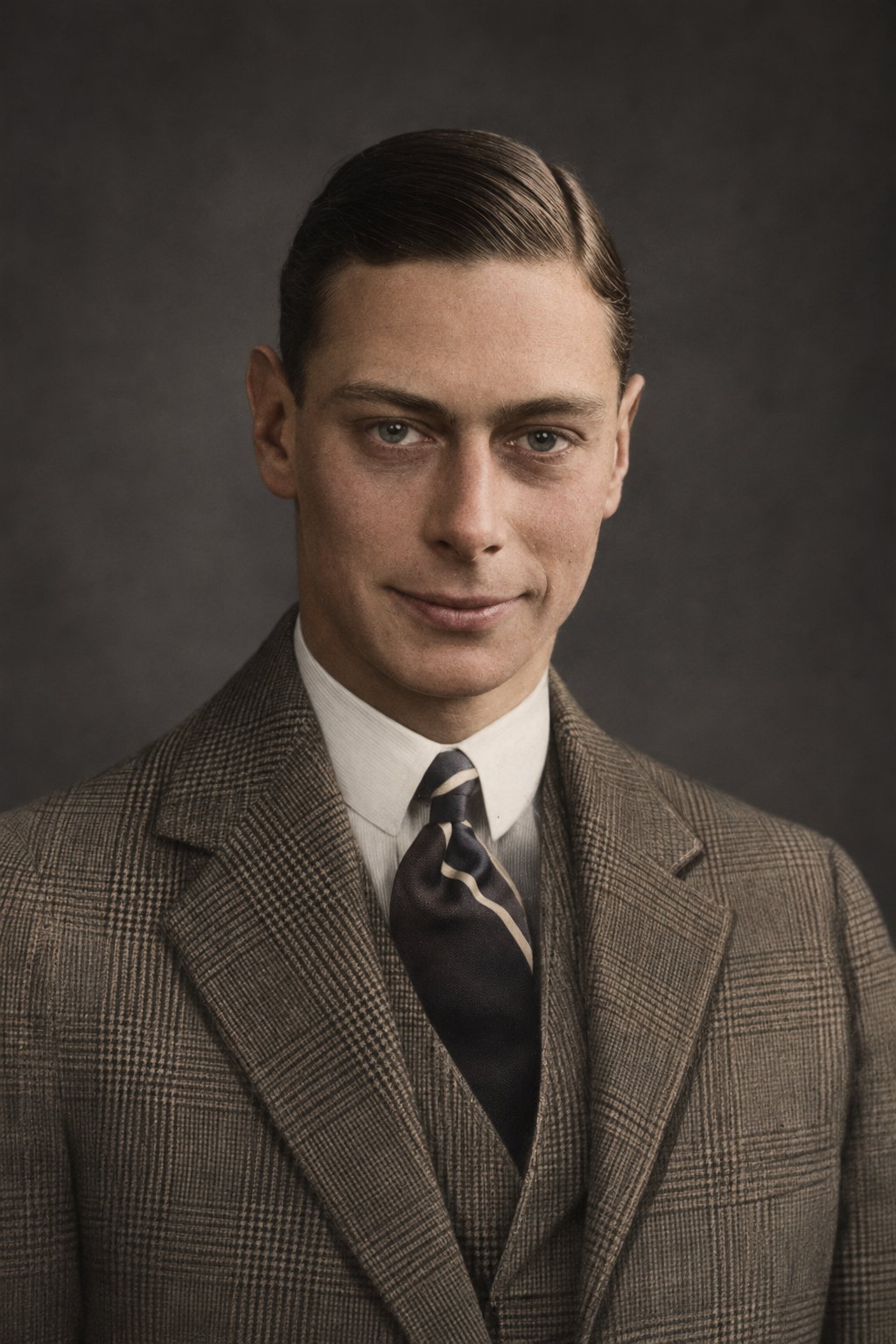
Image information
Click image to magnify
George VI as Prince Albert, Duke of York, in a checked suit, photographed by Olive Edis in 1920.
- Credit
- Olive Edis, 1920. Royal Collection, RCIN 2940841, via Wikimedia Commons. Public domain.
- Notes
- Digitally reconstructed
1895–1952 · King of the United Kingdom, 1936–1952
George VI took a personal interest in the stamps issued during his reign. He asked for more ornament in early designs, rejected proposals for his Silver Wedding and suggested replacing Nelson’s flagship with a modern battleship. His choices could reshape an issue, although practical constraints sometimes prevented designers from carrying out his wishes.
Bringing back the ornament
Born Prince Albert in 1895, George was the second son of the future George V and Queen Mary. He served in the Royal Navy during the First World War and married Lady Elizabeth Bowes-Lyon in 1923. They had two daughters, Elizabeth and Margaret.
He became king unexpectedly in December 1936, following Edward VIII’s abdication. Work on new stamps began almost immediately, and the Post Office asked Eric Gill to adapt designs originally prepared for Edward’s Coronation.
George had seen Gill’s proposed design and found it too plain. In a letter of 12 December, the Post Office explained that he wanted something between the simplicity of Edward VIII’s stamps and the more ornate designs of George V’s reign.
Gill argued against unnecessary ornament but prepared alternatives with richer lettering and floral emblems. On 26 February 1937, George examined the competing proposals with the Postmaster General. He preferred Gill’s revised design, also approved an alternative by Edmund Dulac, conditionally accepted a third and rejected a fourth.
The first everyday stamps used Gill’s frame with a portrait developed by Dulac. Gill’s frames were ultimately used for the ½d–6d values; Dulac designed the frames for the 7d–1s values as well as supplying the portrait. [1, 2]
Choosing a Coronation portrait
Preparations for the Coronation commemorative were equally hurried. The ceremony retained the date arranged for Edward VIII, leaving only a few months to prepare a new stamp.
George selected photographs of himself and Queen Elizabeth taken by Dorothy Wilding’s studio, but the pictures were not ideal for reproduction at stamp size. Edmund Dulac produced drawn interpretations, while Gill prepared a competing design using portraits by Bertram Park.
The King preferred Dulac’s composition. After minor alterations, the finished 1½d stamp appeared on 13 May 1937, the day after the Coronation. [3]
A decision shared with the Queen
When the Post Office prepared stamps for the centenary of the Penny Black in 1940, two designs emerged as serious contenders: one by H. L. Palmer of Harrison & Sons and another by Edmund Dulac.
George examined both in January and kept them to show Queen Elizabeth. Unable to decide between them, he subsequently asked for further guidance.
The Post Office submitted revised essays — trial versions of the designs — following advice from the Royal Fine Art Commission. On 30 January, the King’s private secretary reported that both George and Elizabeth preferred the amended Palmer design. Issued on 6 May 1940, the stamps showed the profiles of Queen Victoria and George VI together. [4]
Rejecting the Silver Wedding designs
For the royal Silver Wedding in 1948, the Post Office initially favoured designs combining the portraits with views of Windsor Castle, drawing on earlier work prepared for Edward VIII.
Four essays were submitted on 27 January. A reply through the King’s secretary on 3 February rejected them all. The scenic settings were considered inappropriate for a personal anniversary, and one design was compared to a conventional birthday greetings card.
George favoured the simpler treatment of Belgian portrait stamps issued during the 1930s. Although the Post Office continued to propose picturesque backgrounds, he maintained his preference for portraits alone.
He chose a new 2½d design by G. T. Knipe, an artist at Harrison & Sons, and a £1 design by Joan Hassall. His preference for line engraving on the high value could not be accommodated in the time available; both stamps were printed by photogravure.
Hassall was disappointed with the finished design. In correspondence with the Post Office, she wrote: ‘I cannot honestly say that I admire the final result’. The stamps appeared on 26 April 1948, the twenty-fifth anniversary of George and Elizabeth’s marriage. [5]
A stamp for his first grandchild?
Later in 1948, the Treasury encouraged a special issue to mark the anticipated birth of Princess Elizabeth’s first child. The Post Office was cautious about establishing a precedent for commemorating every royal family occasion, but George was consulted and was not opposed.
Percy Metcalfe and Reynolds Stone were secretly commissioned to prepare designs. Their proposals were shown to the King, but no response was received, and the issue was abandoned.
Prince Charles was born on 14 November 1948 without a commemorative British stamp. The surviving account does not establish that George rejected the designs; it records only that his approval never arrived. [6]
Vanguard instead of Victory
For the new high-value definitives planned for 1951, Mary Adshead designed a 2s 6d stamp featuring HMS Victory, Nelson’s famous flagship.
In February 1950, the King’s private secretary informed the Post Office that George approved the proposed designs but had two suggestions. He wanted the background netting made less conspicuous and suggested replacing Victory with the modern battleship HMS Vanguard, if the Postmaster General agreed.
Adshead investigated the possibility, consulting drawings and photographs of Vanguard. She found the vessel difficult to accommodate within the stamp’s oval composition. After trying to make the change, the Post Office reported that a satisfactory replacement could not be produced. The issued stamp, released on 3 May 1951, retained HMS Victory. [7]
The collection and the reign
The Royal Philatelic Collection built by George’s father continued to grow during his reign. Its keeper, Sir John Wilson, arranged for the Crown Agents to supply examples from the printing plates used for colonial stamps. Artwork and proofs also entered the collection. Material from George VI’s reign forms the collection known as the Blue Albums, following George V’s Red Albums.
George died on 6 February 1952 and was succeeded by his elder daughter, Elizabeth II. The drawings, essays and correspondence preserved from his reign record the choices behind the stamps: designs he accepted, changes he requested and proposals that never reached the post office counter. [8, 9, 1]
Sources
- The Royal Family: George VI
- The Postal Museum: George VI Definitives — Low Values, 1936–1939
- British Postal Museum & Archive: George VI Coronation (archived exhibition)
- The Postal Museum: Stamp Centenary, 1940
- Giles Allen, The Postal Museum: Royal Silver Wedding, 1948, pp. 2–4
- British Postal Museum & Archive: Proposed Issue for the Birth of the King’s First Grandchild (archived exhibition)
- The Postal Museum: George VI Festival High Values, 1951, pp. 9–11
- National Trust Collections: Royal Philatelic Collection and George VI’s blue albums
- Michael Sefi: The Royal Philatelic Collection — A Commonwealth Mixture, King George VI, RPSL display, 16 September 2010, p. 1