
Understanding the stamp details
1½d purple and green · De La Rue
Country and monarch
The country identifies the postal authority that issued the stamp. The monarch identifies the ruler whose portrait it carries. A definitive is an everyday stamp intended for regular postal use.
On this stamp
This 1½d belongs to Great Britain’s everyday definitive stamps bearing Edward VII’s portrait. De La Rue produced this issue in the 1902–1910 period.
First issued
The first-issue date records when the stamp became available for use. Read it alongside the description: an entry may describe a new design, a replacement colour or a change of printer. A stamp can remain in production long after that first date.
On this stamp
21 March 1902. This records the introduction of the De La Rue issue described on this page. Later shades or changes of paper may have different dates.
Stamp shades
A shade is a variation within a stamp’s colour. Some variations receive their own catalogue numbers even though the design and denomination stay the same.
Compare known examples under consistent lighting. Fading can change a stamp’s appearance, and photographs or screens can alter how colours look. A catalogue colour name helps describe a shade; it is not a colour test by itself.
Catalogue references
A stamp catalogue gives each listed issue a reference number. SG means Stanley Gibbons, the publisher of the catalogue used here. These numbers help collectors refer to the same issue; they are not serial numbers printed on individual stamps.
A range of numbers groups related entries. Colour, paper or perforation differences may account for separate listings within that range.
On this stamp
Stanley Gibbons 221–224. This reference identifies the listing used for the De La Rue 1½d. Check the associated shade and paper description before assigning an individual stamp to it.
Perforation
Perforations are the rows of punched holes that let neighbouring stamps separate. Their gauge describes the spacing over a standard distance of 2 centimetres, rather than the total number of holes along a stamp’s edge.
A perforation gauge has rows of dots or lines at known spacings. Match an edge against them: the marks should line up all the way along. A single number applies to both directions; two numbers give the horizontal gauge first, then the vertical.
Image information
Enlarged perforation spacing: fourteen equal intervals between hole centres span 20 millimetres. This is a schematic, not a ruler.
- Credit
- Stunning Stamps · 2026
On this stamp
This De La Rue 1½d is listed as perforation 14 in both directions. Match the hole spacing over 2 cm; the number does not mean that every edge has exactly fourteen holes.
Dimensions
These dimensions describe the complete stamp, including its perforated edges. Width is given first, followed by height. Measure from the outer tips of the perforations on one side to the outer tips on the opposite side.
The printed design occupies a smaller area inside the paper margins. Its size is a separate measurement.
Image information
Complete stamp width 21 mm and height 24 mm, measured across the outer perforation tips. The printed area is smaller. Schematic, not actual size.
- Credit
- Stunning Stamps · 2026
On this stamp
The listed 21 × 24 mm is the complete stamp: width first, height second, measured across the outer perforation tips. The printed design sits inside those edges. It is a nominal reference size, not a measurement of the image on your screen.
The printer
De La Rue grew from a playing-card business into a major security printer. It supplied British postage stamps from the Victorian period and printed the Edward VII issues before the contract changed in 1911.
Warren de la Rue worked in the family business during the Victorian period. His biography explores the firm’s earlier history; he died before this issue.
On this stamp
De La Rue manufactured this 1½d. Use the paper and colour description with the printer’s name: later firms continued many Edward VII designs, so the portrait alone cannot identify a De La Rue printing.
Sources
- GB Overprints Society: Edward VII printer comparisons
- Royal Mint Museum: the 1911 stamp printing contract
- Sam. C. Buckley: The Edwardian Three-Halfpence, The Philatelic Record, June 1913, pp. 103–106; corrected by T. F. Phillipot, August 1913, p. 148
- Royal Philatelic Society London: The De La Rue Story, 1996
- University of Reading Special Collections: De La Rue Archive (MS 937)
Typography
Typography, or surface printing, uses a raised printing surface. Ink is applied to the raised parts, then transferred to paper under pressure. The lower spaces leave the paper unprinted.
Fine lines and solid areas are both part of that raised image. This is the same basic principle as letterpress printing.
Image information
Side view of surface printing. Paper is pressed down onto ink on the raised parts of a printing plate; the lower spaces do not touch the paper.
- Credit
- Stunning Stamps · 2026
Wove paper
Wove describes the structure of the paper. Viewed against the light, it has a fairly even appearance. Laid paper instead shows a regular pattern of lines left by its manufacture.
Paper structure and watermark are separate characteristics: wove paper can carry a watermark. Both can help distinguish stamps with similar printed designs.
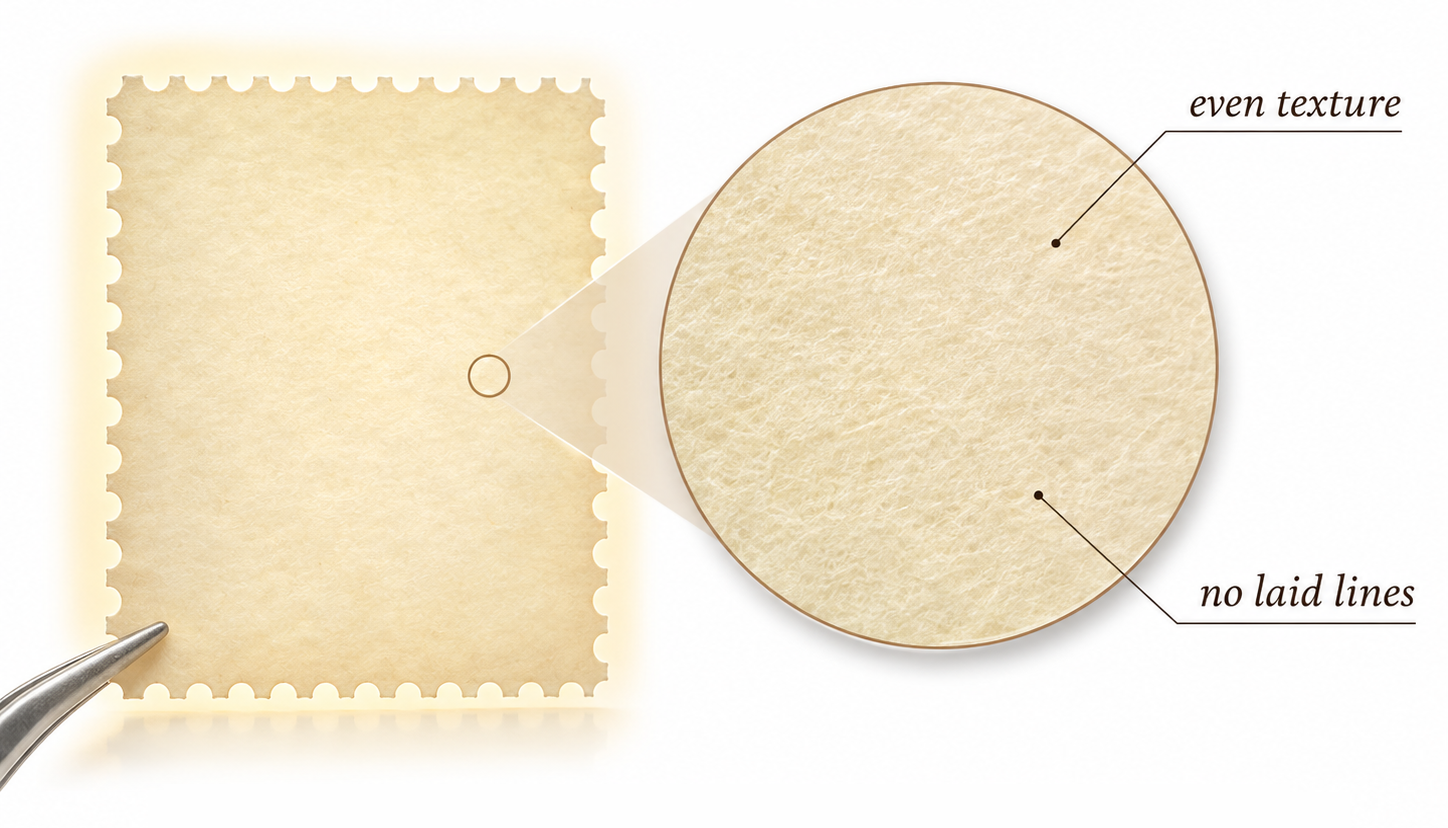
Image information
Click image to magnify
Diagram of wove paper with a magnified inset showing an even texture without laid lines.
- Credit
- Stunning Stamps · 2026
- Notes
- Digitally constructed
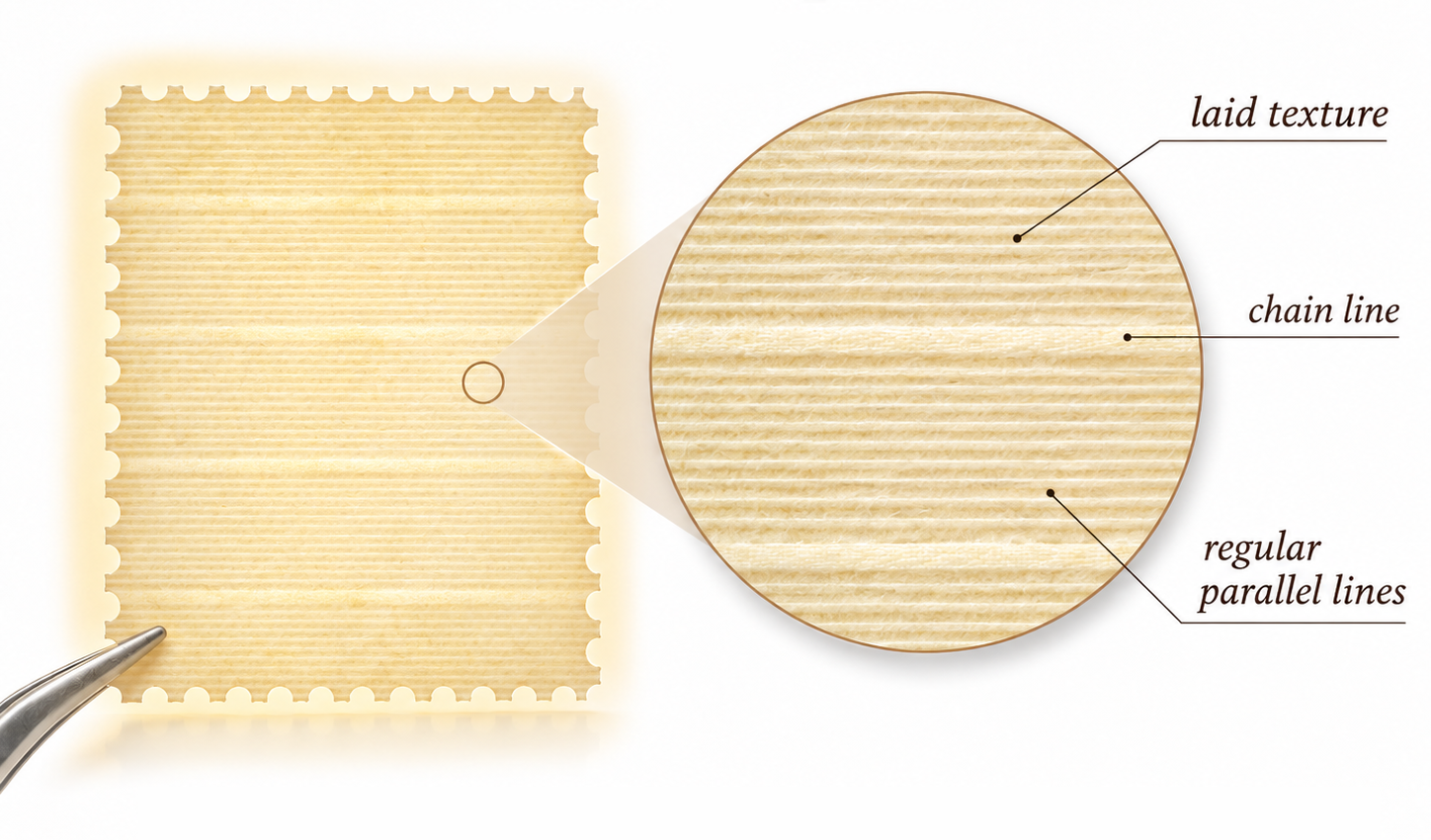
Image information
Click image to magnify
Diagram of laid paper with a magnified inset showing regular parallel lines.
- Credit
- Stunning Stamps · 2026
- Notes
- Digitally constructed
On this stamp
White wove, unsurfaced; De La Rue printings of 1902–1905. Wove describes the paper structure. The watermark is a separate feature formed within that paper.
Watermark
A watermark is a pattern formed in the paper while it is being made. Variations in the paper allow the pattern to show when light passes through it. It is part of the paper itself, rather than an inked design.
A watermark may be faint or only partly visible on a single stamp. Collectors use it to identify the paper and distinguish otherwise similar issues.

Image information
Imperial Crown watermark, front view, upright
- Credit
- Stunning Stamps · 2026
- Notes
- Digitally reconstructed
On this stamp
The De La Rue 1½d uses the Imperial Crown watermark, also called the Crown of 1880 in period descriptions. Look within the paper for the crown pattern shown here. A faint or partial impression needs care when comparing it with the guide.
Denomination
The denomination is the stamp’s face value: the amount of postage it represents. Its price to a collector can be quite different.
In Britain’s old currency, 12 pence made one shilling and 20 shillings made one pound: 240 pence altogether. The abbreviations were d for pence, s for shillings and £ for pounds. The d comes from the Latin denarius. A halfpenny, written ½d, was half an old penny.
On this stamp
This 1½d stamp represented 1.5 old pence in postage. The amount belongs to the pre-decimal currency; the postal-use notes show services for which it could be used.
Two colours, two printing plates
A two-colour stamp needs separate printing elements for its two inks. On these Edward VII stamps, the head plate supplies the portrait and associated ornament. The other plate supplies the remaining parts of the design; it is usually called the duty plate, or the border plate on the shilling.
The two impressions have to line up. That alignment is called registration. A small shift can make the value tablet or frame sit off centre even when the perforations are well placed.
Image information
Two separate coloured impressions align on the same paper to make a complete design. Abstract oval and tablet stand for the two printing elements.
- Credit
- Stunning Stamps · 2026
On this stamp
The De La Rue 1½d combines two printed inks. The head and duty plates supply different parts of the design. Compare the alignment as well as the colours; a shifted impression can change how the frame or value tablet sits.
Two colours, two printing plates
A two-colour stamp needs separate printing elements for its two inks. On these Edward VII stamps, the head plate supplies the portrait and associated ornament. The other plate supplies the remaining parts of the design; it is usually called the duty plate, or the border plate on the shilling.
The two impressions have to line up. That alignment is called registration. A small shift can make the value tablet or frame sit off centre even when the perforations are well placed.
Image information
Two separate coloured impressions align on the same paper to make a complete design. Abstract oval and tablet stand for the two printing elements.
- Credit
- Stunning Stamps · 2026
On this stamp
Head plate: Purple: portrait, crown, mantle, frame and inscriptions. This identifies the part of the design carried by this printing plate. Its impression combines with the other plate’s colour on the same paper.
Two colours, two printing plates
A two-colour stamp needs separate printing elements for its two inks. On these Edward VII stamps, the head plate supplies the portrait and associated ornament. The other plate supplies the remaining parts of the design; it is usually called the duty plate, or the border plate on the shilling.
The two impressions have to line up. That alignment is called registration. A small shift can make the value tablet or frame sit off centre even when the perforations are well placed.
Image information
Two separate coloured impressions align on the same paper to make a complete design. Abstract oval and tablet stand for the two printing elements.
- Credit
- Stunning Stamps · 2026
On this stamp
Duty plate: Green: value tablet and olive branches. This identifies the part of the design carried by this printing plate. Its impression combines with the other plate’s colour on the same paper.
Sheets and panes
A printing sheet may contain several groups of stamps, called panes. Unprinted gaps between panes are gutters; the outer paper margin is also called selvedge. A pane may occupy an entire printing sheet or be one of several panes.
The sheet supplied to a post office may be smaller than the sheet used for printing. Keep those two counts separate. Row and column counts explain how many stamps belong to each pane.
Image information
A schematic printing sheet contains two panes separated by an unprinted gutter and surrounded by a margin.
- Credit
- Stunning Stamps · 2026
On this stamp
240 stamps in two panes, one above the other; each pane has 10 rows of 12 stamps. Read the pane count separately from the total sheet count. The diagram explains the terms; the figures here give this issue’s arrangement.
Ordinary and coated papers
Ordinary paper and chalk-surfaced paper can carry the same design. Chalk-surfaced paper has a prepared layer on its printing face. On Edward VII issues, this change was intended to make the removal of used cancellations more difficult.
The coating can change the surface and the way the ink looks. Paper type therefore matters when matching a stamp to its catalogue entry. A photograph alone may not establish it. The diagram explains the structure; it cannot identify a particular coating.
Image information
Side views of ordinary and coated paper. In both, ink lies on the printed face; the coated paper has a separate surface layer above its paper body.
- Credit
- Stunning Stamps · 2026
On this stamp
De La Rue printings of 1905–1910. This paper entry is separate from the ordinary-paper printing. Read its date and catalogue reference with the paper type, rather than assigning it from colour alone.
First issued
The first-issue date records when the stamp became available for use. Read it alongside the description: an entry may describe a new design, a replacement colour or a change of printer. A stamp can remain in production long after that first date.
On this stamp
Buckley’s 6 September 1905 is the earliest date he reported noticing the chalk-surfaced three-halfpence. It is an observation about that paper change, not the first issue date of the 1902 design.
The people behind the design
A stamp can combine work by several people: a portrait artist, frame designer, photographer or engraver. Their roles are identified separately here.
The people behind the design
Emil Fuchs was a Vienna-born sculptor, medallist and portrait painter who worked in London and later New York. His portrait of Edward VII supplied the likeness used on the King’s British definitive stamps.
On this stamp
Fuchs supplied the Edward VII portrait retained on this 1½d purple and green stamp. The surrounding design was developed for De La Rue; later printers continued the established portrait and frame.