
The design of the 1d scarlet · Die 1B · Royal (Simple) Cypher
King George V · Great Britain · Harrison & Sons · September 1912
A Trafalgar Square lion—and a wreath of bananas
The lion also has a London connection. James Mackay identified its inspiration as Edwin Landseer’s lions at the foot of Nelson’s Column in Trafalgar Square. [1]
The thick bundles of leaves also invited a joke. Philatelic writer W. W. Ward recounts a caricature by Alfred Leete in which a zoo keeper offered the lion beef on a fork and the wreath became bunches of bananas. [2]
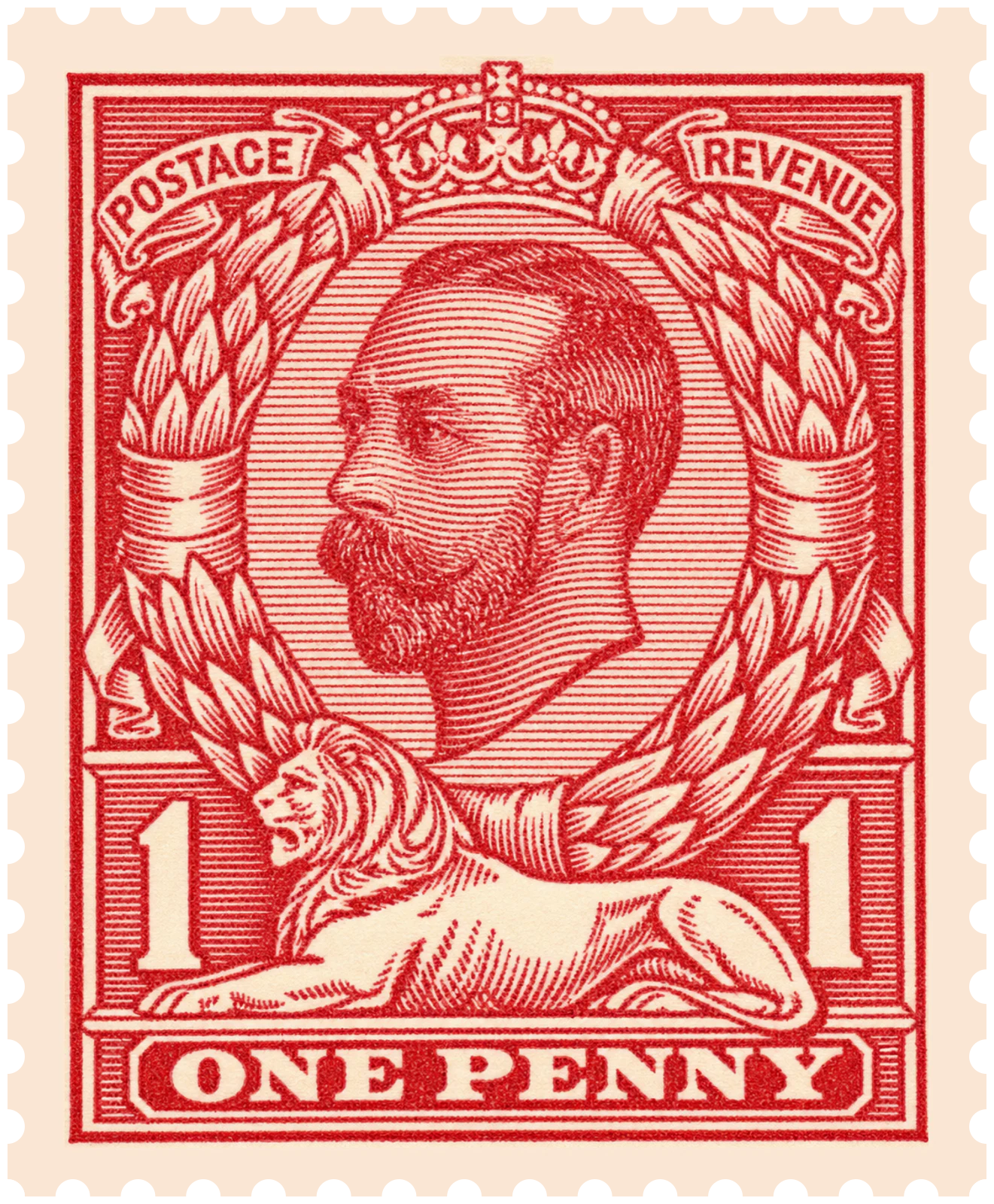
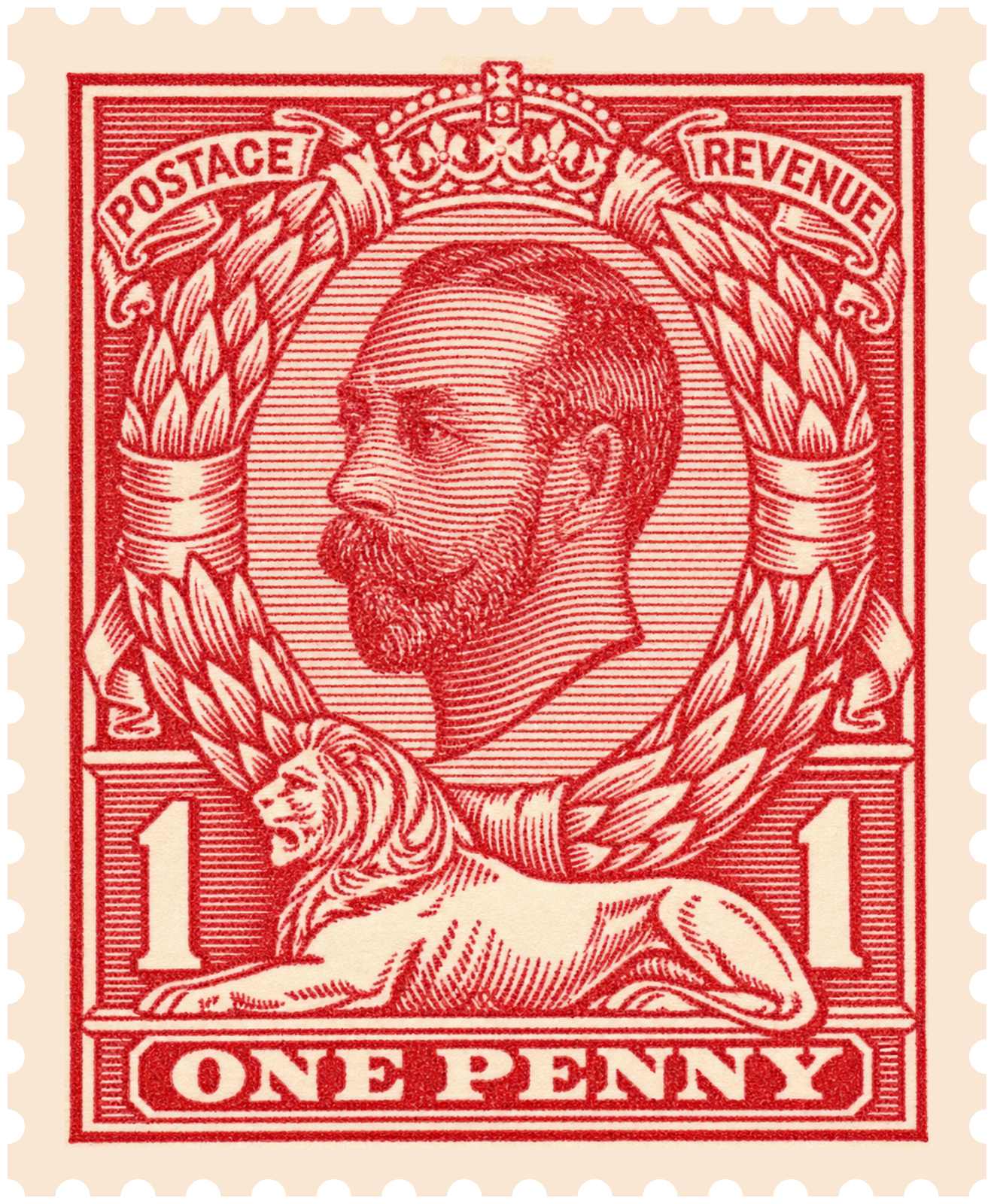
A lion lies directly below the portrait, with its head to the left and its body stretching across the lower frame. Its paws and long back make a horizontal base for the rounder form of the head above. On Die 1, much of the lion’s body is left unshaded, distinct from the more worked mane and head.

Image information
Click image to magnify
Illustration of a laurel branch with glossy pointed green leaves and dark berries.
- Credit
- Stunning Stamps · 2026
- Notes
- Digitally constructed
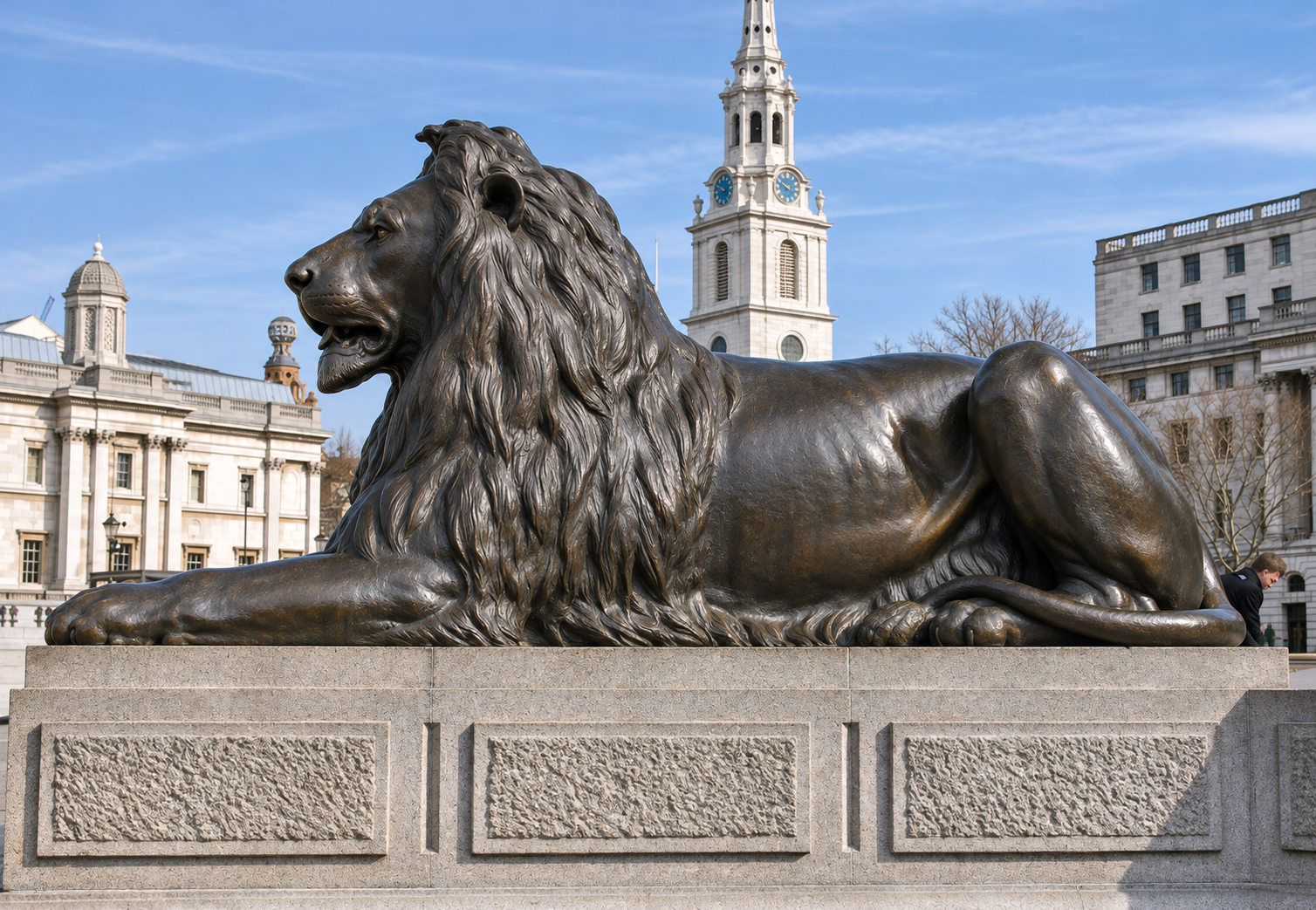
Image information
Click image to magnify
Image of a reclining bronze lion by Edwin Landseer in Trafalgar Square, with its head raised and front paws extended.
- Credit
- Image supplied by the archive owner.
- Notes
- Digitally reconstructed
A thick laurel wreath surrounds the portrait, its narrow, pointed leaves overlapping in tightly packed bundles. Broad ribbons bind it at the sides and beneath the King’s head. Compare these leaves with the more open laurel spray on the later profile penny: the shapes are similar, but the Downey design gathers them into a much heavier frame.
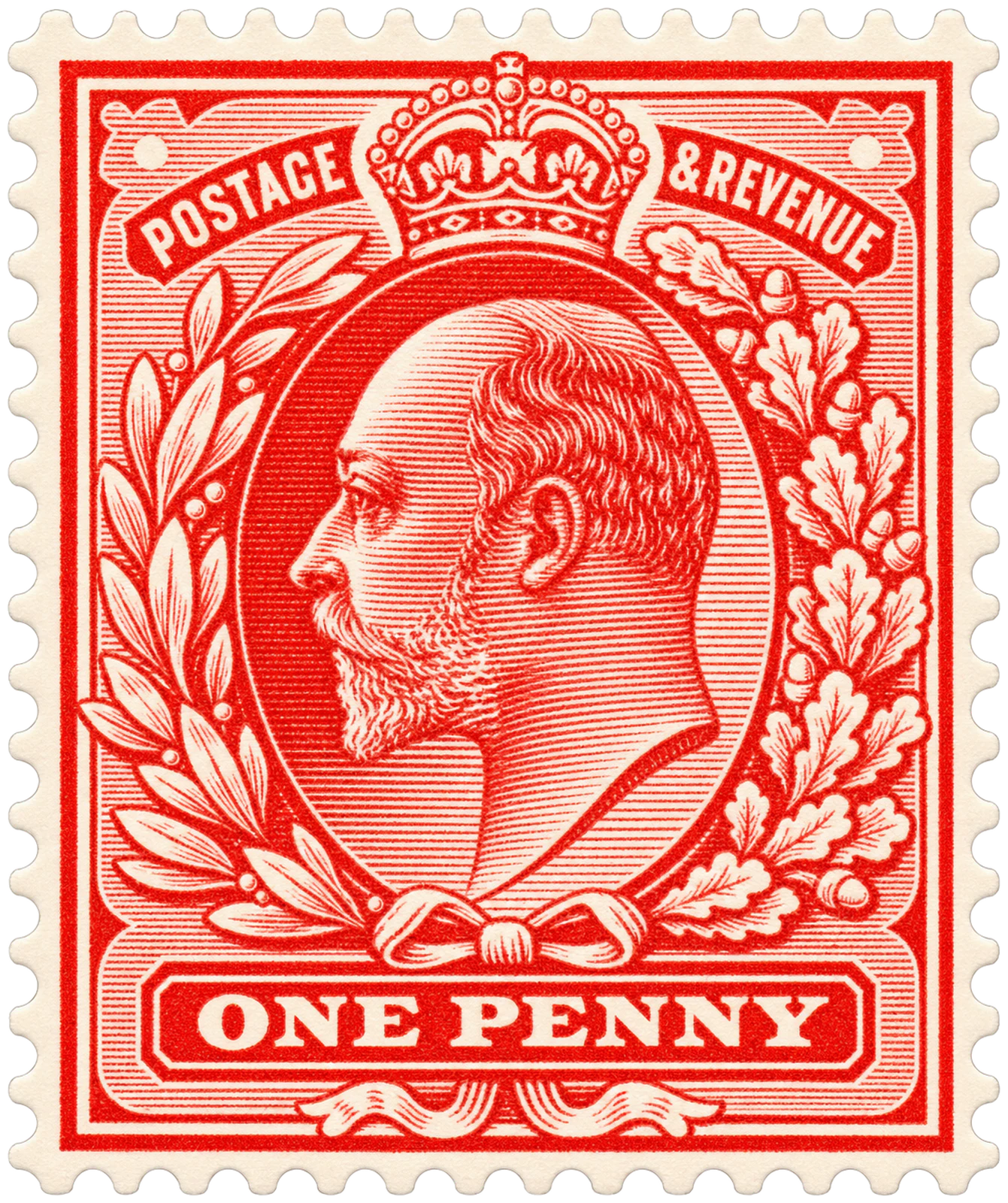
The later profile penny replaced the lion-and-wreath frame with a design described as “Laurel and Oak Leaf” in the Royal Philatelic Society London’s account. Laurel rises on the left and lobed oak leaves on the right, giving the new frame a more open, varied arrangement. [3]
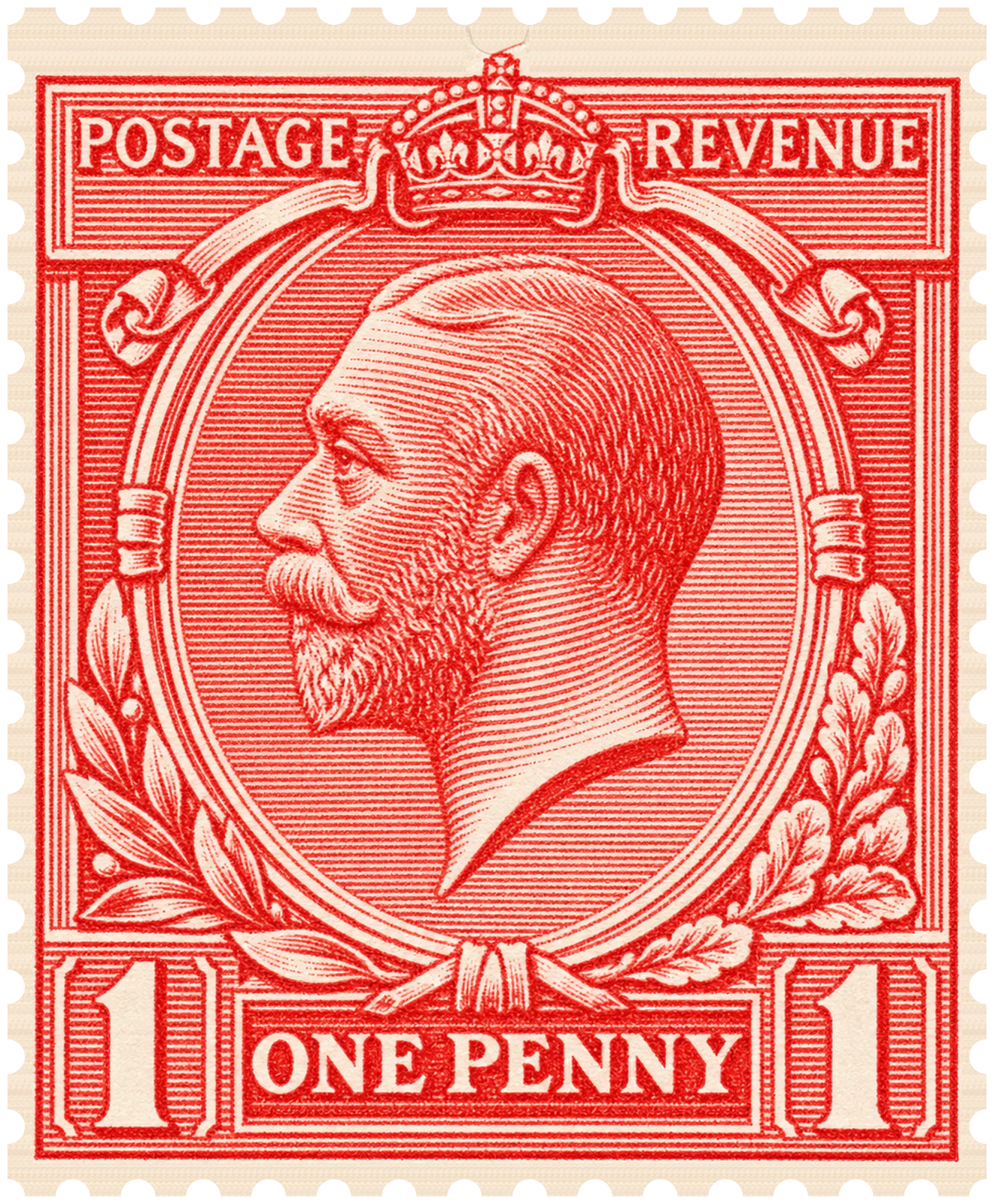
Compare the open laurel-and-oak frame with the heavier Downey wreath.
Click the stamp to magnify
The photograph the King and Queen liked
George V cared deeply about stamps: he was an enthusiastic collector who studied proofs and took an interest in their design. For his first British issue, he chose a photograph by W. & D. Downey that both he and Queen Mary particularly liked. The aim was a convincing likeness of the new King, with his face turned slightly towards the viewer. [4]
The photograph had to become an engraving small enough to print millions of times. J. A. C. Harrison worked on the portrait, translating its soft modelling into lines and dots. He was a separate person from Harrison & Sons, the printing firm. Bertram Mackennal supplied the ornamental frames around the head. [4, 5]
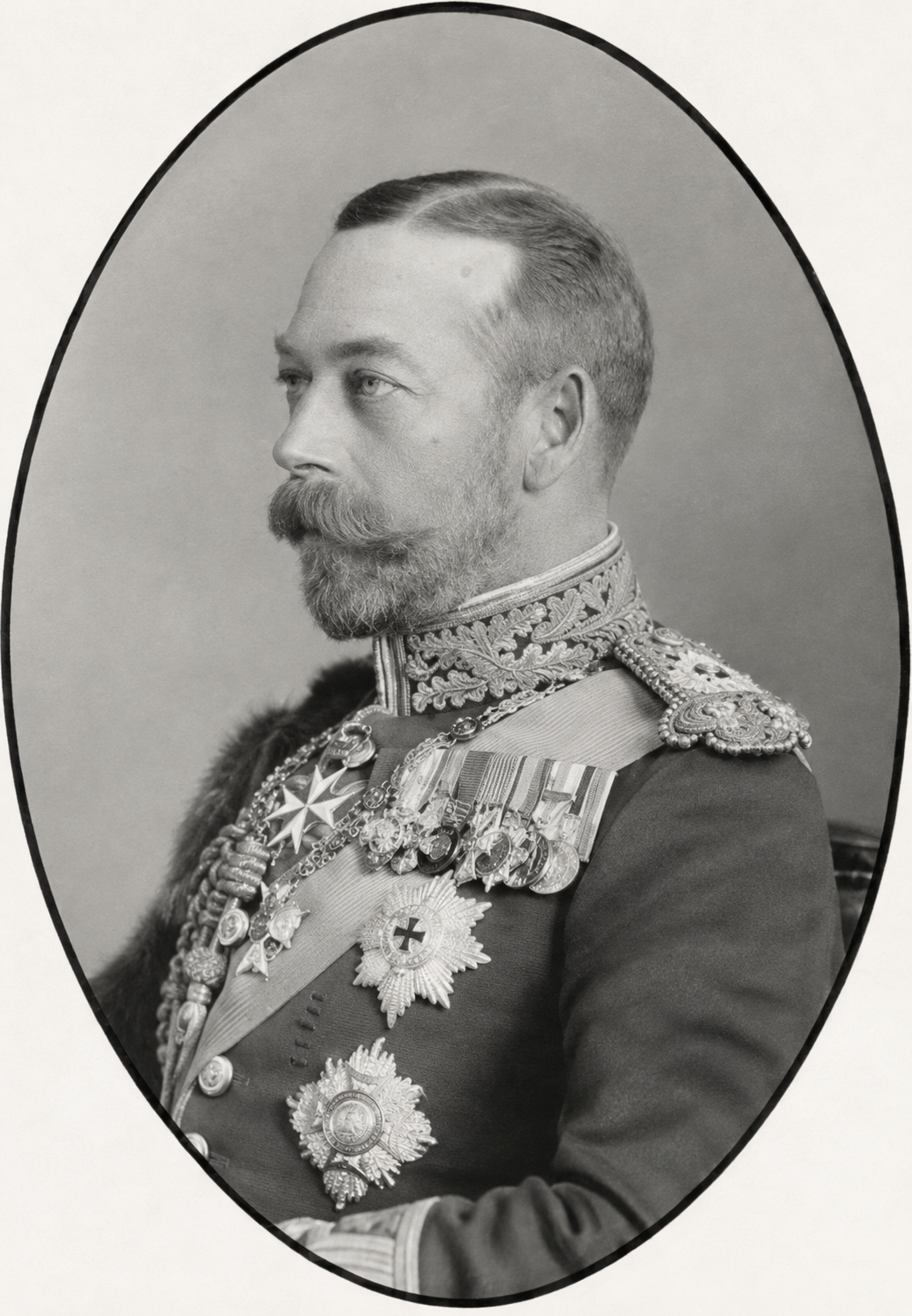
Image information
Click image to magnify
Reconstruction of the Downey photograph: George V bareheaded in naval dress, turned three-quarter left, with both eyes visible.
- Credit
- W. & D. Downey, original photograph; digital reconstruction by Stunning Stamps, 2026.
- Notes
- Digitally reconstructed from the photograph reproduced in David Thompson’s Downey Heads article, cross-checked with a catalogued Downey head photograph (Spink 22018, lot 387). The illustration preserves the pose and broad arrangement; it is not an archival photographic print or evidence of fine printing defects.
The portrait that disappointed the King
The three-quarter portrait broke with the familiar British stamp profile. Both eyes are visible, and the cheek turns towards the viewer. Beside Edward VII’s side-on likeness, the new approach is immediately apparent. [4]
The result provoked a storm of criticism. In Parliament on 15 August 1911, Sir Hildred Carlile called the likeness a “grotesque parody”. Other speakers attacked the crowded ornament and poor execution. When an MP said he had promised better stamps, Postmaster-General Herbert Samuel replied: “It was a hope, not a promise.” [6]
George V was disappointed with the issued stamps and suggested replacing the three-quarter portrait with a profile. The decision was taken in November 1911. His personal enthusiasm for the original photograph had given way to a different judgement of how it worked on a stamp. [4]
Click either stamp to magnify
Attempts to improve the engraving
This is Die 1B, the early revision of the original engraving. Small alterations to the frame preceded the more extensive work on the portrait in Die 2. The earlier Die 1B remained in booklet production after ordinary sheets changed. [4, 7, 8]
The revised portrait was accompanied by changes to the frame. On Die 2 the lion’s body gained shading, while the earlier Die 1 versions had left much of it unshaded. [7, 4]
This entry combines Die 1B with Simple Cypher paper, as issued in the Downey booklets from September 1912. The booklet engraving remained in use after Die 2 had entered sheet production. Die 1A was issued on Imperial Crown paper; some later dies occur on more than one watermark paper. A paper change therefore need not mean a newly engraved design. [7, 9]
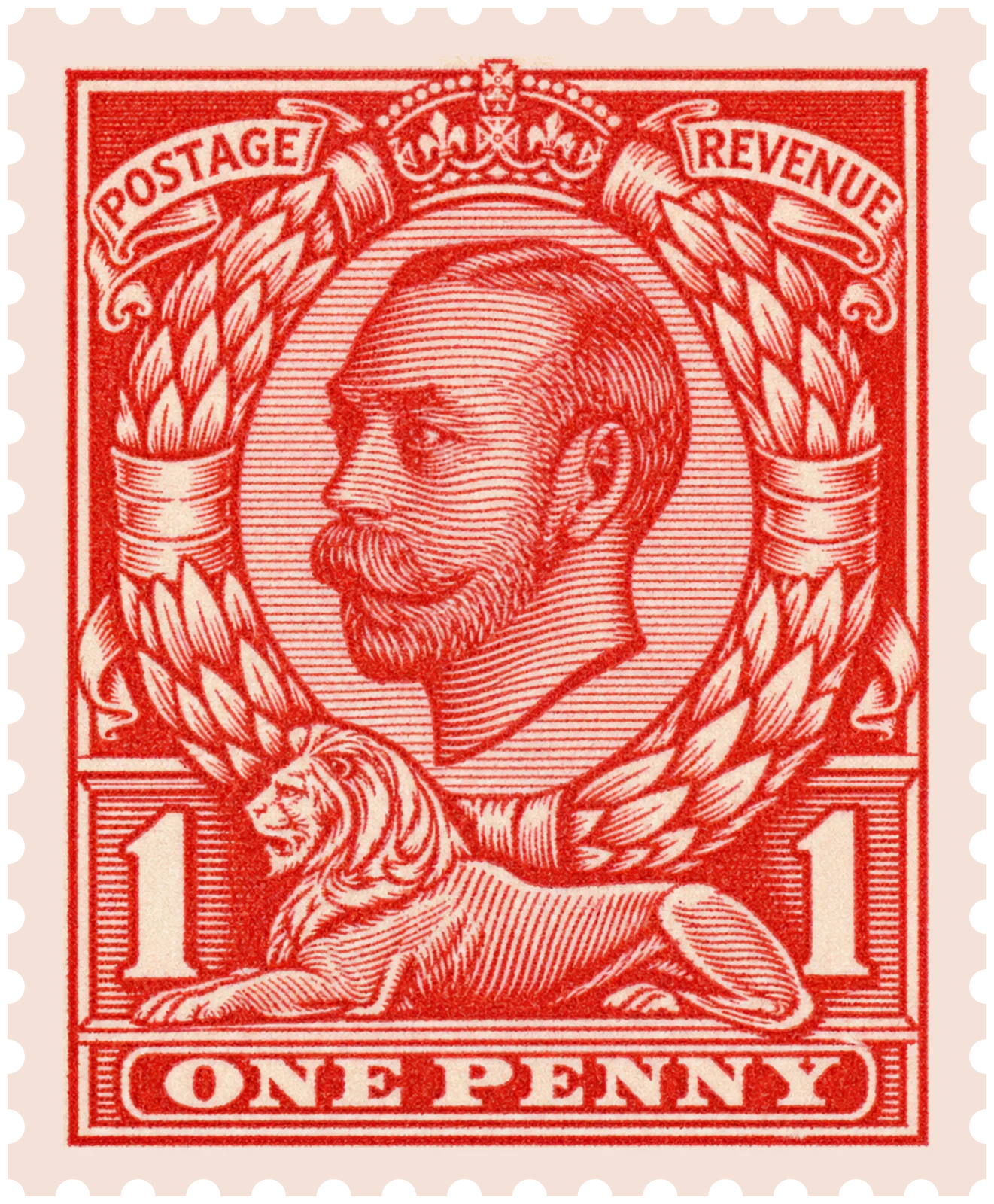
Compare the hair, beard and surrounding frame.
Click either stamp to magnify
Turning a photograph into a printed likeness
The photograph’s smooth tones had to be translated into marks that would reproduce at stamp size. The original dies were engraved, but the issued stamps were printed by letterpress: ink on raised printing surfaces was pressed onto the paper. This differs from recess printing, which holds ink in engraved hollows. [10, 4]
Scarlet ink describes both the fine portrait shading and the stronger frame. Unprinted paper supplies the highlights and the pale bands around the lettering. Lines and dots set close together make the hair and beard appear darker; more open marks leave light on the face. The result depends on the balance between ink and unprinted paper, without a second colour.
A successful likeness depended on how that fine work survived ordinary production. The engraving and the quality of the resulting impressions were both part of the controversy over the new stamps. [6]
Image information
Click image to magnify
Decorative blue, green and white advertisement for Mander Brothers printing inks, Wolverhampton.
- Credit
- Stunning Stamps · 2026
- Notes
- Digitally constructed
Words, value and the surrounding frame
POSTAGE follows the ribbon at the upper left, with REVENUE on its counterpart at the upper right. The words describe the stamp’s postal and fiscal functions: paying to carry mail, or paying a tax or duty on a document. [11]
ONE PENNY runs across the lower tablet. The value 1 is repeated in the lower corners, flanking the lion above the words. Coloured letters stand on pale ribbons that slope towards the crown.
The reclining lion makes a horizontal base beneath the curved portrait and wreath. The repeated figures and the value in words give the lower part of the design a clear purpose alongside its ornament.
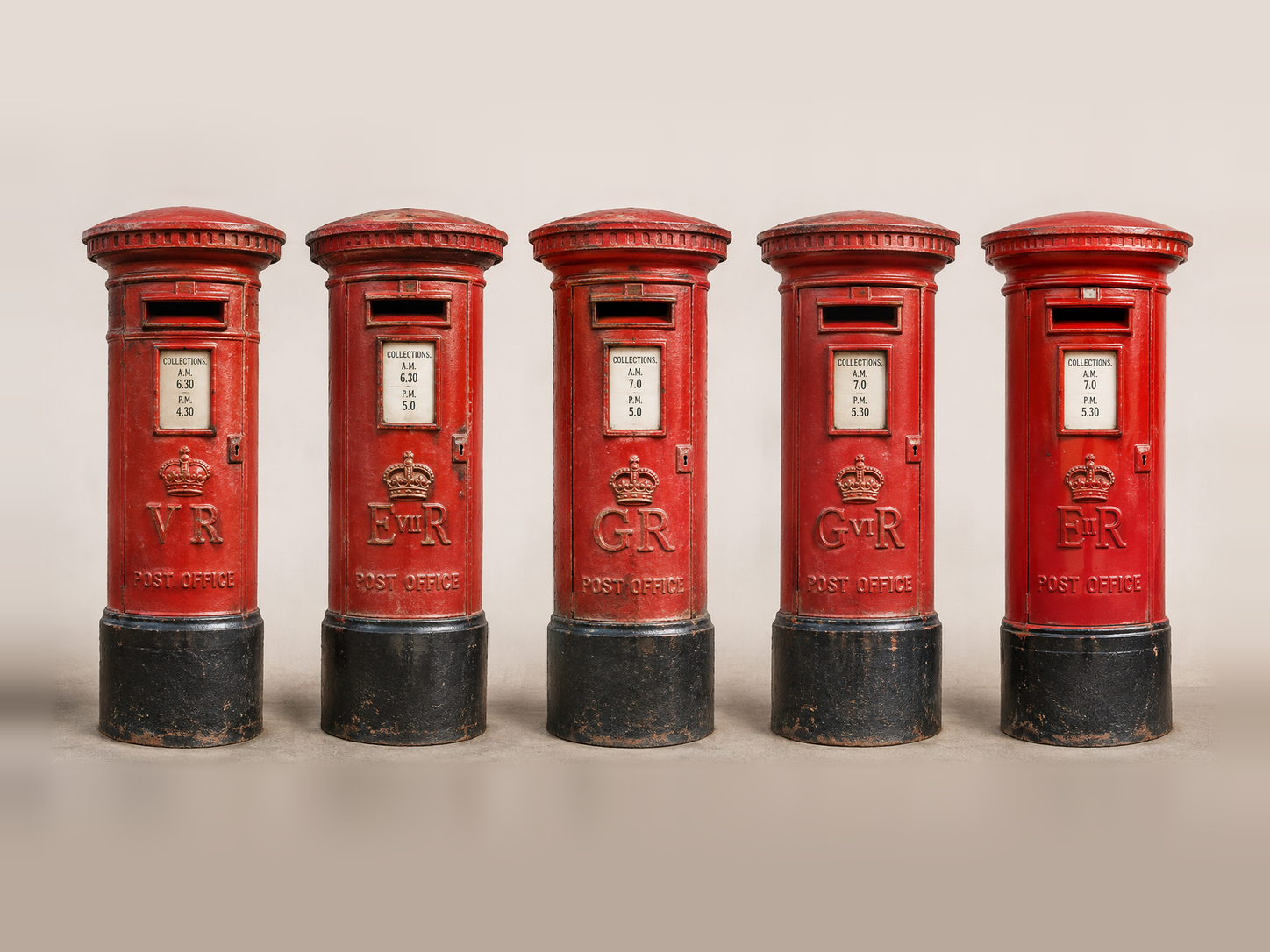
Image information
Click image to magnify
Illustration of five red pillar boxes with royal cyphers.
- Credit
- Stunning Stamps · 2026
- Notes
- Digitally reconstructed
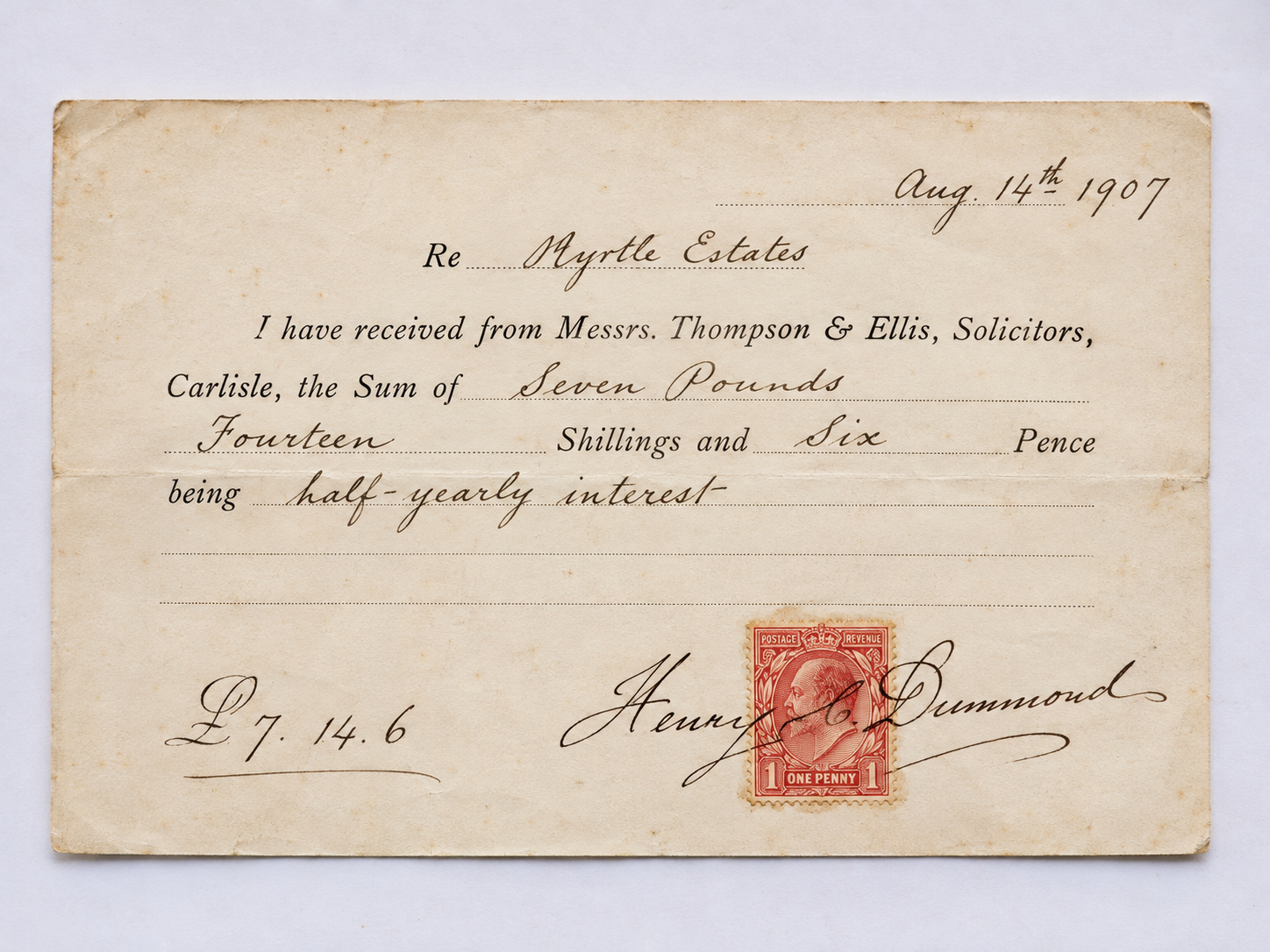
Image information
Click image to magnify
Illustration of a handwritten receipt with an Edward VII penny stamp cancelled by a signature.
- Credit
- Stunning Stamps · 2026
- Notes
- Digitally constructed
The crown above the head
A crown occupies the centre at the top. Rounded ornaments follow its arches above a patterned band, and a small cross completes the outline.
The crown sits in the frame above the King’s bare head. The inscription ribbons pass beside it, linking the crown with the oval and foliage.
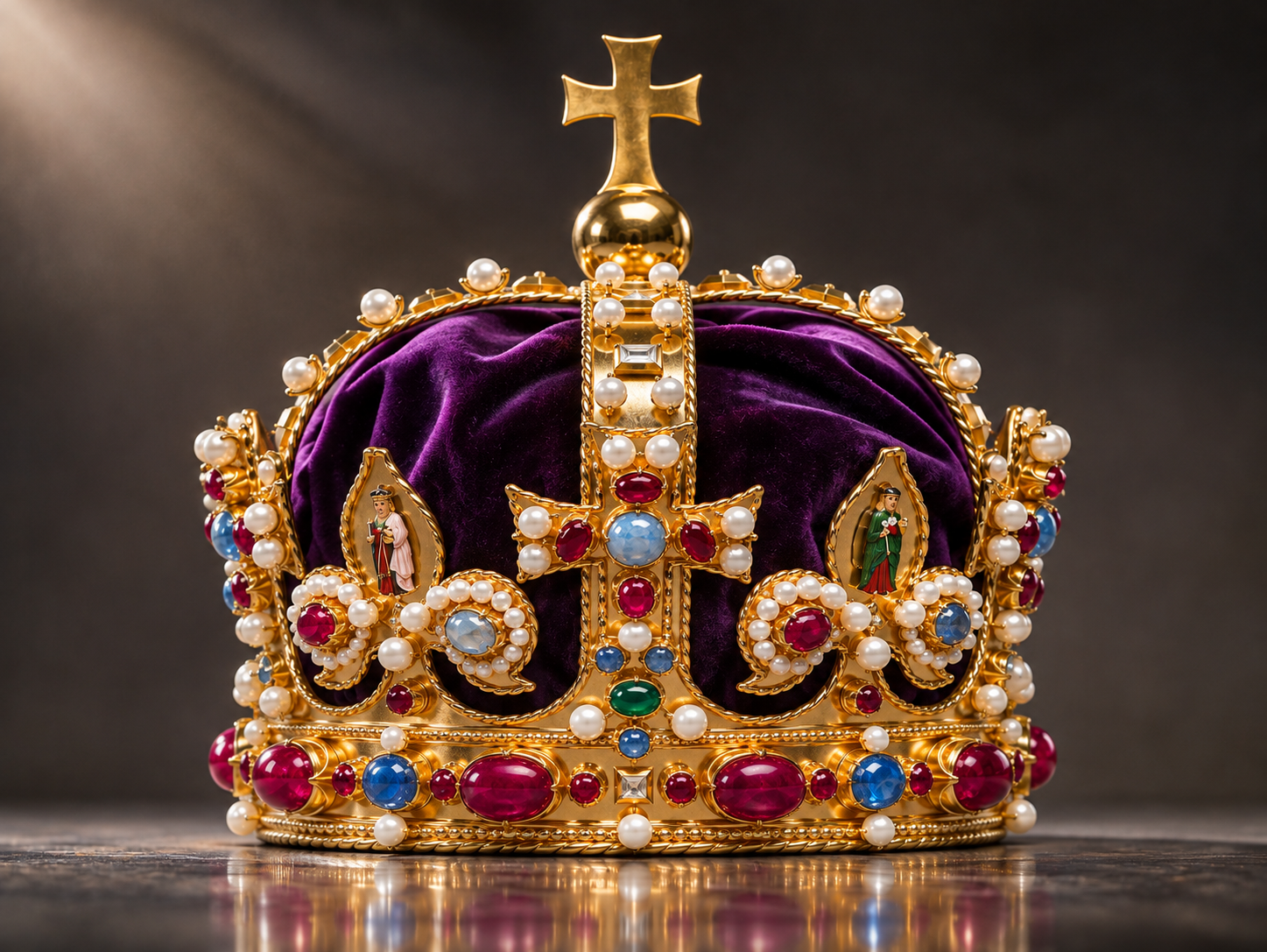
Image information
Click image to magnify
Gold Tudor royal crown with jewels, pearls, small figures and a purple cap.
- Credit
- Stunning Stamps · 2026
- Notes
- Digitally constructed
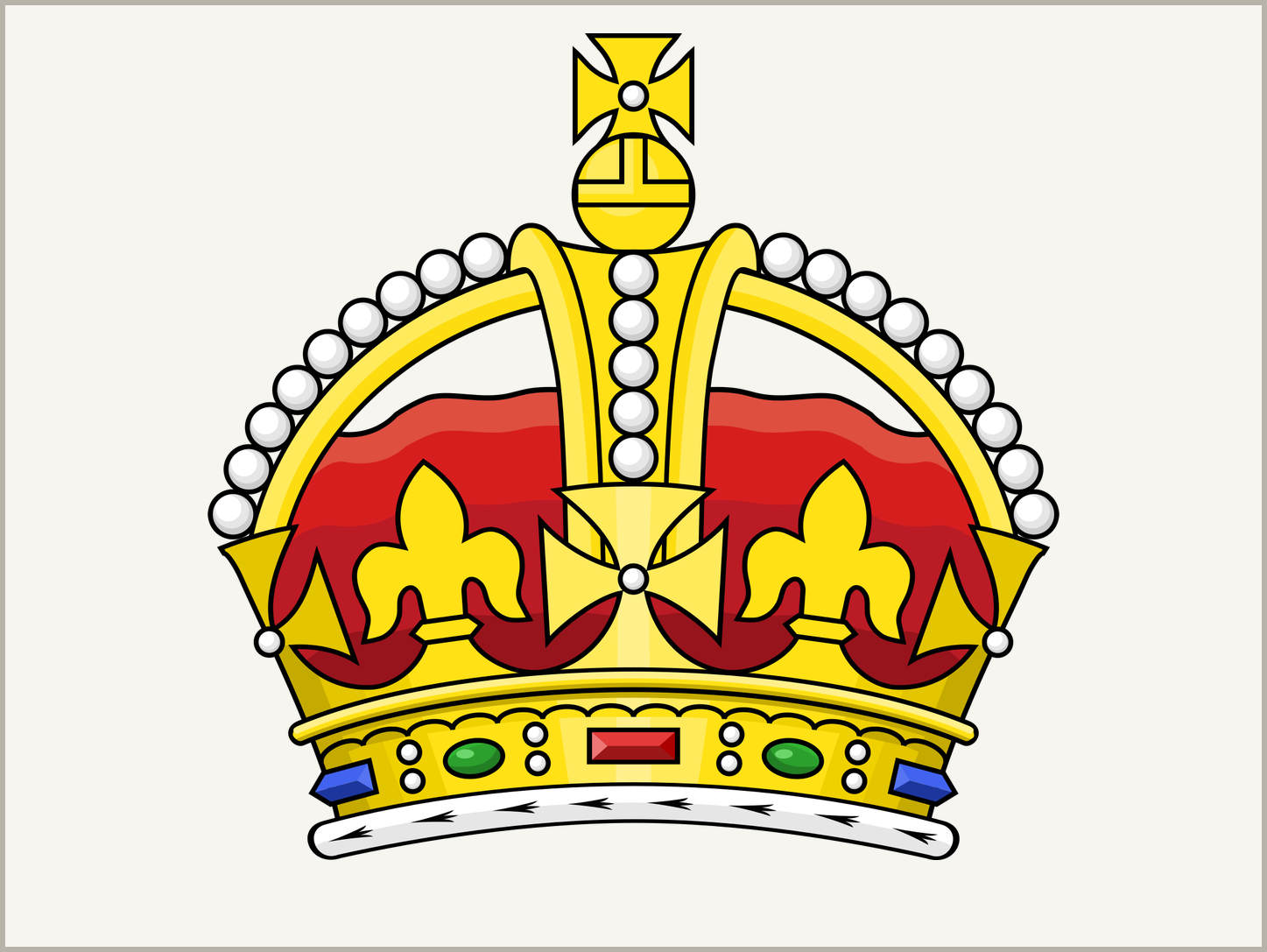
Image information
Click image to magnify
Heraldic Tudor Crown with rounded arches, a cross and orb, red cap, crosses and fleurs-de-lis.
- Credit
- Dgp4004 · Wikimedia Commons · CC0
The people and printer behind this stamp
W. & D. Downey supplied the photograph, J. A. C. Harrison engraved the stamp portrait, and Bertram Mackennal designed the ornamental frame. [12, 3]
Harrison & Sons printed this group. The engraver J. A. C. Harrison was a different person, unrelated to the printing firm. [12, 3, 13, 14]
Sources
- James Mackay, Stamps of the Four Kings: 3. The George V Downey Heads, British Philatelic Bulletin, November 1993, pp.74–75
- W. W. Ward: The Postage Stamps of Great Britain, Part 31 — The George V Downey, Profile Stamps (reprinted account of Alfred Leete’s caricature)
- Royal Philatelic Society London: The King’s Head, 2010
- Alan N. Moorcroft, The King's Head, RPSL display, 25 February 2010
- David Thompson, The George V Downey Heads, illustrated W. & D. Downey photograph; reprinted in Mekeel’s & Stamps, 7 September 2018, p.18
- Hansard, New Postage Stamps, 15 August 1911, cols.1824–1843: public criticism and Herbert Samuel’s response
- Walter Owen, Mix and Match: Downey Head die differences, Stamp News, July 2000
- GB Stamp Booklets: Downey Head booklets, editions and papers
- Ivybridge Heritage: Postage Stamp Paper, Simple and Multiple Cypher manufacture
- Adrian Keppel, The Four Kings, British Philatelic Bulletin 49, February 2012, pp.148–151
- The Postal Museum: British Empire Exhibition stamp history, p.16 — postage stamps and receipt duty
- Buckinghamshire Council: Harrison & Sons printworks
- Charles Goodwyn, Great Britain – King George V, Royal Philatelic Collection display, 17 September 1998
- GB Stamp Booklets: Downey Head booklets, editions and papers
← Return to the 1d scarlet · Die 1B · Royal (Simple) Cypher stamp
Last reviewed · Facts checked