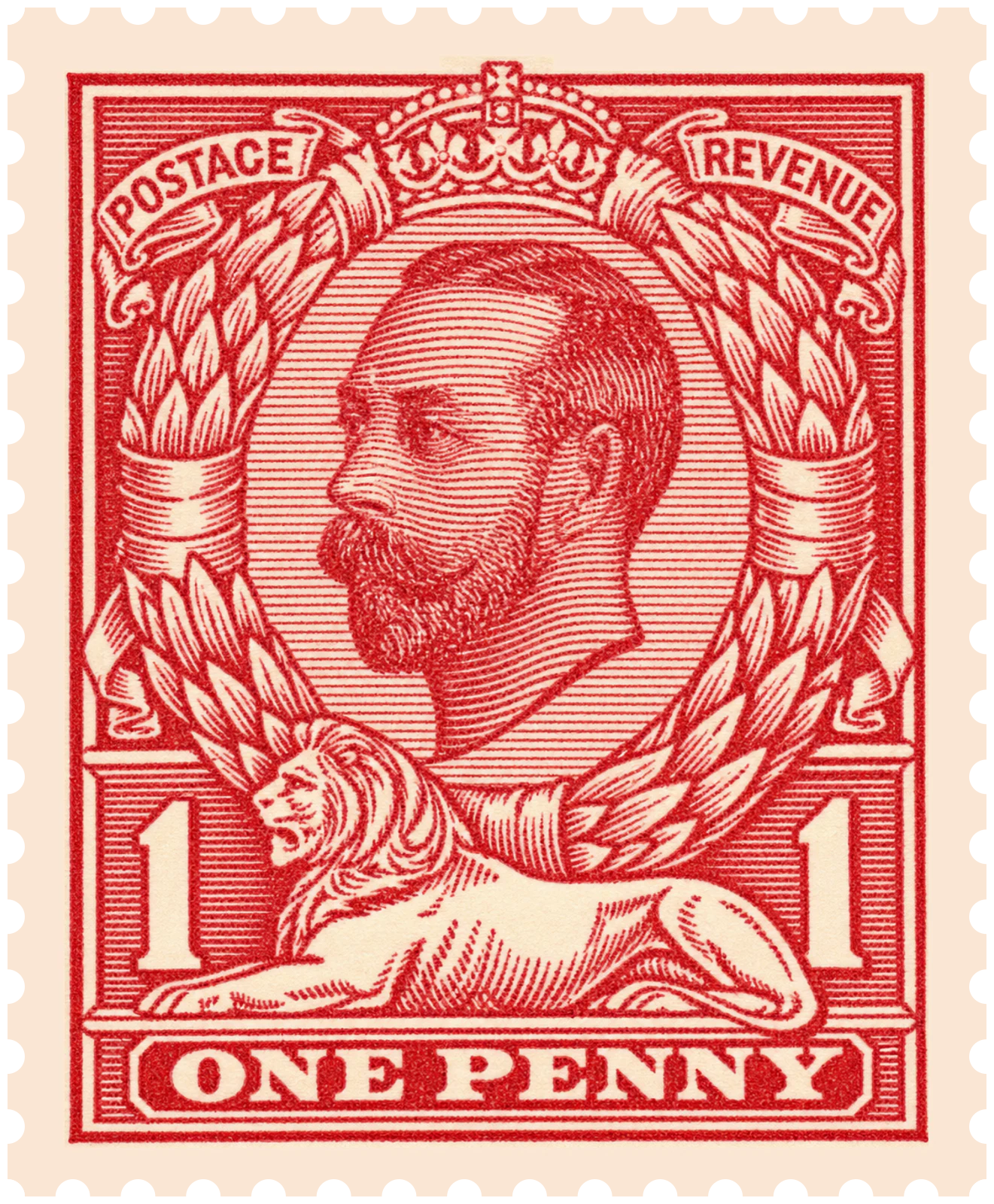
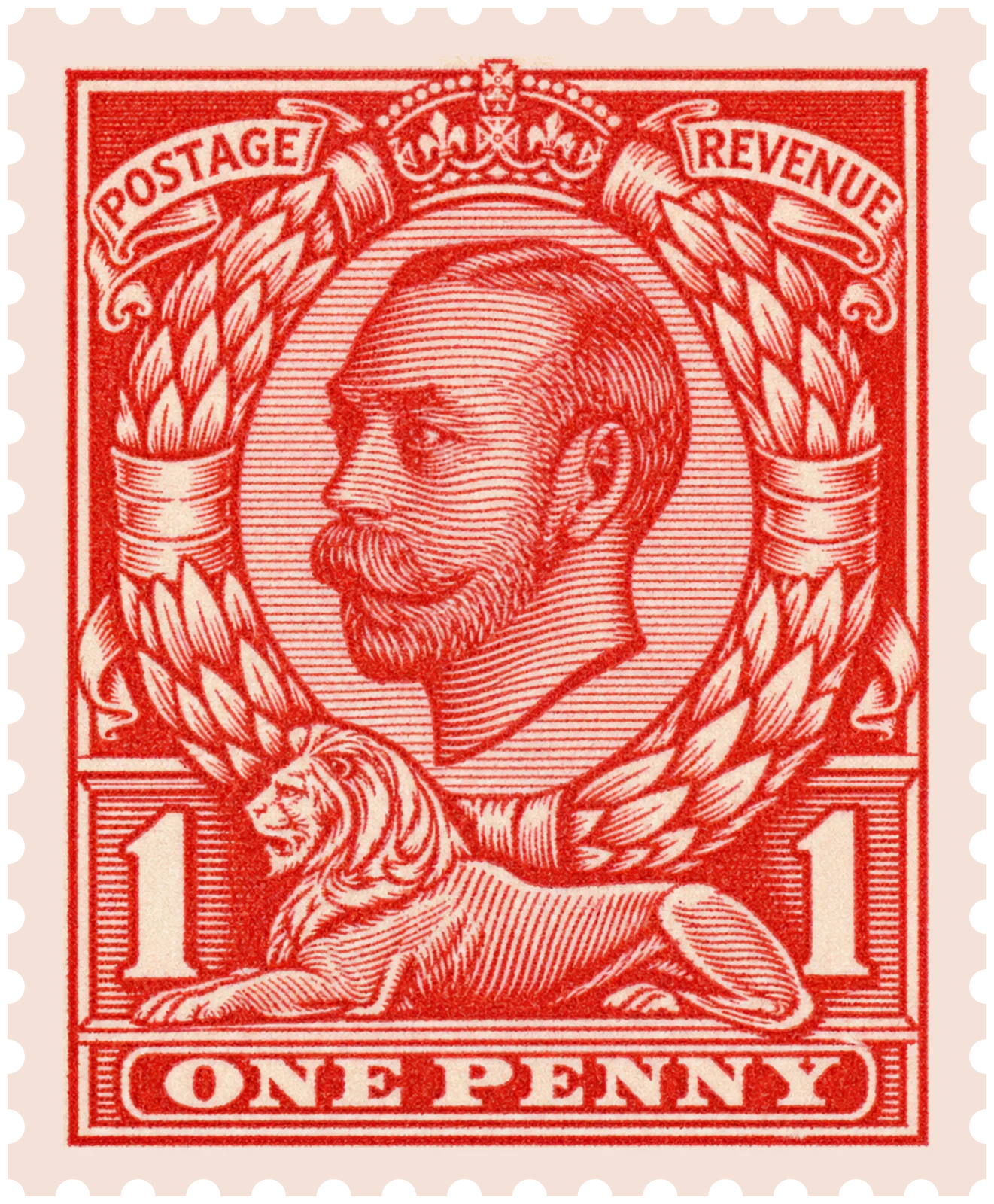
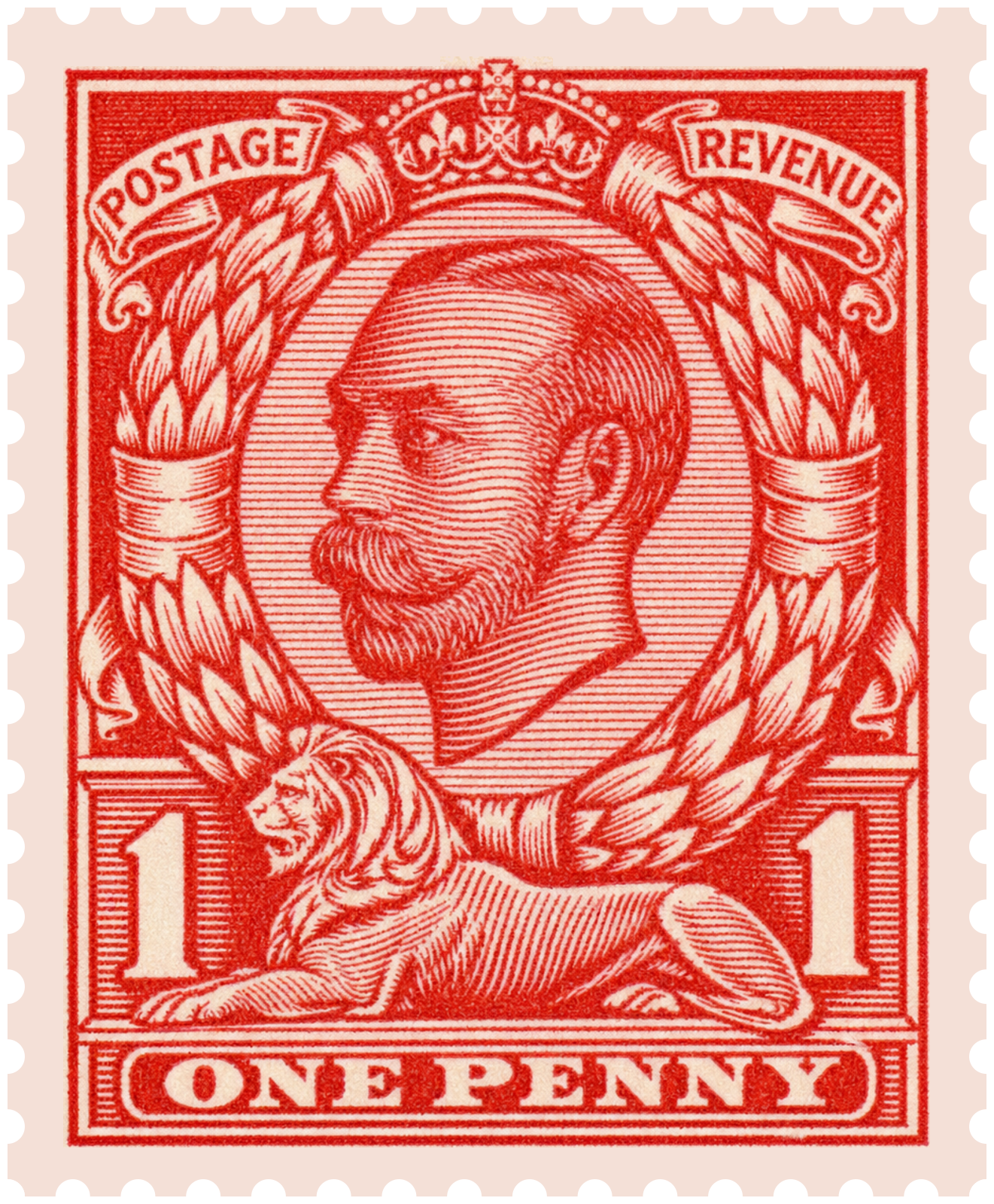
This penny carries the final Downey engraving on paper bearing crowns and the King’s initials. The change to Simple Cypher paper accompanied the short remaining life of a design revised after criticism, while the new profile stamps were being prepared. [1, 2, 3]
Stories
A clearer head, but still a short life
A clearer head, but still a short life
Die 2 was the last attempt to improve the Downey portrait for issued stamps. The head was re-engraved, with clearer treatment of the hair and beard, and details in the surrounding frame were altered too. These revised stamps reached the public in January 1912. [1, 2]
They arrived with a short future already in prospect. The decision to replace the three-quarter likeness with a profile had been taken the previous November. Die 2 could improve the stamps still being supplied while the replacement designs were prepared. [1]
Not everyone admired the new penny stamp. According to philatelic writer W. W. Ward, cartoonist Alfred Leete turned its design into a joke: a zoo keeper offered the reclining lion a piece of beef on a fork, while the thick wreath became bunches of bananas. Once you notice the tightly packed, elongated leaves, the joke is easy to understand. [12]
The joke concerned the original Downey penny of 1911. Its lion and bundled wreath remained recognisable through the later changes of die and paper. [12, 1]
The photograph the King chose—and came to regret
George V cared deeply about stamps: he was an enthusiastic collector who studied proofs and took an interest in their design. For his first British issue, he chose a photograph by W. & D. Downey that both he and Queen Mary particularly liked. The aim was a convincing likeness of the new King, with his face turned slightly towards the viewer. [1]
The photograph had to become an engraving small enough to print millions of times. J. A. C. Harrison worked on the portrait, translating its soft modelling into lines and dots. He was a separate person from Harrison & Sons, the printing firm. Bertram Mackennal supplied the ornamental frames around the head. [1, 13]
The result provoked a storm of criticism. In Parliament on 15 August 1911, Sir Hildred Carlile called the likeness a “grotesque parody”. Other speakers attacked the crowded ornament and poor execution. When an MP said he had promised better stamps, Postmaster-General Herbert Samuel replied: “It was a hope, not a promise.” [14]
The King was disappointed too. Work continued on improving the engraving, but the early revisions did not rescue his chosen portrait. In November 1911 the decision was taken to replace the three-quarter head with a profile. By the time the final Downey revision, Die 2, appeared in January 1912, work on its replacement was already under way. [1, 2]
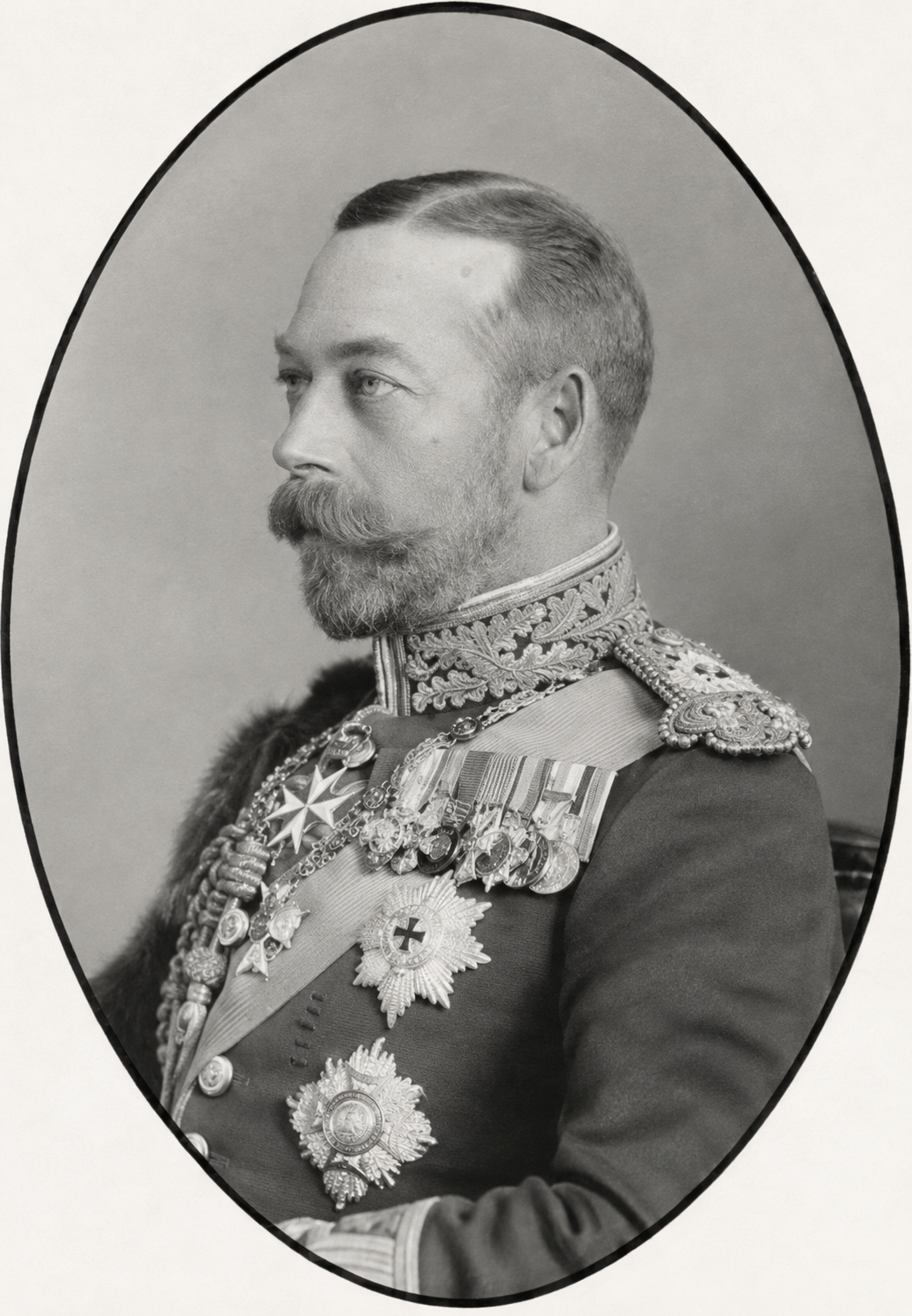
The Downey photograph chosen for the stamp portrait.Image information
Click image to magnify
Reconstruction of the Downey photograph: George V bareheaded in naval dress, turned three-quarter left, with both eyes visible.
Credit
W. & D. Downey, original photograph; digital reconstruction by Stunning Stamps, 2026.
Notes
Digitally reconstructed from the photograph reproduced in David Thompson’s Downey Heads article, cross-checked with a catalogued Downey head photograph (Spink 22018, lot 387). The illustration preserves the pose and broad arrangement; it is not an archival photographic print or evidence of fine printing defects.
The 1d Die 2 stamp.
A new face for Coronation Day
The halfpenny and penny were the first British postage stamps to show George V. They appeared on 22 June 1911, the day of his coronation, while the other denominations continued to carry Edward VII’s portrait. Changing the monarch on the stamps was a gradual undertaking, not an overnight replacement of every value. [1, 5]
More Downey denominations had been planned. Drawings, essays and trial printings survive for values that never reached the post-office counter. The Royal Philatelic Collection preserves this larger programme, including colour trials which put the two accepted designs through different combinations of ink. [1, 5]
Only the green halfpenny and red penny were issued with the three-quarter portrait. [1, 5]
Why do some stories appear on several pages?
Every page is written to make sense on its own. Visitors often arrive directly at a particular stamp or subject, without having explored the rest of the site.
Some stories are relevant to several stamps, so they are repeated where they help explain what you're looking at. For those exploring a series, the details specific to each stamp generally come first, with the more familiar stories further down the page.
This way, you can explore the site in any order without missing interesting background.
Design
1d scarlet · Die 2 · Royal (Simple) CypherStunning StampsOptions
A lion inspired by Trafalgar Square became the target of a cartoonist’s joke, while the King’s chosen portrait was attacked in Parliament. The penny’s design joins familiar London sculpture to a difficult royal commission. [15, 16, 14]
Die 2 was the final Downey revision, issued after a replacement portrait had already been chosen. Explore the lion, the wreath and the attempts to improve the likeness. [2]
An issue date records when a stamp became available for use. A design can remain in production for years, with changes of printer, colour, paper or perforation along the way.
“Denomination introduced” refers to the first appearance of that value in the issue family. The particular printing or design format illustrated may be later. Read the date with the rest of the description.
The printer manufactured the stamps. The designer planned their appearance, and the engraver prepared the original image for reproduction. These are separate jobs, even when the same person or firm undertook more than one.
George V designs passed between firms and the government’s stamp-printing department. A portrait or colour alone may not identify the printing; paper, marginal marks and details of the impression can supply further evidence.
The Royal Cypher low values were printed from raised surfaces by typography. The Seahorses used recess printing, with ink held in engraved lines. The later photogravure issue used a cylinder carrying a fine pattern of ink-bearing cells.
The process describes how ink reached the paper. It is separate from the name of the printer and the way the original artwork was designed.
A shade is a variation within a stamp’s colour. Some variations receive their own catalogue numbers even though the design and denomination stay the same.
Compare known examples under consistent lighting. Fading can change a stamp’s appearance, and photographs or screens can alter how colours look. A catalogue colour name helps describe a shade; it is not a colour test by itself.
A stamp catalogue gives each listed issue a reference number. SG means Stanley Gibbons, the publisher of the catalogue used here. These numbers help collectors refer to the same issue; they are not serial numbers printed on individual stamps.
A range of numbers groups related entries. Colour, paper or perforation differences may account for separate listings within that range.
Perforations are the punched holes that let stamps separate. The gauge describes their spacing over 2 centimetres, not the total number of holes along an edge.
Two numbers give the horizontal gauge first, then the vertical: top and bottom, followed by the two sides. A higher number means closer spacing. Match an actual stamp with a perforation gauge rather than measuring the image on a screen.
Illustrative spacing, not a measuring gauge. The number describes spacing over 2 cm, not the total holes along an edge.Image information
Horizontal gauge 15 and vertical gauge 14: the same 20 mm distance is used in each direction. Enlarged spacing diagram, not a ruler.
Dimensions are given as width × height. Here the listed figures describe the overall stamp format. The printed design sits inside it and has a separate, smaller measurement.
These are nominal reference sizes. They are not measurements of the illustration on your screen, or a claim that every separated example has exactly the same outer edges.
Nominal reference format, enlarged. The inner rectangle explains the separate printed area; its size is illustrative.Image information
Nominal overall format: 21 millimetres wide and 24 millimetres high. The printed design is a separate, smaller measurement.
Credit
Stunning Stamps · 2026
An issue date records when a stamp became available for use. A design can remain in production for years, with changes of printer, colour, paper or perforation along the way.
“Denomination introduced” refers to the first appearance of that value in the issue family. The particular printing or design format illustrated may be later. Read the date with the rest of the description.
On this stamp
The year identifies this die and watermark combination. It is not the original introduction of the Downey portrait, which was on 22 June 1911.
The denomination is the stamp’s face value: the amount of postage it represents. Its price to a collector can be quite different.
In Britain’s old currency, 12 pence made one shilling and 20 shillings made one pound: 240 pence altogether. The abbreviations were d for pence, s for shillings and £ for pounds. The d comes from the Latin denarius. A halfpenny, written ½d, was half an old penny.
On this stamp
The value is 1d. The inscription names the amount paid; the paper, die and printer distinguish issues of the same denomination.
The halfpenny has two curling ornamental dolphins beneath the portrait. The penny has a reclining lion at the base of an oval wreath of pointed leaves, bound with ribbons. Both frames were prepared by Bertram Mackennal.
A frame name describes the surrounding design. It does not identify the watermark, and small details within the same frame can distinguish different dies.
This portrait was engraved from a photograph by W. & D. Downey, chosen by the King. His face is turned slightly towards the viewer, so both eyes can be seen. The name identifies the photographic source, not the printer.
J. A. C. Harrison engraved the design. He was unrelated to Harrison & Sons, the firm which printed many of the stamps. Die revisions altered the engraving before the later profile portraits replaced it.
A die is the engraved master from which the printing design was developed. Collectors distinguish three issued Downey forms for each denomination: Die 1A, Die 1B and Die 2. These names concern the engraving, not the paper or colour.
The halfpenny and penny have different diagnostic marks. Check several features on a clear impression against a specialist reference. Heavy printing, wear and cancellations can hide a small line or dot.
Diagram isolates the first two ribbon strokes nearest the crown; their scale and setting are simplified. It is a reading aid, not a facsimile identification plate.Image information
Penny Die 1 ribbon clues, schematic: 1A has a short first lower stroke and a continuous second line; 1B has a first dot and a broken second line. Die 2 adds shading to the lion’s body.
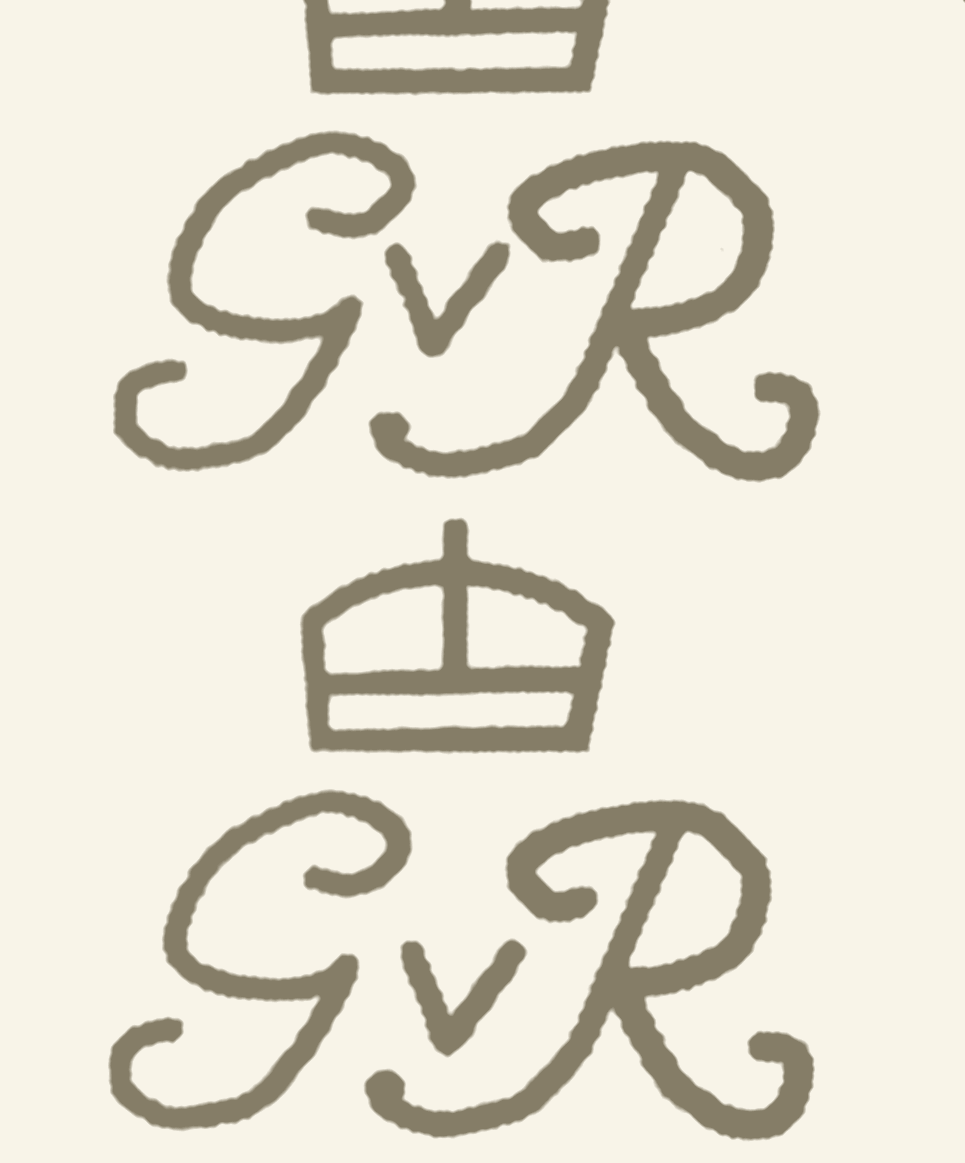
A watermark is formed within the paper during manufacture. The first Downey stamps used Imperial Crown paper, with a crown but no royal initials. Royal or Simple Cypher and Multiple Cypher papers carry small crowns and the King’s cypher.
Simple Cypher is the strip arrangement; Multiple Cypher is the all-over arrangement. Both repeat their motifs. Neither should be confused with the larger Single Cypher used for Seahorses or the later Block Cypher.
Simple Cypher (Royal Cypher) · front view · upright. Small crowns and script GvR cyphers repeated in vertical strips. Enlarged; not a scale or stamp-position template. From the back, the cypher lettering appears mirrored.Image information
Simple Cypher (Royal Cypher) watermark, front view, upright
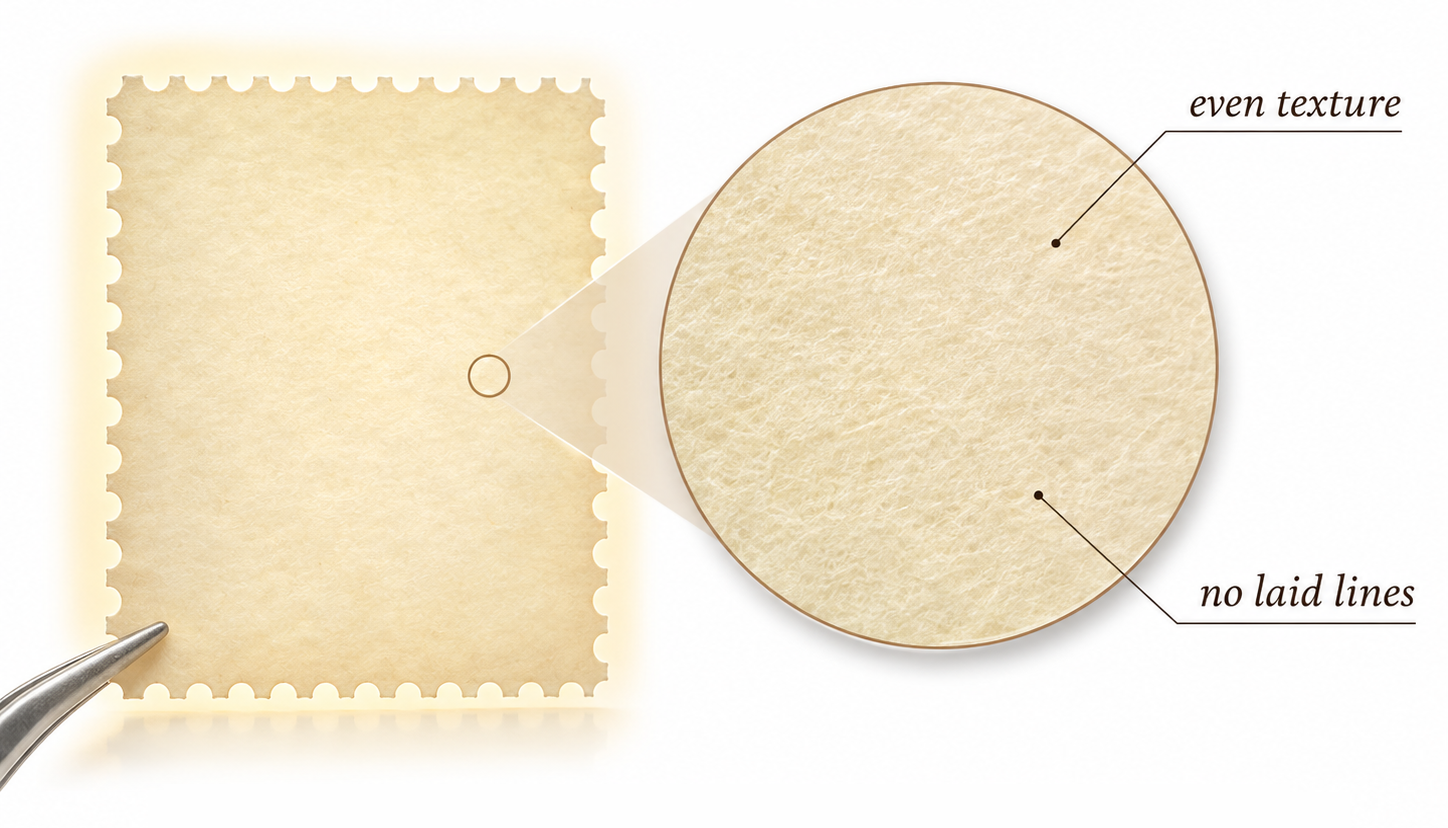
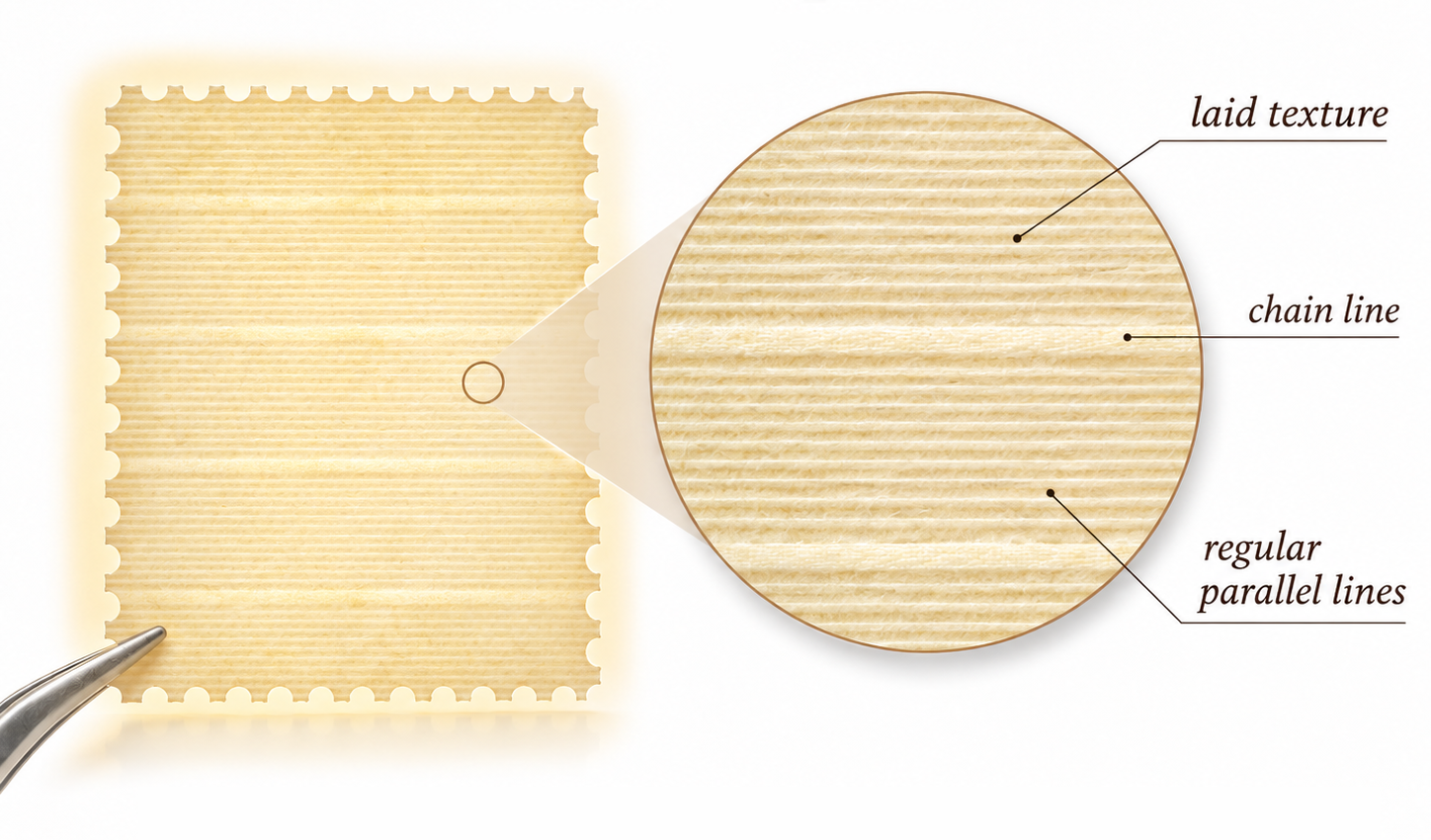
Paper is the material carrying the stamp’s design. Its structure, surface, colour and watermark are separate characteristics. Wove paper has a fairly even structure, unlike laid paper with its regular lines.
A paper description can distinguish stamps with otherwise similar designs. A coloured sheet supplies colour even in areas left untouched by the printing ink.
Wove paper: even texture without laid lines.Image information
Click image to magnify
Diagram of wove paper with a magnified inset showing an even texture without laid lines.
Credit
Stunning Stamps · 2026
Notes
Digitally constructed
Laid paper: regular parallel lines, shown for comparison.Image information
Click image to magnify
Diagram of laid paper with a magnified inset showing regular parallel lines.
A watermark is formed within the paper during manufacture. Differences in the paper let the pattern show when light passes through it. It is not a design printed on the back.
A royal cypher is a monogram identifying the monarch. George V’s cyphers use GvR. Simple Cypher (often called Royal Cypher) has small script cyphers in vertical strips; Multiple Cypher has an all-over arrangement. Single Cypher is the larger individual motif used for Seahorses. Block Cypher uses plain block lettering. These names are not interchangeable.
The illustration is shown from the front of the stamp. From the back, the letters of a normal watermark appear mirrored. That change of viewing direction is not itself a reversed-watermark variety.
Simple Cypher (Royal Cypher) · front view · upright. Small crowns and script GvR cyphers repeated in vertical strips. Enlarged; not a scale or stamp-position template. From the back, the cypher lettering appears mirrored.Image information
Simple Cypher (Royal Cypher) watermark, front view, upright
The halfpenny has two curling ornamental dolphins beneath the portrait. The penny has a reclining lion at the base of an oval wreath of pointed leaves, bound with ribbons. Both frames were prepared by Bertram Mackennal.
A frame name describes the surrounding design. It does not identify the watermark, and small details within the same frame can distinguish different dies.
On this stamp
The Lion frame surrounds the three-quarter Downey Head. Its basic arrangement is retained across the die and watermark combinations.
On the penny, compare the ribbon immediately to the right of the crown. Die 1A has a continuous second shading line and a short first line; in Die 1B the second is broken and the first reduced almost to a dot. Die 2 adds shading to the lion’s body as well as revising the head.
Check original impressions against a clear specialist reference. Heavy printing, wear or a cancellation can hide the diagnostic marks. A die identifies the engraving; paper, watermark and shade are separate questions.
Diagram isolates the first two ribbon strokes nearest the crown; their scale and setting are simplified. It is a reading aid, not a facsimile identification plate.Image information
Penny Die 1 ribbon clues, schematic: 1A has a short first lower stroke and a continuous second line; 1B has a first dot and a broken second line. Die 2 adds shading to the lion’s body.
Credit
Stunning Stamps · 2026
On this stamp
Die 2 has a revised head and shading on the lion’s body. The largely unshaded body belongs to Die 1.
Harrison & Sons was a security-printing firm that supplied stamps as well as passports and other documents. It printed British letterpress stamps before introducing photogravure for the George V definitives in 1934.
Downey sheet margins carry controls made up of a letter and year figures. Somerset House normally used a stop after the control letter, while Harrison & Sons normally omitted it.
For this Die 2 Simple Cypher penny, Harrison & Sons used the controls B 12 (wide setting) and B 13. Earlier Downey printings included Somerset House controls with a stop after the letter, but those markings do not apply to this particular die and watermark combination. The control is a production marking, not a date printed on each stamp. Its year does not by itself establish the first day on which a particular die, shade or paper reached a post office.
On this stamp
Harrison & Sons printed this group. The engraver J. A. C. Harrison was a different person, unrelated to the printing firm.
Typography uses a raised printing surface. Ink is applied to the high parts, which touch the paper under pressure. Lower spaces leave the paper unprinted.
The Royal Cypher low values use this process. The original design could be engraved when its master die was prepared, even though the issued stamps were printed by letterpress.
Surface printing, shown from the side. The paper is pressed onto the inked surface.Image information
Side view of surface printing. Paper is pressed down onto ink on the raised parts of a printing plate; the lower spaces do not touch the paper.
A die is the original image used in making printing plates. A replacement or revised die can introduce small, repeatable differences in the design. Collectors distinguish these as die versions.
Die I and Die II identify stages of a design. They are different from a shade, a paper variety or damage on one used stamp. Compare the recorded features together before assigning a version.
A feature that recurs at the same position can help identify a printing plate or a stage in its use. A temporary blemish, weak impression or later damage is a different matter.
Specialist descriptions give the detail to inspect and, where known, its position. A named variety applies to the documented examples; it is not necessarily present on every stamp of that denomination.
A printing sheet may contain several groups of stamps, called panes. Unprinted gaps between panes are gutters; the outer paper margin is also called selvedge.
The sheet supplied to a post office may be smaller than the sheet used for printing. Keep those two counts separate. Row and column counts explain how many stamps belong to each pane.
Sheet, panes and margins: a simplified example.Image information
A schematic printing sheet contains two panes separated by an unprinted gutter and surrounded by a margin.
Typography uses a raised printing surface. Ink is applied to the high parts, which touch the paper under pressure. Lower spaces leave the paper unprinted.
The Royal Cypher low values use this process. The original design could be engraved when its master die was prepared, even though the issued stamps were printed by letterpress.
Surface printing, shown from the side. The paper is pressed onto the inked surface.Image information
Side view of surface printing. Paper is pressed down onto ink on the raised parts of a printing plate; the lower spaces do not touch the paper.
Credit
Stunning Stamps · 2026
On this stamp
The stamps were printed by typography, or letterpress, from inked raised surfaces. Engraving the original die was a separate stage and does not make the issued stamp recess-printed.
Paper is the material carrying the stamp’s design. Its structure, surface, colour and watermark are separate characteristics. Wove paper has a fairly even structure, unlike laid paper with its regular lines.
A paper description can distinguish stamps with otherwise similar designs. A coloured sheet supplies colour even in areas left untouched by the printing ink.
Wove paper: even texture without laid lines.Image information
Click image to magnify
Diagram of wove paper with a magnified inset showing an even texture without laid lines.
Credit
Stunning Stamps · 2026
Notes
Digitally constructed
Laid paper: regular parallel lines, shown for comparison.Image information
Click image to magnify
Diagram of laid paper with a magnified inset showing regular parallel lines.
Credit
Stunning Stamps · 2026
Notes
Digitally constructed
On this stamp
Ordinary wove paper has no regular laid-line structure. The watermark is a separate feature formed in that paper; “ordinary” does not mean that the sheet lacks a watermark.
Die 1A was issued on Imperial Crown paper. Later dies occur on other watermark papers: some dies therefore appear on more than one paper, but not every die occurs with every watermark. Identify the engraving and paper separately.
Simple Cypher (Royal Cypher) · front view · upright. Small crowns and script GvR cyphers repeated in vertical strips. Enlarged; not a scale or stamp-position template. From the back, the cypher lettering appears mirrored.Image information
Simple Cypher (Royal Cypher) watermark, front view, upright
Credit
Stunning Stamps · 2026
Notes
Digitally reconstructed
On this stamp
Royal Cypher and Simple Cypher name the same strip arrangement. This is not the larger Single Cypher watermark of the Seahorses.
Perforations are the punched holes that let stamps separate. The gauge describes their spacing over 2 centimetres, not the total number of holes along an edge.
Two numbers give the horizontal gauge first, then the vertical: top and bottom, followed by the two sides. A higher number means closer spacing. Match an actual stamp with a perforation gauge rather than measuring the image on a screen.
Illustrative spacing, not a measuring gauge. The number describes spacing over 2 cm, not the total holes along an edge.Image information
Horizontal gauge 15 and vertical gauge 14: the same 20 mm distance is used in each direction. Enlarged spacing diagram, not a ruler.
Credit
Stunning Stamps · 2026
On this stamp
15 × 14 means gauge 15 horizontally and gauge 14 vertically, measured as spacing over 2 cm. It is not a count of the holes on the whole stamp.
A shade is a variation within a stamp’s colour. Some variations receive their own catalogue numbers even though the design and denomination stay the same.
Compare known examples under consistent lighting. Fading can change a stamp’s appearance, and photographs or screens can alter how colours look. A catalogue colour name helps describe a shade; it is not a colour test by itself.
On this stamp
Scarlet is the broad colour description for this catalogue group. Specialist shades require comparison with identified originals under consistent light.
Dimensions are given as width × height. Here the listed figures describe the overall stamp format. The printed design sits inside it and has a separate, smaller measurement.
These are nominal reference sizes. They are not measurements of the illustration on your screen, or a claim that every separated example has exactly the same outer edges.
Nominal reference format, enlarged. The inner rectangle explains the separate printed area; its size is illustrative.Image information
Nominal overall format: 21 millimetres wide and 24 millimetres high. The printed design is a separate, smaller measurement.
Credit
Stunning Stamps · 2026
On this stamp
21 × 24 mm is the rounded overall reference format used here for the small letterpress stamps, across the outer perforation tips. It is adopted from the related profile family as a nominal guide, not a new measurement of this particular issue or of the screen image. The printed frame is smaller.
W. & D. Downey was the photographic business of William and Daniel Downey. It became known for royal portraits. A photograph credited to the studio supplied the likeness used for George V’s first definitive stamps.
On this stamp
The portrait derives from the Downey photograph and shows both eyes. It precedes the full-profile Coinage Head and Medal Head designs.
A stamp catalogue gives each listed issue a reference number. SG means Stanley Gibbons, the publisher of the catalogue used here. These numbers help collectors refer to the same issue; they are not serial numbers printed on individual stamps.
A range of numbers groups related entries. Colour, paper or perforation differences may account for separate listings within that range.
On this stamp
SG 345 identifies the principal die and watermark group; a range includes its principal shade listings. It does not claim a particular specialised shade, control or watermark orientation.
The same denomination could be supplied in more than one form. A booklet binds small panes between covers; a roll feeds a long strip of stamps into a machine. The form of supply can leave evidence in margins, joins and perforations.
Downey booklets retained Die 1B. The Post Office’s Downey rolls used Die 2. Read those distinctions together with the watermark rather than assuming every die appeared in every format.
Downey stamps also came in rolls for machines which affixed stamps to letters. The Post Office introduced these supplies in September 1912, with rolls of 500 for smaller machines and 1,000 for larger equipment. Both the halfpenny and penny were supplied.
These were Die 2 stamps, and examples are known on all three Downey watermark papers. The rolls were assembled by joining strips cut from sheets. A surviving join is therefore evidence of manufacture, rather than a damaged stamp repaired by a collector. The printed paper leader at the start of a roll can identify its intended machine and contents.
The Post Office added a preparation charge of one penny for each 500 stamps. The customer was buying a convenient way of feeding stamps through office machinery as well as the postage itself. A detached single preserves much less of that practical story than a roll leader and its attached stamps.
On this stamp
This entry is organised by die and watermark. Die 2 also occurs in rolls; Imperial Crown Die 1B occurs in booklets. A surviving margin, join or booklet pane can establish the form of supply.
A stamp can combine work by several people: a portrait artist, frame designer, photographer or engraver. Their roles are identified separately here.
W. & D. Downey was the photographic business of William and Daniel Downey. It became known for royal portraits. A photograph credited to the studio supplied the likeness used for George V’s first definitive stamps.
Bertram Mackennal was an Australian-born sculptor whose royal portraits appeared on coins, medals and stamps. He also designed stamp frames and the Seahorse composition, joining portrait modelling to ornamental design.
J. A. C. Harrison was an engraver of portraits, stamps and bookplates. His work included the original Seahorse die and George VI high-value engraving. He was an individual craftsman, distinct from the firm Harrison & Sons.
On this stamp
A photograph from W. & D. Downey supplied the three-quarter-view royal likeness on this 1d scarlet stamp. Harrison translated the photograph into an engraving. Mackennal designed the ornamental frame for this 1d scarlet Downey Head. The royal likeness came from a Downey photograph, a separate contribution. Harrison translated the Downey photographic likeness into the stamp portrait engraving used for this 1d scarlet design.