
Understanding the stamp details
1d scarlet · Harrison & Sons
Issue dates and later printings
An issue date records when a stamp became available for use. A design can remain in production for years, with changes of printer, colour, paper or perforation along the way.
“Denomination introduced” refers to the first appearance of that value in the issue family. The particular printing or design format illustrated may be later. Read the date with the rest of the description.
Who printed the stamp?
The printer manufactured the stamps. The designer planned their appearance, and the engraver prepared the original image for reproduction. These are separate jobs, even when the same person or firm undertook more than one.
George V designs passed between firms and the government’s stamp-printing department. A portrait or colour alone may not identify the printing; paper, marginal marks and details of the impression can supply further evidence.
Three ways of printing
The Royal Cypher low values were printed from raised surfaces by typography. The Seahorses used recess printing, with ink held in engraved lines. The later photogravure issue used a cylinder carrying a fine pattern of ink-bearing cells.
The process describes how ink reached the paper. It is separate from the name of the printer and the way the original artwork was designed.
Stamp shades
A shade is a variation within a stamp’s colour. Some variations receive their own catalogue numbers even though the design and denomination stay the same.
Compare known examples under consistent lighting. Fading can change a stamp’s appearance, and photographs or screens can alter how colours look. A catalogue colour name helps describe a shade; it is not a colour test by itself.
Catalogue references
A stamp catalogue gives each listed issue a reference number. SG means Stanley Gibbons, the publisher of the catalogue used here. These numbers help collectors refer to the same issue; they are not serial numbers printed on individual stamps.
A range of numbers groups related entries. Colour, paper or perforation differences may account for separate listings within that range.
Reading a perforation gauge
Perforations are the punched holes that let stamps separate. The gauge describes their spacing over 2 centimetres, not the total number of holes along an edge.
Two numbers give the horizontal gauge first, then the vertical: top and bottom, followed by the two sides. A higher number means closer spacing. Match an actual stamp with a perforation gauge rather than measuring the image on a screen.
Image information
Horizontal gauge 15 and vertical gauge 14: the same 20 mm distance is used in each direction. Enlarged spacing diagram, not a ruler.
- Credit
- Stunning Stamps · 2026
Overall size and printed design
Dimensions are given as width × height. Here the listed figures describe the overall stamp format. The printed design sits inside it and has a separate, smaller measurement.
These are nominal reference sizes. They are not measurements of the illustration on your screen, or a claim that every separated example has exactly the same outer edges.
Image information
Nominal overall format: 20.32 millimetres wide and 24.13 millimetres high. The printed design is a separate, smaller measurement.
- Credit
- Stunning Stamps · 2026
Denomination introduced
An issue date records when a stamp became available for use. A design can remain in production for years, with changes of printer, colour, paper or perforation along the way.
“Denomination introduced” refers to the first appearance of that value in the issue family. The particular printing or design format illustrated may be later. Read the date with the rest of the description.
On this stamp
24 September 1934 records the first photogravure issue of the 1d. The illustration represents the small design, introduced in 1935. The design-format date and the denomination’s first issue are separate facts.
Denomination
The denomination is the stamp’s face value: the amount of postage it represents. Its price to a collector can be quite different.
In Britain’s old currency, 12 pence made one shilling and 20 shillings made one pound: 240 pence altogether. The abbreviations were d for pence, s for shillings and £ for pounds. The d comes from the Latin denarius. A halfpenny, written ½d, was half an old penny.
On this stamp
1d represented one old penny.
Large, intermediate and small designs
The early photogravure designs were reduced in size to leave more room for accurate perforating. The overall stamp format stayed the same. “Large”, “intermediate” and “small” therefore describe the printed image.
The 1d and 1½d occur in all three sizes. The ½d and 2d have intermediate and small designs. The remaining issued values use the small design. All the photogravure stamps illustrated in this archive represent the small format.
Image information
Three photogravure design widths inside an unchanged overall stamp format: large 18.7 mm, intermediate 18.4 mm, small 17.9 mm. Not every denomination has all three.
- Credit
- Stunning Stamps · 2026
Format represented
The early photogravure designs were reduced in size to leave more room for accurate perforating. The overall stamp format stayed the same. “Large”, “intermediate” and “small” therefore describe the printed image.
The 1d and 1½d occur in all three sizes. The ½d and 2d have intermediate and small designs. The remaining issued values use the small design. All the photogravure stamps illustrated in this archive represent the small format.
Image information
Three photogravure design widths inside an unchanged overall stamp format: large 18.7 mm, intermediate 18.4 mm, small 17.9 mm. Not every denomination has all three.
- Credit
- Stunning Stamps · 2026
On this stamp
Small format, 1935 is the form illustrated here. “Small” refers to the printed design, with more surrounding room for perforations; the nominal overall stamp format did not shrink.
Printer
Harrison & Sons was a security-printing firm that supplied stamps as well as passports and other documents. It printed British letterpress stamps before introducing photogravure for the George V definitives in 1934.
On this stamp
Harrison & Sons printed this 1d by photogravure. The firm’s photogravure production belongs to the 1934–1936 series.
Photogravure
Photogravure carries ink in tiny recessed cells on a printing cylinder. A blade removes surplus ink from the surface before the cells transfer their ink to the paper. The cell pattern allows the image to reproduce different tones.
Harrison introduced the process for British definitive postage stamps in 1934. On original stamps, the fine grid visible under magnification can help distinguish photogravure from the earlier letterpress printing.
Image information
Enlarged plan view of a gravure cell grid. Separate recessed cells carry ink; varying the ink they hold creates tone.
- Credit
- Stunning Stamps · 2026
On this stamp
This 1d uses a cylinder with recessed cells. It is part of the small-format photogravure series, rather than the earlier Royal Cypher letterpress issue.
Cypher watermarks
A watermark is formed within the paper during manufacture. Differences in the paper let the pattern show when light passes through it. It is not a design printed on the back.
A royal cypher is a monogram identifying the monarch. George V’s cyphers use GvR. Simple Cypher (often called Royal Cypher) has small script cyphers in vertical strips; Multiple Cypher has an all-over arrangement. Single Cypher is the larger individual motif used for Seahorses. Block Cypher uses plain block lettering. These names are not interchangeable.
The illustration is shown from the front of the stamp. From the back, the letters of a normal watermark appear mirrored. That change of viewing direction is not itself a reversed-watermark variety.
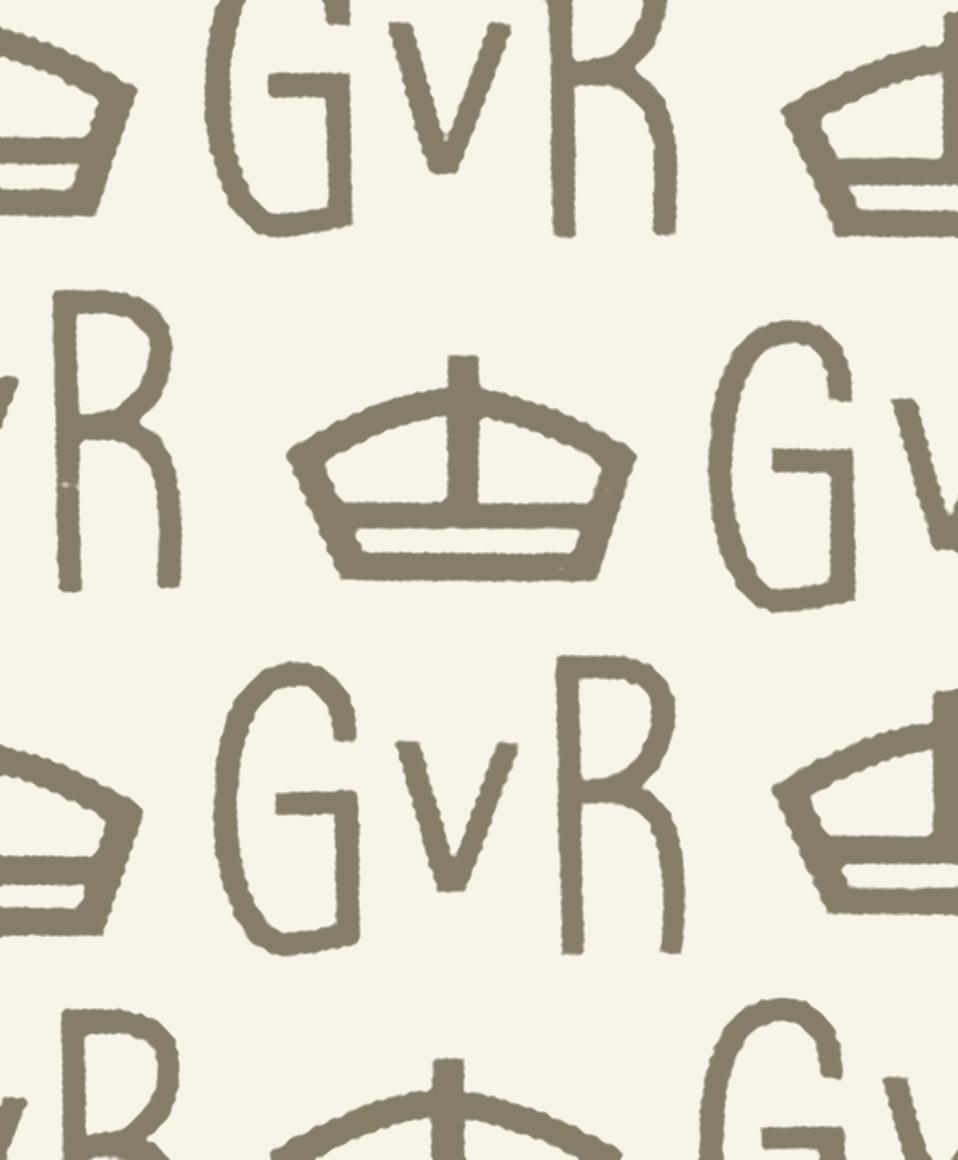
Image information
Block Cypher watermark, front view, upright
- Credit
- Stunning Stamps · 2026
- Notes
- Digitally reconstructed
Paper and the printed image
Paper is the material carrying the stamp’s design. Its structure, surface, colour and watermark are separate characteristics. Wove paper has a fairly even structure, unlike laid paper with its regular lines.
A paper description can distinguish stamps with otherwise similar designs. A coloured sheet supplies colour even in areas left untouched by the printing ink.
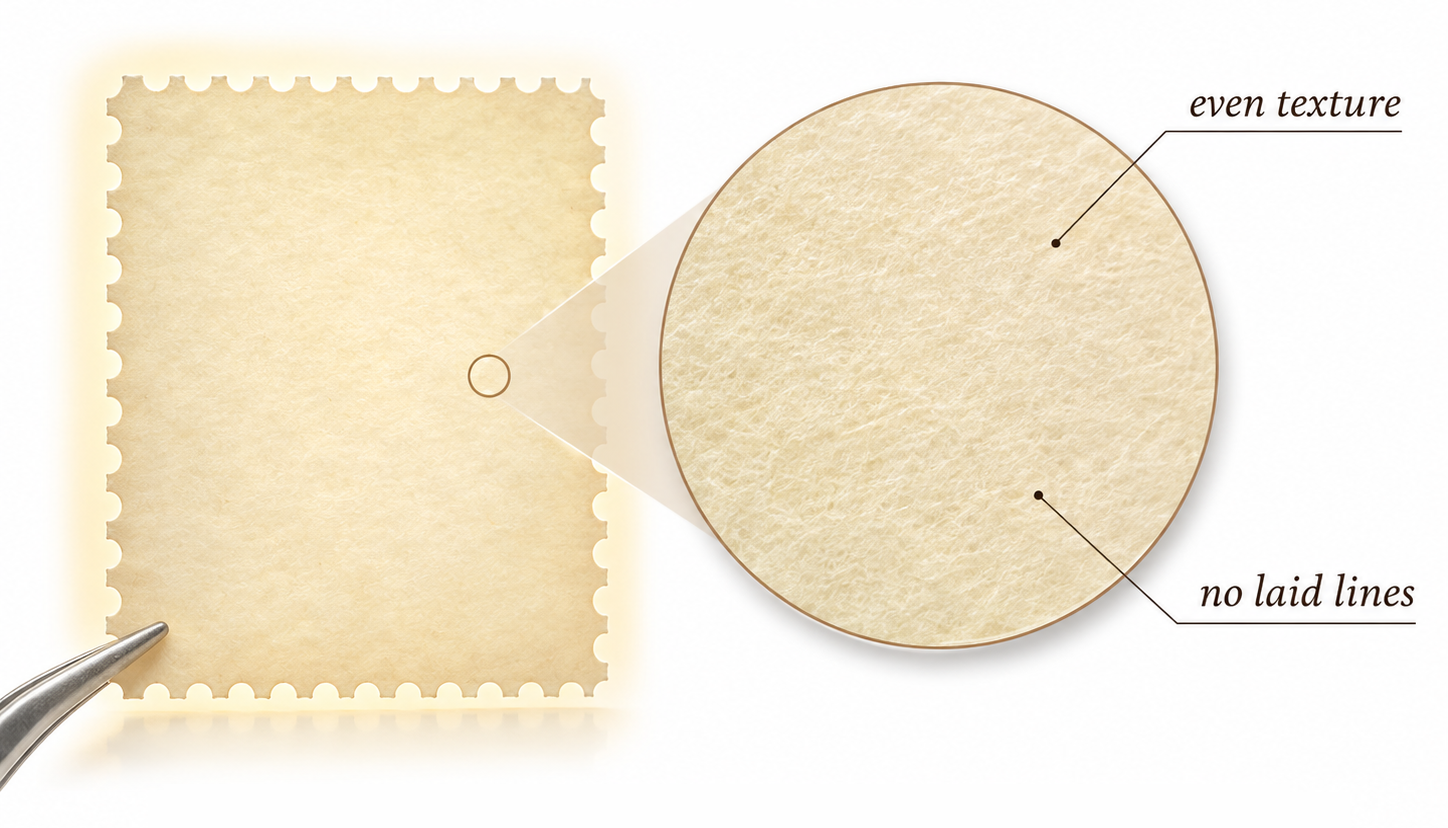
Image information
Click image to magnify
Diagram of wove paper with a magnified inset showing an even texture without laid lines.
- Credit
- Stunning Stamps · 2026
- Notes
- Digitally constructed
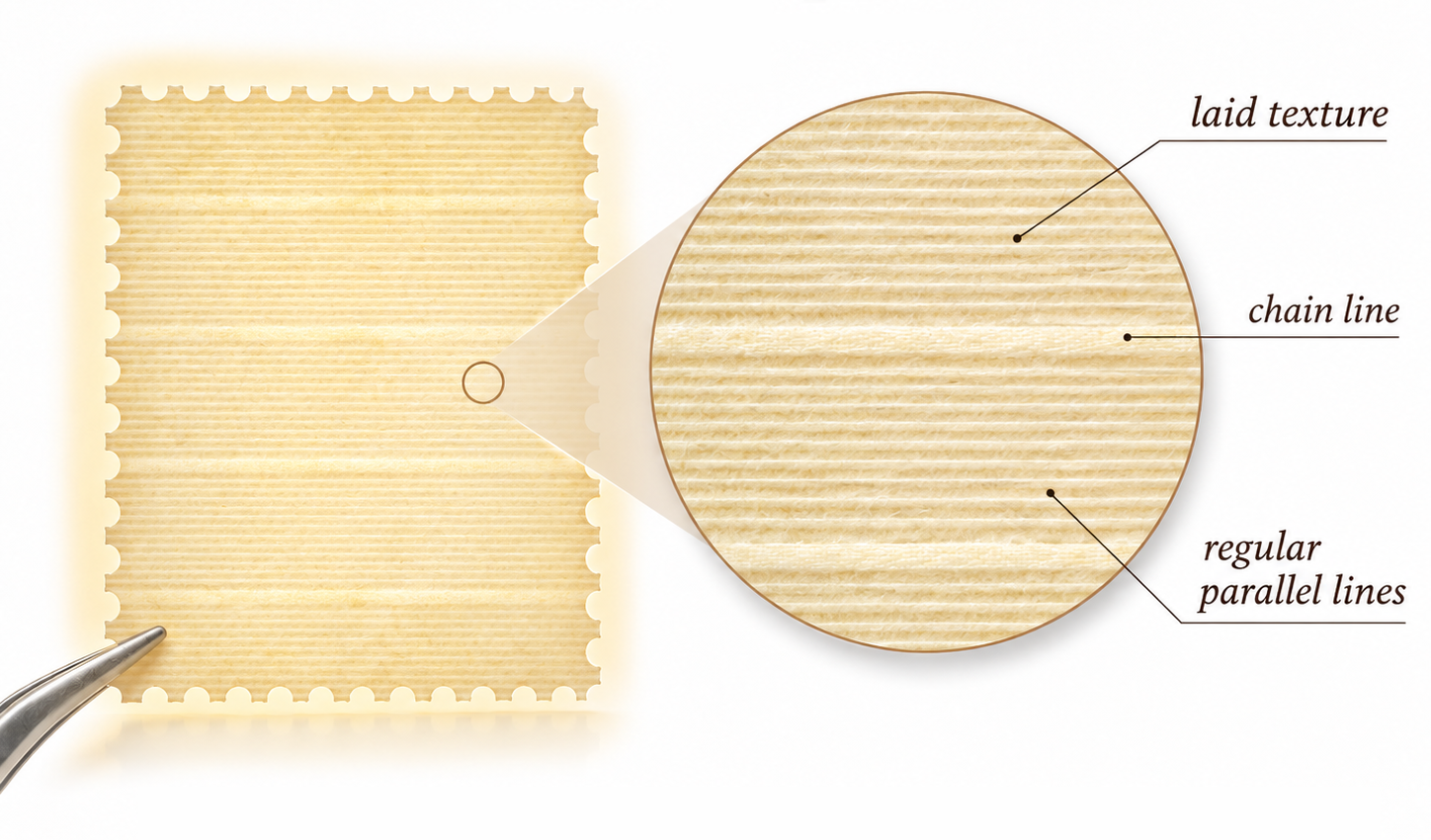
Image information
Click image to magnify
Diagram of laid paper with a magnified inset showing regular parallel lines.
- Credit
- Stunning Stamps · 2026
- Notes
- Digitally constructed
Cypher watermarks
A watermark is formed within the paper during manufacture. Differences in the paper let the pattern show when light passes through it. It is not a design printed on the back.
A royal cypher is a monogram identifying the monarch. George V’s cyphers use GvR. Simple Cypher (often called Royal Cypher) has small script cyphers in vertical strips; Multiple Cypher has an all-over arrangement. Single Cypher is the larger individual motif used for Seahorses. Block Cypher uses plain block lettering. These names are not interchangeable.
The illustration is shown from the front of the stamp. From the back, the letters of a normal watermark appear mirrored. That change of viewing direction is not itself a reversed-watermark variety.
Image information
Block Cypher watermark, front view, upright
- Credit
- Stunning Stamps · 2026
- Notes
- Digitally reconstructed
On this stamp
Block Cypher uses plain block letters in a repeating crown-and-GvR pattern. It differs from the script Royal Cypher paper of the earlier low values.
Reading a perforation gauge
Perforations are the punched holes that let stamps separate. The gauge describes their spacing over 2 centimetres, not the total number of holes along an edge.
Two numbers give the horizontal gauge first, then the vertical: top and bottom, followed by the two sides. A higher number means closer spacing. Match an actual stamp with a perforation gauge rather than measuring the image on a screen.
Image information
Horizontal gauge 15 and vertical gauge 14: the same 20 mm distance is used in each direction. Enlarged spacing diagram, not a ruler.
- Credit
- Stunning Stamps · 2026
On this stamp
15 × 14: gauge 15 across the top and bottom, gauge 14 down the sides. Check both directions when matching a catalogue listing.
Stamp shades
A shade is a variation within a stamp’s colour. Some variations receive their own catalogue numbers even though the design and denomination stay the same.
Compare known examples under consistent lighting. Fading can change a stamp’s appearance, and photographs or screens can alter how colours look. A catalogue colour name helps describe a shade; it is not a colour test by itself.
On this stamp
Scarlet is the colour description used for this 1d by Harrison & Sons. It identifies the represented issue; more specialised shade distinctions need comparison with known examples.
Overall size and printed design
Dimensions are given as width × height. Here the listed figures describe the overall stamp format. The printed design sits inside it and has a separate, smaller measurement.
These are nominal reference sizes. They are not measurements of the illustration on your screen, or a claim that every separated example has exactly the same outer edges.
Image information
Nominal overall format: 20.32 millimetres wide and 24.13 millimetres high. The printed design is a separate, smaller measurement.
- Credit
- Stunning Stamps · 2026
On this stamp
20.32 × 24.13 mm converts the documented overall format of 0.8 × 0.95 inches. These figures do not describe the small printed design: its width is about 17.9 mm. The decimal precision comes from the conversion.
Design formats
The early photogravure designs were reduced in size to leave more room for accurate perforating. The overall stamp format stayed the same. “Large”, “intermediate” and “small” therefore describe the printed image.
The 1d and 1½d occur in all three sizes. The ½d and 2d have intermediate and small designs. The remaining issued values use the small design. All the photogravure stamps illustrated in this archive represent the small format.
Image information
Three photogravure design widths inside an unchanged overall stamp format: large 18.7 mm, intermediate 18.4 mm, small 17.9 mm. Not every denomination has all three.
- Credit
- Stunning Stamps · 2026
On this stamp
Large, intermediate and small. The illustrated 1d is the small version, rather than every earlier format listed for that denomination.
Catalogue references
A stamp catalogue gives each listed issue a reference number. SG means Stanley Gibbons, the publisher of the catalogue used here. These numbers help collectors refer to the same issue; they are not serial numbers printed on individual stamps.
A range of numbers groups related entries. Colour, paper or perforation differences may account for separate listings within that range.
On this stamp
SG 440 is the general Stanley Gibbons reference for this photogravure 1d. Specialised descriptions may distinguish design sizes, shades and production varieties within the family.
Postal rates and other uses
The face value tells you how much postage a stamp represents. The charge for sending an item depended on its date, destination, weight and the service used. A denomination could serve several purposes or be combined with other stamps.
Registration was an additional service with its own fee. A stamp’s use on a document for a tax or duty is described as fiscal use, rather than payment for carrying a letter.
On this stamp
Inland postcard rate: 1d. The date, weight and service qualify this example of use; the stamp could also contribute to other charges.
The people behind the design
A stamp can combine work by several people: a portrait artist, frame designer, photographer or engraver. Their roles are identified separately here.
The people behind the design
Bertram Mackennal was an Australian-born sculptor whose royal portraits appeared on coins, medals and stamps. He also designed stamp frames and the Seahorse composition, joining portrait modelling to ornamental design.
On this stamp
This 1d scarlet stamp continues Mackennal’s royal profile and ornamental frame. Harrison & Sons adapted the established design for photogravure; this was not a new portrait commission.