
The design of the 2d orange
King George V · Great Britain · Harrison & Sons · 1912
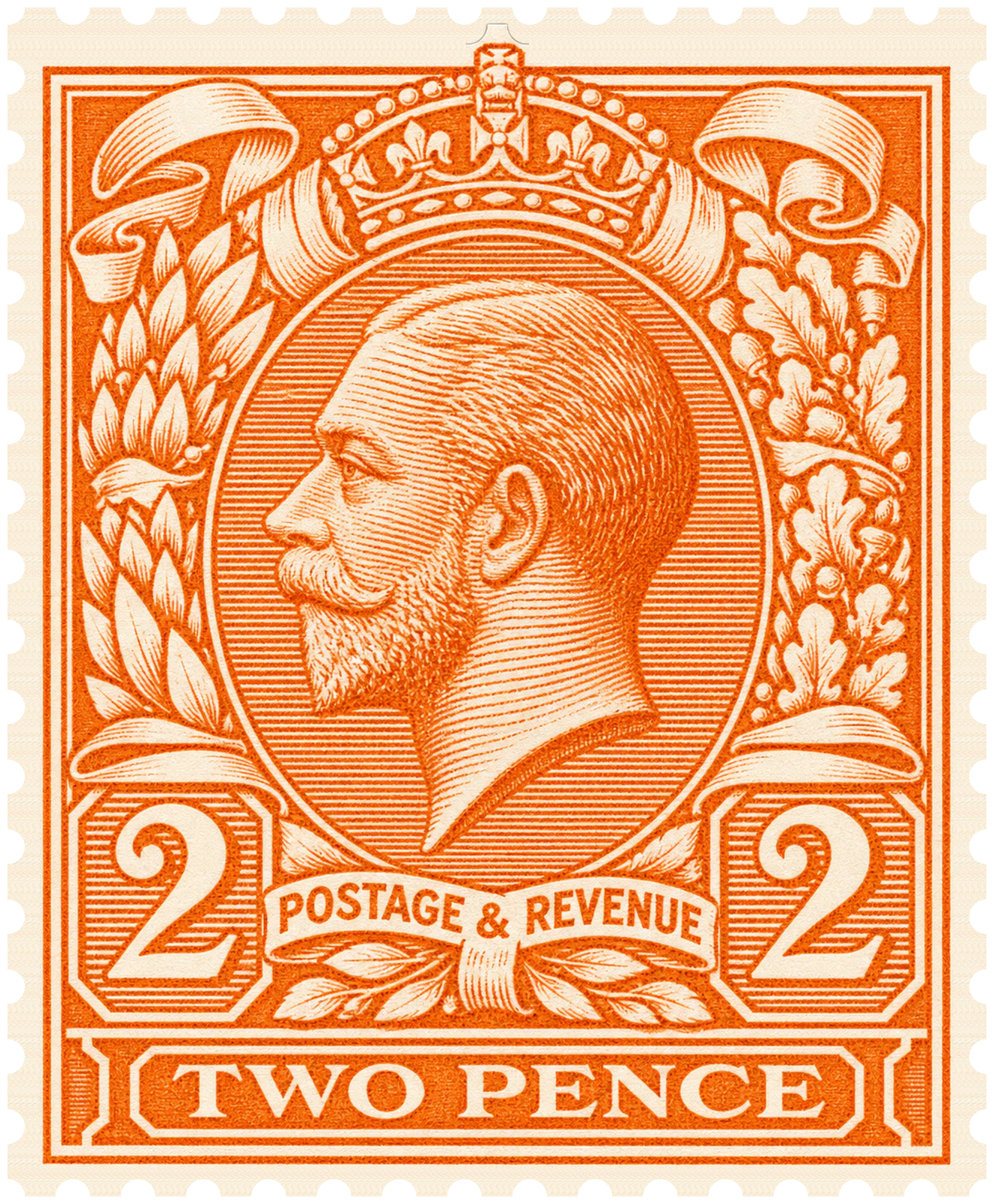
The first profile to reach the post office
The twopence introduced George V’s new profile-head definitives on 21 August 1912. It reached the post-office counter before the penny and threepenny, while other denominations were still being prepared. The first issued profile was therefore a twopenny stamp, rather than either of the two everyday values that had launched the Downey portrait. [1]
The basic inland letter charge rose to 2d on 1 June 1920. With more letters needing twopenny stamps, the printers required extra plates, but the old master die—the engraved tool used to reproduce the design—was no longer satisfactory. A new die was engraved in 1921 to keep production supplied. [1, 2]
Leaves, ribbons and the lower bow
Laurel rises along the left side of the portrait and oak along the right. Wide ribbons curl outwards at the top corners, then weave through the foliage. Their pale folds contrast with the smaller, more irregular leaves.
The branches meet beneath the portrait, where the ribbon carries POSTAGE and REVENUE before forming a central knot.
This is Mackennal’s wreath arrangement, used for the 2d, 3d and 4d. It is distinct from Eve’s Wreath frame on the higher low values. [1]
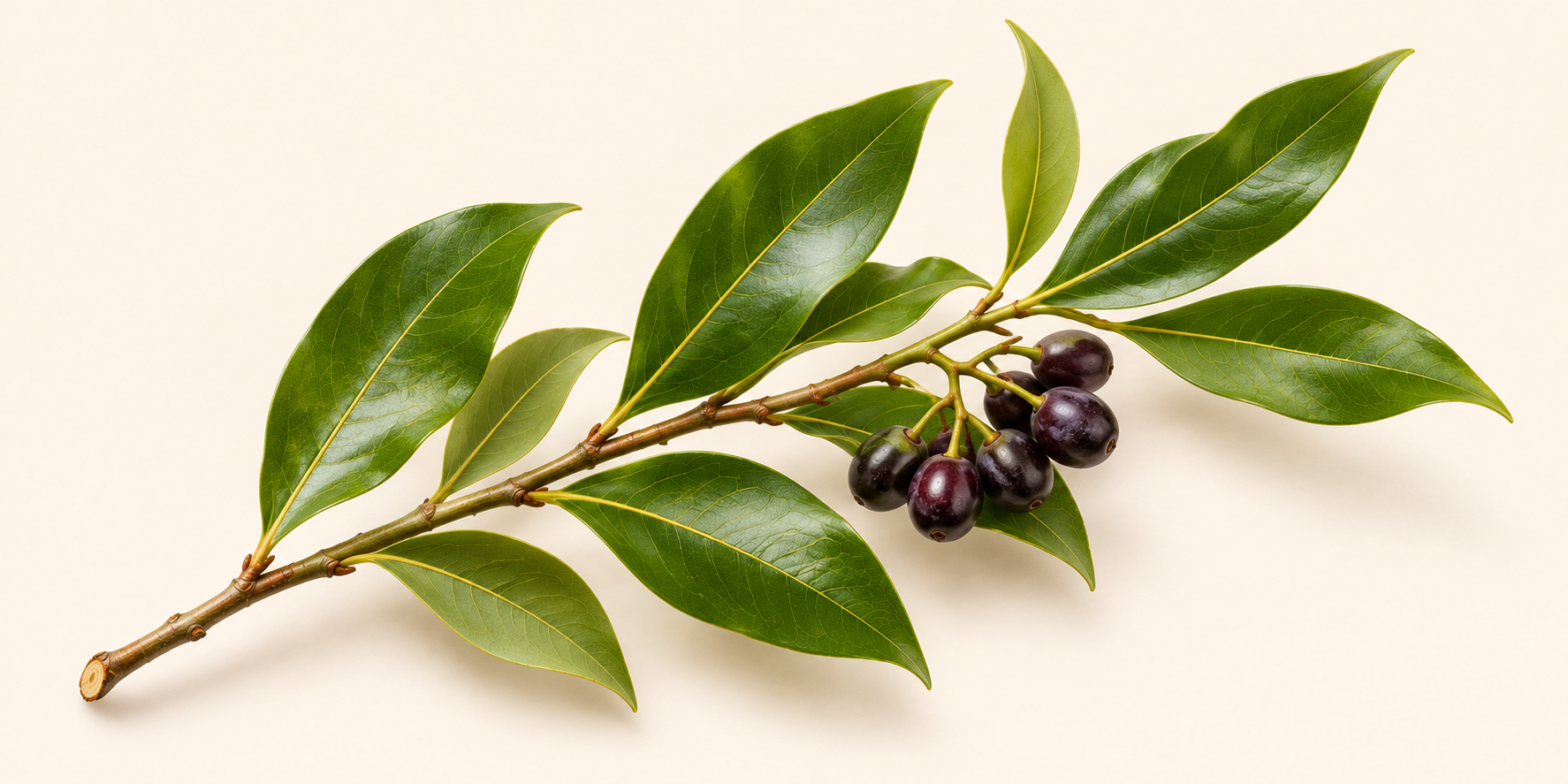
Image information
Click image to magnify
Illustration of a laurel branch with glossy pointed green leaves and dark berries.
- Credit
- Stunning Stamps · 2026
- Notes
- Digitally constructed
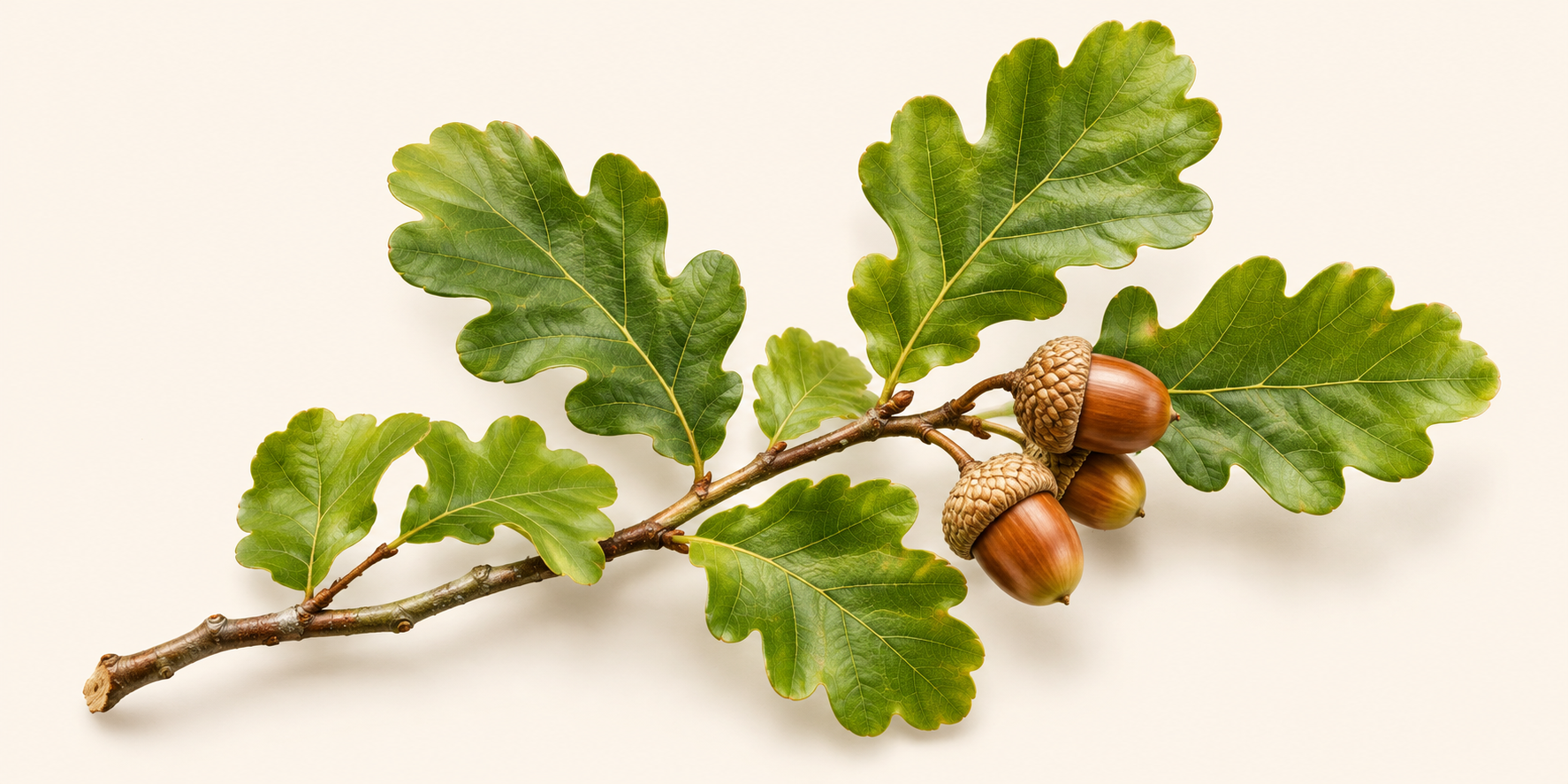
Image information
Click image to magnify
Illustration of an oak branch with green lobed leaves and brown acorns in textured cups.
- Credit
- Stunning Stamps · 2026
- Notes
- Digitally reconstructed
The portrait — the Coinage Head
George V’s first small stamps used a photograph by W. & D. Downey, showing his face turned towards the viewer. The printed likeness disappointed him and attracted public criticism. A profile offered a fresh start, but changing the head also meant reconsidering the frames around it. [1, 3]
This left-facing profile belongs to the version collectors call the Coinage Head. It was adapted from Bertram Mackennal’s model for George V’s coins, with the stamp engraving prepared by J. A. C. Harrison. [1]
Follow the profile from the forehead to the nose, moustache and pointed beard. The curved end of the neck recalls the sculpted model, while lines within the face describe light and shadow.
On the issued letterpress low values, the Coinage Head appears on the ½d, 1½d, 2d, 3d and 4d. The 1d and 2½d use the Medal Head, while the 5d to 1s use Medal Head II. These are three distinct stamp engravings, even though all show a bare head facing left. [1]
On the proposed penny, the new profile looked cramped above the lion. Mackennal replaced the lion with laurel and oak and used a portrait derived from his South African medal model, which the King preferred. That became the Medal Head of the penny and twopence-halfpenny. Eve’s later frames required another adjustment: Harrison engraved a smaller version of the medal portrait, called Medal Head II. The three heads record different solutions to the problem of fitting the King into a small stamp. [1]
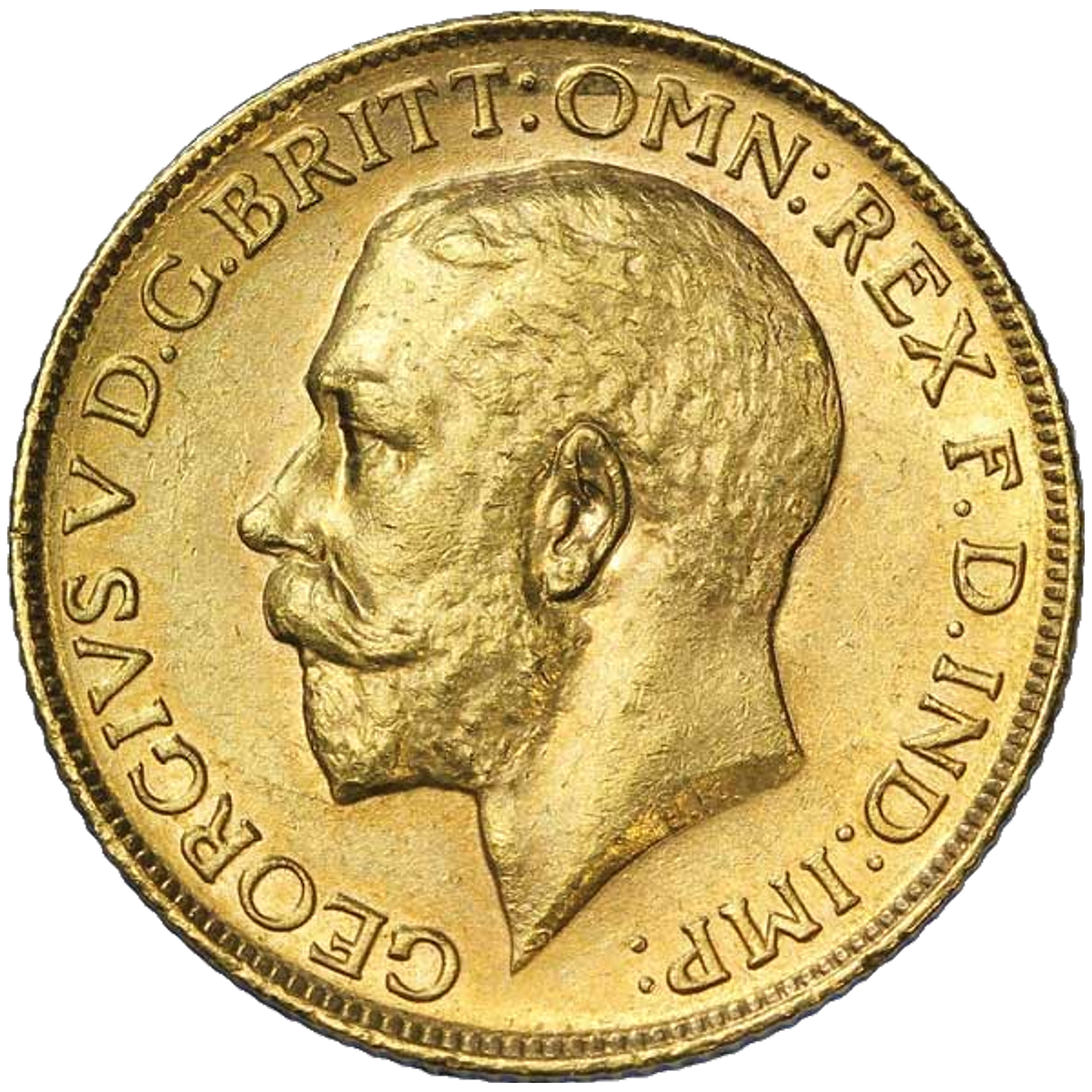
Image information
Click image to magnify
Gold sovereign showing George V’s bare head facing left, with the surrounding inscription and beaded rim.
- Credit
- cgb, via Wikimedia Commons. CC BY-SA 3.0.
- Notes
- Digitally reconstructed
Ink, paper and the printed image
The original dies were engraved, but these stamps were printed by typography, also called letterpress. Ink on the raised parts of a printing surface was pressed onto the paper. An engraved master does not mean the issued stamp was recess-printed. [4]
The width and spacing of printed marks create apparent tones. Closely worked hair and beard appear darker than the open background; unprinted paper supplies the highlights. This page represents the Harrison & Sons printing of the design. [4]
The orange ink sets the loops and leaves against a pale ground. Dense printing makes the deepest shadows; open passages keep the lettering and facial highlights clear.
Image information
Click image to magnify
Decorative blue, green and white advertisement for Mander Brothers printing inks, Wolverhampton.
- Credit
- Stunning Stamps · 2026
- Notes
- Digitally constructed
Lettering, value and arrangement
POSTAGE and REVENUE run along the tied ribbon below the portrait, between the two value numerals. The two words name the stamp’s postal and fiscal functions. Revenue use means paying a tax or duty on a document; it is separate from paying to carry a letter. [5]
Coloured letters stand on pale ribbons or bands, keeping the words legible among the ornament.
TWO PENCE fills the panel beneath the portrait. The matching numerals occupy the two lower corners just above it.
The figure 2 is repeated for quick recognition. The panel below spells out the value in old pence, rather than leaving it as a number alone.
The large ribbon loops carry the eye from the crown down through the foliage to the knot beneath the portrait. The repeated corner numerals interrupt those curves, making the value stand out. The separate word panel completes the design along the bottom.
Image information
Click image to magnify
Illustration of five red pillar boxes with royal cyphers.
- Credit
- Stunning Stamps · 2026
- Notes
- Digitally reconstructed
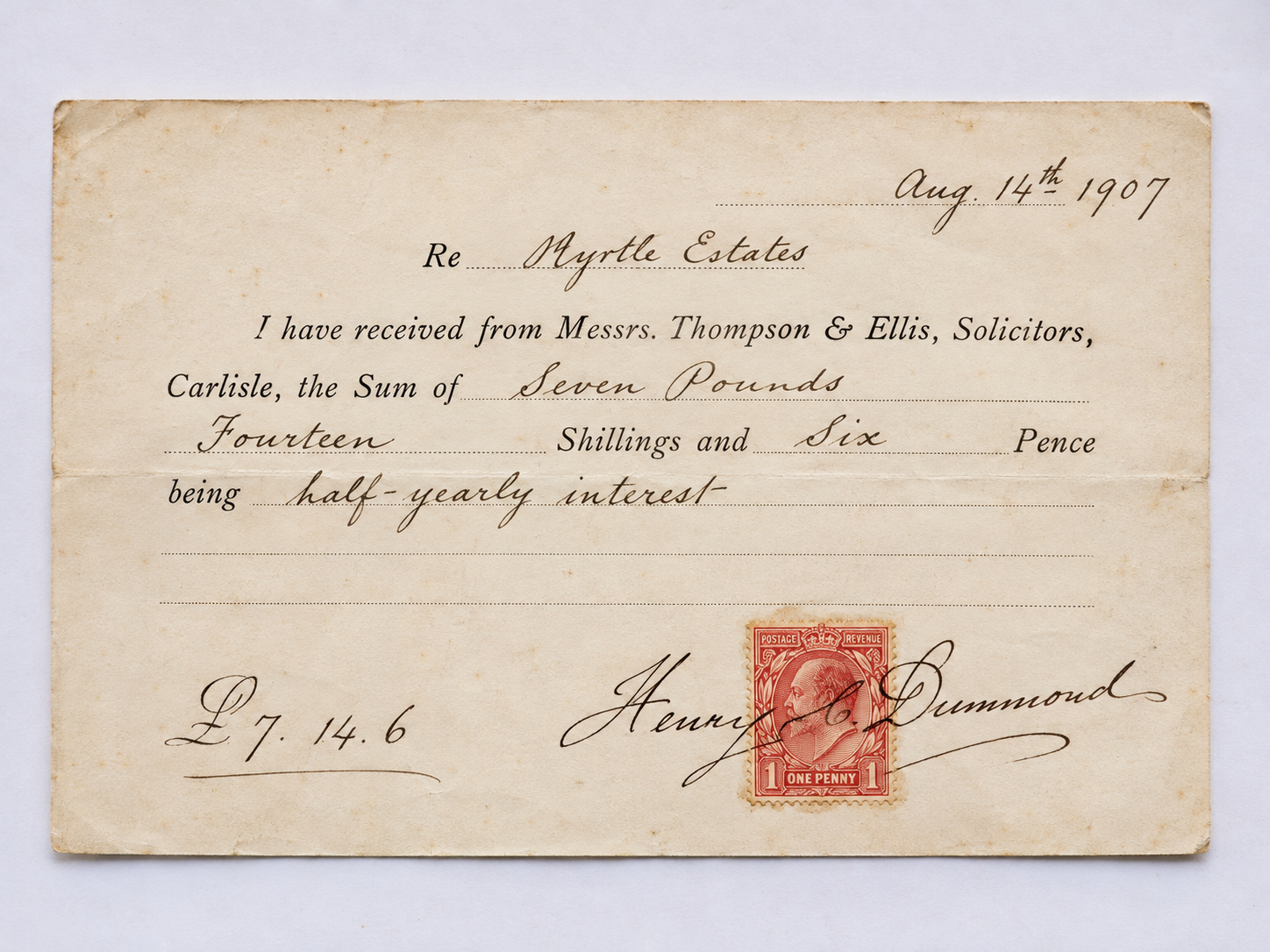
Image information
Click image to magnify
Illustration of a handwritten receipt with an Edward VII penny stamp cancelled by a signature.
- Credit
- Stunning Stamps · 2026
- Notes
- Digitally constructed
The crown above the head
A crown occupies the centre at the top. Rounded ornaments follow its arches above a patterned band, and a small cross completes the outline.
The crown sits in the frame above the King’s bare head. Large ribbon loops open outwards on either side, filling the top corners.
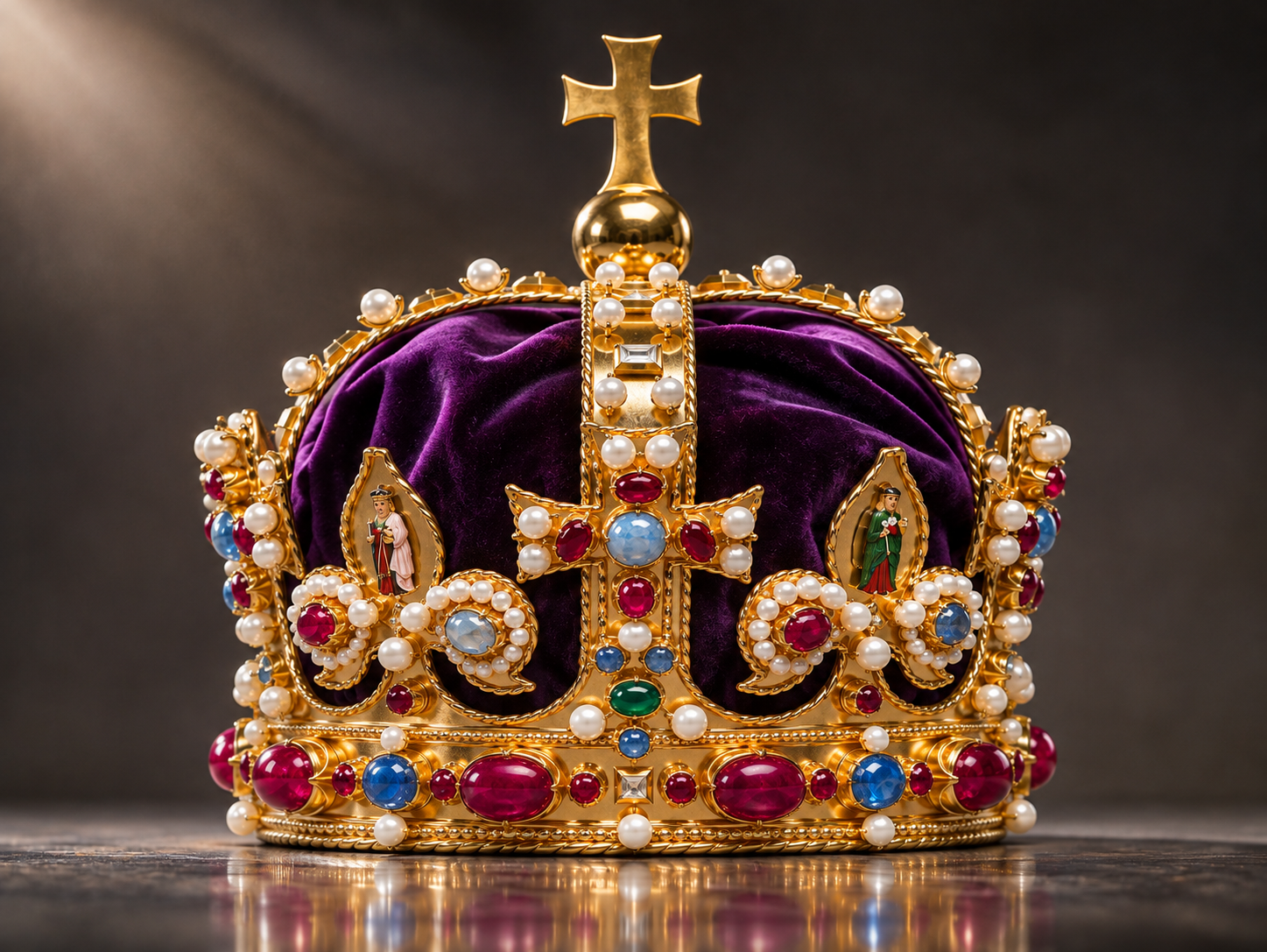
Image information
Click image to magnify
Gold Tudor royal crown with jewels, pearls, small figures and a purple cap.
- Credit
- Stunning Stamps · 2026
- Notes
- Digitally constructed
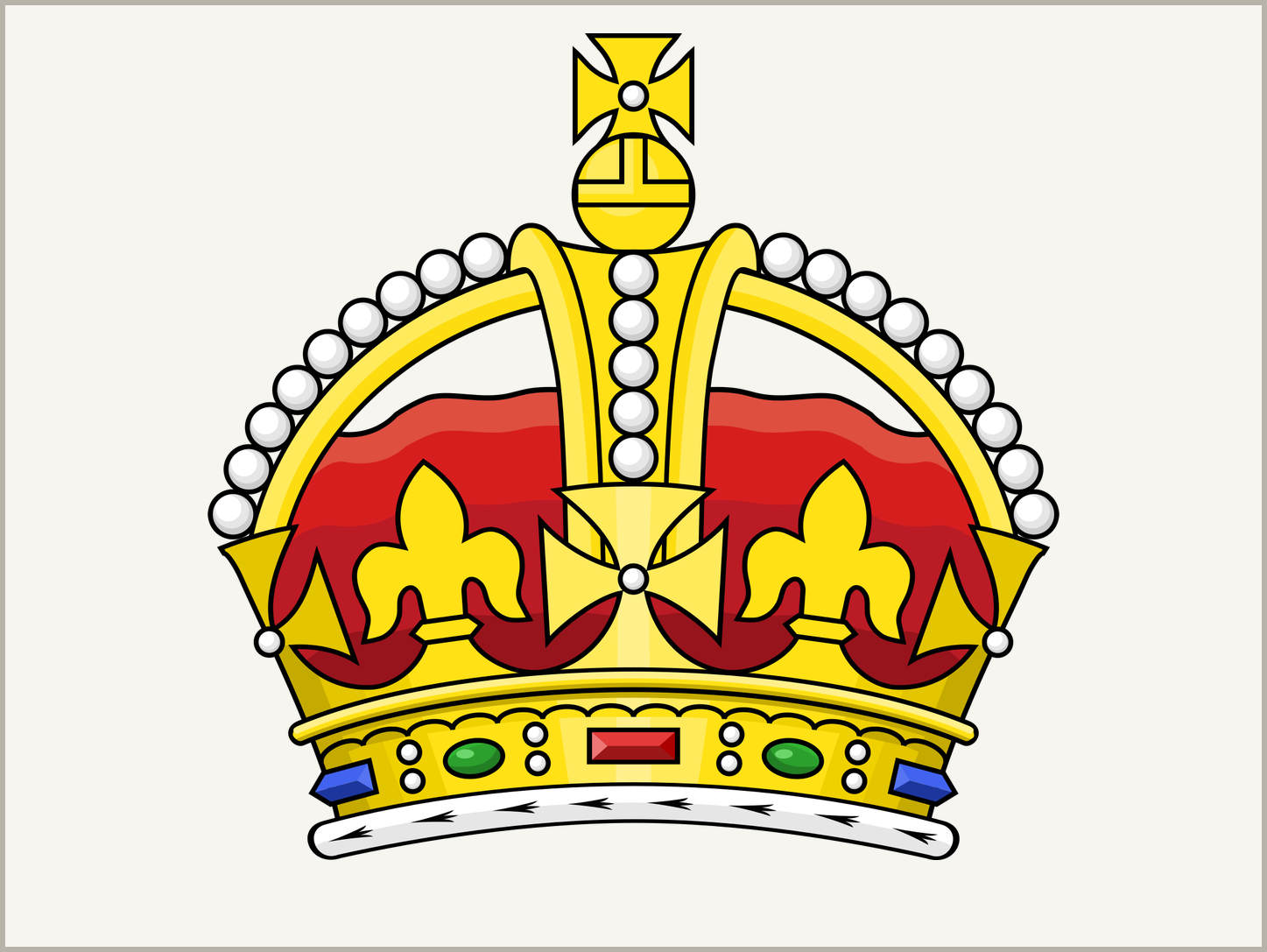
Image information
Click image to magnify
Heraldic Tudor Crown with rounded arches, a cross and orb, red cap, crosses and fleurs-de-lis.
- Credit
- Dgp4004 · Wikimedia Commons · CC0
The people and printer behind this stamp
Bertram Mackennal supplied the royal portrait model and ornamental frame; J. A. C. Harrison prepared the stamp engraving. [6, 7]
Harrison & Sons printed this 2d by typography. This belongs to the Royal Cypher letterpress issue. [6, 7, 8]
Sources
- Alan N. Moorcroft, The King's Head, RPSL display, 25 February 2010
- Great Britain Philatelic Society: inland letter rates, 1840–1968
- Charles Goodwyn, Great Britain – King George V, Royal Philatelic Collection display, 17 September 1998
- Adrian Keppel, The Four Kings, British Philatelic Bulletin 49, February 2012, pp.148–151
- The Postal Museum: British Empire Exhibition stamp history, p.16 — postage stamps and receipt duty
- Buckinghamshire Council: Harrison & Sons printworks
- Royal Philatelic Society London: The King’s Head, 2010
- Adrian Keppel, The Four Kings, British Philatelic Bulletin 49, February 2012, pp.148–151
← Return to the 2d orange stamp
Last reviewed · Facts checked