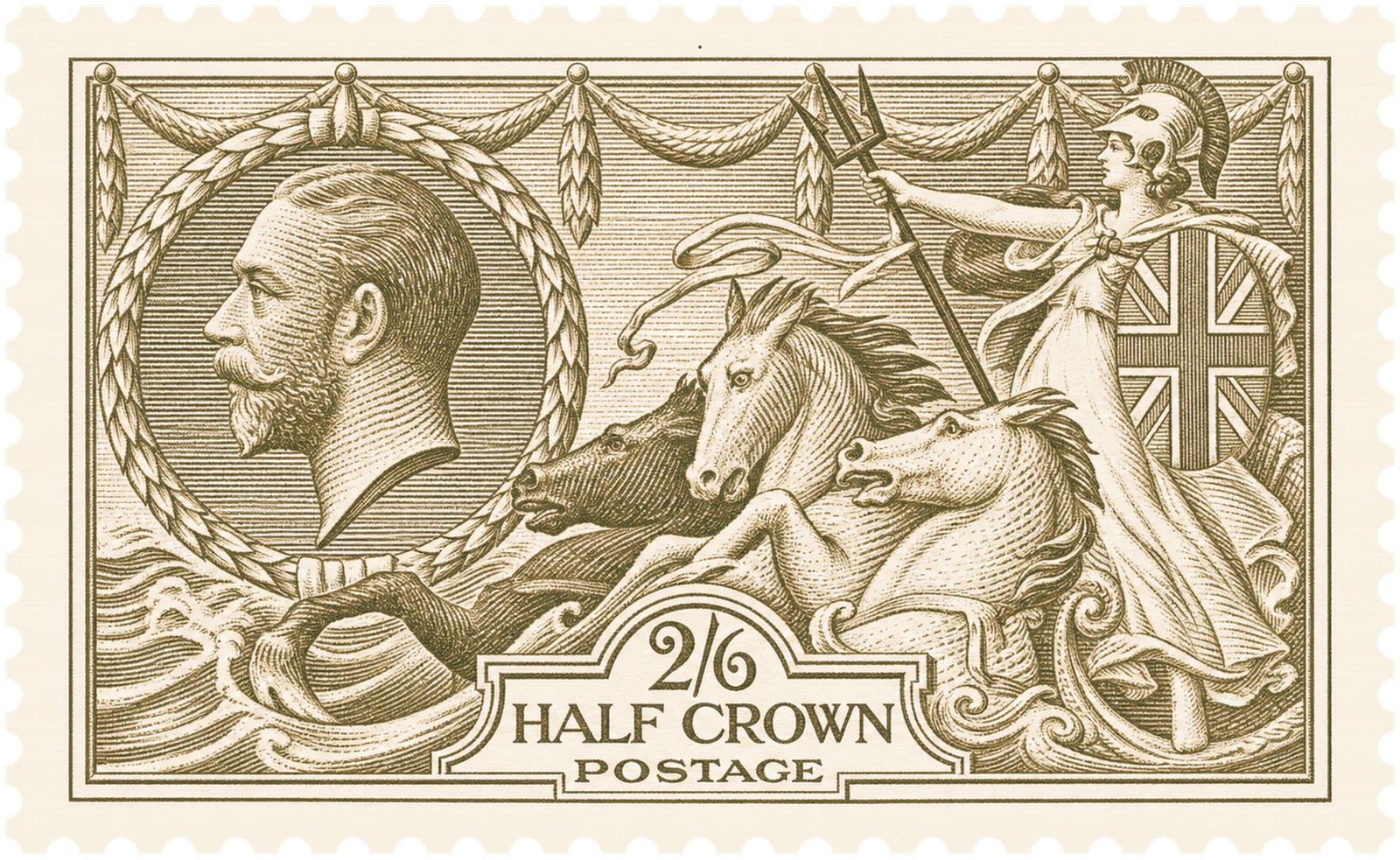
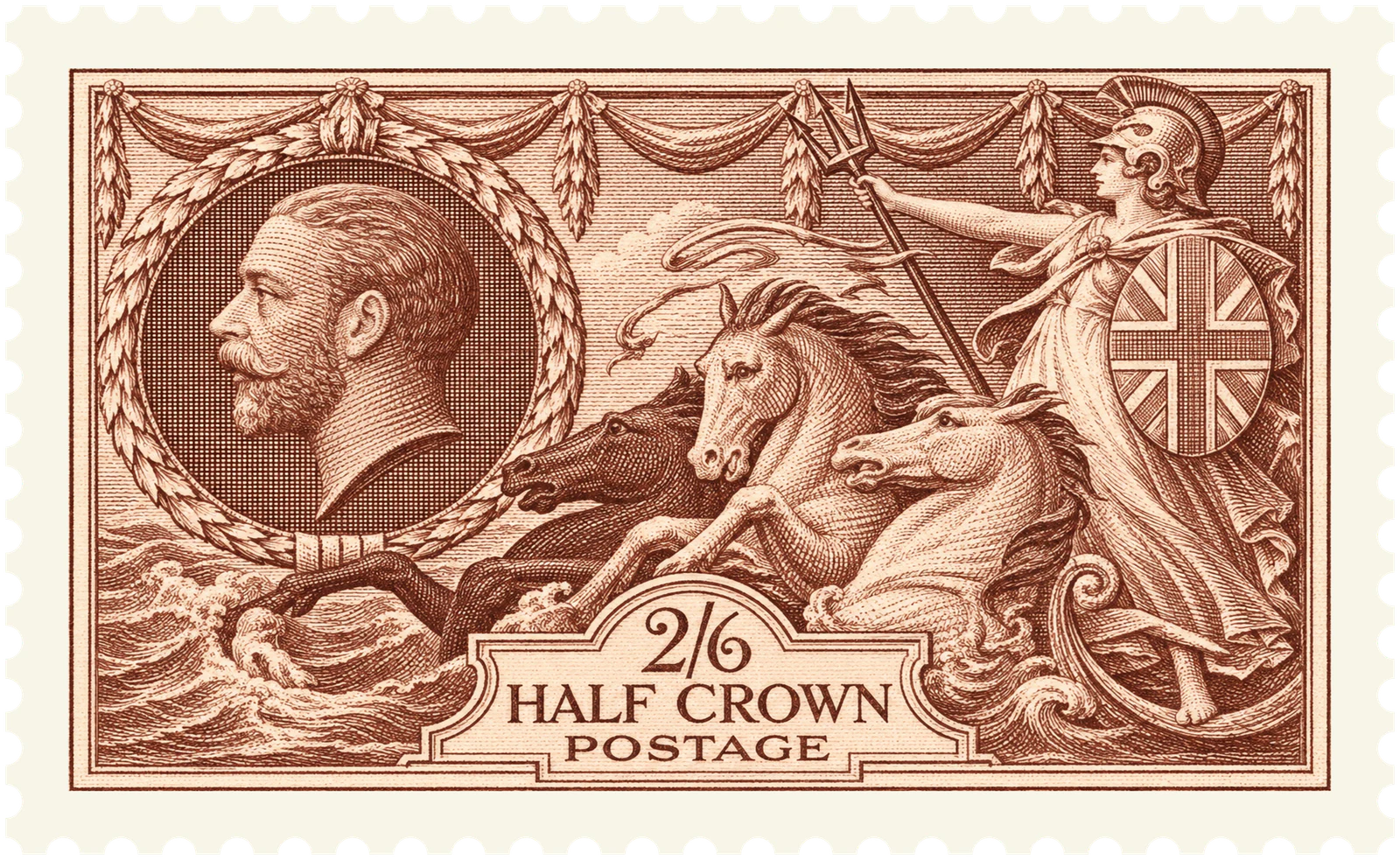
Bradbury Wilkinson needed curved printing plates for its Seahorses. When the firm took over production in 1918, the familiar portrait and sea scene had to be transferred to equipment suited to its press. This half-crown began that new stage in the design’s working life. [1, 2]
Stories
A familiar design on curved plates
A familiar design on curved plates
When Bradbury Wilkinson took over the Seahorses in 1918, its press required curved printing plates. The Royal Mint lent dies from which roller punches could be made. These tools transferred the established design into the new plates. [1]
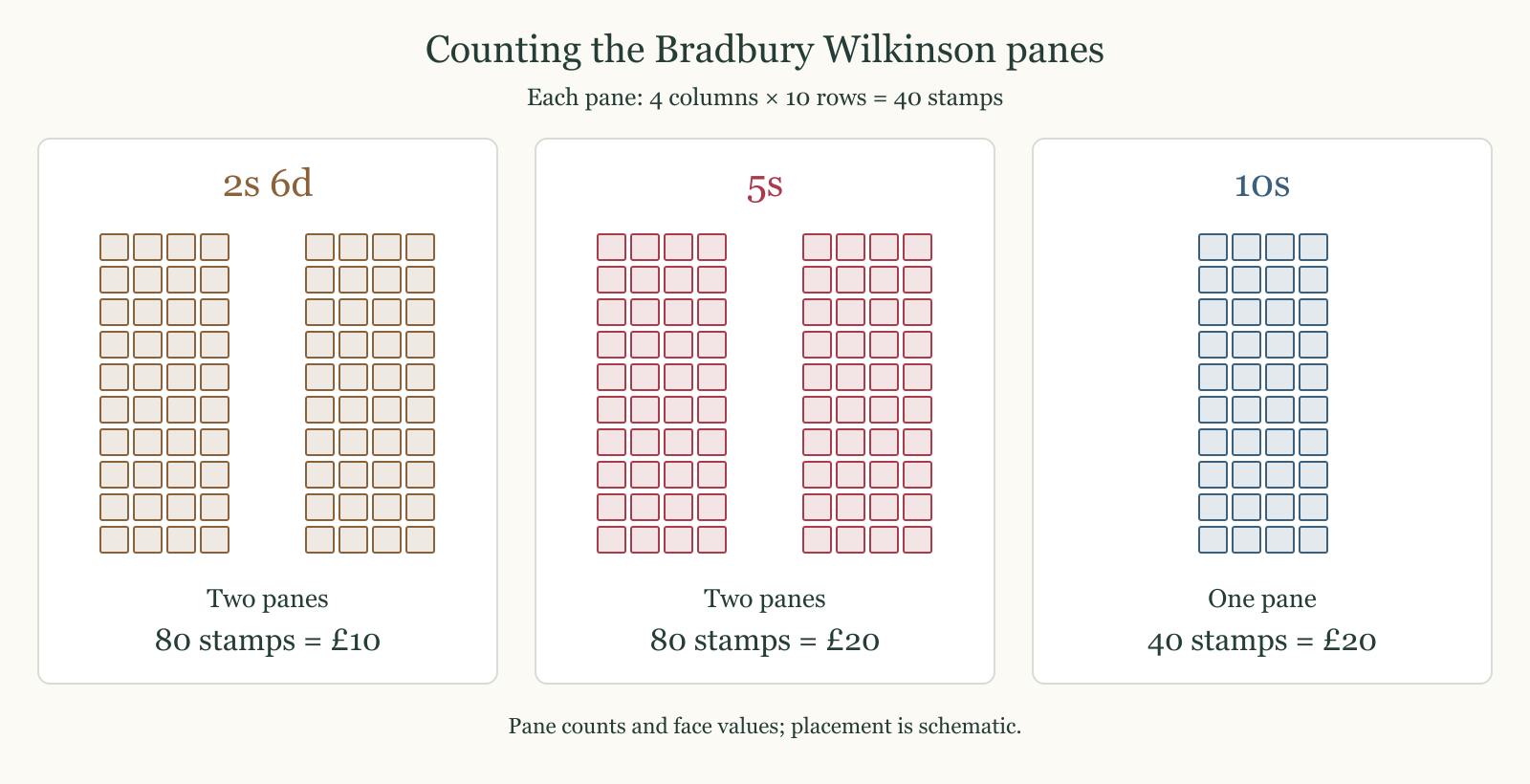
The half-crown and five-shilling were printed using two curved plates, producing two panes of forty stamps. The ten-shilling used one plate. The picture remained recognisable even though the machinery carrying it had changed. [2]
A half-crown was thirty old pence, or an eighth of a pound. Eighty half-crowns therefore represented £10. The later five-shilling and ten-shilling arrangements each represented £20, despite containing different numbers of stamps. [2]
The pane arrangements and their face values.Image information
Click image to magnify
Diagram showing two panes of forty half-crowns worth £10, two panes of forty five-shilling stamps worth £20, and one pane of forty ten-shilling stamps worth £20.
Credit
Stunning Stamps · 2026
Notes
Digitally constructed schematic from Barry Cousins’s account. Cells represent stamps; pane placement is schematic, not a reconstruction of sheet margins.
Seahorses in Irish postal use
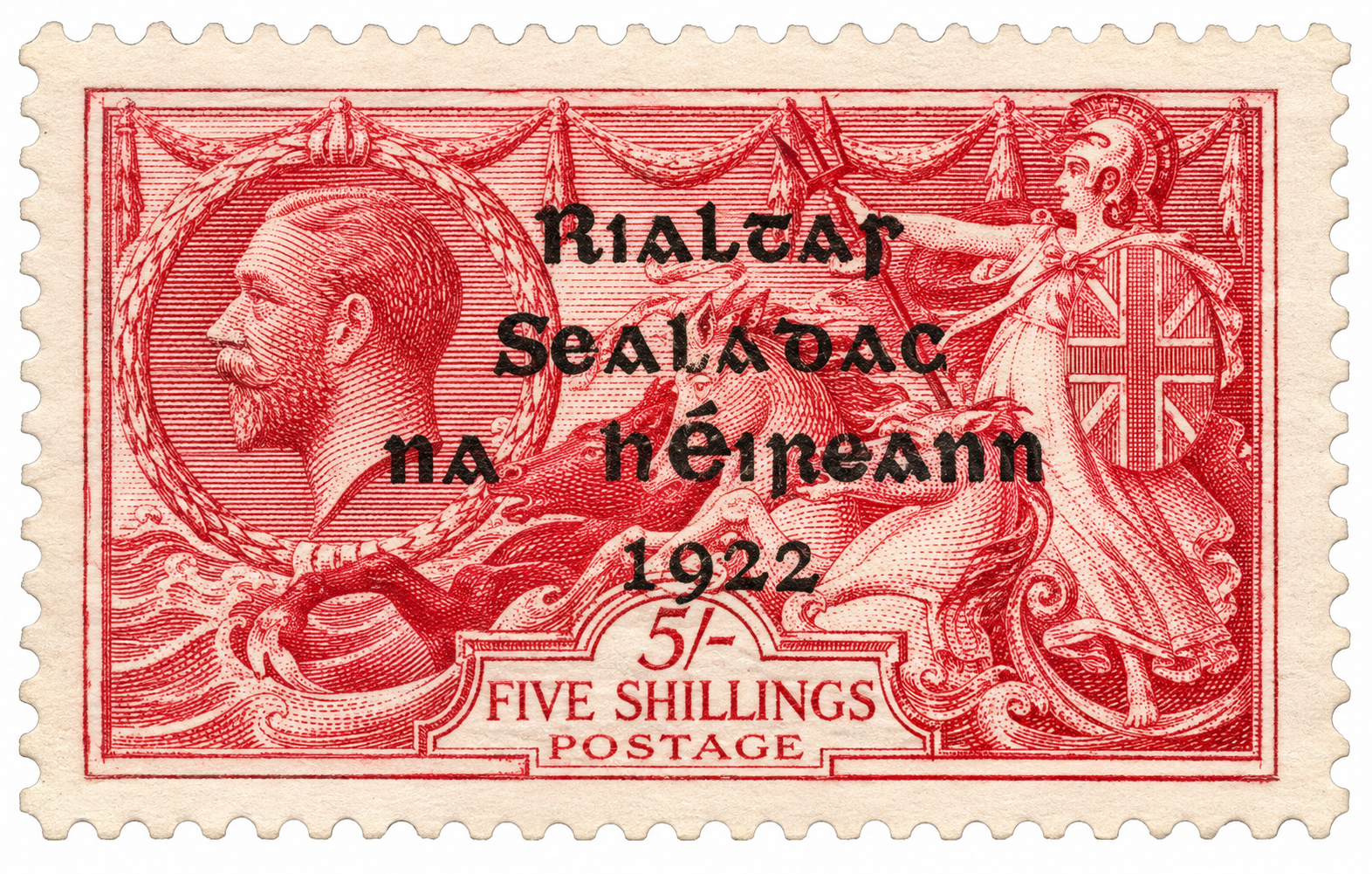
The half-crown, five-shilling and ten-shilling were all overprinted for Ireland. The first high-value issue of February 1922 named the Irish Provisional Government; later that year the wording changed to identify the Irish Free State. The British picture remained beneath the added inscription. [2, 8]
The overprinted high values had a practical role beyond ordinary letters. In Irish use, the half-crown and five-shilling helped pay for air-mail packets, parcels and customs dues, while the ten-shilling served for telegraph fees. [2]
1922 · Five-shilling adapted for the Irish Provisional Government.Image information
Click image to magnify
Red five-shilling Bradbury Wilkinson Seahorse with four lines of black Irish overprint and the date 1922.
Credit
Digital reconstruction by Stunning Stamps, after the example illustrated by the GB Overprints Society.
Notes
Digitally reconstructed. Illustrates the wording and placement of the overprint; fine printing details are interpretive. The printed date 1922 is retained on the 1935 issue.
Britannia rules the waves
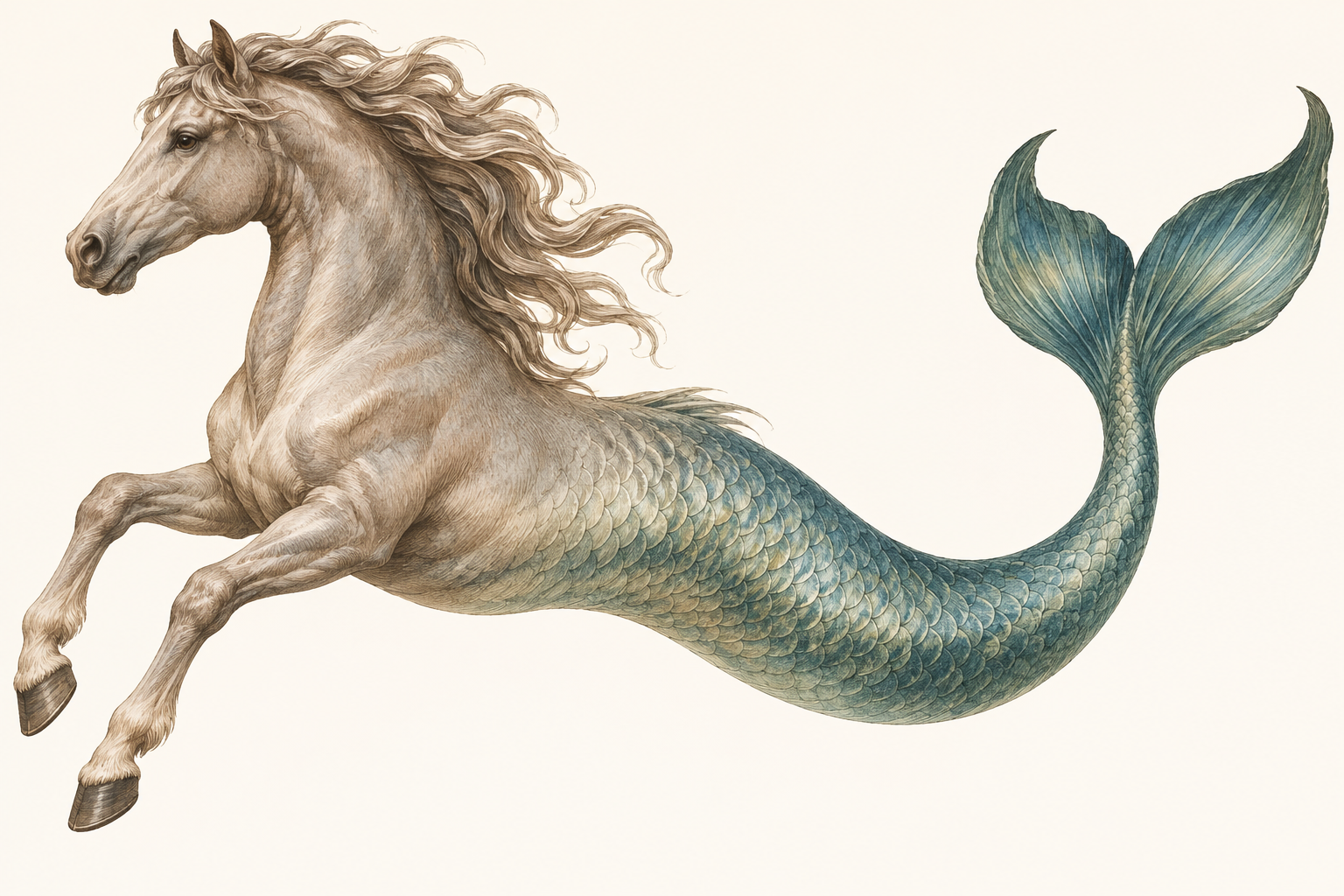
The three animals drawing Britannia’s chariot are ordinary horses moving through the sea. They differ from the hippocamps of classical art: creatures with a horse’s forequarters and a fish’s tail, often shown drawing the sea god Neptune’s chariot. Royal Mail’s account of the stamps specifically describes the team as horses. [9, 10]
Here Britannia, the helmeted figure representing Britain, directs the chariot. With her trident and shield, she turns a scene from maritime mythology into an allegory of national power. Familiar land animals carrying her through the waves make that imagined command of the sea particularly striking. [11]
The original design appeared in 1913, after years of naval competition between Britain and Germany. Both countries had invested in powerful new battle fleets. That rivalry gives the image of Britannia ruling the waves a contemporary political resonance, although it does not establish that the stamp was commissioned specifically in response to Germany. [12, 11]
An imagined classical hippocamp: a horse’s forequarters joined to a fish’s tail.Image information
Click image to magnify
Watercolour-style illustration of a mythical creature with a horse’s head and two forelegs, ending in a long blue-green fish tail.
Credit
Stunning Stamps · 2026
Notes
Digitally constructed. An illustration of a mythological creature, not a copy of a historical object.
A design that passed between printers
The Seahorses had a separate printing contract from Britain’s smaller everyday definitives. Waterlow Bros & Layton made the original issue in 1913. De La Rue took over in 1915, followed by Bradbury Wilkinson in 1918. Waterlow & Sons, following its 1920 merger with Waterlow Bros & Layton, printed the re-engraved issue of 1934. [13, 1, 6, 14]
The scene stayed recognisable as production moved between workshops. The quality of the impression and the perforated edges help distinguish the earlier printings. The 1934 revision is easier to spot: crossing lines behind the King replace the original horizontal shading. [13, 6]
Compare the horizontal shading with the crossed lines behind the King in the 1934 engraving.
Click either stamp to magnify
Why do some stories appear on several pages?
Every page is written to make sense on its own. Visitors often arrive directly at a particular stamp or subject, without having explored the rest of the site.
Some stories are relevant to several stamps, so they are repeated where they help explain what you're looking at. For those exploring a series, the details specific to each stamp generally come first, with the more familiar stories further down the page.
This way, you can explore the site in any order without missing interesting background.
Bradbury Wilkinson transferred an established engraving onto curved printing plates. Its new press changed the way the Seahorses were made while retaining the familiar composition. [2, 1, 15]
Explore that production story and the older artistic sources behind Britannia’s chariot. [2, 1, 15]
An issue date records when a stamp became available for use. A design can remain in production for years, with changes of printer, colour, paper or perforation along the way.
“Denomination introduced” refers to the first appearance of that value in the issue family. The particular printing or design format illustrated may be later. Read the date with the rest of the description.
The printer manufactured the stamps. The designer planned their appearance, and the engraver prepared the original image for reproduction. These are separate jobs, even when the same person or firm undertook more than one.
George V designs passed between firms and the government’s stamp-printing department. A portrait or colour alone may not identify the printing; paper, marginal marks and details of the impression can supply further evidence.
The Royal Cypher low values were printed from raised surfaces by typography. The Seahorses used recess printing, with ink held in engraved lines. The later photogravure issue used a cylinder carrying a fine pattern of ink-bearing cells.
The process describes how ink reached the paper. It is separate from the name of the printer and the way the original artwork was designed.
A shade is a variation within a stamp’s colour. Some variations receive their own catalogue numbers even though the design and denomination stay the same.
Compare known examples under consistent lighting. Fading can change a stamp’s appearance, and photographs or screens can alter how colours look. A catalogue colour name helps describe a shade; it is not a colour test by itself.
A stamp catalogue gives each listed issue a reference number. SG means Stanley Gibbons, the publisher of the catalogue used here. These numbers help collectors refer to the same issue; they are not serial numbers printed on individual stamps.
A range of numbers groups related entries. Colour, paper or perforation differences may account for separate listings within that range.
Perforations are the punched holes that let stamps separate. The gauge describes their spacing over 2 centimetres, not the total number of holes along an edge.
Two numbers give the horizontal gauge first, then the vertical: top and bottom, followed by the two sides. A higher number means closer spacing. Match an actual stamp with a perforation gauge rather than measuring the image on a screen.
Illustrative spacing, not a measuring gauge. The number describes spacing over 2 cm, not the total holes along an edge.Image information
Horizontal gauge 11 and vertical gauge 12: the same 20 mm distance is used in each direction. Enlarged spacing diagram, not a ruler.
Dimensions are given as width × height. Here the listed figures describe the overall stamp format. The printed design sits inside it and has a separate, smaller measurement.
These are nominal reference sizes. They are not measurements of the illustration on your screen, or a claim that every separated example has exactly the same outer edges.
Nominal reference format, enlarged. The inner rectangle explains the separate printed area; its size is illustrative.Image information
Nominal overall format: 44 millimetres wide and 28 millimetres high. The printed design is a separate, smaller measurement.
Credit
Stunning Stamps · 2026
An issue date records when a stamp became available for use. A design can remain in production for years, with changes of printer, colour, paper or perforation along the way.
“Denomination introduced” refers to the first appearance of that value in the issue family. The particular printing or design format illustrated may be later. Read the date with the rest of the description.
On this stamp
1918 is the date listed for this 2s 6d printing by Bradbury Wilkinson & Co.. Other printers’ versions of the same value have their own issue dates.
The denomination is the stamp’s face value: the amount of postage it represents. Its price to a collector can be quite different.
In Britain’s old currency, 12 pence made one shilling and 20 shillings made one pound: 240 pence altogether. The abbreviations were d for pence, s for shillings and £ for pounds. The d comes from the Latin denarius. A halfpenny, written ½d, was half an old penny.
On this stamp
2s 6d represented 30 old pence: two shillings and sixpence.
Bradbury Wilkinson produced banknotes, stamps and other security documents. It was one of the successive printers of George V’s Seahorses. Its large works at New Malden became a major local employer.
On this stamp
Bradbury Wilkinson & Co. produced this 2s 6d by recess printing. The same broad design also appears in other printers’ issues; compare the documented printing features.
In recess printing, ink lies in lines cut below the surface of the printing plate. Surplus ink is wiped from the surface. Pressure brings the paper into contact with the ink in the grooves.
The Seahorses are line-engraved stamps printed by this method. Closely spaced engraved lines build up the portrait, waves and other shaded parts of the design.
Enlarged cross-section. Engraved lines hold the ink; the surrounding surface is wiped clean before printing.Image information
Side view of recess printing: ink remains in grooves below the plate surface and pressure brings paper into contact with it.
The engraver translated artwork into the detailed original from which printing surfaces could be made. A die is a master image, not a complete sheet of stamps.
J. A. C. Harrison was an individual engraver. He should not be confused with Harrison & Sons, the printing firm. Later firms could print a design descended from his original die.
A die is the original image used in making printing plates. A replacement or revised die can introduce small, repeatable differences in the design. Collectors distinguish these as die versions.
Die I and Die II identify stages of a design. They are different from a shade, a paper variety or damage on one used stamp. Compare the recorded features together before assigning a version.
A feature that recurs at the same position can help identify a printing plate or a stage in its use. A temporary blemish, weak impression or later damage is a different matter.
Specialist descriptions give the detail to inspect and, where known, its position. A named variety applies to the documented examples; it is not necessarily present on every stamp of that denomination.
A printing sheet may contain several groups of stamps, called panes. Unprinted gaps between panes are gutters; the outer paper margin is also called selvedge.
The sheet supplied to a post office may be smaller than the sheet used for printing. Keep those two counts separate. Row and column counts explain how many stamps belong to each pane.
Sheet, panes and margins: a simplified example.Image information
A schematic printing sheet contains two panes separated by an unprinted gutter and surrounded by a margin.
Typography uses a raised printing surface. Ink is applied to the high parts, which touch the paper under pressure. Lower spaces leave the paper unprinted.
The Royal Cypher low values use this process. The original design could be engraved when its master die was prepared, even though the issued stamps were printed by letterpress.
Surface printing, shown from the side. The paper is pressed onto the inked surface.Image information
Side view of surface printing. Paper is pressed down onto ink on the raised parts of a printing plate; the lower spaces do not touch the paper.
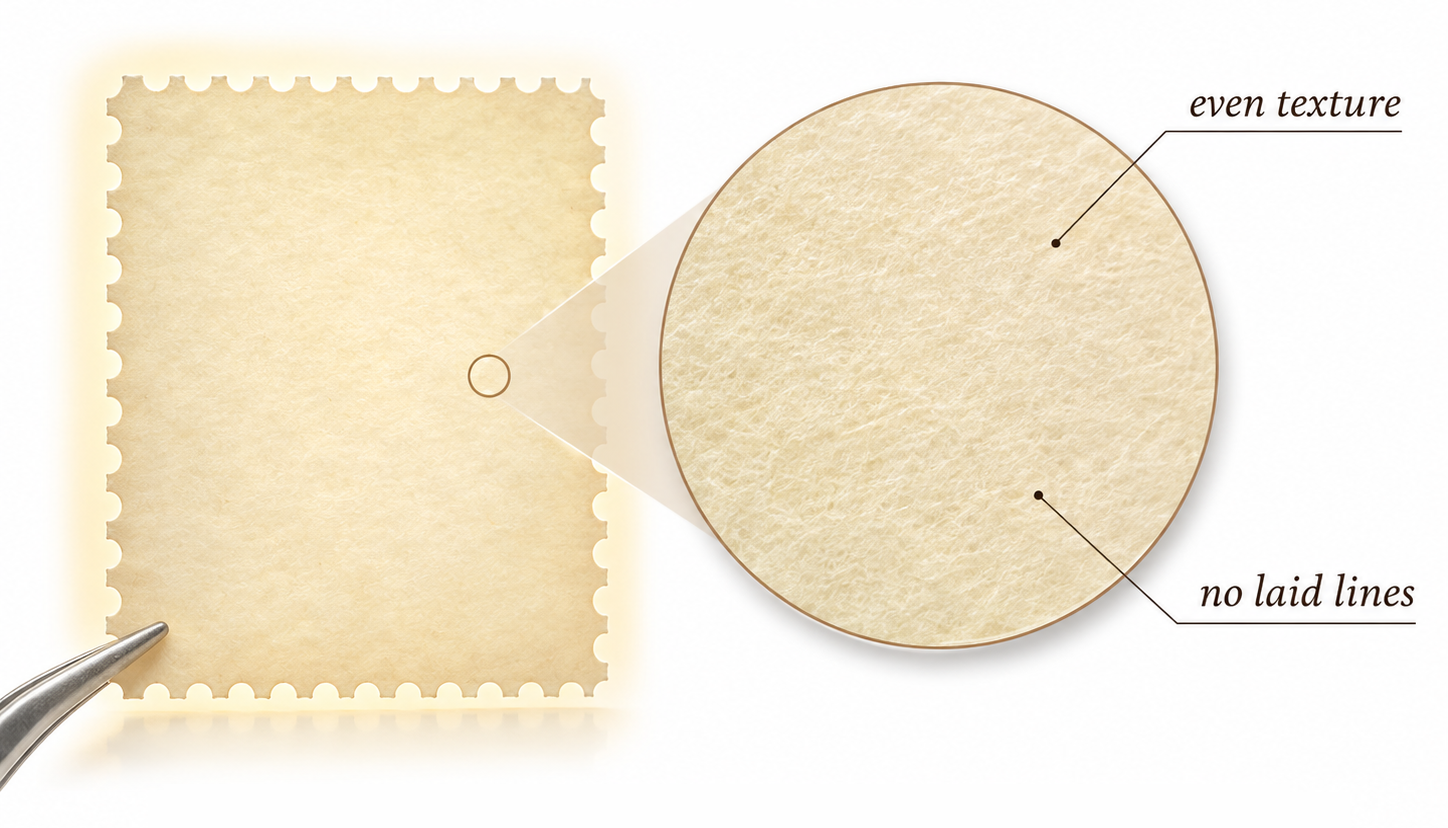
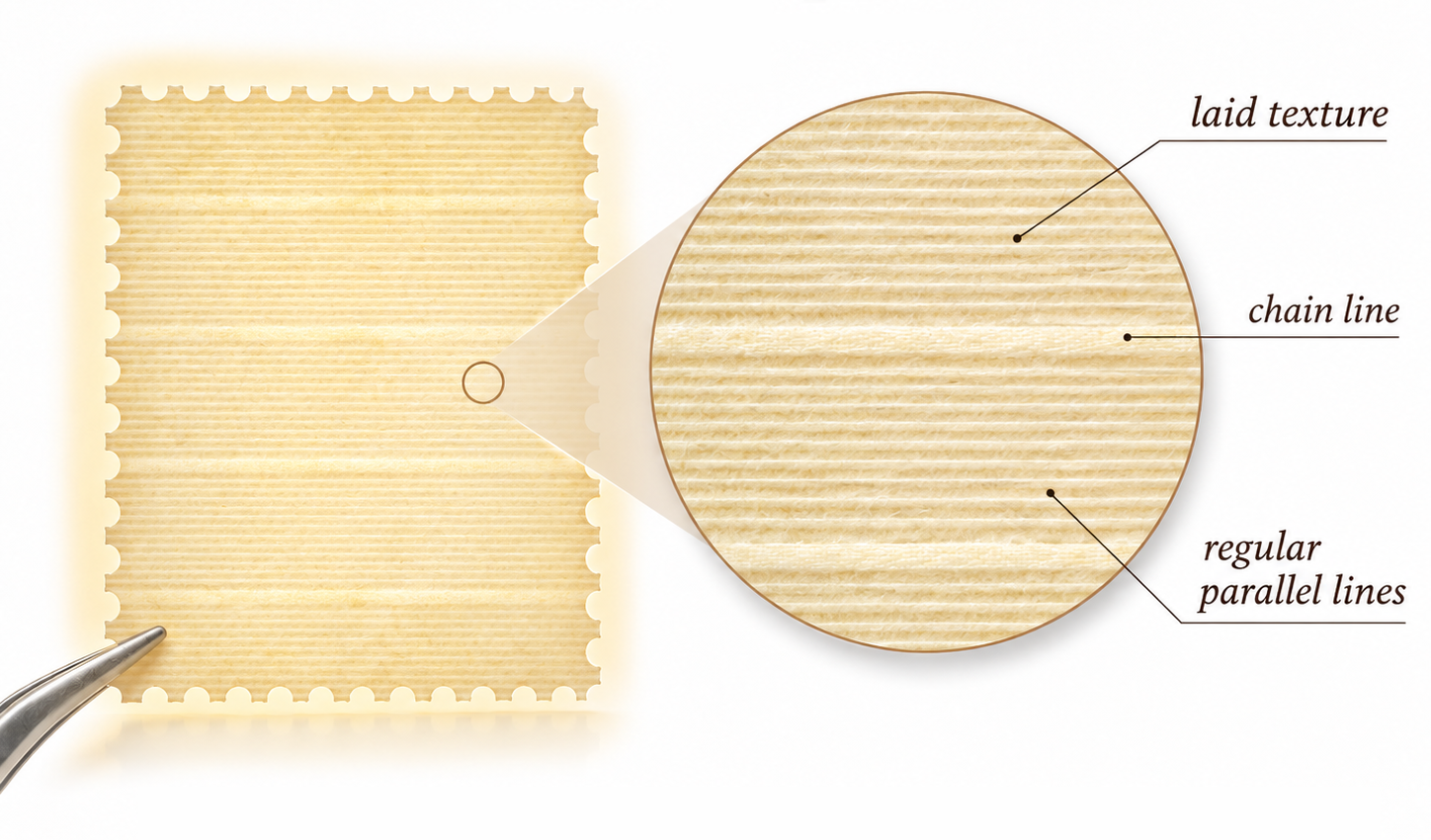
Paper is the material carrying the stamp’s design. Its structure, surface, colour and watermark are separate characteristics. Wove paper has a fairly even structure, unlike laid paper with its regular lines.
A paper description can distinguish stamps with otherwise similar designs. A coloured sheet supplies colour even in areas left untouched by the printing ink.
Wove paper: even texture without laid lines.Image information
Click image to magnify
Diagram of wove paper with a magnified inset showing an even texture without laid lines.
Credit
Stunning Stamps · 2026
Notes
Digitally constructed
Laid paper: regular parallel lines, shown for comparison.Image information
Click image to magnify
Diagram of laid paper with a magnified inset showing regular parallel lines.
A watermark is formed within the paper during manufacture. Differences in the paper let the pattern show when light passes through it. It is not a design printed on the back.
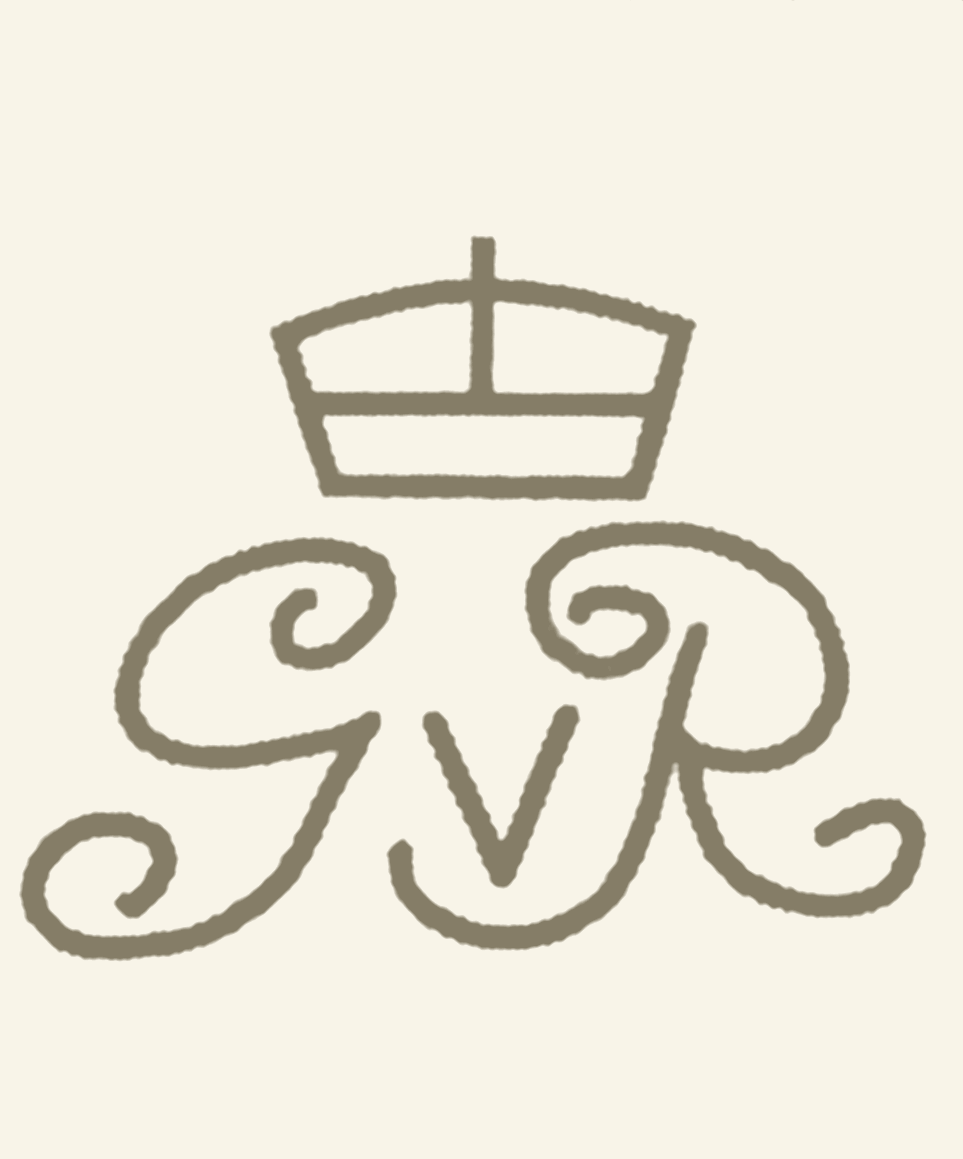
A royal cypher is a monogram identifying the monarch. George V’s cyphers use GvR. Simple Cypher (often called Royal Cypher) has small script cyphers in vertical strips; Multiple Cypher has an all-over arrangement. Single Cypher is the larger individual motif used for Seahorses. Block Cypher uses plain block lettering. These names are not interchangeable.
The illustration is shown from the front of the stamp. From the back, the letters of a normal watermark appear mirrored. That change of viewing direction is not itself a reversed-watermark variety.
Single Cypher · front view · upright. One larger crown and script GvR cypher for each Seahorse stamp. Enlarged; not a scale or stamp-position template. From the back, the cypher lettering appears mirrored.Image information
Cross-hatching adds a second direction of lines across the first. On the re-engraved Seahorses introduced in 1934, the background immediately behind the King’s head is cross-hatched.
The earlier Waterlow, De La Rue and Bradbury Wilkinson issues have horizontal lines in that area. Those earlier printings need other features to tell them apart.
Enlarged line patterns, not stamp details. On Seahorses, look behind the King’s head for the change to the 1934 re-engraved design.Image information
Enlarged horizontal lines compared with horizontal and diagonal lines that make cross-hatching.
The Seahorse design passed through several printings. Collectors compare the engraved background, the printed frame, the perforation holes and the shape of the paper teeth at the upper corners.
All four groups shown here have the same listed 11 × 12 gauge and Single Cypher watermark. Those two features cannot separate the printers. Use the documented combination of features, supported by reference examples.
In recess printing, ink lies in lines cut below the surface of the printing plate. Surplus ink is wiped from the surface. Pressure brings the paper into contact with the ink in the grooves.
The Seahorses are line-engraved stamps printed by this method. Closely spaced engraved lines build up the portrait, waves and other shaded parts of the design.
Enlarged cross-section. Engraved lines hold the ink; the surrounding surface is wiped clean before printing.Image information
Side view of recess printing: ink remains in grooves below the plate surface and pressure brings paper into contact with it.
Credit
Stunning Stamps · 2026
On this stamp
The 2s 6d Seahorse is line engraved and recess printed. Its shaded areas are built from engraved lines, including the background behind the King’s head.
A watermark is formed within the paper during manufacture. Differences in the paper let the pattern show when light passes through it. It is not a design printed on the back.
A royal cypher is a monogram identifying the monarch. George V’s cyphers use GvR. Simple Cypher (often called Royal Cypher) has small script cyphers in vertical strips; Multiple Cypher has an all-over arrangement. Single Cypher is the larger individual motif used for Seahorses. Block Cypher uses plain block lettering. These names are not interchangeable.
The illustration is shown from the front of the stamp. From the back, the letters of a normal watermark appear mirrored. That change of viewing direction is not itself a reversed-watermark variety.
Single Cypher · front view · upright. One larger crown and script GvR cypher for each Seahorse stamp. Enlarged; not a scale or stamp-position template. From the back, the cypher lettering appears mirrored.Image information
Single Cypher watermark, front view, upright
Credit
Stunning Stamps · 2026
Notes
Digitally reconstructed
On this stamp
Single Cypher is the larger crown-and-GvR form used for the Seahorses. It is distinct from the repeating Royal or Simple Cypher of the low values. All four Seahorse printing groups here share it.
Perforations are the punched holes that let stamps separate. The gauge describes their spacing over 2 centimetres, not the total number of holes along an edge.
Two numbers give the horizontal gauge first, then the vertical: top and bottom, followed by the two sides. A higher number means closer spacing. Match an actual stamp with a perforation gauge rather than measuring the image on a screen.
Illustrative spacing, not a measuring gauge. The number describes spacing over 2 cm, not the total holes along an edge.Image information
Horizontal gauge 11 and vertical gauge 12: the same 20 mm distance is used in each direction. Enlarged spacing diagram, not a ruler.
Credit
Stunning Stamps · 2026
On this stamp
11 × 12: gauge 11 across the top and bottom, gauge 12 down the sides. This gauge is shared by all four Seahorse printing groups; differences in hole size and corner teeth require a separate comparison.
A shade is a variation within a stamp’s colour. Some variations receive their own catalogue numbers even though the design and denomination stay the same.
Compare known examples under consistent lighting. Fading can change a stamp’s appearance, and photographs or screens can alter how colours look. A catalogue colour name helps describe a shade; it is not a colour test by itself.
On this stamp
Olive-brown is the colour description used for this 2s 6d by Bradbury Wilkinson & Co.. It identifies the represented issue; more specialised shade distinctions need comparison with known examples.
Dimensions are given as width × height. Here the listed figures describe the overall stamp format. The printed design sits inside it and has a separate, smaller measurement.
These are nominal reference sizes. They are not measurements of the illustration on your screen, or a claim that every separated example has exactly the same outer edges.
Nominal reference format, enlarged. The inner rectangle explains the separate printed area; its size is illustrative.Image information
Nominal overall format: 44 millimetres wide and 28 millimetres high. The printed design is a separate, smaller measurement.
Credit
Stunning Stamps · 2026
On this stamp
44 × 28 mm describes the nominal overall stamp format. The printed design is a separate measurement: the specialist study records heights of about 22.6–23.1 mm across Bradbury plate groups. The often quoted 22¾ mm is a guide, not a fixed height for every example.
A stamp design combines the portrait, frame, inscriptions and value. Different artists may have supplied different parts. A credit for lettering means the form and arrangement of the words or numerals, rather than the whole composition.
Bertram Mackennal and George W. Eve both contributed to George V’s stamps. Their work was then translated into the dies and printing surfaces used to produce the issued designs.
The issued profile-head letterpress low values use three distinct portrait engravings. The same allocations continue in the later Multiple Cypher and Block Cypher letterpress issues where those denominations occur.
Coinage Head: ½d, 1½d, 2d, 3d and 4d. J. A. C. Harrison engraved the stamp portrait from Mackennal’s coinage model in 1912.
Medal Head, also called Medal Head I: 1d and 2½d. Its model was Mackennal’s portrait for the 1910 South African Union Parliament medal, rather than the crowned Coronation medal.
Medal Head II: 5d, 6d, 7d, 8d, 9d, 10d and 1s. Harrison engraved this smaller head afresh from the medal model in March–April 1913. It is not a reduced Coinage Head.
Coinage Head trials for Eve’s frames preceded the adopted Medal Head II. An essay can therefore show a different portrait from the issued stamp. The names identify the engraving and its source, independently of the paper watermark.
Collectors use frame names to distinguish the arrangements around the King’s head. Pillars, wreaths, foliage and the small dolphins give the designs recognisable identities.
Several denominations can share a frame while keeping their own value inscriptions and colours. A frame name describes the composition; it does not by itself identify the printer, paper or shade.
Bertram Mackennal was an Australian-born sculptor whose royal portraits appeared on coins, medals and stamps. He also designed stamp frames and the Seahorse composition, joining portrait modelling to ornamental design.
George William Eve was an etcher and heraldic artist, known for bookplates and decorative lettering. His work on George V stamps included the Pillar and Wreath frames and lettering for the Seahorse value tablets.
J. A. C. Harrison was an engraver of portraits, stamps and bookplates. His work included the original Seahorse die and George VI high-value engraving. He was an individual craftsman, distinct from the firm Harrison & Sons.
On this stamp
Mackennal supplied the Seahorse composition, with value-tablet lettering by Eve. The same basic arrangement continued through the later printings.
J. A. C. Harrison was an engraver of portraits, stamps and bookplates. His work included the original Seahorse die and George VI high-value engraving. He was an individual craftsman, distinct from the firm Harrison & Sons.
On this stamp
J. A. C. Harrison engraved the original Seahorse die. This credit describes the origin of the design; it does not identify the firm printing this issue or assign every later revision to him.
Cross-hatching adds a second direction of lines across the first. On the re-engraved Seahorses introduced in 1934, the background immediately behind the King’s head is cross-hatched.
The earlier Waterlow, De La Rue and Bradbury Wilkinson issues have horizontal lines in that area. Those earlier printings need other features to tell them apart.
Enlarged line patterns, not stamp details. On Seahorses, look behind the King’s head for the change to the 1934 re-engraved design.Image information
Enlarged horizontal lines compared with horizontal and diagonal lines that make cross-hatching.
Credit
Stunning Stamps · 2026
On this stamp
This Bradbury Wilkinson & Co. printing has horizontal shading behind the King’s head. The same feature occurs in the other pre-1934 groups, so it is only the first step in identifying the printing.
A feature that recurs at the same position can help identify a printing plate or a stage in its use. A temporary blemish, weak impression or later damage is a different matter.
Specialist descriptions give the detail to inspect and, where known, its position. A named variety applies to the documented examples; it is not necessarily present on every stamp of that denomination.
On this stamp
Specialists distinguish complete and broken forms of the R in CROWN, and worn or repaired frames above AL in HALF. These features help group printing plates and also remain visible under Irish overprints. No single flaw is promised on every example.
A printing sheet may contain several groups of stamps, called panes. Unprinted gaps between panes are gutters; the outer paper margin is also called selvedge.
The sheet supplied to a post office may be smaller than the sheet used for printing. Keep those two counts separate. Row and column counts explain how many stamps belong to each pane.
Sheet, panes and margins: a simplified example.Image information
A schematic printing sheet contains two panes separated by an unprinted gutter and surrounded by a margin.
Credit
Stunning Stamps · 2026
On this stamp
Two panes of 40 (4 × 10 each). The two listed panes contain 80 stamps altogether. A block retaining its margins can preserve evidence of this arrangement.
A stamp catalogue gives each listed issue a reference number. SG means Stanley Gibbons, the publisher of the catalogue used here. These numbers help collectors refer to the same issue; they are not serial numbers printed on individual stamps.
A range of numbers groups related entries. Colour, paper or perforation differences may account for separate listings within that range.
On this stamp
Stanley Gibbons SG 413a — Bradbury Wilkinson olive-brown