
The design of the 2s 6d yellow-green
King George VI · Great Britain · Waterlow & Sons · 3 May 1951
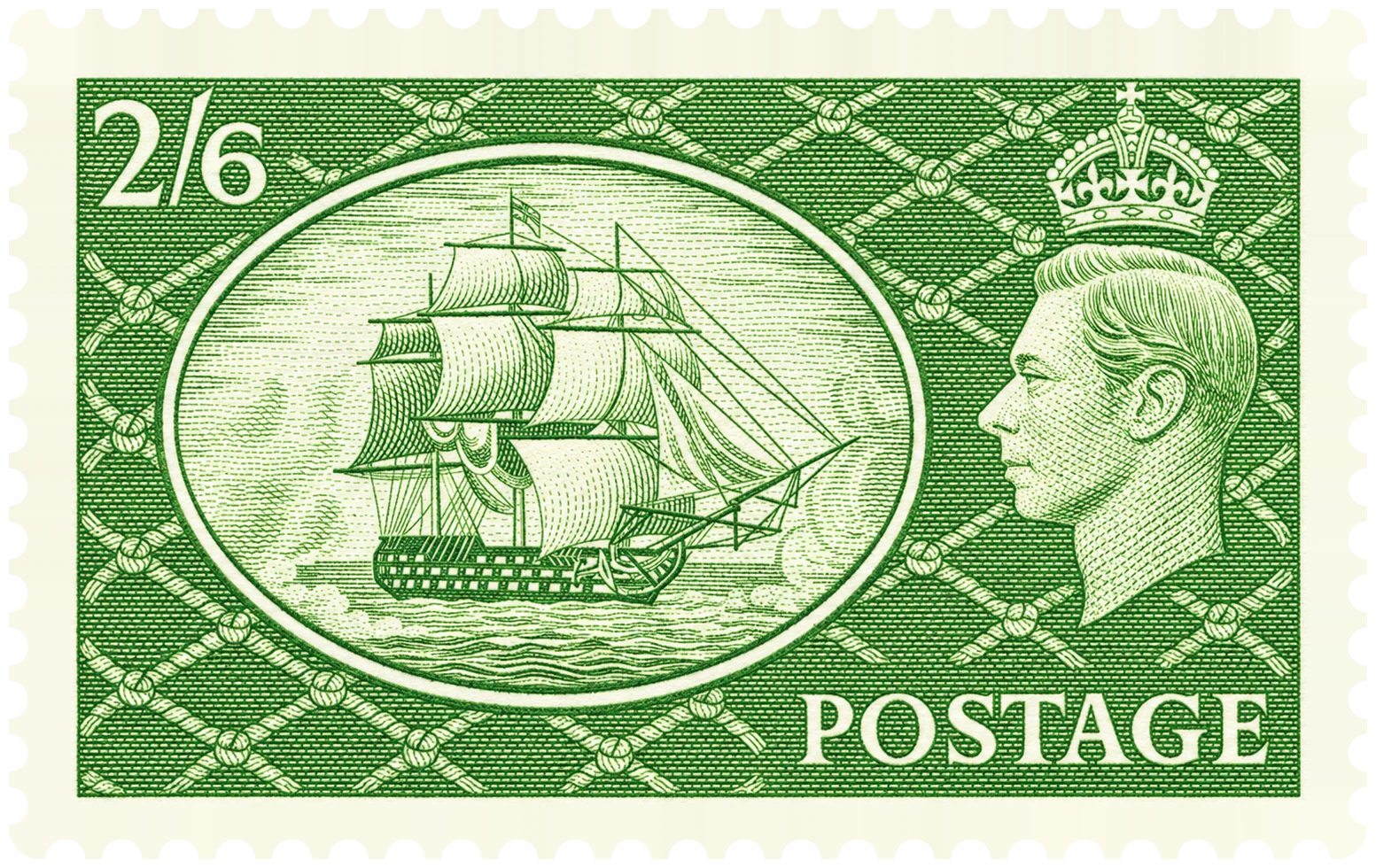
Victory nearly lost its place
Mary Adshead’s HMS Victory almost missed the 1951 half-crown. In February 1950, the Council of Industrial Design preferred her White Cliffs of Dover for the 2s 6d value and kept Nelson’s Trafalgar flagship in reserve. The Postmaster General wanted four different designs across the set, and recommended Victory for the half-crown and Dover for the 5s. [1]
George VI approved that arrangement but suggested another ship: HMS Vanguard, the modern battleship. Adshead studied drawings by her husband, the painter Stephen Bone, and searched for suitable photographs. She doubted that Vanguard would make a good oval picture. Bone thought her provisional sketch needed a “tremendous bow wave”. Despite the search, no satisfactory design emerged, and Victory remained. [1]
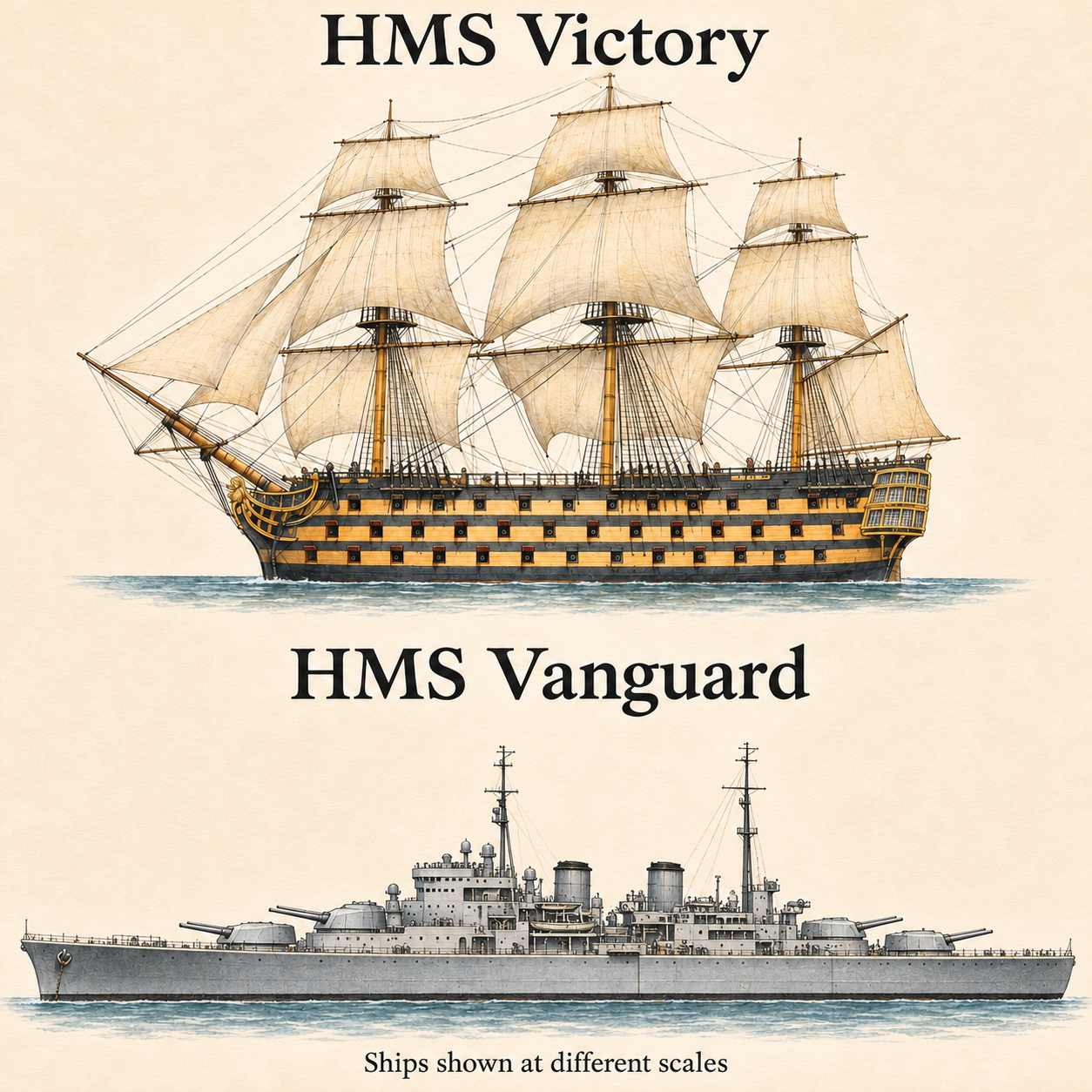
Image information
Click image to magnify
Illustrated comparison of the tall sailing ship HMS Victory and the long, low battleship HMS Vanguard.
- Credit
- Stunning Stamps · 2026
- Notes
- Digitally reconstructed. An explanatory ship study, not a reproduction of Mary Adshead’s artwork.
Too many sails for the Admiralty
Adshead had drawn Victory from a print. When Admiralty experts examined her artwork in April 1950, they found extra sails on two of the masts, an incorrectly shaped bow and missing details beneath the bowsprit — the spar projecting from the front of the ship. They supplied a tracing from official drawings to help her revise it. [1]
Accuracy still had to survive reduction to stamp size. Adshead found the bow and anchor particularly difficult, and described her revision as a compromise between two drawings. The next inspection brought further objections: the anchor’s pointed flukes needed to lie at right angles to its wooden crossbar, or stock, and the arrangement of sails was still questioned. By 16 May, the revised design had passed the Admiralty and was ready for Waterlow & Sons to engrave. [1]
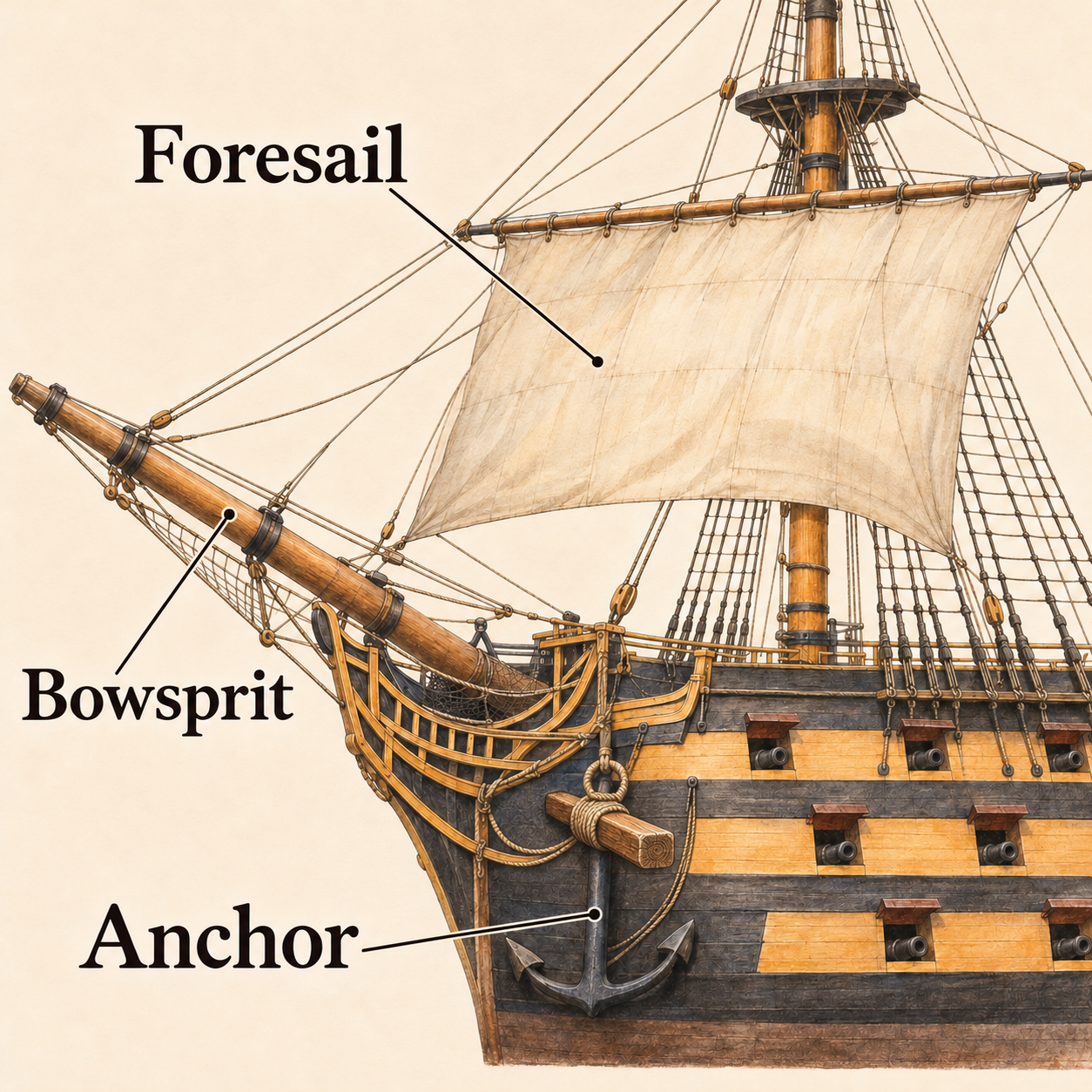
Image information
Click image to magnify
Illustrated detail of HMS Victory’s bow, with labels identifying the foresail, projecting bowsprit and anchor.
- Credit
- Stunning Stamps · 2026
- Notes
- Digitally reconstructed. A simplified explanation of nautical terms, not a reconstruction of a stamp proof.
A name erased and a rope removed
An earlier version identified the ship with the words HMS Victory. By December 1949 the lettering had been deleted, leaving a patch of sky to retouch. The net-like background also divided opinion. The Council of Industrial Design’s Sir Francis Meynell wanted it removed; the King later asked for it to be less prominent. It survived in a softer form. [1]
Approval came with one last small correction. In November 1950, the engraved proof was accepted subject to one change: a short piece of rope on the right of the oval, opposite the King’s nose, was to be removed from the working plate. The instruction concerned that small detail, not the whole netted background. [1]
Room for a ship and a king
The broad format was a practical choice made before the designs were selected. Waterlow & Sons recommended the long shape used for George V’s high values as the best fit for a royal portrait and a picture. The upright format of the previous half-crown could have been retained, but only with a smaller head. In March 1949 the Post Office chose the wider dimensions. [1]
The portrait’s size remained important during engraving. In August 1950, Waterlow was told to preserve the proportions in the artists’ originals. Adshead’s Victory and Dover stamps consequently kept smaller heads than Percy Metcalfe’s 10s and £1 designs. [1]
Colour was tested on printed proofs. In December 1950, two greens were considered for the half-crown. The darker was preferred because it was closer to the existing 2s 6d colour and showed the design to better advantage. The King approved the final colours in January 1951, ahead of the set’s issue on 3 May. [1]
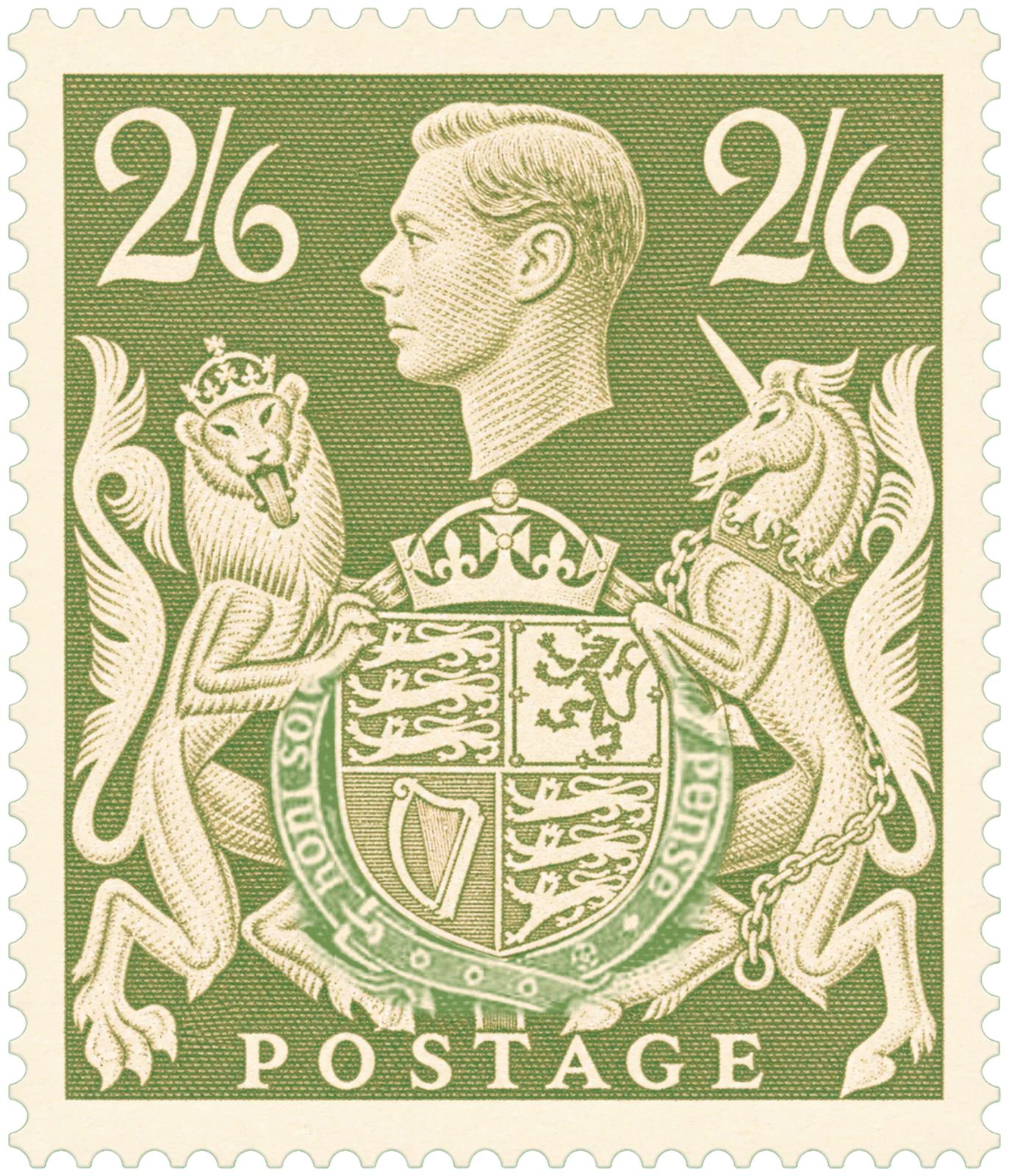
Click either stamp to magnify
The crown as a royal emblem
The crown is a separate royal emblem in this design, while the King’s portrait is uncrowned. Its rounded arches belong to the heraldic tradition commonly called the Tudor Crown. The illustration below shows that tradition at a larger scale; the stamp simplifies it to suit its small printed form. [2, 3, 4]
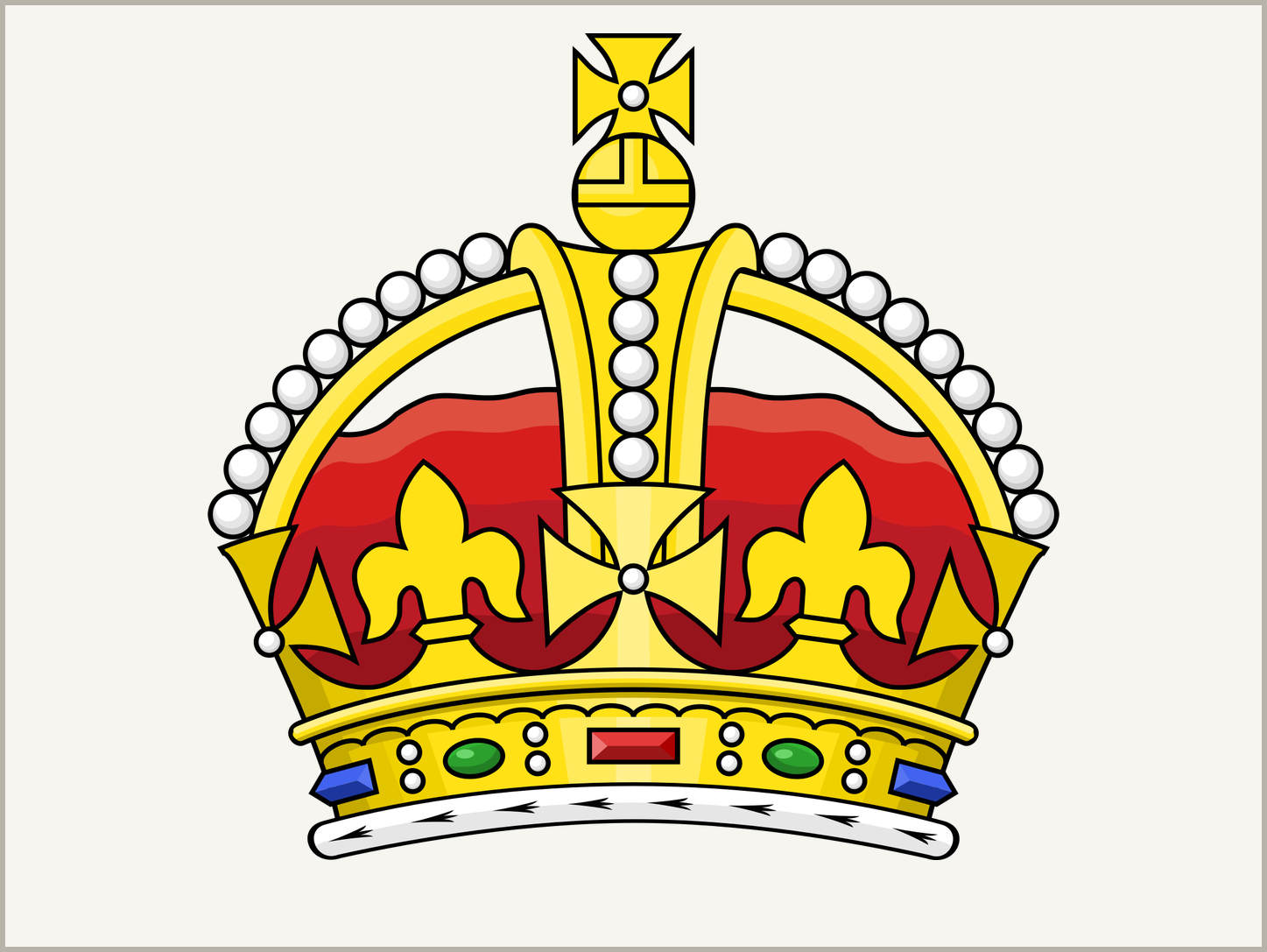
Image information
Click image to magnify
Heraldic Tudor Crown with rounded arches, a cross and orb, red cap, crosses and fleurs-de-lis.
- Credit
- Dgp4004 · Wikimedia Commons · CC0
Sources

← Return to the 2s 6d yellow-green stamp
Last reviewed · Facts checked