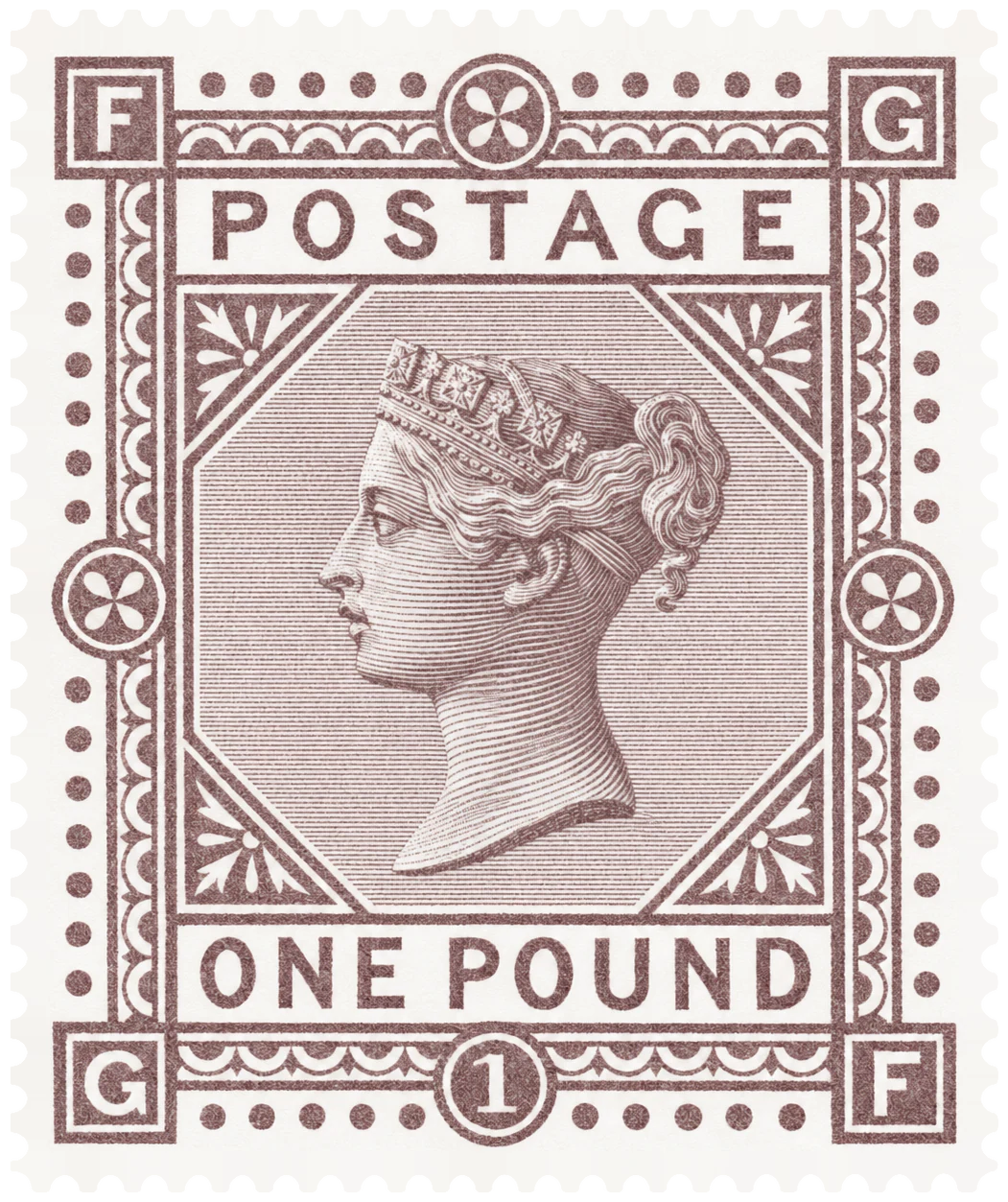
The one-pound brown-lilac appeared in September 1878, joining Britain's new large-format high values. De La Rue placed Victoria's youthful portrait inside an ornamental octagon, printed from a single plate. Only one initial production run was needed. In 1882, the same plate was dismantled and rearranged to accommodate paper with a new Anchor watermark, preserving the design while changing the way it was manufactured.
Stories
A printing plate that worked only once
A printing plate that worked only once
De La Rue prepared the printing plate for Britain's new one-pound postage stamp in the summer of 1878.
The plate was registered and put to press on 6 August. It contained eighty impressions of Victoria's portrait, arranged in four panes of twenty. [4]
The printers had ordered sufficient special paper for 3,025 sheets, including the sheet retained for official registration. The resulting production amounted to 242,000 stamps.
Yet the surviving records indicate that this was the only printing made for the original issue.
The plate had been carefully prepared for repeated use, but the government required only one relatively modest batch. The stamp appeared on 26 September 1878, and the plate remained available for future production.
The plate that had to be taken apart
In 1882, the government changed the paper used for its higher-value stamps. The familiar cross-shaped watermark was replaced by a Large Anchor.
The new paper required a different arrangement of stamp impressions. De La Rue could not simply continue printing from the existing plate. [4]
The printers dismantled plate 1 and rearranged fifty-six of its eighty impressions into a single pane of seven rows of eight. [9]
The altered plate was registered on 20 November 1882, with the official record noting that its size had been changed.
Victoria's portrait and the surrounding design remained untouched. Skilled workers had rebuilt an expensive printing tool rather than discard it.
A new stamp hidden among old supplies
The revised one-pound stamps were printed during November 1882, but their arrival in post offices was not immediately announced.
For years, philatelic references gave November as the issue date. When Hastings Wright and A. B. Creeke examined the official stock books in the 1890s, they found reason to disagree. [4]
The records showed that supplies of the older cross-watermarked stamps were still being exhausted during December. The researchers concluded that the new Anchor-watermarked issue probably appeared towards the end of that month.
A small detail of stamp production had been reconstructed from warehouse figures rather than the stamps themselves.
Two one-pound stamps, two different designs
Before the one-pound postage stamp appeared, De La Rue had already produced a one-pound stamp for the Post Office's telegraph service.
The telegraph stamp was introduced in March 1877. Its long horizontal design displayed Victoria's portrait between elaborate inscriptions. The printers had tested six colours before selecting brown-lilac. [10]
When the postage stamp followed in September 1878, it used the same general colour but a completely different arrangement.
Instead of adapting the telegraph design, De La Rue placed the Queen inside a vertical octagonal frame.
The contrast is particularly interesting because the later five-pound postage stamp would be made by adapting an existing telegraph printing plate.
The sheet with instructions around its edges
The first one-pound printing plate carried more than eighty individual stamps.
Around each pane, De La Rue included inscriptions identifying the denomination and the value of the complete group. The side margins stated that twenty one-pound stamps were worth twenty pounds. [4]
The margins also carried plate numbers, production markings and small guides for the perforating machinery.
When the plate was rearranged in 1882, these inscriptions had to be reconsidered along with the layout.
A single stamp showed the finished design, but a complete printing sheet revealed the additional work needed to manufacture and handle it.
Why do some stories appear on several pages?
Every page is written to make sense on its own. Visitors often arrive directly at a particular stamp or subject, without having explored the rest of the site.
Some stories are relevant to several stamps, so they are repeated where they help explain what you're looking at. For those exploring a series, the details specific to each stamp generally come first, with the more familiar stories further down the page.
This way, you can explore the site in any order without missing interesting background.
An octagonal frame gives Victoria’s portrait a distinctive setting. Explore the cross-shaped ornaments, reversed corner letters and plate number worked into the brown-lilac design. [11]
De La Rue grew from a playing-card business into a major security printer. It supplied British postage stamps from the Victorian period and printed the Edward VII issues before the contract changed in 1911.
On this stamp
Thomas De La Rue & Co. printed the 1878 one-pound brown-lilac by typography, retaining the earlier royal portrait within a new octagonal setting. The illustration represents the original plate-1 issue on Maltese Cross paper; the later Anchor-paper issue retained the design.
Jean Ferdinand Joubert de la Ferté was a French engraver and photographer. He trained in Paris and later worked in London, where his engraving helped establish De La Rue’s surface-printed postage stamps.
On this stamp
The 1878 one-pound brown-lilac inherited Joubert’s portrait engraving for the earlier surface-printed stamps. This credit identifies the original portrait, not a separately documented commission to engrave the one-pound frame in 1878.
William Wyon was a medallist and engraver at the Royal Mint. His models of royal heads were made for coins and medals and also became sources for stamp portraits.
On this stamp
Wyon’s City of London medal supplied the youthful likeness inherited through Corbould’s drawing and Joubert’s engraving on the 1878 one-pound brown-lilac.
Henry Corbould was a draughtsman and book illustrator. He trained with his father and at the Royal Academy Schools, where he received a silver medal for a life study.
On this stamp
Corbould’s drawing after Wyon’s medal supplied the model for Joubert’s earlier surface-printed portrait, inherited by the 1878 one-pound brown-lilac.
The country identifies the postal authority that issued the stamp. The monarch identifies the ruler whose portrait it carries. A definitive is an everyday stamp intended for regular postal use.
On this stamp
This £1 brown-lilac belongs to Great Britain’s definitive stamps bearing Queen Victoria’s portrait. Its 1878 first-appearance year identifies the design described here; the represented paper and plate are specified separately.
The denomination is the stamp’s face value: the amount of postage it represents. Its price to a collector can be quite different.
In Britain’s old currency, 12 pence made one shilling and 20 shillings made one pound: 240 pence altogether. The abbreviations were d for pence, s for shillings and £ for pounds. The d comes from the Latin denarius. A halfpenny, written ½d, was half an old penny.
On this stamp
£1 equals 240 old pence. A twenty-stamp pane was worth £20, and the eighty-stamp printing sheet £80. These are original face values, not present-day prices.
A shade is a variation within a stamp’s colour. Some variations receive their own catalogue numbers even though the design and denomination stay the same.
Compare known examples under consistent lighting. Fading can change a stamp’s appearance, and photographs or screens can alter how colours look. A catalogue colour name helps describe a shade; it is not a colour test by itself.
On this stamp
The illustration represents the brown-lilac colour family recorded for SG129. Different lighting, paper tone, fading and treatment can alter an original’s appearance. The digital image is not a calibrated shade sample; compare the watermark, plate and paper as well.
A stamp can be printed, sent to post offices, put on sale and made valid for postage on different dates. An official notice or instruction can establish when it was intended to be used; a dated letter shows that a particular example was actually used.
An early surviving cover is evidence of use by that day. It does not necessarily identify the first day of sale. A year in the heading may also cover later printings of the same design.
On this stamp
The one-pound was announced with the ten-shilling in the circular of 23 September 1878. Despatch was scheduled for the night of the 25th; Wright and Creeke give 26 September as the issue date. This dates the original Cross-paper stamp, not its later Anchor-paper printing.
The five-shilling introduced in 1867 was followed by the ten-shilling and one-pound in 1878. Their larger upright formats gave the denominations a distinct appearance. The five-pound of 1882 used an even wider design adapted from a telegraph stamp.
A first-appearance year dates the design or issue family. It does not date every surviving example: changes of watermark, paper and perforation can divide an unchanged design into several catalogue issues.
The three upright designs began on Cross-watermarked paper and later continued on Large Anchor paper. The five-pound postage stamp used Anchor paper from the outset. Its predecessor inscribed TELEGRAPHS is a different stamp.
On this stamp
The £1 is one of the upright earlier high values. The illustration represents its original Cross-paper issue; the later Anchor-paper printing retained the visible design but changed its manufacture.
A stamp catalogue gives each listed issue a reference number. SG means Stanley Gibbons, the publisher of the catalogue used here. These numbers help collectors refer to the same issue; they are not serial numbers printed on individual stamps.
A range of numbers groups related entries. Colour, paper or perforation differences may account for separate listings within that range.
On this stamp
SG129 is the recorded identity for this reconstruction: the £1 brown-lilac on Cross paper, plate 1, lower letters G–F. The existing reference records support its represented design and colour family. Watermark orientation, original gum and paper condition require examination of an actual stamp.
Typography, or surface printing, uses a raised printing surface. Ink is applied to the raised parts, then transferred to paper under pressure. The lower spaces leave the paper unprinted.
Fine lines and solid areas are both part of that raised image. This is the same basic principle as letterpress printing.
De La Rue multiplied the engraved design in metal by electrotyping: a metal layer was deposited against a mould, then backed and mounted for printing. Printing from raised surfaces is different from the recessed lines used for the Penny Black. The paper was gummed before printing.
Surface printing, shown from the side. The paper is pressed onto the inked surface.Image information
Side view of surface printing. Paper is pressed down onto ink on the raised parts of a printing plate; the lower spaces do not touch the paper.
Credit
Stunning Stamps · 2026
On this stamp
De La Rue printed this £1 from raised metal surfaces. The white lettering and ornament are areas left unprinted. The complete design was printed in one operation. The process is surface printing, not recess engraving.
The number of colours is not necessarily the number of printing operations. A complete design can be printed from one plate, or assembled by passing the same sheet through the press again. Registration means aligning those separate impressions.
The five-shilling, ten-shilling and upright one-pound were printed as complete designs. The five-pound postage stamp was different: TELEGRAPHS was removed from the old plate, leaving a blank panel. A separate plate added POSTAGE and an ornament at either end.
Both parts of the five-pound were orange. Small differences in strength or alignment can reveal the two operations; they are not automatically a different ink colour or a separate issue. A pale, incomplete or shifted inscription needs comparison with documented examples.
On this stamp
The £1 design, including its value, portrait and plate numeral, was printed together in brown-lilac. Its white details are unprinted paper, not a second white-ink impression. The two-stage method described in the related £5 article does not apply to this stamp.
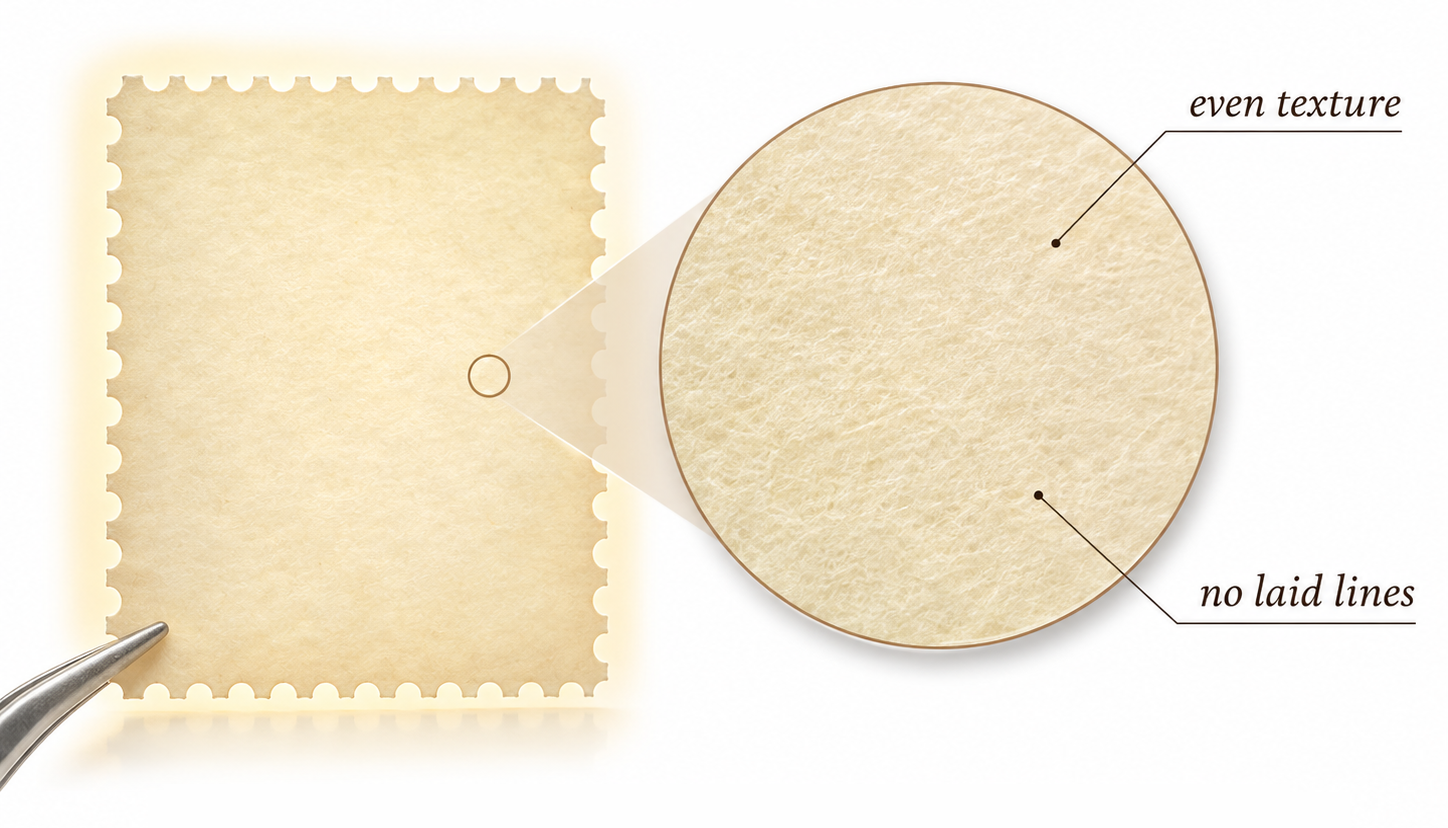
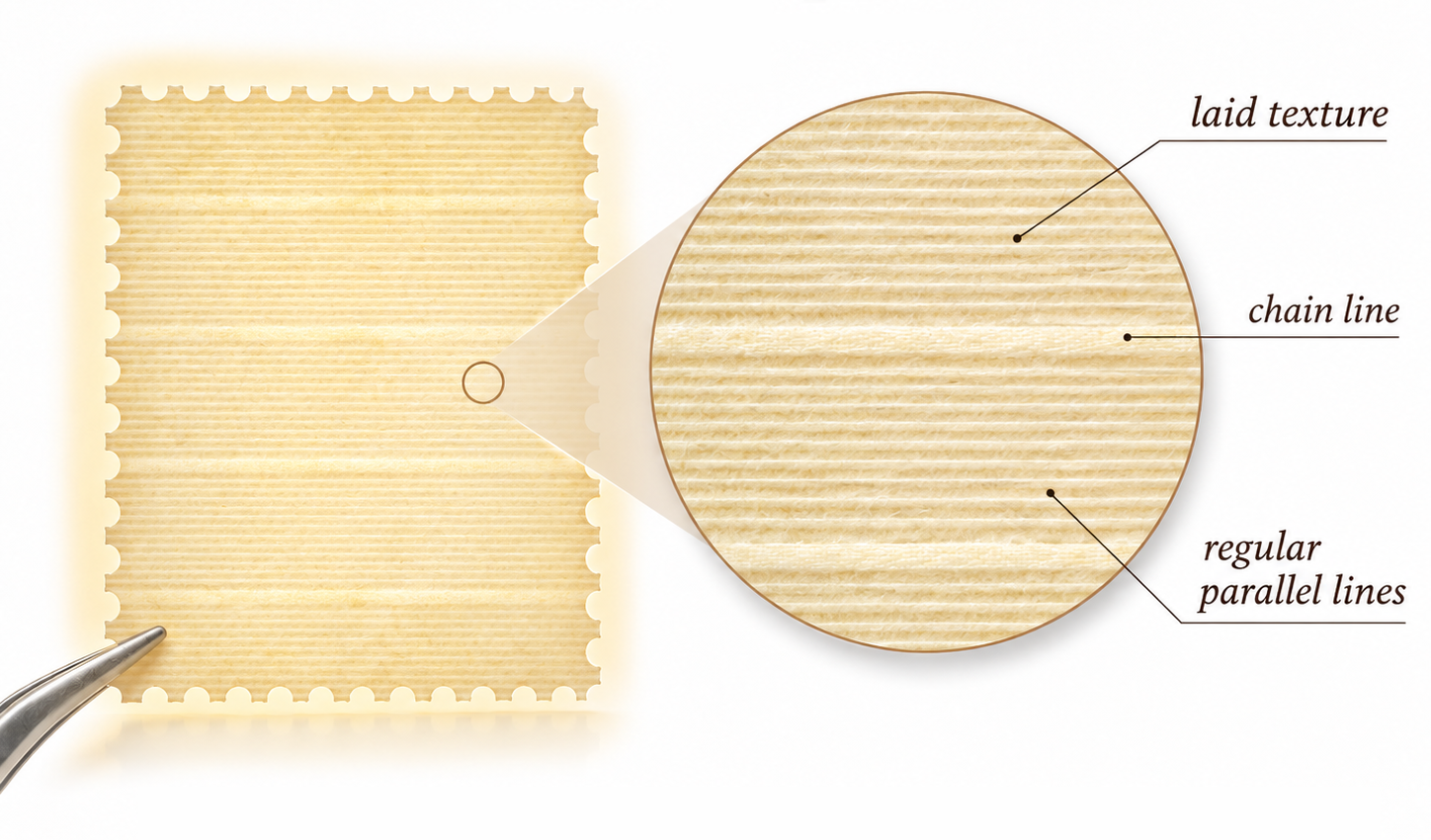
Wove describes the structure of the paper. Viewed against the light, it has a fairly even appearance. Laid paper instead shows a regular pattern of lines left by its manufacture.
Paper structure and watermark are separate characteristics: wove paper can carry a watermark. Both can help distinguish stamps with similar printed designs.
Both the Cross paper of the original upright high values and the later Large Anchor fiscal paper were machine-made. A patterned dandy roll formed the watermark while the paper was wet. “Wove”, “machine-made”, the watermark and the colour describe separate properties of the same sheet.
Wove paper: even texture without laid lines.Image information
Click image to magnify
Diagram of wove paper with a magnified inset showing an even texture without laid lines.
Credit
Stunning Stamps · 2026
Notes
Digitally constructed
Laid paper: regular parallel lines, shown for comparison.Image information
Click image to magnify
Diagram of laid paper with a magnified inset showing regular parallel lines.
Credit
Stunning Stamps · 2026
Notes
Digitally constructed
On this stamp
The original £1 was printed on machine-made white wove Cross paper. Each intended stamp position had one cross watermark. Later Anchor paper was also machine-made; the change is not from handmade to machine-made paper.
Paper colour is separate from ink colour. Look at the unprinted areas, the margins and the back rather than judging only the coloured design. Age, staining and lighting can change their apparent tone.
The original Cross-paper high values used white wove paper. The Large Anchor stock came from fiscal-stamp manufacture and can be white or bluish. A blue tint in the paper is not an additional printed colour, and it is unrelated to the shape of the watermark.
Some bluing is very faint. A front photograph alone cannot reliably settle the paper category, and an uncalibrated reconstruction is not a colour reference. The individual note states the paper represented by this article’s illustration.
On this stamp
This SG129 represents white paper in the original Cross-watermarked issue. Later Anchor-paper examples can be white or bluish. No particular thickness, original gum condition or chalk coating is inferred from this face illustration.
A watermark is a pattern of thinner paper formed during manufacture. It belongs to the sheet rather than the inked design. Its shape, spacing and position help distinguish stamps whose printed faces look alike.
The original upright five-shilling, ten-shilling and one-pound each have one large cross. Traditionally called a Maltese Cross, its broadening arms are more precisely a cross pattée. Large Anchor paper replaced it for the five-shilling and pound in 1882 and for the ten-shilling in 1883.
The five-pound postage stamp uses Large Anchor paper, with two watermark devices across each stamp. It does not use the Cross paper of the upright values. “Two anchors” describes the number covered by its wide design, not a second printing operation.
A partial or inverted watermark must be checked in the actual paper. Neither the visible corner letters nor an illustration of the front proves the watermark’s orientation. Watermarked marginal words and frame lines belong to the original sheet layout.
On this stamp
One large cross watermark belongs beneath each stamp in this original SG129 issue. The familiar catalogue name is Maltese Cross; the shape is a cross pattée. The later Large Anchor issue is separate. The front image does not establish watermark orientation.
Perforations are the rows of punched holes that let neighbouring stamps separate. Their gauge describes the spacing over a standard distance of 2 centimetres, rather than the total number of holes along a stamp’s edge.
A perforation gauge has rows of dots or lines at known spacings. Match an edge against them: the marks should line up all the way along. A single number applies to both directions; two numbers give the horizontal gauge first, then the vertical.
The upright Cross-paper issues use 15½ horizontally and 15 vertically. Their later Anchor-paper counterparts use 14 in both directions, as does the five-pound postage stamp. The gauge-14 diagram explains the measuring principle; the note below identifies this stamp’s own gauge.
A different gauge must be checked with the watermark and issue. These articles do not group the later Anchor issues as interchangeable perforation options. An imperforate proof or exceptional issued imperforate is a separate identification problem.
Enlarged spacing diagram, not to scale. Match the spacing with a perforation gauge.Image information
Enlarged perforation spacing: fourteen equal intervals between hole centres span 20 millimetres. This is a schematic, not a ruler.
Credit
Stunning Stamps · 2026
On this stamp
This original Cross-paper £1 uses gauge 15½ horizontally and 15 vertically. The later Anchor-paper issue uses 14 × 14, with a different sheet arrangement. It is not an interchangeable perforation option within this article. There are no grouped alternatives in this set.
Gum is the adhesive on the back of a stamp. For these De La Rue surface-printed issues, gum arabic was applied to the paper before printing. The sheet could then be printed without the preliminary dampening required by the earlier line-engraved method.
The gum and the printed ink are different layers with different purposes. A smooth printing face does not describe the adhesive on the reverse. On an unused original, the presence and condition of the gum are examined separately from the paper and watermark.
A front-view illustration supplies no evidence that original gum survives. Handling, removal from an album or later regumming may affect the back while leaving the printed design recognisable.
On this stamp
Gum arabic was applied to the paper before the £1 was printed. The face illustration makes no claim about surviving gum, hinge traces or regumming on an original specimen.
A printing sheet records the impressions made together. A pane is a block of stamp positions; a gutter separates panes, while the outer blank border is the margin or selvedge. The paper supplied by the mill can be larger than the sheet put through a particular press.
The original Cross-paper high values were printed in four panes of twenty, arranged two across and two down. Each pane had four rows of five stamps. Across the whole plate, this gives eight rows and ten columns, or eighty stamps.
For Anchor paper the upright designs were rearranged into a single pane of fifty-six, seven rows of eight. The five-pound instead had fifty-six stamps in two vertically arranged panes of twenty-eight, each seven rows of four.
The diagram illustrates the terms, not the exact layout of each issue. The individual note supplies the applicable arrangement. A registration sheet with examples subsequently removed still records the original printing layout.
Sheet, panes and margins: a simplified example.Image information
A schematic printing sheet contains two panes separated by an unprinted gutter and surrounded by a margin.
Credit
Stunning Stamps · 2026
On this stamp
Four panes were arranged two across and two down. Each contained four rows of five stamps: 20 per pane, 80 per printing sheet. Across the full plate this gives eight rows and ten columns; the sequence does not restart at each pane.
The face value of a pane is the number of stamps multiplied by their denomination. This was an accounting amount, not a measure of a stamp’s present collecting value. A whole printing sheet could contain several such units.
On the Cross-paper issues, a twenty-stamp pane was a Post Office sheet: twenty five-shillings made £5, twenty ten-shillings made £10, and twenty pounds made £20. Each full printing sheet held four panes.
The altered Anchor-paper upright plate held fifty-six stamps, although twenty-eight formed the Post Office unit in the five-shilling account. A half-sheet accounting unit is not evidence that the printing plate itself had two panes. For the five-pound, each actual pane contained twenty-eight stamps worth £140.
On this stamp
The twenty-stamp pane was the Post Office sheet for the original £1. Its face value was £20; the complete eighty-stamp printing sheet was £80. This accounting unit is separate from later Anchor-paper arrangements.
The three upright high values have white letters in all four corners. On the original eighty-stamp layout, the lower-left letter gives the row, A to H, and the lower-right gives the column, A to J. The upper pair repeats those two letters in reverse.
The five-pound follows its telegraph predecessor’s different convention. Only the lower corners carry position letters: the first gives the column, A to D, and the second gives the row, A to N. Thus its fifty-six positions run from AA to DN. The upper corners contain plate numbers.
Letters locate a stamp within a sheet. They are not an engraver’s initials or a post-office code. Reversed pairs on the upright designs also made it harder to assemble convincing unused stamps from uncancelled pieces.
Read the layout for the particular issue. Altering an upright plate for Anchor paper changed its range of positions, whereas the five-pound retained its column-first convention. The pair shown in a reconstruction represents one position, not every stamp of the issue.
On this stamp
The illustration reads G–F below; F–G above. The lower pair gives row 7, column 6 of the original eighty-stamp sheet. The upper letters reverse that pair; other positions have other letters.
A complete sheet carries information lost when individual stamps are separated. Marginal inscriptions could name the denomination, state the value of a pane and show plate or production numbers. Lines and crosses helped guide cutting and perforating.
On the original upright high values the panes carried denomination and accounting inscriptions. Printed plate and current numbers appeared in the outer margins. The watermarked word MARK on later Cross paper identified a place for a separate duty-control impression.
The reduced Anchor-paper plates had much plainer margins. The five-pound conversion also removed the telegraph plate’s marginal wording. A missing inscription on one later layout does not mean the stamp was printed from a completely new design.
A printed control, a watermark in the margin and a cancellation are different things. A narrow single stamp usually cannot establish which sheet markings originally surrounded it.
On this stamp
The original £1 panes carried denomination inscriptions and accounting totals. Plate and current numbers and perforating guides were outside the stamps. The 1878 Cross paper included watermarked MARK in its margins for the duty-control system. These sheet features are not additional inscriptions on the stamp itself.
A die originates the design; a printing plate repeats it over the positions needed for a sheet. The plate number identifies the printing plate, while corner letters identify a position within that plate.
Registration preserved an approved impression, often called an imprimatur. The registration date, first printing and first sale need not coincide. A plate could be registered long before use, or altered and registered again while retaining the same numeral.
The five-shilling has a sequence of plate numbers. The ten-shilling and upright one-pound used plate 1 throughout their Cross and Anchor stages. The five-pound also bears 1, inherited from the telegraph plate, although its postage inscription required another printing surface.
Read the numeral with the design and paper. “Plate 1” by itself does not establish the first printing, the year, or whether a stamp is an ordinary issued example.
On this stamp
The white figure 1 in the bottom circle identifies the only plate for this upright one-pound design. It was registered and put to press on 6 August 1878. Re-registration on 20 November 1882 recorded its alteration for a different paper layout; it did not create a new plate numeral.
A change in paper can require an alteration to the printing plate even when the stamp design remains unchanged. The size and spacing of the watermark devices must agree with the stamp positions.
The upright high-value plates were reduced from eighty positions to fifty-six when Large Anchor paper replaced Cross paper. The new layout was one pane of seven rows of eight, perforated 14. Five-shilling plate 4, ten-shilling plate 1 and pound plate 1 were used for those later issues.
The five-pound has a different history: its postage design already used two panes of twenty-eight on Anchor paper. Later white-paper printings retain that arrangement. These distinctions concern paper, plate layout and date together, rather than a free choice of perforation for the illustrated stamp.
On this stamp
The original SG129 illustrated here uses Cross paper and perforation 15½ × 15. For the 1882 Anchor-paper issue, plate 1 was reduced to a single pane of fifty-six, seven rows of eight, and the stamps were perforated 14. This is the printing-pane arrangement documented by Wright and Creeke and the surviving registration-sheet inventory; it is distinct from smaller accounting units.
A proof tests an engraving or printing plate. A colour trial tests an ink choice. A registration impression records approval. A SPECIMEN overprint identifies a stamp supplied for reference or official distribution rather than normal sale. These categories can overlap, but they are not interchangeable.
Some exceptional stamps arose from the small number of sheets prepared at registration. Their survival does not establish an ordinary production run from that plate or on that paper. Conversely, an unperforated edge alone cannot prove that an item is a proof.
Complete margins, matching blocks and documentary records can establish where a piece came from. Do not infer rarity, original gum or a missing perforation variety from the face of a reconstruction; the individual note identifies the relevant evidence for this issue.
On this stamp
The original paper warrants cover 3,025 sheets including the registration sheet, equivalent to 242,000 impressions. The altered 1882 plate had its own registration impression. An imprimatur records approval and may be imperforate; it should not be described as an ordinary unused stamp solely because it lacks a postmark.
A high denomination reduced the number of smaller stamps needed for a large charge. It did not necessarily pay one special letter rate. Weight, destination, service and date determined the charge on an actual postal item.
The five-shilling was introduced to avoid covering heavy letters with many low values. The 1878 circular for the ten-shilling and pound also asked postmasters to use them to record unpaid-postage amounts on Head Office Letter Bill Dockets. Those were accounting documents, not envelopes.
The five-pound postage design was adapted from a telegraph stamp and could serve postal or telegraph purposes. A stamp used to account for a payment is different evidence from a complete cover showing an actual journey.
On this stamp
One pound equalled twenty shillings or 240 old pence. The circular introducing this stamp encouraged its use on Letter Bill Dockets to represent large unpaid-postage amounts with fewer stamps. A complete cover or accounting document is needed to establish the purpose of an individual used example.
A cancellation normally prevents a stamp being used again. Its office, date and form can also help explain how it was used. The printed plate numeral and sheet-position letters are part of the stamp, not part of the cancellation.
High values require particular care: a dated handstamp can belong to postal, telegraph or accounting work. A loose stamp seldom contains enough evidence to reconstruct the original charge. A surviving cover, form or docket gives the needed context.
Used, fiscally used, officially marked SPECIMEN and apparently unused are different descriptions. A plausible date or clear office name does not by itself authenticate an expensive stamp. The illustration here shows the design without a cancellation.
On this stamp
This reconstruction shows an unused £1 without a postmark. An office datestamp or numeral on a used example is separate from its printed plate number and check letters. The original cover, form or docket is needed to interpret the charge and purpose confidently.