
The design of the £1 brown-lilac
Queen Victoria · Great Britain · Thomas De La Rue & Co. · 1878
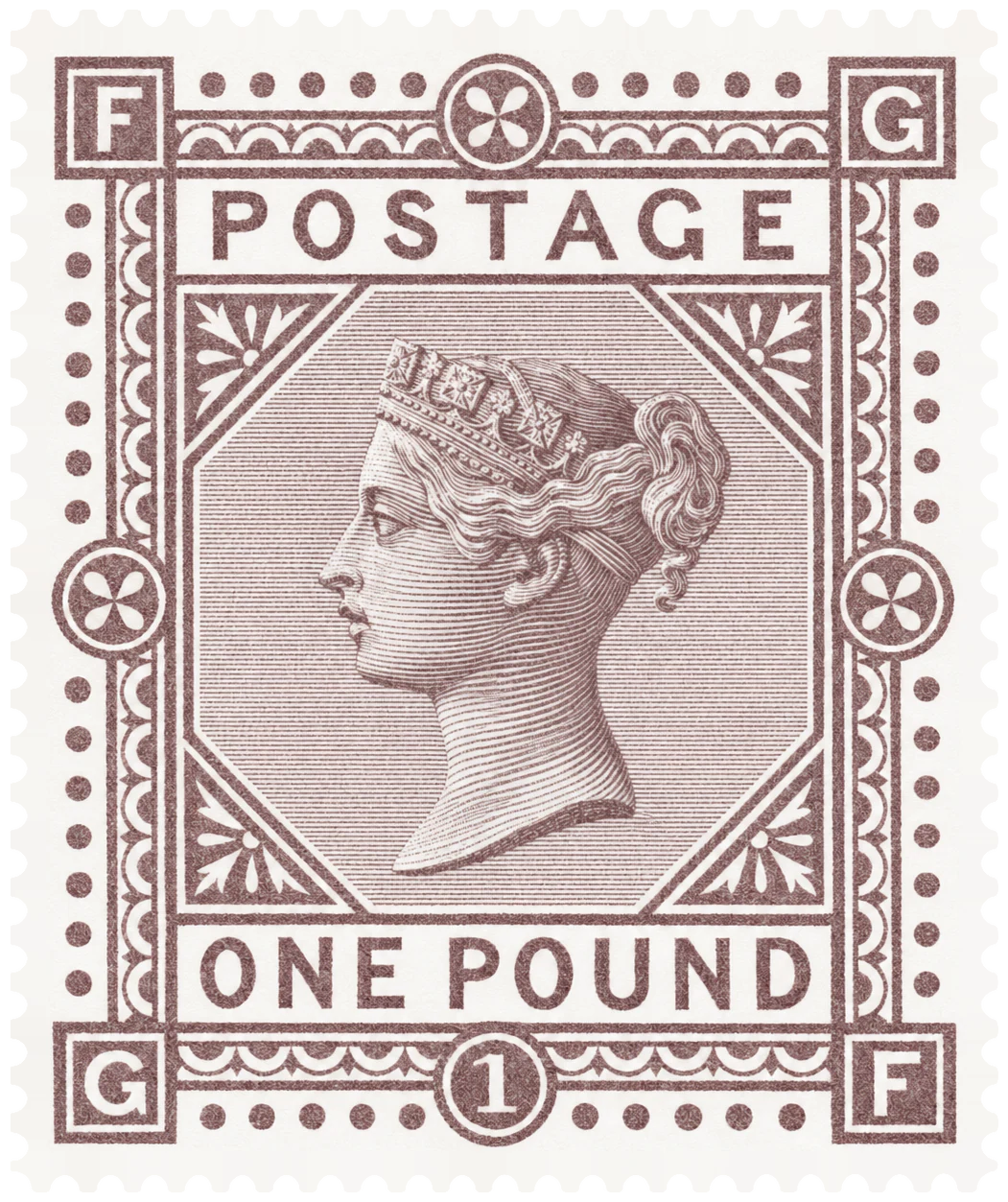
An octagon around Victoria's portrait
The one-pound brown-lilac has an unusual eight-sided frame surrounding the Queen.
Victoria's head appears against fine horizontal lines, enclosed within an octagon and an ornamental rectangular border. [1]
Above and below the portrait are white panels inscribed POSTAGE and ONE POUND in coloured capitals.
The octagon makes the stamp noticeably different from the circular five-shilling and the more elaborate ten-shilling designs.
The result is a strong geometric composition in which the frame gives the royal portrait a distinctive identity.
Three little crosses around the frame
Look closely at the ornamental border. Small circles appear at the top and on either side of Victoria's portrait.
Each contains a cross-shaped ornament. A matching circle at the bottom instead contains the printing plate number, shown as a white figure 1. [1]
Leaf-like patterns fill the spaces between the octagon and rectangular frame.
The engraver combined geometric shapes with more natural ornament, balancing the stern lines of the octagon against the softer decoration around it.
The plate number was made part of this arrangement rather than added as an obvious technical marking.
The four letters that reversed themselves
The one-pound has large white letters in all four corners.
The lower letters identify the stamp's position in the printing sheet. The upper pair repeats the same letters in reverse order. [1]
The arrangement helped expose attempts to assemble apparently unused stamps from pieces of previously used examples.
Each letter appears against a solid brown-lilac block.
The same security system had been introduced on lower-value Victorian stamps many years earlier, but on the one-pound it forms part of a larger and more elaborate design.
The cross hidden within the paper
The original one-pound stamp was printed on paper carrying a large cross-shaped watermark.
Traditionally called a Maltese Cross, the emblem is more precisely described as a cross pattée. It was formed within the paper during manufacture rather than printed in ink. [1]
The watermark helped make the paper difficult to imitate.
The same special paper was used for the five-shilling and ten-shilling high values.
In 1882, the one-pound changed to Large Anchor paper. The visible design remained identical, but the hidden emblem and the arrangement of the printing sheet were different.
A new watermark, a different sheet
The change from Cross to Anchor watermarks required a major alteration to the printing plate.
The original plate contained eighty stamps in four panes of twenty. The new paper required fifty-six stamps, arranged in a single pane of seven rows of eight. [1, 2]
De La Rue dismantled and rearranged the existing plate.
The new paper was also perforated differently, using gauge 14 rather than the finer gauge of the original issue.
A single stamp cannot reveal the reconstruction of the plate. The change becomes apparent when comparing complete sheets and their margins.
A portrait of a fifteen-year-old princess
Victoria's portrait originated before she became Queen. William Wyon, Chief Engraver at the Royal Mint, created a medal commemorating her visit to the City of London in November 1837. Its portrait drew on a sketch made in 1834, when Victoria was fifteen. The medal was issued in 1838. [3]
Henry Corbould prepared a drawing based on Wyon's portrait, which later supplied the model for Jean Ferdinand Joubert de la Ferté's surface-printed engraving.
The one-pound retained the familiar youthful profile, although Victoria was nearly sixty when the stamp appeared. [4, 5]
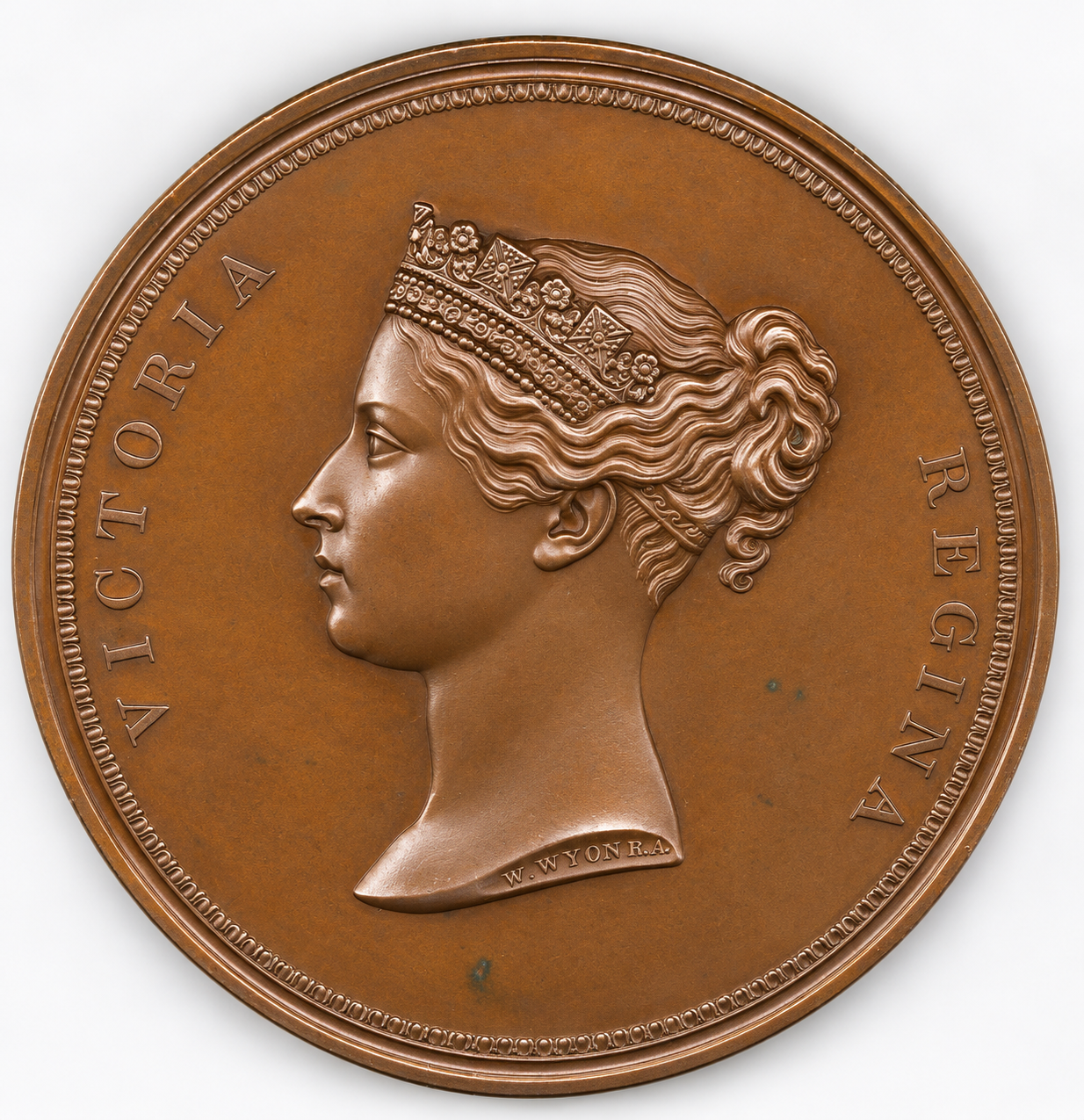
Image information
Click image to magnify
Bronze medal showing the young Victoria in left-facing profile, wearing the diamond diadem, with the inscription VICTORIA REGINA.
- Credit
- Heritage Auctions, via Wikimedia Commons. CC BY 3.0.
- Notes
- Brightness, contrast, sharpness and colour balance adjusted by Stunning Stamps.
The diamond diadem made for a king
The ornament in Victoria's hair was commissioned for George IV's coronation in 1821. [6]
It contains 1,333 diamonds, with crosses and the national emblems of the rose, thistle and shamrock.
Victoria later wore the diadem in portraits, and it became a familiar feature of British postage stamps.
On the one-pound brown-lilac, its elaborate jewels are reduced to tiny printed lines. A magnificent royal ornament had become part of a postage stamp worth one pound.
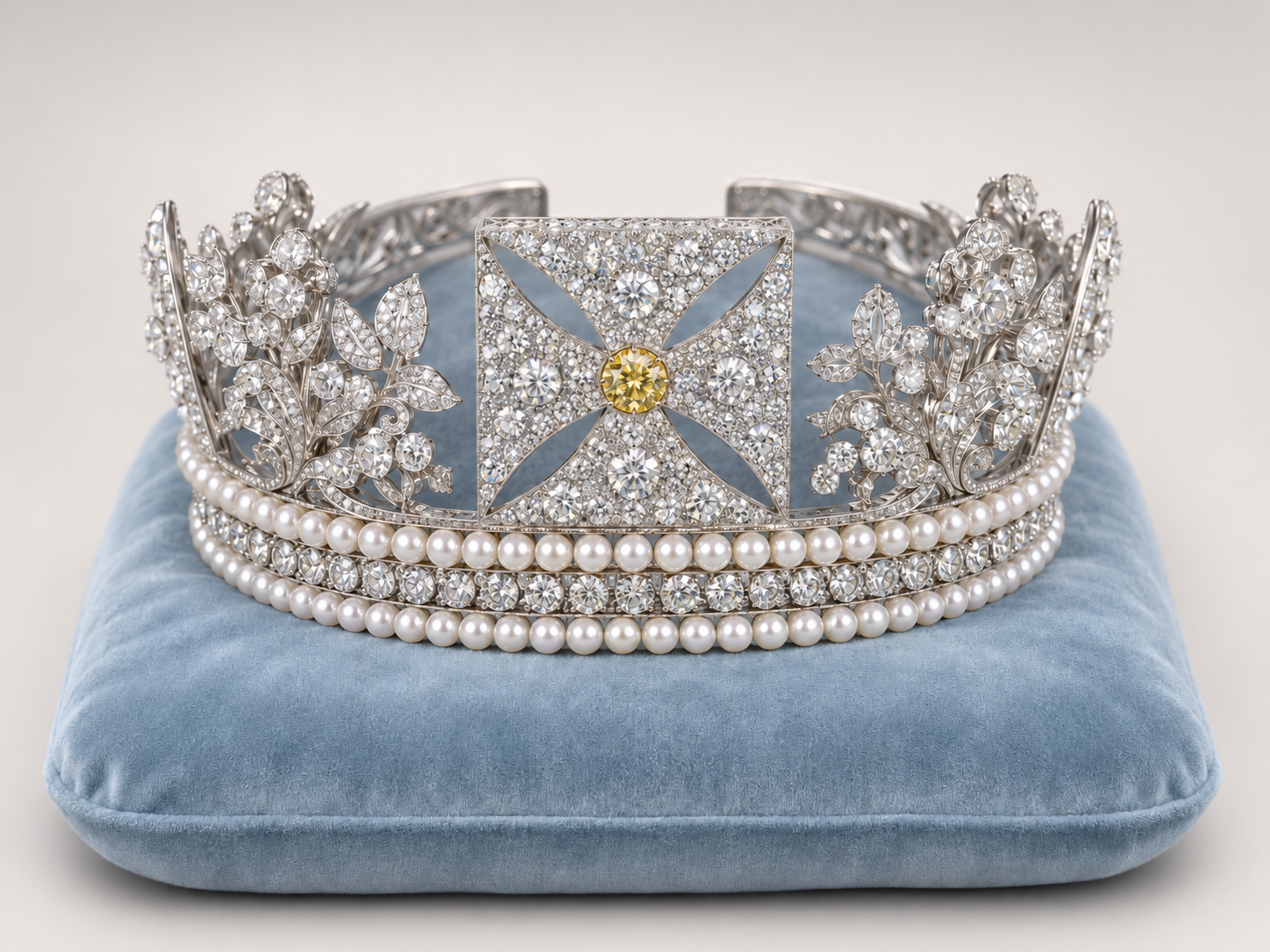
Image information
Click image to magnify
Digitally created illustration of the diamond diadem, with crosses, floral emblems and rows of pearls, resting on a blue cushion.
- Credit
- Stunning Stamps.
- Notes
- Digitally created.
Sources
- Hastings E. Wright and A. B. Creeke: A History of the Adhesive Stamps of the British Isles (1899), pp. 143–145
- GBPS: Postal Museum registration-sheet inventory, POST 150/785, reconstructed one-pound plate
- Douglas N. Muir, Royal Mint Museum: William Wyon & the Penny Black
- Heritage Auctions, William Wyon medal photograph, via Wikimedia Commons (enhanced for display)
- Wyon medal photograph: Creative Commons Attribution 3.0 licence
- Royal Collection Trust: George IV's Diamond Diadem
