
The design of the 1s green
Queen Victoria · Great Britain · Board of Stamps and Taxes, Somerset House · 1847
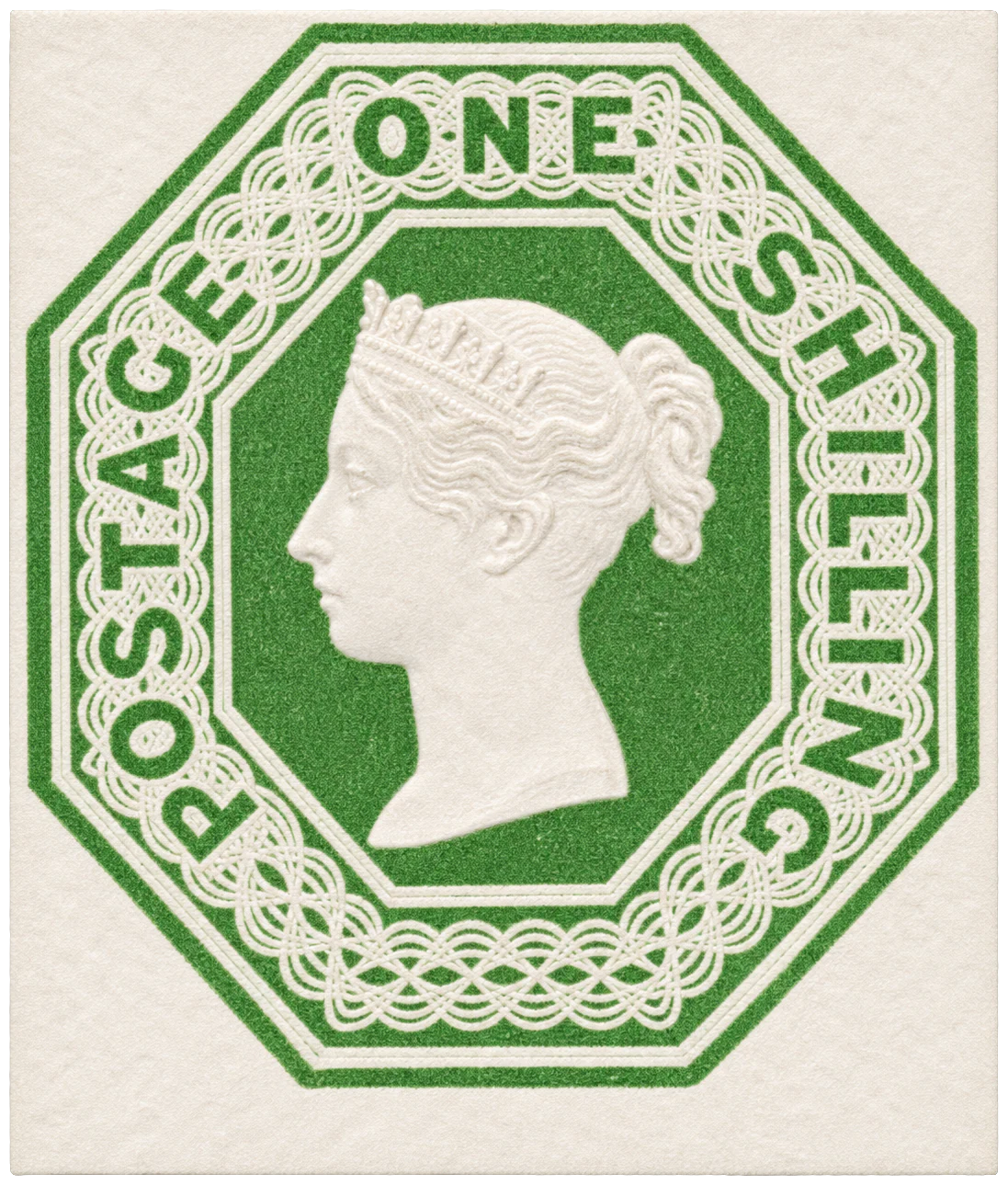
Why the Queen's face was left white
The white portrait on the one-shilling green was not simply an artistic choice. Government officials believed that embossing could make the stamp more difficult to reuse dishonestly.
The Penny Black had caused trouble because its red cancellation marks could sometimes be removed without seriously damaging the printed portrait. The embossed design offered a different approach. Victoria's head would stand proud of the surrounding paper, making it difficult for a cancellation mark to miss the portrait. [1]
In 1846, the Commissioners of Stamps and Taxes explained that the raised head, being free from printing ink, would readily absorb the ink of a cancellation. The white surface would also show a dark cancellation clearly.
The engraving was therefore designed to make the portrait prominent in more than one sense. It projected physically from the paper, while its lack of colour helped the Post Office make a cancellation visible and difficult to remove.
How an engraving became a raised portrait
The engraver had to create the image in reverse. Instead of cutting lines into a plate to hold printing ink, as with the Penny Black, the raised parts of the finished stamp were created by cutting recesses into a steel die.
At Somerset House, the surface of the die was inked and pressed against the paper. Beneath the sheet was a softer counterpart, made from materials such as leather, lead or another soft metal. This allowed the paper to be forced into the engraved recesses. [2]
The coloured portions of the design remained comparatively flat. Victoria's head and the interlaced border stood out in uncoloured relief, while the denomination lettering was sunken and coloured.
The result was closer to a miniature medal than an ordinary printed image. William Wyon was well suited to the task: he had spent much of his career engraving the portraits and intricate details required for coins and medals.
The stamp's appearance depended on the depth and precision of the engraving, the pressure of the machinery and the behaviour of the paper. A good impression was a small piece of sculpture, created in a single operation. [2, 3]
The second engraver and Victoria's extra curl
William Wyon's original embossed portrait showed Victoria's hair without the prominent pendant curl seen on the finished one-shilling stamp.
The curl was added during the preparation of the working dies. Its shape was not identical on the one-shilling and tenpenny stamps, providing a small but recognisable difference between the two portraits. [2]
Another craftsman, Thomas Moss, worked on the designs at Somerset House. He engraved the interlaced framework surrounding the portrait and the denomination inscriptions, adapting Wyon's original engraving into a complete postage stamp. [1]
Wyon's portrait supplied the central image, but the finished design was the result of further work by the government engravers. The decorative frame, lettering and carefully arranged hair made the one-shilling stamp distinct from the earlier embossed envelopes.
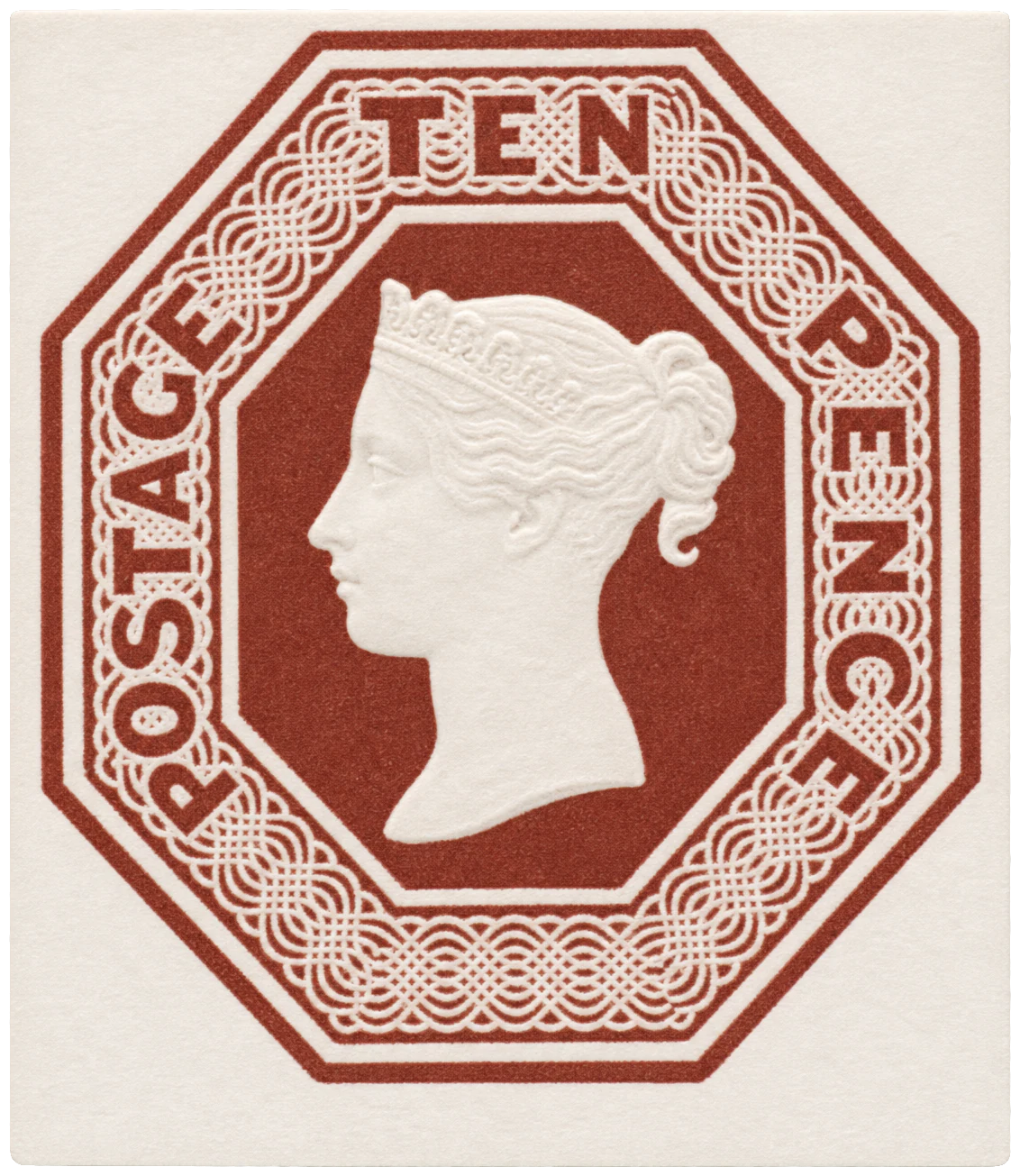
Compare the hair behind the neck and the surrounding frames; magnify each design for a closer view.
Click either stamp to magnify
The engraver's initials hidden beneath the Queen
Look closely at the base of Victoria's neck on the one-shilling stamp. There are tiny embossed characters that are easily overlooked.
They contain the initials W.W., standing for William Wyon, followed by a number identifying the working die. Only two working dies were used for the adhesive one-shilling stamps. [2]
The characters were included in the dies themselves, so they appeared as colourless raised marks on the paper. Their small size and the difficulties of obtaining a clear embossed impression mean that they are sometimes faint or impossible to distinguish.
Wyon's initials provided a discreet acknowledgement of the engraver's contribution. Unlike the highly visible signature on a painting, his name was almost hidden within the Queen's portrait, where only a careful observer might discover it.
Why the designers chose an octagon
William Wyon's embossed portrait had already appeared on British postal stationery. The new adhesive stamps needed to be recognisably different from those earlier designs.
An octagonal frame was chosen for the one-shilling and tenpenny values. It surrounded Victoria's head with an elaborate pattern of interlaced lines, while allowing the words POSTAGE, ONE and SHILLING to occupy three of its sides. [1]
The authorities also considered how colour could help distinguish the stamps. During discussions in 1846, yellow, light green and black were among the colours suggested.
Green was eventually chosen for the one-shilling stamp. The finished design combined a strongly recognisable outline with intricate engraving that was intended to resist imitation.
The octagon was not simply a decorative frame. Its shape helped give the new stamp an identity of its own, distinct from the earlier embossed postal stationery.
Two blue lines hidden in the paper
The one-shilling stamp was printed on special paper made by John Dickinson. Two narrow blue threads were incorporated into the paper during manufacture, normally passing vertically through the design about five millimetres apart. [4]
The threads were intended to make forgery more difficult. They could not simply be printed onto the surface, because they were part of the paper itself.
Although this material is traditionally called silk-thread paper, the threads used for the embossed stamps were made from twisted cotton. Dickinson had patented the principle of incorporating security threads into paper in 1829.
The embossing operators had to position each impression relative to the threads. When they missed the intended alignment, the result could be a stamp with one thread near each edge rather than the usual closely spaced pair.
The small blue lines are easy to mistake for marks added after printing. In fact, they were present before the paper reached Somerset House, a hidden contribution from the papermaker to the finished stamp. [4, 1]
Why the stamp has no perforations
The embossed one-shilling green has no perforations because its method of manufacture did not produce stamps in sufficiently regular positions.
Each impression was struck separately. Even with care, the spacing between neighbouring stamps varied. Some impressions were almost touching, while others overlapped. [2]
When perforation machinery became available in the 1850s, it could not be applied reliably to these irregularly arranged stamps. The holes might pass through the printed design instead of the space between impressions.
The stamps therefore continued to be produced without perforations, and had to be separated with scissors. Their plain edges are a direct consequence of the machinery and handwork used to create the raised portrait.
The diamond diadem made for a king
The ornament in Victoria's hair has an unexpected history. It is not a crown made for the young Queen, but a diamond diadem commissioned for George IV's coronation in 1821. [5]
The diadem contains 1,333 diamonds, with crosses and the national emblems of the rose, thistle and shamrock. The diamonds were originally hired for George IV's coronation, but he decided to keep them and paid a bill of more than £8,000. Later, Queen Adelaide wore the ornament, establishing its association with royal women.
Victoria wore the same diadem in portraits, and William Wyon included it in the youthful image that became familiar through British postage stamps. On the embossed one-shilling green, its elaborate jewels were reduced to tiny raised details in the paper.
A magnificent piece of royal jewellery had become part of an everyday object worth one shilling. [5, 3]

Image information
Click image to magnify
Digitally created illustration of the diamond diadem, with crosses, floral emblems and rows of pearls, resting on a blue cushion.
- Credit
- Stunning Stamps.
- Notes
- Digitally created.
Sources
- Ricky Verra: The Embossed Issues of Great Britain, David Feldman (2026)
- Hastings E. Wright and A. B. Creeke: A History of the Adhesive Stamps of the British Isles (1899), pp. 57–58 and 67–68
- Douglas N. Muir, Royal Mint Museum: William Wyon & the Penny Black
- Alan K. Huggins: Great Britain — Before and After, the Embossed Issues, Royal Philatelic Society London (2002)
- Royal Collection Trust: George IV's Diamond Diadem